Ernest Hemingway: Living, Loving, Dying: Part Ii
The 1950s were years of triumph and decline for Hemingway, His next-to-last book, ACROSS THE RIVER AND INTO THE TREES, was a critical failure. Hardly had the literary obituaries dried when THE OLD MAN AND THE SEA reignited his fame and moved the Nobel Prize judges to award him “that Swedish thing.”After a plane crash in Africa, a good part of the world thought him dead, only to learn a few hours later that he was busted in several places but very much alive. But the body was failing and the corners in the back of Hemingway’s mind were darkening in the period covered in this final of two ATLANTIC excerpts from ERNEST HEMINGWAY: A LIFE STORYby Carlos Baker, to be published in April by Scribner’s.
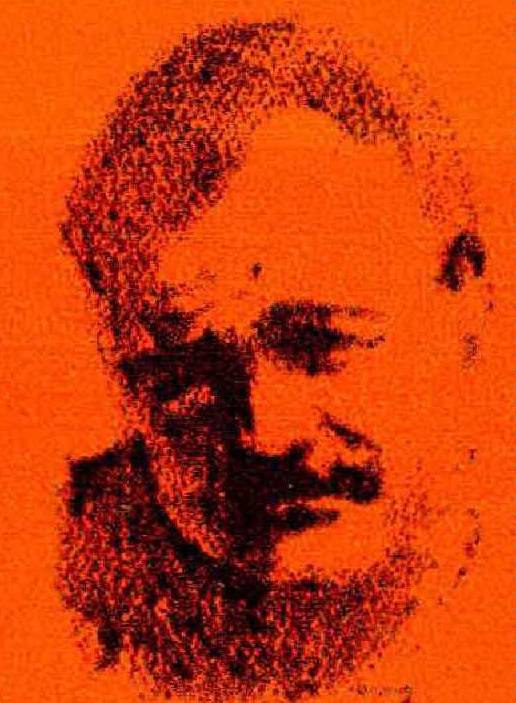
THE spring of 1948 went smoothly and well. Malcolm Cowley, whom Ernest called the best critic then working in the United States, came down to Cuba in February with his wife and son for a two-week session of interviews in preparation for a long article on Hemingway’s career to be published in Life magazine. Ernest had also begun to correspond with Lillian Ross, the profile-writer for the New Yorker, his recent visitor in Ketchum, Idaho. He was already addressing her as “daughter.” Cowley and Miss Ross were to become the first chroniclers of his life to operate with his personal blessing. He said that talking about himself made him almost physically sick. After Cowley left Cuba, Ernest wrote him that their biographical sessions had destroyed his ability to write for a whole week.
The interviews with Cowley had helped, however, to lay the groundwork for the perpetuation of the Hemingway legend. Ernest virtually guaranteed this result by urging Cowley to consult General Charles Trueman (“Buck”) Lanham about the events of the war. Hemingway knew very well that the general’s loyalty and friendship would make him speak of Hemingway in the most glowing terms, with considerable emphasis on his bravery under fire.
All through the spring he continued his correspondence with Cowley and Miss Ross, throwing out helpful hints about his personal history and beliefs. He told Cowley of his Bronze Star medal, his membership on the governing board of the International Game Fishing Association, of his having once shot thirty-six straight doubles against Ronnie Tree and Bill Astor of England while returning from Spain aboard the Normandie, of boxing with Tom Heeney at Bimini in 1935, and of besting the big Negro challenger Willard Saunders. He described his submarine hunting in the Caribbean and boasted that he had bedded every woman he had ever wanted and some that he hadn’t. He said that his hatred of his mother was non-Freudian, that she was an all-time, all-American bitch, and that the first big psychic wound of his life had come when he discovered that his father was a coward. He even offered a detailed account of Dr. Hemingway’s suicide.
The letters to Miss Ross were filled with goodwill and humorous anecdotes. He indicated his disgust with Sidney Franklin’s “lies” about their former association, and suggested suitable subjects for her future profiles in the New Yorker, among them Jimmy Cannon, the sportswriter, Trujillo, the Dominican dictator, and Arturo Suárez, the Cuban newspaper columnist. He said disarmingly that he had early taught himself to walk dangerously so that people would leave him alone. He provided Lillian with a list of his personal heroes, including Peter Wykeham Barnes of the RAF; Michel Ney, Napoleon’s rearguard commander on the retreat from Moscow; his fourth wife, Mary Welsh, for her refusal to die on the operating table in Casper long after pit bulls would have quit; and his son Patrick, who had now completed a successful year at Stanford University and was about to leave on a vacation trip to Europe. The names of Gustave Flaubert and James Thurber rounded out his list.
The editors of Cosmopolitan now sent one of their staff members to Havana on a special assignment. His name was Aaron Edward Hotchner, an Air Force veteran in his middle twenties. He had been an admirer of Hemingway’s work since his high school days in St. Louis, Missouri, and was awed by the prospect of meeting the master, though full of doubt about his assignment, which was to ask him to write a piece on “The Future of Literature.” Ernest met him at the Floridita, treated him to a bewildering series of frozen daiquiris, talked with him about everything but the future of literature, and took him out fishing next day aboard the Pilar, Hemingway’s boat. When they shook hands in parting on the sidewalk in front of the Hotel Nacional, Ernest half-promised to write the article that Hotchner had come to get, and the young man flew home filled with nascent hero-worship.
In June Ernest pridefully declined an invitation to become a member of the American Academy of Arts and Letters, and sent Charles Scribner a series of letters full of down-to-earth family gossip, including the statement that he always had to ease off’on making love when he was working hard because the two things were run by the same motor. Later in the month, as a parting gesture for Patrick, he arranged a ten-day cruise to Cay Sal, the Anguillas, and the Bahama Banks, with Mary, Mayito Menocal, and Elicio Arguelles. His sons Gigi and Patrick came over from Key West, and the whole company slept each night aboard Menocal’s newly refurbished yacht, the Delicias, using the Pilar for fishing by day. A heavy East wind made the currents too strong for bottom fishing in twenty fathoms, but their success with trolling was phenomenal. During three five-hour stretches, by Ernest’s account, they averaged one fish every three minutes, including marlin, wahoo, albacore, amberjack, three kinds of grouper, yellowtail, kingfish, mackerel, and 120 barracuda. They also captured three large turtles. The ice bins of the Delicias and the Pilar were filled with almost a full ton of game fish.
Part of Ernest’s introduction for the new illustrated edition of A Farewell to Arms was done during this voyage. Four days after his return, on June 29, it stood complete, a loose remembrance of things past, stressing his difficulties and joys in writing the novel. He was less than happy with Rasmusson’s illustrations, especially those of Catherine Barkley. In fact, said he, consulting the mirrors of his memory, she had resembled the youthful Marlene Dietrich. All such girls, with naturally lovely faces, looked best when they cried or were about to cry, swelling slightly around the eyes and lips instead of getting the pinched-up Mother Superior look of Rasmusson’s portrait of Catherine Barkley on the bed. He did not believe in illustration. There was an inevitable gap between the author’s and the artist’s conception of things and places and people. If Ernest wrote a book about the Bahamas, he would like it to contain pictures — not illustrations — by Winslow Homer; if he were Guy de Maupassant, pictures by Toulouse-Lautrec or Renoir would suit the books he wrote. But no mere illustrator could avoid disappointing the author of a novel; almost by definition he was an outsider: the “someone else who was not there.”
ANOTHER long cruise in July was carefully planned to include his forty-ninth birthday. Having recently completed the preface to A Farewell to Arms, he now said that he always thought of himself as just “going on thirty” —exactly the age he had attained when that novel was finished. His fellow voyagers this time were Mary, Gigi, Sinsky (shortened from Sinbad the Sailor, the name Hemingway gave his mer-
“. . . just stink happy all day long.”
ry-eyed Basque friend Juan Dunabeitia), Gregorio Fuentes, his veteran mate and cook aboard the Pilar, and Manolito, the young son of the owner of a small café at Cojimar. Ernest was much taken with Manolito, who loved the ocean, never got seasick, helped Gregorio, and worshiped Gigi. The whole cruise went well, and the birthday itself was a special delight to Ernest. Mary had gone to a good deal of trouble, buying and wrapping “wonderful presents,” many of them bearing presentation cards from the cats and dogs of the Finca. There was also a half pound of fresh caviar and a cake with icing and candles. The Hemingways’ wine merchant in Havana had presented a case of champagne. Ernest and Sinsky broke it out at six o’clock in the morning and drank it steadily until after nightfall. Ernest affirmed his joy and pride at having attained the age of forty-nine and said that he was looking forward to his fiftieth, when all the world would damn well have to respect him. But his forty-ninth was also memorable. He told Lillian Ross that he had been “just stink happy all day long.”
His mood of euphoria lasted through most of the summer. He helped his friend Roberto Herrera make up a birthday purse for “Leopoldina,” the aging Havana prostitute, and said that he was thinking seriously of giving his Thompson submachine gun to a museum as a memento of his wartime adventures: it would be as valuable as one of Hawthorne’s shoes or a comma left over from the works of Henry James. He also began planning a trip to Europe, his first since the war. He convinced himself that Sun Valley was becoming “cluttered up” with too many people, and that a change of pace and place would benefit both Mary and himself. He wanted to board a slow boat from Havana early in September, going through the Northwest Providence Channel in the Bahamas, through the Sargasso Sea, and then straight across, with stops at Funchal, Lisbon, and Gibraltar, and debarkation at Cannes. The ship would be small enough so that he hoped to troll all the way across. Gregorio was already preparing a Hardy rod for the purpose.
In the midst of these plans came the disturbing news that his lawyer, Maurice Speiser, was gravely ill. A young assistant named Alfred Rice was acting in his stead. Ernest reminisced fondly about his first meeting with Speiser in Hendaye twenty years earlier. The words were scarcely out of his typewriter when a cable from Rice notified him that Maury had died on August 7. Although he had often been highly critical of Speiser’s conduct of his business affairs, Ernest mourned his death as yet another in the long series of deprivations which he had endured in the years since 1944. Many “perfectly OK people” who had thought that “Papa was dumb” were now dead. He took satisfaction in having proved that he could outlast them. Yet from time to time in the darker moods of his fiftieth year, he could hear the cold wind sighing around the gateposts of Eden.
THE romantic days of his youth in Italy were much in Ernest’s mind when he docked at Genoa, the port from which he had sailed homeward thirty years before. Except for the post-war tours with Hadley in the early 1920s and the quick trip with Guy Hickok in 1927, he had not set foot inside the country since 1918. As soon as his Buick was unloaded, he hired a chauffeur and drove off with Mary for Stresa while past and present, the imagination and the reality, contended within him for mastery.
“Christ, Buck, this is wonderful country,” he told Lanham. Mary, the newcomer, was enchanted by the profusion of fall flowers and the violet-colored mists in the valleys; Ernest reveled in a homecomer’s euphoria. The North Italians treated them both “like royalty.” Alberto Mondadori, one of his two Italian publishers, assured him that his books had outsold those of any other author in Italy since the war. Everyone was reading him, from common sailors to the sporting families of the Italian nobility. His pleasure mounted as they drove from Stresa through Como, Bergamo, and up the winding road to Cortina d’Ampezzo. Although the village itself had grown, the contours of the pink and red peaks had not changed since Ernest and Hadley and Renata Borgatti had wintered there in 1923. Most wonderful of all, said Ernest, forgetting his intermediate trips, was the chance to rediscover the North Italian countryside, which he had seen before only from crowded military camions or through the dust goggles he had worn while driving the Fiat ambulance. Count Federico Kechler and his wife, Maria Luisa, were on holiday in the village. He came to the hotel to ask Ernest to join him in trout fishing. It was a far cry from the old days with the down-atheel guide “Peduzzi.” Kechler was a member of the Friulian nobility, who had served in the Navy during the war — a thin man with a high forehead, prominent eyes, and cadaverous cheeks. Ernest’s Italian was rusty, but it came back gradually in conversation with the Kechlers. Federico’s English was so impeccable that he might have been mistaken for a retired officer of the Royal Navy.
From Cortina late in October they drove down through Belluno and Treviso to the magical city of Venice. If you cared anything about history, said Ernest, Venice was absolutely god-damned wonderful. The fact that he and Mary were “very popular characters” among the Venetians did nothing to diminish his pleasure. He was presented with a scroll which made him Cavaliere di Gran Croce al Merito in the Knights of Malta, and rejoiced with Lady Mary in the solid comforts of the Gritti Palace Hotel and Harry’s Bar. The whole city, he now believed, belonged to him personally. He even managed to persuade himself that he had twice helped to defend it in his youth. Out of his dreams arose a romantic image of himself standing chest-deep in the salt marshes of the lagoon at Capo Sile, fighting side by side with other defenders of the city. It was, of course, a complete invention, but in his own mind it had the force of fact.
The old war was so much in his mind that he made a special trip to the site of his wounding thirty years before. From the much rebuilt, redestroyed, and dingy town of Fossalta, he drove out along the sunken road that gave the place its name. The miles of old earthworks along the riverbank had long since been filled in and grassed over in a complex of protective dikes. Reeds rustled in the wind along the edges of the river. In the valley behind one of the dikes stood a long low yellow house that had been there in 1918, perhaps the same that Ernest had recalled and used in “A Way You’ll Never Be.” He came upon what he took to be the very crater (“like a designed depression in a golf-course”), which was all that remained of the dugout where the trench-mortar projectile had exploded. He would have liked to accomplish a ceremonious defecation. Finding this impossible, he dug a small hole with a stick and inserted a 1000-lire note. This homemade symbolism was meant to indicate that he had contributed both blood and money to the Italian soil. That evening he returned to Venice, as Mary said, “wizer and jubilant.”
Ernest spent most of November, partly with Mary and partly alone, at the Locando Cipriani, a pleasant inn on the island of Torcello, an hour’s boat ride north of Venice in the lagoon. There he settled into a loose schedule of work in the mornings and duck shooting in the afternoons. He was charmed by the flaming logs of beech and birch in their open fireplace as well as by the eleventh-century church nearby. From the church tower on clear days it was possible to see the marshland around Capo Sile, and with the aid of binoculars, the town of Fossalta beyond. What could exceed the romance of such a situation, where a man could almost literally look back over thirty years? On the plea that he hated sightseeing, at least of that sort, he declined to accompany Mary on a motor trip to Florence and Fiesole, and stayed behind to write “The Great Blue River,” a piece about the Gulf Stream, for Holiday magazine. Mary returned late in the month, full of her adventures, which had included frequent visits to the Florentine galleries in the company of her British friends Lucy and Alan Moorehead, and even a meeting with Bernard Berenson, the art historian, in the garden of his villa, I Tatti, near Fiesole — a neat little white-bearded wisp of a man, aged eighty-three, with a towering intellect.
They were going to winter in Cortina, having engaged a chalet called the Villa Aprile in the southern outskirts of the village. Early in December Ernest went partridge shooting with Count Carlo Kechler, the brother of Federico, and appeared next day at a shooting preserve south of Latisana on the lower Tagliamento, the property of the Barone Nanyuki Franchetti. The only woman present that rainy Saturday afternoon was Adriana Ivancich, a friend of Nanyuki’s. She had never shot before, and by the close of the day she was tired, wet through, and thoroughly disgusted at having been whacked in the forehead by the empty shell cases ejected from her gun. When the huntsmen gathered to warm up with whiskey and discuss the day’s events, she was in the kitchen before an open fire, drying her hair and longing for a comb to straighten it with. Ernest spoke kindly to her: he was sorry, he said, that she was the only girl there. She was struck at once by his evident sympathy and by the alacrity with which, on learning that she wanted a comb, he broke his own in two and handed her half of it.
Adriana was a jeune fille bien élevée, only a month short of nineteen. The family Ivancich had anciently come from Lussinpiccolo on the island of Lussino off the Dalmatian coast. Shortly before 1800, they had established themselves in Venice. Their palazzo stood in the Calle de Rimedio, a narrow little thoroughfare just east of the Piazza San Marco. Adriana had been educated at a Catholic girls’ day school in Venice and was still leading a sheltered life under the watchful eyes of her widowed mother, Dora. She was of medium height, with a slender girlish build and a narrow pale face that went shadowy under the cheekbones. Her eyes were hazel, her ancestral nose was slightly hooked, and she had capable hands, with which she was always drawing small cartoons and sketches. Ernest liked her soft voice, her rather ardent feminine manner, the evidences of her devout Catholicism, the fact that she was superstitious, and (not least) her dark beauty. Standing at ease before the fire, he chatted amicably for some time while she combed out and arranged her black hair. When he asked her to lunch to meet Mary, she carried along her scrapbook, full of girlish cartoons and even such keepsakes as the wrapper from the first bar of chocolate that she had been allowed to eat. He added his autograph to her collection. He was already calling her “daughter.”
With the back of the car full of the birds he had shot, Ernest drove up to Cortina. He and Mary spent a quiet Christmas, with a fir tree cut from the mountain forest and a pitcher of Bloody Marys at noon. His chief Christmas present was the sale of “My Old Man” to Twentieth-Century Fox for $45,000. As the year closed, he mentioned his novel about the land, sea, and air, telling Charles Scribner that he was now at work on the part about the sea. It was the hardest of the three parts, since it covered the years 1936—1944, whereas he had been with the RAF only two months and with the infantry another seven. He assured Scribner that he was working slowly for two reasons. One was the constant bad ringing in his ears, which had required him to take a nauseous medicine every four hours for the past fifteen months. The other was that this time he was determined to write better than he had ever written before.
MALCOLM COWLEY’S “A Portrait of Mister Papa” had just appeared in Life magazine. It was the first biographical study that Ernest had authorized; it made much of his adventures in the war, and he read it avidly. Although it was “not awfully accurate,” as he told Lanham, it was continuously interesting. He praised Cowley’s scrupulous honesty in having withheld data which he had been forbidden to use, and soon wrote to assure the author that he had found the article “OK.” But he retreated hastily when Cowley raised the question of going on to a full-length biography. As he later explained to Lillian Ross, it seemed “sort of chicken” to permit himself to be thus embalmed while still alive. If he were ever to be “mounted,” the people for the job were Jonas Brothers of Yonkers, the finest taxidermists in the land.
Mary, who had lately taken to calling herself “the short happy wife of Mr. McPappa,” took issue with Cowley’s implication that Ernest had not been a star athlete in his days at Oak Park High School. With some heat, she wrote to Cowley that he clearly did not know enough about Ernest to become his biographer. Her husband was in fact a remarkable athlete. But Ernest followed up her letter with one of his own in which he admitted his limitations as a football player. On the other hand, he said with some pride that he had been good with rifle, shotgun, and fishing rod since age twelve, and that he had often shot cigarettes out of Bill Smith’s mouth around Horton Bay. Shooting and fishing, yes; team sports, no.
Both the Hemingways were shortly in trouble — Mary with a broken anklebone from a skiing accident in soft snow, and Ernest with a severe chest cold that kept him in bed for two weeks in February. But the worst physical problem came in March, some weeks after Mary had emerged from her plaster cast. An infection from a small scratch in the corner of his left eye began to spread rapidly across his face. The doctors in Cortina diagnosed erysipelas, a contagious disease of the subcutaneous tissue. Ernest believed that the trouble had begun with a dust particle which had lodged in his eye while riding in the open Buick over unpaved secondary roads. A more romantic story was later given out that the injury had originated from a fragment of wadding from a shotgun shell during one of his duck-shooting expeditions. When the doctors expressed fear that the infection might spread to the brain, Ernest entered a hospital in Padua. Massive doses of penicillin reduced the fever and arrested the disease. By this time, his whole face was covered with what he called “crut,” his eyes were swollen shut, and his discolored beard thrust up through the dark ointment like stubble in a muddy field.
Sinclair Lewis had now reached Venice and taken a suite at the Gritti. As Ernest later reported it, Lewis took the occasion of his absence to “nail” Mary with a three-hour diatribe on the theme of “I love Ernest, but . . . .” His chief objections were that Ernest was a snob, that his productivity as a writer was niggardly, and that he had never responded in kind for Lewis’ generous praise of For Whom the Bell Tolls. Lewis concluded by expressing his sympathy for Mary in her role as wife to a genius, and left her to pay for all the drinks. When Ernest returned from Padua with the ravages of erysipelas still evident on his face, he indulged the snobbery of which Lewis had accused him by telling the headwaiter at the Gritti that Lewis was nothing but a Baedeker-bearing bastard with a complexion that resembled the mountains of the moon.
Adriana Ivancich’s older brother, Gianfranco, had just returned from an extended trip to New York, and Ernest had them both to lunch at the Gritti. Gianfranco was twenty-eight, a short lively brown-haired, brown-eyed man whose war record at once endeared him to Ernest. He had served as an officer in an Italian armored regiment at the battle of El Alamein in 1942 under the command of General Erwin Rommel. He was soon afterward wounded and then evacuated on the last Red Cross ship to leave North Africa before it fell to the Allies. Following months of recuperation in various Italian hospitals, he joined the American OSS, serving as chief of partisan activity in the Veneto. In the confusion of enmities at the end of the war, he was captured by criminal elements and driven for several miles with a cocked pistol held coldly at the base of his skull. Meantime the family’s country estate at San Michele al Tagliamento had been inadvertently destroyed by American medium bombers whose target was a nearby bridge. On the twelfth of June, 1945, Gianfranco had found the body of his eminent father, Gr. Uff. Dott. Carlo Ivancich, murdered by hands unknown, lying amidst the rubble of an alley in San Michele. The family had ever since been struggling to recover from the tragic events of 1944-1945. Ernest’s romantic view of Adriana, as well as his admiration for the manly and stoical Gianfranco, was enhanced by all he heard of their recent history.
“Jeezoo Chrise, you have to have confidence to be a champion and that is the only thing I ever wished to be.”
Ernest now left off his desultory work on the sea sections of his long novel in order to attempt a shorter one. At first it was only a story about shooting ducks before dawn in the chilly waters of the lagoon. But it quickly expanded in his imagination to a far more ambitious effort in which he drew on various other aspects of his recent months in Northern Italy. He was at least enough of a snob to want to make fictional use of his new friendships with the families of Franchetti, Di Robillant, Kechler, and Ivancich. He had a perfect setting in the hospitable interiors of Harry’s Bar and the Gritti Palace Hotel, as well as the seascapes and cityscapes of Venice in winter. He wanted a structure which would dramatize the confrontation between two spots of time thirty years apart. In the first, like himself, his hero would be a boy of nineteen severely wounded on the Basso Piave within distant eyeshot of Venice. Over against this would be laid the attitudes and experiences of the same man revisiting the region in his forty-ninth year and looking back on his youth with characteristic nostalgia. Such a structure would enable him to include some of His recollections of the war as he had known it in France, Belgium, and Germany.
The book was still little more than a duck shooter’s story when the Italian visit ended and the Hemingways boarded the Jagiello at Genoa on April 30 for the circuitous voyage back to Havana. He was still uncertain of the novel’s direction or its final dimensions. When the ship docked at Cristobal in the Canal Zone on May 22, he declined to discuss his work beyond saying to a reporter that it was still in progress. Further progress was delayed by the usual mountain of unanswered mail. To deal with it, he hired a part-time secretary named Juanita Jensen from the American Embassy in Havana. Nita had been forewarned that his language might on occasion become a little rough. She was both pleasantly surprised and slightly disappointed when her new employer turned out to be the “most polite perfect gentleman” that she had ever met. For several weeks he dictated with the utmost regard for her sensibilities. Then one day he said, “Would you mind if I call you daughter?” “Not at all,” said the girl. As if encouraged, he began to use somewhat less decorous language than before and at last reached the climactic moment when he uttered a fourletter word. At this lie stopped dictating and fixed Nita with a fatherly eye. “You must forgive me, daughter,” said he, “for using this language, but I find that it is absolutely necessary.”
“Go right ahead,” the girl said. “Please feel free to say whatever you like.” The effect was almost miraculous. “From then on,” she said, “I noticed a terrific change in his dictation. He was more at ease, he said whatever came into his mind, and I don’t think he withheld anything.”
THE book was now going along so well that Ernest allowed himself a bout of bragging to Charlie Scribner. “Jeezoo Chrise,” he wrote, “you have to have confidence to be a champion and that is the only thing I ever wished to be.” His novel was very likely going to be a better book than any other son of a bitch alive or dead could write. Each day he stood before his typewriter, listening to the morning crowing of his fighting roosters in the yard and rejoicing in the fact that he had been born to write. He had now reached the stage of looking for titles. One of his favorites was The Things That I Know. Another was A New-Slain Knight, from the medieval ballad of “The Twa Corbies.” He had secretly treasured it since 1926. Now, perhaps, was the time to use it.
From the boastful mood it was only a step to one of dark rage. A woman at McCall’s magazine had been trying to get an interview with his aging mother in River Forest, Illinois. Grace was now seventyseven and was being cared for by Ruth Arnold. Lately, he had been “playing the role” of a devoted son. But the truth, Ernest said, was that he hated his mother’s guts precisely as she hated his. Sometime in the Depression, when Ernest had ordered her to sell the worthless Florida real estate, she had warned him never to threaten her: his father had tried it once when they were first married, and he had lived to regret it. Now Ernest took a firm stand. If she ever granted an interview to that bitch from McCall’s, he would cut her off without a penny. He had found a new generic phrase for such situations: “How do you like it now, gentlemen?” It applied not only to his decision about his mother, but also to the case of a German soldier he said he had killed sometime during the “rat-race” of the summer and fall of 1944. In his capacity as self-appointed intelligence officer he was interrogating several of the enemy. One was so arrogant that Ernest threatened to kill him unless he revealed the proposed German escape route. “You will not kill me,” said the soldier. “because you are afraid and because you are a race of moral degenerates, and besides it is against the Geneva Convention.” Ernest fixed him with a cold eye. “What a mistake you made, brother,” he said, and shot him three times in the belly and once more in the head, so that his brains came out through his nose as he fell over. This at any rate was his boast to his gentlemanly publisher, Charles Scribner. Like so many of his war stories, it was either invented or picked by hearsay from someone else. Yet the mere telling of it was a way of getting rid of the gall that rose in his throat whenever he thought of the woman at McCall’s and his poor old mother in River Forest, Illinois.
But he was a man of many moods. In one of them he sent a tactful letter to the octogenarian Bernard Berenson, thanking him for having been so kind to Mary during her visit to Fiesole in November, and assuring the old man that he was “one of the [few] liveing people that I respect most.” He hoped it was not heretical to say that he did not care for Firenze, being “an old Veneto boy” himself. A man had only one virginity to lose, and there his heart would ever be. Such a statement might sound “slightly wet,” but it admirably expressed how he felt about all parts of the Veneto, including even Pordenone. He was already talking of another trip to Italy, leaving in November on the Île de France, calling in at the Ritz in Paris, and then descending to the Veneto, where he could revise the book on weekdays and shoot ducks on Sundays. Once finished, the novel would be serialized in Cosmopolitan magazine, largely because of Ernest’s liking for young Aaron Hotchner, whom he now called “one of the nicest kids I have ever met.” Hotch was coming to Cuba with his wife for a vacation early in September. He touched Ernest’s heart by insisting on staying at Varadero to avoid interrupting the master at his work. When he arrived on the fifth, Ernest lost no time in getting him aboard the Pilar and handing him the early chapters of the novel. As he had done with Buck Lanham in 1945, he leaned over Hotchner’s shoulder while the reading went on, breathing into his ear, offering marginal comments, and laughing heartily at some of the passages which he thought were witty. Hotchner found it hard to concentrate, and covered his embarrassment by asking to take the pages away to be read at greater leisure. The upshot of the visit was happy enough, since Hotchner virtually became Ernest’s agent in the negotiations for serialization with the senior editors of Cosmopolitan.
A week after Hotchner’s departure, Ernest settled at last on a title: Across the River and Into the Trees, a slightly abbreviated version of the dying words of General Stonewall Jackson. He borrowed $10,000 from Charles Scribner and sent Mary off to see her aging parents in Chicago as well as to buy a mink coat — “to make up to her,” he explained, “for how shitty I have been when jamming in the stretch.” The racetrack metaphor was fairly just: he computed his wordage at 13,441 between September 5 and 29, in spite of time off for two fishing trips. While Mary was away, he did his best to keep his bad-boy reputation. A new whore whom he nicknamed Xenophobia had recently appeared in Havana, and he sent his retainer, Roberto Herrera, to bring her out to the Finca for dinner. Some days later he paid a nonprofessional call on Leopoldina, who was just his age. They exchanged the local gossip and told each other what Ernest described as “sad stories of the death of kings.” Afterward he set Roberto to counting the words of the manuscript. There were roughly 45,000, and Ernest believed that another 15,000 would finish the job. “Am trying to knock Mr. Shakespeare on his ass,” he told Scribner. “Very difficult.”
When Mary got back early in October, Ernest was already talking of completing the novel by November 1. All the time he had ever spent in Italy, he wrote Buck Lanham, was now “paying off doubled and redoubled.” He said that his hero Cantwell was a composite portrait of three men: Charlie Sweeny, the former soldier of fortune; Lanham, the hard-driving West Pointer; and most of all himself as he might have been if he had turned to soldiering instead of writing. What he wanted to get was a picture of a highly intelligent fighting man deeply embittered by experience. The background, as always, was love and death. In the foreground stood the embattled hero, the eternal type of “one against the world.” The fighting in the book, said he, was “all offstage as in Shakespeare.” It included some remarks on the taking of Paris, and some more on his experiences in the Ardennes, the Schnee Eifel, and Hürtgen Forest. He said that his struggle to finish the novel was worse than Hürtgen — a considerable exaggeration. But then, he was in an exaggerating mood. He said that he had now decided to expend all he knew about the land war instead of saving out some of it for his big tripledecker novel on the Land, the Sea, and the Air. It was the kind of operation he had performed in “The Snows of Kilimanjaro” in the middle thirties: condensing the materials of several novels into the flashbacks of a single short story. The mood of reckless spending was upon him.
He was right in asserting that he had borrowed much from his recent visit to Italy. He not only sent his Colonel past the bombed-out country estate of the Ivancich family at San Michele al Tagliamento, but also provided him with a romanticized duplicate of his own ceremonial visit to the dikes of Fossalta. He gave him a distant view from the tower of the ancient church on Torcello and lodged him at the Gritti Palace in Venice. He introduced him to an American novelist whose face was “as pockmarked and as blemished as the mountains of the moon seen through a cheap telescope.” He provided him also with an estranged wife whom the Colonel, like Ernest, had “cauterized . . . and exorcised” in the intervening years. Finally, he gave him such real-life friends of his own as the headwaiter at the Gritti Palace, Cipriani of Harry’s Bar, and Nanyuki Franchetti.
In evolving the figure of Renata, the fifty-yearold Colonel’s nineteen-year-old inamorata, Ernest followed a line not unlike that of the mythical sculptor Pygmalion, who fashioned the image of a woman so beautiful that he promptly fell in love with his creation. As Renata’s prototype, he chose the black-haired nineteen-year-old Adriana Ivancich, for whom he had broken his comb near Eatisana in December, and with whom he had had lunch in Venice in April. Adriana was not a countess like Renata, nor was she (except in a remote and schoolgirlish fashion) in love with Ernest. The relationship could best be described as sentimentally Platonic. He was at pains not to reveal what he was doing to her fictional counterpart, Renata, when he sent her the first of many letters early in October. He called her “daughter” and saluted her as “My Dear Adrianna.” He told her that his son Gigi, who had met her on a recent trip to Venice, had called her the loveliest girl he had ever seen. He said that he was coming to Paris in November; if she would come too, they could have fun betting on the races at Auteuil. He would be “quite rich from the book,” so that they need not worry if they lost money on the horses. He hoped that she was well and happy; he knew that she was beautiful, but he would rather have her well. He urged her to write to him in Italian, and closed the letter, “With much love, Mr. Papa.”
What this romantic paternalism did not reveal was that in the figure of Renata Ernest was attempting a poetic metaphor of greater complexity than he had ever tried before. He wished to surround her with a Venus-like aura, like a goddess risen from the sea to become the presiding spirit of the ancient city of Venice. He had borrowed her name from the Renata Borgatti whom he and Hadley had befriended at Cortina in 1923, but was fully conscious that the name itself meant “reborn.” What he wanted her to represent was the spirit of youth, reborn in the mind of his fifty-year-old Colonel. She could stand for the freshness, innocence, courage, and idealism that both Ernest and Colonel Cantwell had enjoyed in the days before war had aged and embittered them. In the passage of lovemaking under an O.D. blanket in a wind-swept gondola, Ernest was indulging himself in the same sort of vicarious eroticism which he had followed in A Farewell to Arms. Adriana had never been — would not in fact ever be — alone in a gondola or in his room at the Gritti Palace Hotel with Ernest. But this did not prevent him from dreaming his dreams.
Apart from the symbolic meanings he was seeking to convey, the relationship between Renata and the Colonel was curiously comparable with that of the lovers in The Garden of Eden, Ernest’s long and emptily hedonistic novel of young lovers in the old days at Grau-du-Roi and the Costa Brava: page after page of their talk was filled with inconsequential commentary on the color and condition of their hair, the food and drink they were always consuming, and the current state of their suntanned skins. Something of this carried over into the food-drink-and-lovemaking passages in Across the River. The atmosphere was darkened, however, by a strange psychological malaise, as if Ernest were using the pages of his novel as the equivalent of a psychiatrist’s couch. Even the bold talk in his letters about knocking Mr. Shakespeare across the ring and into the front seats might have been construed as more of the same: an exercise in self-assurance to restore his flagging courage.
The gall inside him came out in various ways, most notably in the mocking remarks which he dictated to Nita Jensen for the Roosevelt Birthday Memorial Concert to be held at the Waldorf Astoria Hotel in New York on January 30, 1950. Averell Harriman had written to ask his assistance. Ernest benignly promised to help if his work on the novel allowed him to do so. But it was a promise he meant to ignore. The “dedication,” which happily was never sent, spoke with the utmost scorn of the rich and spoiled paralytic who had changed the world and then died of overwork.
By November it was clear that Ernest would not finish his novel before leaving for New York and Paris. Nita Jensen typed out some of the opening chapters for Hotchner to show to Herbert Mayes, the new editor in chief at Cosmopolitan. Ernest was already promoting a trip to France for his young friend. “Wish we had him on our team,” he wrote. “Maybe we have.” Lillian Ross had lately suggested doing a profile of Ernest. “I probably couldn’t talk good enough to make it worthwhile,” he told her. “But it would be fun to do it if you did it.” On the eve of departure, the usual air of mild desperation overhung the Finca. Mary saw to the packing of fourteen pieces of luggage. Adriana’s brother Gianfranco, who had now come to Havana, worked all hours over Nita’s typescript, correcting the spelling of Italian place-names and the errors of geography. Mary wrote Bernard Berenson that the push to complete his novel had turned Ernest into “a vial of seething chemicals, dangerous to meddle with.” But the corrosives had simmered down by the time Ernest cabled Lillian Ross that they would fly up next day, arriving late in the afternoon of November 16.
“New York is murder.”
Lillian Ross was on hand to meet the plane. She found Ernest standing at one of the gates, hugging a well-scuffed briefcase and waiting for Mary, who was assembling the luggage. His graying hair needed cutting, and his face was covered with a ragged white beard half an inch long. A wad of paper eased the pressure of his steelrimmed glasses on the bridge of his nose. His brown tweed jacket was too tight in the shoulders and too short in the sleeves. As if he were expecting cold weather, his shirt, tie, sweater-vest, and slacks were all of wool, and his brown loafers were as scuffed as the briefcase. He said that he was in good shape physically but royally pooped from jamming with his book. People didn’t appreciate the “terrible responsibility of writing.” All they saw was the irresponsibility that came afterward, when the writer was relaxing from his work, as he was now.
New York did not impress him. “This ain’t my town,” he said. “It’s a town you come to for a short time. It’s murder.”
When Lillian Ross arrived at Ernest’s suite late Thursday morning, she found him wearing a plaid bathrobe and drinking champagne. He said that he had been up since dawn working on his book, and launched at once into further autobiographical reminiscences, heavily larded with boxing terminology. It was fun to be fifty and about to defend his title again. He had won it in the twenties and defended it in the thirties and forties. Now here he was coming into the ring once more. “I am a strange old man,” he murmured, as if to himself. But he knew that Miss Ross was listening. The program for Friday morning was a visit to the Metropolitan Museum. When Lillian arrived for her third interview session, Patrick had come down from Harvard, Ernest was wearing his new Abercrombie & Fitch topcoat, and they set off in a taxi through the rainy streets. The Brueghel room was closed for repairs, but Ernest was in his element with El Greco’s Toledo — which he called “the best picture in the Museum” — and particularly with the Cézanne collection. He stood for some minutes before Rocks — Forest of Fontainebleau and told Lillian that he had learned to make landscapes from his study of Cézanne during the old days in Paris.
Crossing on the Île de France, he spent his time working on the book, though not much, exercising in the gymnasium, drinking at the bar, and renewing old friendships with members of the crew. He sent Lillian a shipboard letter, thanking her for a parting gift of tequila and for having refused to “crowd” him during the interview sessions. She had his permission to write any goddamn thing she wanted to write, though she must be sure to spell the names correctly, and avoid libelous statements about the people he had mentioned to her. They docked at Le Havre in gray November weather, drove to Paris, and were given Mary’s old wartime room at the Ritz. Marlene Dietrich had caused it to be filled with red roses. Hotchner flew across and stayed at an unpretentious hotel where he had been quartered during the war. Ernest began to talk excitedly about the fall steeplechase meeting at Auteuil: he and Hotch would form a syndicate in the Little Bar on the rue Cambon side of the Ritz, gathering each day at noon to drink Bloody Marys and study the racing forms.
Amidst these joys, Ernest finished the first draft of his book. He immediately began telling his friends that he was “beat to the wide” — a phrase he had resurrected from Duff Twysden’s vocabulary of 1925. He was proud of the final scene in which Colonel Cantwell climbed into the back seat of his “god-damned, over-sized luxurious automobile” and died of a heart attack. Mary, Hotchner, Virginia Viertel, and even Madame Le Gros, the elderly woman who was typing the manuscript, were all in tears, or so Ernest said, and he rode the crest of their emotion. His letters of the fortnight before Christmas were almost incredibly boastful. He had “won again” and asserted that he had finished the job in a burst of energy, writing for twentytwo to twenty-four hours a day for several days, revived only by catnaps in his chair. He had sold the serial rights for $85,000, and expected tradebook sales to reach or exceed 500,000 copies. He professed to be “all mixed up” in his fatigue “with womens and horses.” He was letting his beard grow, and he thought that he resembled Flaubert beachcombing. Still, said he, it was a damned good beach.
THE homeward voyage was both stormy and dull. He gazed with surly distaste at the skyline of New York — the damned “chickenshit cement canyon town” which he had left so exuberantly four months earlier. The social life in the Hemingways’ suite at the Sherry Netherland was active as before. Patrick appeared from Harvard; Marlene Dietrich came to dinner, full of praise for the early chapters of Across the River and pretending to be jealous of Renata. Ernest had lunch with Colonel Sweeny, coffee with Harold Ross of the New Yorker, and breakfast with Buddy North, who also took them to the circus. Evan Shipman came in, reminding Ernest that it was just twenty-five years ago this coming October that he had first climbed the dark staircase to the apartment in the rue Notre-Damedes-Champs, under the erroneous impression that he was about to meet Gorham B. Munson. Ernest showed him the “First Poem to Mary,” composed in London in 1944. What impressed him more forcibly, however, was something in Ernest’s manner which hinted that he was “more than ordinarily unhappy.” Lillian Ross spent as much time as possible in Ernest’s company. Her profile was partly done, and he answered her probing questions with his usual mélange of truth and fiction.
The happiest event of the pause in New York was a totally unexpected reunion with Chink Smith, who had come over on a speechmaking tour for the Irish government. He had now succeeded to his ancestral heritage in County Cavan, changed his name to Dorman-O’Gowan, and retired from the British Army as lieutenant-general, after having served as chief of staff to Auchinleck against Rommel in the African desert. He was a distinguished soldierly figure with that cheerful look in the eyes that never failed to arouse Ernest’s admiration. The degree to which Ernest had “bleached and bloated” in twenty-five years surprised him, but he was quick to suggest that he ought to join the Irish Army as “the O’Hem, a mythical figure from the American underworld.” Having read an installment of Across the River, he delighted Ernest by calling it “devilish good.” How did Ernest know things that were known only to retired army officers? “You understand sorrow,” he wrote. “Why didn’t you tell me?”
Ernest was certain that he understood sorrow in all its forms. It returned in billows when they reached the Finca on April 7 and he found three letters from Adriana. He replied that he had missed her every minute since Le Havre. Gianfranco, who met them at the pier, had just lost his job with a shipping company, and Ernest promised Adriana to look after his welfare. He also busied himself by sending Lillian Ross a series of autobiographical reminiscences which he felt might tone up her forthcoming profile, and did his best to bother Mary with various bits of irresponsible behavior. On May 5, for example, he kept her and her elderly lady cousin waiting for lunch at the Club Náutico for the best part of an hour. When he appeared at last he brought the whore he had nicknamed Xenophobia. Mary’s cousin thought that it was all “quite funny and jolly, as it was meant to be,” but Mary was “god-damned mad.” Ernest excused the lapse by explaining to his friends that he was deadtired from working on the galleys of his novel, while Xenophobia was not only crisp, fresh, and young, but also hungry for the lunch he had promised her. In his Dr. Jekyll moods, he continued to behave like a sober citizen, accepting with grace the honorary presidency of the local PTA. As Mr. Hyde, however, he told Lillian Ross that while he would not bring Xenophobia to the Yacht Club again, he hoped that he would do something worse.
The talk of the town around New York was Lillian Ross’s profile of Ernest, published on May 13 and widely if not universally regarded as “devastating.”This attitude astonished Miss Ross, who prided herself on her objectivity. She had tried to present only what she had seen and heard in Ernest’s presence on November 16-18, 1949, leaving implicit her “feeling of affection and admiration” for the man and his work. Ernest did not wholly share her view. On reading the profile in galley proof two weeks earlier, he had predicted to Charles Scribner that it would make him “plenty good new enemies.” Despite Miss Ross’s good intentions, she had managed to present both Scribner and Hemingway as “horses’ asses.” Still, they were “well intentioned H.A.’s,” and people would doubtless remember nothing but the fact that their names had been in the paper. As he had done after the publication of Cowley’s “Portrait” in Life, he wrote the author kindly that it was a “good straight OK piece.” It was losing him no more than one friend a day. She must not worry about such losses. People always got things mixed up. He did not suppose for a moment that she had been trying to “put him out of business.”
He was still sinking almost daily into sentimental dreams of Venice. He said that it was no sin to love both Mary and Adriana, but merely a form of hard luck. The literary benefits were obvious. True creativity, he felt, came to full flowering only from being in love. Apart from his nostalgia he continued to behave according to his inclinations. On June 10 he went to Havana, “checked with a couple of old whores,” got home for lunch two hours late, and was “bawled out” by his wife. Next day he wrote Scribner that Across the River was to be dedicated “To Mary With Love.”
At sea again on July 1, he had another of his odd accidents. He and Mary, with Roberto and Gregorio, were starting a three-day fishing trip to celebrate completion of the page proofs. A heavy sea was running. They were coming into Rincon to anchor. Ernest was climbing to the flying bridge when Gregorio turned the Pilar broadside to an oncoming wave. The boat lurched just enough to throw Ernest off balance. He slipped on the wet deck and fell heavily, banging his head against one of the large clamps that held the gaffs in place. He managed to hold on to the rail and to pass his unbroken glasses down to Gregorio. But when he touched his hand to the top of his head, it came away bright with arterial blood. Roberto was following in the Tin Kid. He hurried aboard and stanched the bleeding, although it was some time before they could get Ernest home. It was a deep scalp wound, down to the bone. Dr. Herrera closed it with three stitches. Next morning Ernest was up and about by six, though his head ached badly and there was a lump on his spine the size of a golf ball. Two surgeons assured him that only the thickness of his skull had saved his life. Perhaps, he said wryly, that was a form of literary criticism.
All through the summer he kept up a barrage of letter-writing to close friends and strangers. In moods of loneliness, of which he professed to have many, letters enabled him to be gregarious. Dorman-O’Gowan was back in Ireland, and Buck Dunham was still in Europe. He spoke much of war, including the new one in Korea, where he said he would gladly serve under Lanham. To Adriana he sent praise and protestations of his love, as well as a running account of the fortunes of Gianfranco. He had done two children’s fables about Venice for Holiday magazine, and she was going to make the illustrations. He had struck up a friendship with Harvey Breit of the New York Times, to whom he wrote frequently and knowingly about baseball and boxing. To Lillian Ross, who had gone to California to gather profile material on the making of the film of The Red Badge of Courage, he sent anything that came into his head, an amusing gallimaufry of news, complaints, philosophic observations, advice, and wit. He suited his tone to the temper of his recipients, writing with great politeness to a young teacher named Fraser Drew, who had sent some of his books to be autographed. On the other hand he was capable of almost incredible savagery, as in his reply to a letter from Miss Kathleen Sproul, who had taught his sister Carol during her days as a student at Rollins College in Florida. Since Carol had first met her husband while they were undergraduates at Rollins and married him against Ernest’s wishes, he still had a deep-seated grudge against the college. When Miss Sproul addressed him as “Ernie” and commiserated with him over the “tragic” reviews of a book of his that she had not read, he exploded in wrath. His blast called her presumptuous and impertinent, and he sent her three dollars to buy the book in question. If she found it too sad for her tastes, she was instructed to give it to some young person who might appreciate it more.
As his tone suggested, he was often highly irritable, partly from headaches which had reappeared after the accident of July 1, partly from feelings of frustration over Adriana. He said that he needed no psychiatrist’s couch to understand the causes of his depressed moods. They were boredom, pride, and disgust. All of them were curable — if not one way, then another. He even hinted at the possibility of suicide, not without some incidental histrionics. He told Lillian Ross of a long deep dive he made on the twenty-third of August far out in the Gulf Stream where the water was a mile and a half deep. By his own account he went “way down,” letting out all the air. It was awfully nice down there, and he was tempted to stay. Then he reflected on the need of setting a good example to his children, and his pride came surging back. If “they" wanted him, they would have to come and get him. He told himself that he would not stay down there — “not for nobody nor for nothing.” He swam and kicked his way to the surface, redfaced and blowing, and climbed back aboard the Pilar. Or so he said, though perhaps it was only self-dramatization taking over.
IN SPITE of Ernest’s high hopes and preliminary vauntings, Across the River was received that September with boredom and dismay. The reviews bristled with such adjectives as disappointing, embarrassing, distressing, trivial, tawdry, garrulous, and tired. Many said that the book read like a parody of his former style.
Hemingway’s behavior at home was becoming increasingly difficult. He was still angry over the reviews and irritable from unexplained pains in his right leg. He subjected Mary to various forms of childish behavior, insulting her in the presence of guests at the Finca, setting his freshly served dinner plate on the floor beside his chair, using abusive language, and complaining about her actions in private letters to his friends. Mary half suspected that a general disintegration of his personality was taking place. Like most such eruptions, this one presently simmered down. Ernest invented several scapegoats to blame for the poor reception of his book. One was the Lillian Ross profile: he believed that Time magazine’s “shoddy” review had been strongly influenced by it. A second was the photograph of the author on the back of the dust jacket: he thought it made him look like “a cateating Zombie.” He also held that the time lag between the end of the serialization in Cosmopolitan and the publication of the book had played into the hands of those “critics” who had been trying for years to put him out of business.
But business, as such, was not bad. Across the River was steadily climbing toward the top of the best-seller lists, while the fan mail indicated that many of his admirers had been deeply moved by the story. He was touched and encouraged by laudatory letters from three generals: H. W. Blakely, who had taken command of the 4th Infantry Division at Christmas, 1944; Dorman-O’Gowan, who was still writing frequently from Ireland; and Lanham, who praised the military aspects of the novel and congratulated Ernest for having had the guts to attack such sacred cows as Bernard Law Montgomery. Another consolation was Hollywood’s interest in buying his story. He said, probably with some exaggeration, that he had turned down an offer of $250,000 for an outright sale. After his experience with A Farewell to Arms, he preferred to hold out for a “leasing agreement.” This would pay dividends to his heirs whenever a new version of the film was made.
The best consolation of all came on October 28, with the arrival of Adriana, chaperoned by her mother, Dora. In the company of Gianfranco, Roberto, and Gregorio, Ernest and Mary met the ship outside Morro Castle. They helped their guests through immigration, and then took them to lunch at the Club Náutico. It seemed to Ernest that he was happier while they were there than he had ever been, although this was a characteristic illusion. Each morning he woke in the setting that he loved best in all the world— the old house on the hilltop, with the Pilar only fifteen minutes away in the Bay of Havana, and the pigeon-shooting club a mere three kilometers from the front drive of the Finca, and the Floridita exactly fourteen kilometers distant along the old Camino Real. At first light, the Guernsey cow and the heifer could be seen grazing in the misty meadow below the house, the beloved cats and dogs roamed the domain as if they owned it, tropical fruits hung ripening on the trees. Over in the guesthouse, still asleep beside her mother, was the girl with the “loveliest name there ever was.”
He took pains to avoid any breath of scandal, keeping clear of the guesthouse at all times, taking care not to dance with Adriana or give any outward sign of his feelings about her. When she worked on her drawings in the room at the top of the tower, he usually stayed downstairs. He told her that they were equal partners in a firm called White Tower, Incorporated, and that when he saw her it made him feel that he could do anything, including writing better than he could possibly write.
All through their stay, as Adriana told Charles Scribner, she and her mother had a “wonderful time” doing “all sorts of interesting and amusing things” with those “lovely people” the Hemingways. They shot pigeons, shopped in Havana, and late in November were stormbound aboard the Pilar at Puerto Escondido. They returned on the twenty-seventh to celebrate Thanksgiving one week late. Mary gave a large party for them on December 9. Ernest continued to behave in a manner both paternal and avuncular, though inwardly he was telling himself that Adriana was fresh as a young pine tree in the snow of the mountains, strong as a good colt, and lovely as the first rays of the morning sun among the Dolomites.
Early in December his writing ability suddenly blossomed. He later told Adriana that it came about because she was there. He was neither the first nor the last of the romantics to elevate a pretty girl to the status of a muse while managing to remain in love with his wife. His “huge working streak” lasted unbroken through the first three weeks of the month, and on Christmas Eve he declared that one of his three books about the sea was “finished.” His tentative titles were The Sea When Young, The Sea When Absent, and The Sea in Being. He said rather mysteriously that he had not touched The Sea When Young since 1947, and there is a strong presumption that he was referring to his cut-down version of the abortive Garden of Eden. The one he had just finished was The Sea When Absent. Its hero was an American named Thomas Hudson. In appearance, manner, and personal history, he was clearly based on Ernest himself. His former wife, who appeared prominently in the story, was much like Hadley, while their eldest son, whose death the book recorded, bore a superficial resemblance to Bumby. Part 3, The Sea in Being, had been taking shape in his mind for sixteen years, but none of it had yet been set down.
The “completion” of The Sea When Absent, incomplete though it was, combined with the presence of Adriana to make “a lovely Christmas.” Patrick was there with his new wife, Henny; Gigi appeared with a girl whom Ernest did not like. There was a constant stream of visitors, including Winston Guest, Tom Shevlin, Gary Cooper, and Patricia Neal, who had all come over from Palm Beach for some midwinter pigeon shooting. Even the news that Faulkner had been awarded the Nobel Prize for Literature could not dampen Ernest’s holiday enthusiasm. “Cabled him as soon as I heard,” he told Harvey Breit in a New Year’s Day letter, adding that Faulkner was a nice guy and deserved the prize. If it should ever be offered to him, said Ernest, he would be strongly tempted to thank them politely and then refuse to appear for the ceremony.
AFTER the holiday hubbub, the early mornings were cool and quiet, and his urge to write returned with a rush. He began to tell the story of the old Cuban fisherman and the giant marlin that Carlos Gutierrez had told him in 1935. He presently wrote Harvey Breit that he had been afraid to tackle it for ten years, though in fact he had put it off for sixteen. By January 17, his manuscript stood at 6000 words, about a quarter of the whole. The old man, whose name was Santiago, had drunk his morning coffee, said good-bye to the youth Manolo, “left the smell of the land behind, and rowed out into the clean early morning smell of the ocean.” On the eighteenth. Ernest added 808 words, knocked off for lunch with Gene Tunney and his wife, went to the cockfights with Tunney and Gigi, stood around drinking until the middle of the evening, and at dawn next day returned to his story with renewed vigor. On February 6, he wrote Harvey Breit that he had been working like a bulldozer, averaging a thousand words a day for sixteen days, a remarkable record for one whose normal daily complement was five hundred. That afternoon he attended the cockfights again. His entry won in less than a minute, using its natural spurs. It seemed a happy augury.
He needed the consolation of winning, for this was the day when Adriana and her mother boarded the plane from Havana airport. Mary went with them to take them on a guided tour of Florida before they caught the train from Jacksonville for New York and a homeward voyage starting on the twenty-third. Ernest complained of great loneliness just after they had gone, though he was in fact too firmly in the grip of his novel to think of much else. By February 17 it stood virtually finished. The old man had caught his great marlin, lashed it alongside his skiff, and then lost it to the sharks on the way back to Havana. Nothing now remained but to take him up the hill and into his shack, where he would sleep the sleep of absolute exhaustion until the boy Manolo awakened him on the morning after.
Ernest could never afterward quite express his astonishment at the speed and ease with which the story of Santiago had spun loose from the cocoon where it had lain waiting for sixteen years. Nor could he fully comprehend the parabolical quality which this seemingly simple story of profit and loss, perseverance and durability, somehow managed to convey both to himself and to those whom he allowed to read it in typescript. Seven years earlier, in the introduction to an anthology which really initiated the study of Hemingway’s work in depth, Malcolm Cowley had called Ernest much more than a naturalistic descendant of Theodore Dreiser and Jack London. Instead, Cowley held, he had from the first shown kinship with those “haunted and nocturnal writers” who dealt in “symbols of an inner world.” He was thus able to endow many of the activities of his heroes “with a curious and almost supernatural value.” It was this quality, more than any other, which he had now managed to bring to his portrait of Santiago.
The Santiago story had leveled out finally at 26,531 words. As he had done with other work, he began testing its effect on his friends, assuring and reassuring himself that they would find it as moving as he did. When they came down for a visit late in February, he handed it to Charles and Vera Scribner, and also to Hotchner, who had flown over to discuss his proposal to make some free-lance money with a ballet version of “The Capital of the World.” Among the other readers were his sister Ura and her husband, Air Marshal Lord Tedder and his lady, Alfred Rice the attorney, and Ernest’s wartime friend Bill Walton. They all agreed, as he put it, that the book contained a “mysterious quality” not visible in his other work. In April he handed a copy to his Norwegian publisher, Harald Grieg, and sent off another to Carlos Baker, a Princeton professor. Baker obeyed his instructions to read and return it without showing it to anyone else, and told Ernest that Santiago reminded him of King Lear. Ernest said that Lear was indeed a wonderful play, but added that the sea was already “quite old” when Lear was king.
He was almost as enthusiastic over his current novel about the pursuit and near capture of the Nazi submarine crew. On May 17, after two and a half months of work, he declared it finished. It followed chronologically the novel he had finished on Christmas Eve and contained many of the same characters. He told Charlie Scribner that it was similar in quality to the story of Santiago, although the action was very fast and the dialogue very exact. At 45,000 words it was also nearly twice as long. To celebrate its completion and the arrival of a substantial royalty check from Jonathan Cape, he ordered “three big wonderful steaks from the posh American food place” in Havana, and drank two bottles of Pomtnard. Mary, who had now seen the completion of four novels since her marriage to Ernest, three of them in the past five months, was “too excited to eat.”
Refreshed by a weekend holiday and several victories in the annual marlin tournament, he returned to the “long first section” of his sea book. The original three-part plan had now expanded to four. He hoped to make each section an independent unit. Later he would accomplish the welding job that would unify the whole. He judged the present length of Part 1 at 85,000 words, though he was characteristically vague about its content. The parts he regarded as really finished were 3 (the sea chase) and 4 (Santiago and the marlin). In his judgment, they were “impregnable to criticism” and proved how fallacious was the view that he was “through” as a writer. A Cosmopolitan editor named Jack O’Connell came down from New York to talk business. O’Connell was so enthusiastic over what Ernest showed him that he proposed to publish the Santiago story complete in one issue. After a pause of three months, he would bring out the sea-chase story in two consecutive numbers. For a time the question of serialization looked settled. But when Ernest learned that they were willing to pay only ten thousand for the first and twenty for the second, he cooled off rapidly and turned the offer down.
In the midst of these negotiations came news of the death of his mother, aged seventy-nine, in Memphis, Tennessee. Ernest wrote Baker that the news had made him recall how beautiful Grace had been when she was young before “everything went to hell in the family,” and also how happy they had all been as children before it all broke up. On the day she was buried in Forest Home Cemetery in Illinois, the bell in the village of Santiago de Paula began tolling at dawn. He explained that his mother had not lately been well enough to live in her own home in River Forest, even with Ruth Arnold as a companion, and that his sister Sunny had been looking after her. He added that he did not believe that she had had “the grace of a happy death.” For the time being, at any rate, he seemed willing to forget the withering words that lie had so often used to describe her, both in private letters and public fiction.
On July 5, Mary left Havana airport for New Orleans, first to see her parents in Gulfport and then to fly north for a reunion of her high school class in Minnesota, followed by a visit to her cousin in Michigan. Ernest wrote her almost daily. His letters were filled with complaints about the emptiness of their bed, the impossible cooking of her maid, Clara, and the pressure of domestic details. He had resolved to spend his fifty-second birthday aboard the Pilar once again, anchoring out of the heat and humidity in the “natural icebox" of Puerto Escondido. Lee Samuels borrowed a microfilm unit and copied 1600 pages of Ernest’s manuscript so that he could safely take the originals with him on the trip. He wrote Charlie Scribner that if anything happened to him, Scribner could safely publish “the old man and the sea” as one small book. It was the first time he had used the phrase which ultimately became the book’s title.
Most of Ernest’s time from May to December of 1952 was given to The Old Man and the Sea. Cables from Leland Hayward and Alfred Rice told him early in May that Life magazine had agreed to publish the entire text in a single number during the first week of September. This was a triumph, since Life had never before made such an experiment. It would also pay well. Things looked so good that Ernest could not help worrying. Perhaps there was some hidden catch. Wouldn’t the Bookof-the-Month Club have to notify its membership that the book would appear first in a magazine? Could they then make a guarantee and stick to it? He feigned a triumphant manner and bought a tin of caviar to make the feigning easier. Yet still he worried.
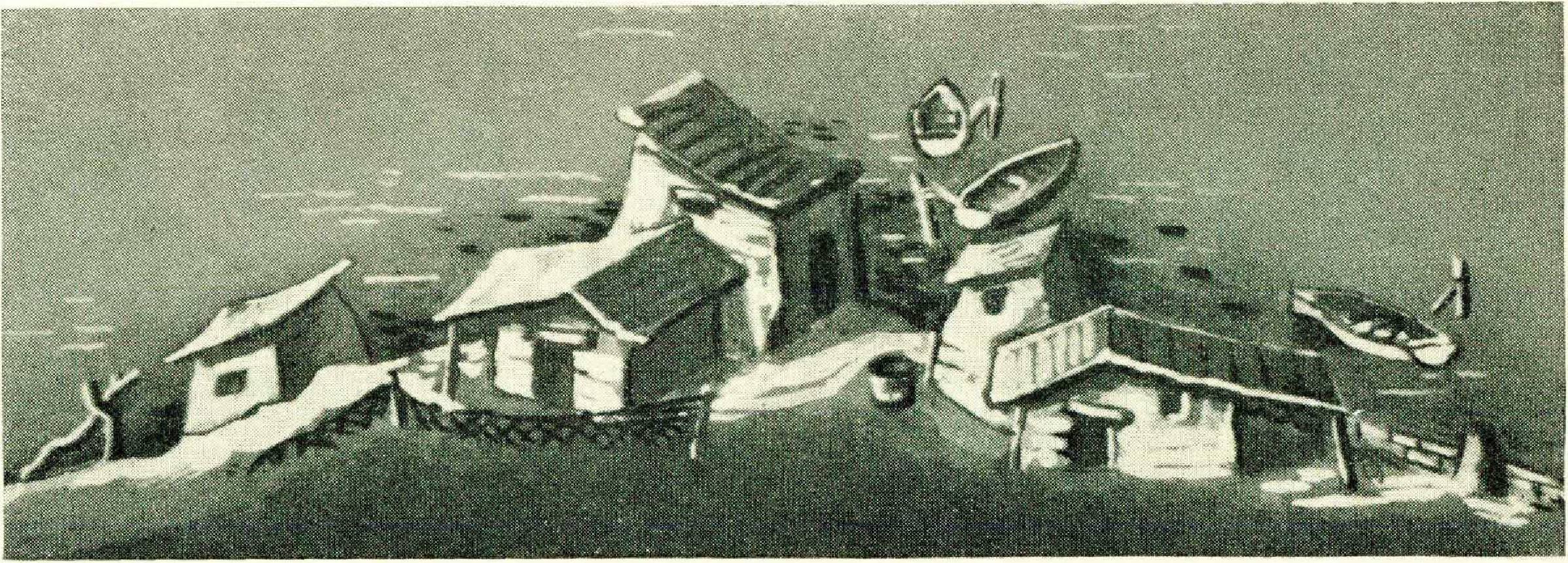
By the middle of the month his fears were set at rest. Rice cabled that the money from Life had been received and deposited, though much of it would have to be set aside in the special tax account. The Book-of-the-Month-Club officers reassured him about the guarantee. Ernest made it plain to Wallace Meyer that advance publicity for the novel must not depict him as a curiosity or a controversial figure. He wished to be “dignified with this book”: he must be judged as a writer and nothing else. If necessary, the critical free-for-all could start again with the next novel. The dustjacket designs from Scribner’s did not please him, and he cabled Adriana to try her hand. She soon airmailed a set of designs to New York. The choice was a stylized downhill view, in white, blue, and brown, showing five shacks, three fishing boats, and beyond them the sea, stretching out toward infinity. Ernest was delighted. He wrote that he had never been prouder of her. Viva El Torre Blanco, he cried. Viva! (Un Momento de Silencio). Viva! The question of the portrait of the author for the back of the dust jacket was solved by Lee Samuels, who snapped thirty-five pictures of Ernest sitting beside the pool. Ernest was sure that one of them would do. All he wanted was not to look like a zombie. He told Meyer that he was truly not vain about his face and body, adding that when he had been goodlooking, he had not known it.
This time, for once, there would be no need for a disclaimer about the identities of his fictional characters. The old man and the fish, as Ernest pointed out, were both dead long since. The sharks would not be likely to bring libel suits. He did not seem to be worried over difficulties with Manolito, the young son of the café owner at Cojimar, who had probably served him as a rough model for Manolo, the boy in the story. He was momentarily agitated when Carlos Baker wrote to remind him of an old letter to Max Perkins in which he had mentioned Carlos Gutiérrez as one distant prototype of Santiago. But he solved that problem by asking Baker not to mention the connection. Sitting by the pool in the heavy heat of May 30, he decided that the book would be dedicated “To Mary and to Pilar.” But it was Memorial Day, and he began to think of friends who had died. That evening he told Mary that he wanted to inscribe the book “To Charlie Scribner and to Max Perkins.” She magnanimously agreed. Nothing now remained but the proof sheets, which he corrected on a long holiday at Paraíso.
During the severe heat of mid-June, with the thermometer at 92 in the shade, Alfred Eisenstadt came down to make color portraits of Ernest for the Life magazine cover, as well as pictures of fishermen and boats to guide Noel Sickles, who was going to illustrate The Old Man and the Sea. Ernest contracted a severe headache from sitting in the sun for several hours while Eisenstadt worked, and discoursed on his hatred of illustrations. Eisenstadt hired the eighty-year-old fisherman Anselmo Hernández to walk up the hill at Cojimar as a stand-in for the fictional Santiago. Anselmo made such a touching picture as he toiled stoically through the heat that Ernest could not stand it, and quietly told Eisenstadt that the photography must stop.
Harvey Breit of the New York Times Book Review had now conceived the ingenious notion of asking William Faulkner to review The Old Man and the Sea. When Faulkner reached New York on his way back from Europe, Breit put the question. Faulkner said that he wouldn’t know how to tackle such a thing, and went off to Mississippi. But he presently surprised and delighted Breit by sending along a “statement” in praise of Hemingway. “A few years ago,” it began, “. . . Hemingway said that writers should stick together, just as doctors and lawyers and wolves do. I think there is more wit in that than truth or necessity either, at least in Hemingway’s case, since the sort of writers who need to band together willy nilly, or perish, resemble the wolves who are wolves only in pack, and, singly, are just another dog.” There was a good deal more, in Faulkner’s characteristic style, praising Hemingway’s integrity as a writer and indicating that of all men he was least in need of the protection of the pack.
But when Breit mailed Ernest a copy, he discovered that he had stirred up a hornet’s nest. Ernest pored over Faulkner’s syntax and foolishly concluded that the same man who had called him a coward in 1947 was now describing him as “just another dog.” Faulkner had never acknowledged his congratulatory cable at the time of the Nobel Prize. Meantime, said Ernest, he himself had written a novel that was better and straighter than Faulkner’s Nobel Prize oration, and it had all been done “without tricks nor rhetoric.” Why hadn’t Faulkner merely refused to review The Old Man and the Sea and let it go at that? And so on through a long letter. By this time the seat of Harvey Breit’s pants was on fire. “Listen, I’m damn sorry,” he told Ernest. His innocent purpose had been “to sow friendship, not discord.”
Midway of these maunderings it dawned on Ernest that he might have misunderstood Faulkner’s meaning. He admitted that perhaps he was just a soreheaded and touchy bastard, but still he continued to worry the “statement” as a dog worries a squirrel. Great writing contained a “mystery” that could not be dissected out and stayed vaiid forever. A real writer could make this mystery with a simple declarative sentence. Maybe he was being too hard on Faulkner. But he was not being as hard on him as he had always been on himself. He would soon be fifty-three, and in all those years he had tried to write well. Old Faulkner could have his “Anomatopoeio County.” As for Ernest, he felt cramped in a county — any county. His domain was the Gulf Stream, and his fish was the fighting marlin. All that Faulkner knew about was the lowly catfish.
None of this, luckily, reached the ears of Faulkner, who presently sent in a short review of The Old Man and the Sea to the little magazine Shenandoah. He called the novel Hemingway’s best. “Time may show it to be the best single piece of any of us,” he wrote, “I mean his and my contemporaries. This time, he discovered God, a Creator. Until now, his men and women had made themselves, shaped themselves out of their own clay; their victories and defeats were at the hands of each other, just to prove to themselves or one another how tough they could be. But this time, he wrote about pity: about something somewhere that made them all: the old man who had to catch the fish and then lose it, the fish that had to be caught and then lost, the sharks which had to rob the old man of his fish; made them all and loved them all and pitied them all. It’s all right. Praise God that whatever made and loves and pities Hemingway and me kept him from touching it any further.”
If Ernest saw this review of his novel, he gave no sign. But in letters of this period he repeatedly discoursed on what a “strange damn story” it must be that could profoundly affect so many people, himself included. His Italian translator
“The emotion was made with the action.”
wrote that she had been weeping all afternoon over the book. This and similar reactions from other readers confirmed him in his conviction that he had achieved an effect “way past what I thought I could do.” The aesthetics behind it was outwardly simple and inwardly complex. “The emotion was made with the action,” he said proudly. He rejected the notion that he had set out to portray the malignity of nature. It was of course true that the ocean could trap you by seeming so fair and attractive; but a man was a fool who allowed himself to be trapped. He also denied that he had employed “what they used to call Naturalism.” A naturalistic treatment could easily have been a thousand pages long, filled with the history and sociology of Santiago’s village and all its people, the dinghy races, the bootlegging activities, the revolutions, and all the day-to-day aspects of rural life. His task, on the other hand, had been to convey Santiago’s experience so exactly and directly that it became part of the reader’s experience, freighted with all the implications that the reader could bring to it inside or outside the frame the book provided.
As the time of publication drew near, Ernest’s boyish excitement mounted. Dan Longwell of Life told him of a “whispering campaign” which had attained national proportions. Six hundred extra sets of galleys of the Life edition had been distributed for promotional purposes. Each man who read it had boasted of his inside track to a dozen others. Meantime, the bookstores, fearful of losing sales because of the serial appearance, were bootlegging the book to their customers. The ironic aspect of all this quiet furor was that Ernest had been obliged to sequester for his special tax account $24,000 of the $40,000 that Life had paid him, while the Book-of-the-Month-Club guarantee would just suffice to pay off the $21,000 he had borrowed from the late Charles Scribner to meet past tax bills. This left him $16,000 in the black. “You can’t win, General,” he told Buck Lanham.
Apart from the tax problems, the publication of The Old Man and the Sea produced nothing but pleasure. Life sold 5,318,650 copies within fortyeight hours. Advance sales on the regular American edition ran to 50,000 and settled thereafter into a brisk weekly sale of 3000. In London, advance sales reached 20,000 and continued at 2000 a week. These statistics were impressive, but Ernest was struck even more by the effect the book was making on readers. All kinds, he said, kept telephoning congratulations. Those who saw him personally thanked him and often burst into tears. It was “worse than Pagliacci,” said Ernest happily.
American reviewers were mostly ecstatic. Harvey Breit called the book “momentous and heartening.” Joseph Henry Jackson had nothing but praise for this “miracle-play of Man against Fate.” Time found “none of the old Hemingway truculence” and judged the book a masterpiece of craftsmanship. The letter columns of Life blossomed with laudatory epithets. Rabbis and ministers began preaching sermons on Hemingway’s text. For three weeks, he himself averaged eighty to ninety letters a day from well-wishers: high school kids, boys in the service, various professors, columnists in New York, old pals from Italy, Montana, and Bimini, and many strangers.
Although he said privately that he disliked living under the new Batista dictatorship, he accepted a Medal of Honor from the Cuban government “in the name of the professional marlin fishermen from Puerto Escondido to Bahía Honda.” But he declined to go to New York to celebrate his success. There had been too damned much publicity anyhow. Drunks kept wanting to hit him (so he said) for having double-crossed Scribner’s by letting Life publish the book first. Sober people praised his story with tears in their eyes. Both reactions were now wearing his temper thin. Having books published, he believed, was even more destructive than making love too much. If he went to New York, he would only have to drink with various wits of the town, and doubtless it would end by his having to knock someone out. Mary could go in his place and taste the taste of triumph. He would stay in Cuba and light the giant marlin. By the end of September he had caught twenty-nine and was hoping for a thirtieth. “The leaving of the water and the entering into it of the huge fish,” he told Berenson, “moves me as much as the first time I ever saw it.” Perhaps he thought that the curious style of such sentences was in some way comparable to Homer’s. A Havana paper reviewed The Old Man and the Sea with much emphasis on the hidden symbolism. A local fisherman (so Ernest said) was puzzled by the term. “Ernesto,” he asked in Spanish, “what is symbolism? In the paper it said that the sharks were the critics.” Ernest smiled. “Symbolismo,” he said sententiously, “es un truco nuevo de los intellectuales.” It amused him to keep up this anti-intellectual and antisymbolic pose.
One of Ernest’s projects at this time was his determination to help Gianfranco Ivancich, who had been trying unsuccessfully to sell his Cuban farm, and whose future still remained uncertain. He was only three years older than Bumby, and Ernest looked upon him half as brother and hall as son. He needed the loyalty and devotion that Gianfranco displayed — like Sinsky, Roberto, Gregorio, and Don Andrés, but with greater intelligence, delicacy, and “mystery” than the others. It was well that he was on hand for another reason. Gigi had lately taken to quarreling with his father by mail, blaming him for his treatment of Pauline and condemning The Old Man and the Sea as sentimental slop. It was only, or mainly, a young man’s declaration of spiritual independence on having reached the age of twenty-one, but it served to darken one of the corners in the back of Hemingway’s mind.
Another project reached the boiling point in December, when Leland Hayward came to see Hemingway about a film version of the novel. Ernest respected Hayward for having persuaded Life to serialize the book, and also as the producer of such hits as South Pacific, Oklahoma, and Call Me Madam. Hayward suggested that Spencer Tracy and a younger actor should read aloud from the book in a series of one-night stands across the country, as Charles Laughton had been doing with Shaw’s Don Juan in Hell. This would soften up the public for a film, directed by Vittorio de Sica, narrated by Tracy, and using “local people on a local ocean with a local boat” as the actors. They could begin major shooting in a year and a half. Meantime, Ernest could film the shark sequences off Punta Purgatorio, a reef near Paraíso, lashing baitfish alongside a skiff and mounting cameras on the flying bridge of the Pilar.
Ernest approved the idea in principle, but the notion which really appealed to him was that of another shooting safari in Africa. Patrick was now in Kenya with his wife, and his reports to his father were highly enthusiastic. Ernest got out a Lonsdale Library volume called Shooting Big Game in Africa so that Mary could do some advance homework on the edible and the hostile beasts. Darryl F. Zanuck’s film of The Snows of Kilimanjaro had recently opened with much fanfare in New York. Ernest said that he was oiling up his old .577, which was good for rhino, buffalo, and lightly armored vehicles. On arrival at Mombasa, he would put the gun on his shoulder, head for Mount Kilimanjaro, climb Kibo Peak, and start “a search for the Soul of Zanuck.”
MOST of Ernest’s thoughts were now of Africa. The pending business with Leland Hayward delayed his departure all through the spring of 1953, and he chafed at the postponement. For nearly three years, as he told Berenson, he had labored steadily at sea level. Now he was eager to “get up into the hills.” He sharpened his shooting eye with quail-hunting expeditions into the back country, and banged away at pigeons in the Club de Cazadores.
The bright spring weather brought many visitors to the Finca — “the usual Cirque d’Hiver,” Mary called it — filling every bed in the house, to say nothing of drinking glasses and ashtrays. Kip La Farge spent several weeks in the Little House, joined there on March 7 by Evan Shipman, who was very ill with cancer of the pancreas. Next day Mary wrote Gianfranco an account of the hubbub. “After I got the mob breakfasted and off fishing this morning,” she said, “I wandered around the Finca and went to the pool. Sunbathed all morning . . . and watched the leaves and tiñosas [buzzards] gliding so high in the sky they were mere specks. It is the first Sunday I’ve had all alone here since you left, and in a way I am enjoying it, feeling free.” Twice in March she went with Ernest for extended visits to Paraíso, with Gregorio and the boy Felipe as mate and able seaman. Ernest browned to a color he called “ Indio tostado.” Mary swam, searched for shells, and was “very happy.” They got back home on the evening of April 2, just in time to prepare for the long-awaited arrival of the Haywards and Spencer Tracy.
Ernest was pleasantly surprised with Tracy, who seemed both modest and intelligent. Under the guidance of his host, he went to inspect the small port of Cojimar, and even had the good luck to see old Anselmo Hernández asleep in his shack after having fished all through the night before. Tracy was a teetotaler who endeared himself to Ernest by getting up each morning at six thirty, whereas the Haywards customarily slept until noon. It was the Easter weekend, which struck Ernest as a poor time for business transactions. It soon became clear that Tracy would not be free to make the picture until 1955. Easter Sunday was Mary’s birthday, and she spent an hour alone in the sun on the tower, happy in the conviction that this seventh year of their marriage had been the best of them all in harmony and good friendship.
On the first Monday in May they were fishing the reefs off Pinar del Río when they heard Ernest’s name on the six o’clock news broadcast. The Old Man and the Sea had won the Pulitzer fiction prize for 1952. He tried not to look as pleased as he felt. It was the only Pulitzer he had ever won, though he had come close in 1940. He began calling it the Pullover Prize and the IgNoble Prize, and signed over the award check to Bumby, for whom it represented five months’ jump pay at a hundred a month. Ernest could afford the gesture. The arrangements just concluded with Hayward guaranteed him a $25,000 advance royalty for the use of his novel, and an equal amount for his services in supervising the photographic work with the sharks in the Caribbean and the giant marlin off Peru. In the middle of May a group of editors from Look magazine came down to offer Ernest substantial payments for a series of articles on his forthcoming safari. He promptly bought Mary a yellow Plymouth convertible and began “staffing out” the African trip.
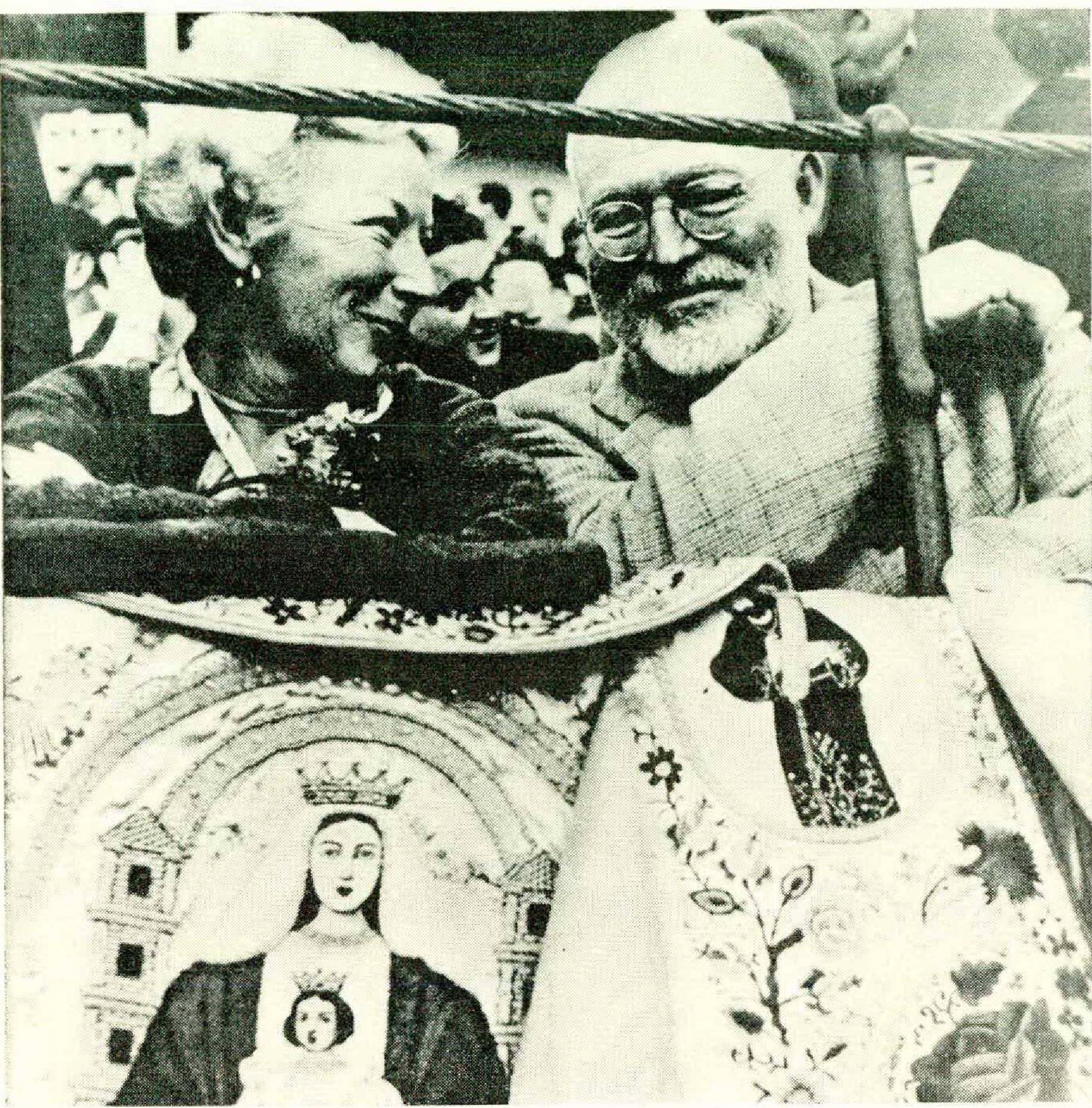
Before setting sail for Mombasa he was hoping for another visit to the fiesta of San Fermín in Pamplona. The problem was that Franco was still in power and that Ernest was universally known to have been a staunch Loyalist. But when he talked with his friends about a stopover in Spain, they agreed that he might honorably return, provided that he did not recant anything that he had written and kept his mouth shut about politics. The time of departure was chosen with this plan in mind. Ernest and Mary booked passage aboard the Flandre for June 24 and arranged with Gianfranco to meet them at Le Havre on the thirtieth. From there they could proceed leisurely to Pamplona in the Lancia, moving on to Madrid and Valencia and then to Paris before sailing from Marseilles for Mombasa. In Nairobi they would meet their Cuban friend Mayito Menocal, who would fly in to join them on safari with Philip Percival as white hunter.
Madrid was full of ghosts, and Ernest called it “sort of spooky.” But he was determined to occupy the same room in the Hotel Florida where he had lived in the fall of 1937. He told Buck Lanham that he knew by built-in radar that the Spaniards would regard this as the correct thing for him to do. In the same letter, he strongly implied that he had actually fought with the Loyalists in 1937, urinating into the water jackets of the Maxim machine guns when they became overheated, and smelling the boiled urine smell in the dust of the naked gray terrain (“worse than Hürtgen”) where he and his comrades had held off the fifth counterattack by Franco’s rebels.
They rounded out the Spanish tour with a call on Ordóñez and his brother-in-law, Luis Miguel Dominguín, at the Villa Paz ranch near Saelices, and then moved on to Valencia. Mary went sightseeing with Juanito Quintana and Peter Buckley, and they all saw several bullfights. Then it was time to hurry back to Paris and a room at the Ritz until the morning of August 4, when they left for Marseilles with Adamo in the Lancia, stopping over at Aix-en-Provence, and going aboard the Dunnottar Castle for the voyage to Mombasa.
The weather was better and the ship far cleaner than either had been in 1933. Four days out, a cold wind blew off the northern mountains, like a breath of winter in the midst of August, Egypt and the Suez were hot and windless until the desert cold settled down late at night. The sky was full of clear stars, and the lights of passing ships looked bright and warm. They amused themselves with trapshooting as long as the weather allowed. But in the Red Sea the heat closed in with a vengeance, accompanied by heavy monsoon winds that raised twenty-foot waves.
IT WAS raining when they reached Mombasa. Ernest was fishing in his pocket for papers and glaring furiously at the African policeman who guarded the gates to the dock. But he was all smiles when Philip Percival appeared. The passage of twenty years, as well as a recent bout with tick typhus, had aged him noticeably without in the least diminishing his cheerful outlook. Mary fell in love with him at once. Mayito Menocal had already flown into Nairobi, only to be hospitalized by severe arthritis. But he emerged in good spirits to join the others at the camp on Philip Percival’s Kitanga Farm. The photographer from Look also appeared, a pleasant man named Earl Theisen, much preoccupied with his camera equipment.
They spent the closing days of August luxuriously encamped in nine tents on the green-and-brown hillside at Kitanga Farm in the Mua Hills near Machakos, making several trips to Nairobi for supplies, hunting clothes, and final safari arrangements. Before breakfast on the second day, Philip came to say that Kilimanjaro had emerged from its cloud bank a hundred miles to the southeast, and they all piled into the car for a look from the Crest of Potha Hill. Ernest was jubilant to learn that they were to be allowed to spend the month of September as sole hunters in the Southern Game Reserve in the Kajiado District forty miles south of Nairobi. The region had just been reopened to hunters and was said to be teeming with game. They picked up their hunting licenses in Machakos, paid a thousand shillings each and two hundred more for an extra lion, lunched on cold lesser bustard, fresh tomatoes, and beer, and set off in a small cavalcade, prepared for instant action.
They did not have to wait long. A few miles down the road they were hailed by a young and dusty game ranger named Denis Zaphiro, who had parked his Land Rover at the roadside and stood there smiling. “You want to shoot a rhino?” he asked. “Yes,” said Ernest. “Well, come along,” Zaphiro said. “He’s just in here.” Ernest and Mary, Mayito and Theisen climbed into the Land Rover. The ranger swerved off the road into deep grass, and stopped when the rhino came into sight, standing beside a thorn bush. Zaphiro had been tracking him since late morning; someone had shot him, and he was dragging one foot. The men went forward, leaving Mary to watch. Dusk was falling. She was slightly nervous; it seemed to her that Ernest was getting too close. He closed the gap to twelve paces before he raised the sixteen-pound .577. The heavy rifle roared, and the rhino spun around. He fired again, and the beast ran off among the thorn clumps. They followed the blood spoor while the light lasted and gave up only when it was too dark to see. In their absence the boys had set up the camp, which looked cheerful when they came to it by firelight. Seven tents stood under a huge thorn tree beside the Salengai River, a wide dry bed with a trickle of water down one side. Denis Zaphiro said that many elephants might pass in the night on their way to the watering places: they would sound like giants wearing galoshes. A curious lion might even peer into the tent.
The night passed, however, without visitations. Next morning at dawn Ernest and Zaphiro went in search of the rhino. They found it dead near where they had stopped the evening search, and left the carcass untouched in the hope of attracting hyenas, which Ernest was eager to destroy. Zaphiro and Ernest were already good friends when they got back to the camp for breakfast. He was a Londoner, aged twenty-seven, nearly as tall as Ernest but slenderly built. During the war he had been in the British Army and afterward had served with the Equatorial Corps in some of the finest game country in Africa. For the past three years he had been a ranger with the Kenya Game Department, an ardent and articulate conservationist who had pioneered in the use of light aircraft for locating the moving herds of game. It was he who had just secured permission to open the Southern Game Reserve for hunting.
In the early morning of their last day at Salengai, Ernest got his first lion. Despite his subsequent boasting, it was not a good show. The sky was drizzle-gray when they left in the Land Rover. Two lions were feeding on the bait. “Papa shot one at 200 yards,” wrote Mary. “We heard the whock, but he didn’t fall and he didn’t roar.” All he did was vanish. Percival and Menocal came to swell the posse for a search. In half an hour Denis found the wounded lion and finished him off with two quick shots. Ernest also shot twice. At the skinning out, the Hemingways each took a raw tidbit of meat to chew on.
The gesture was meant in part for luck. Mayito Menocal was consistently outshooting Ernest, while modestly attributing his good fortune to the yellow scarf he wore. If it was luck, it showed clearly two days later in the Kajiado District, near the Kimana River and Swamp. The move southward was accomplished in four hours, and the camp was pitched under tall trees beside a dusty but parklike plain. On the eleventh, Mayito shot a black-maned lion, nine feet from tail tip to nose and weighing 500 pounds. Ernest’s difficulties reappeared when he and Mary penetrated Kimana Swamp with Denis. A large herd of buffalo was grazing there, their ebony backs showing above the tall reeds. When Ernest shot at one, Denis assured him that the bullet had connected. But they were able to find neither buffalo nor blood spoor.
In an attempt to recoup, Ernest unpacked the old Springfield that he had used so unerringly in 1933. At first it worked well: on two successive days he killed a zebra and a gerenuk with one shot apiece. Then he began missing again — two zebras, a warthog, a lion, a lioness, and a baboon — all in two weeks of hunting around Kajiado. But he continued to be a good wing shot and seized every opportunity to go out after birds. The walking was good for him. His weight fell off to 190 despite his strong appetite, and his letters always reported that he was having a wonderful time. Except for his difficulties with the rifle, it was true. The cook N’Bebia fed them well, and the dishes were so abundant and exotic that Ernest’s appetite for game began to fall off. He renewed his Western-ranch-style breakfasts, with sandwiches of fried egg, ham, sliced onion, ketchup, Worcestershire sauce, and mustard pickle.
They broke camp on September 19, returned to Salengai for three days, and by the twenty-fourth had reached a new region which the Game Department had named Figtree Camp. It lay west of Magadi and north of Lake Natron beside a clear creek called the Oleibortoto that flowed out of the western edge of the Rift Escarpment. Mary was enchanted with the place. It was a few miles south on a hillside that Mayito got a fine male leopard and Mary soon afterward a lesser kudu buck with a single shot in the neck.
Theisen left for Nairobi and the long trip home on the first Sunday in October. Mayito and Roy Home set off for Tanganyika, while Ernest and Mary stayed on for another ten days at Figtree Camp, still hoping that Mary would get a lion. On October 13 they broke camp, drove back to Nairobi, met Tom Shevlin, and returned to Percival’s Kitanga Farm for a hilarious dinner. Mary stayed on there to write an article on Spain while Ernest flew down to Tanganyika to see Patrick, whose new 3000-acre farm lay near a place called John’s Corner among high wooded hills and mountain meadows. Ernest had shaved off all his hair. The scars from his various head wounds showed and he pointed them out proudly to Patrick and Henny. He took the occasion to write Gianfranco, praising Mary’s “ideal” behavior throughout the safari.
Although they both assured their friends at home that they had never had a better time in their lives, the third month of shooting produced much bad luck. Their trip to Ibohara Flats in the Usangu District was a failure. Game was scarce, and daytime temperatures often reached 114 degrees. Back in Kajiado they spent a week in Denis’ new house, where Bill Lowe, the Look editor, joined them for ten days of generally unsatisfactory hunting. Rounding a sharp curve, Ernest tumbled out of the Land Rover, cutting his face and spraining a shoulder. Mary learned sorrowfully of the death of Baa, her pet gazelle. Henny was ill, and Patrick came down with a bad case of malaria.
Ernest had been showing signs of wanting to go native. At dinner one night he told Mary that she was “depriving him of his new wife” — a Wakamba girl named Debba from a shamba near the village of Laitokitok. Mary, who had long since elected to believe that boys will be boys, observed helpfully that the problem could easily be met, though Debba ought first to have a much needed bath. Ernest quickly subsided, saying that it was not the time to discuss it.
For a couple of weeks thereafter nothing much happened. On the twelfth, Mary flew to Nairobi for Christmas shopping with a bush pilot named Roy Marsh, who had been bringing the mail to the Kimana camp and taking the hunters for joyrides over the swamp and the Chulu Hills. When she returned on the sixteenth, she found that Ernest had been going native with a vengeance. He had dyed his suede jackets and two shirts “into various shades of the Masai rusty pink ochre,” and taken up hunting with a spear. He had gone out leopard hunting. He knocked a leopard out of a thorn tree and followed it into heavy bush. Ten feet away they found a splash of blood and a piece of the leopard’s shoulder blade. When N’Gui handed Ernest the bone fragment, he popped it into his mouth like a savage talisman. The leopard took refuge in a clump of thorn. Ernest had to throw in six rounds with the Winchester pump gun before the animal stopped roaring and died. Ernest celebrated the event Western-style with five bottles of beer, only to be awakened in the evening by the arrival of Debba and some of her friends. He took them into Laitokitok and bought them dresses for Christmas. Back at the camp, as Mary wrote, the celebration soon became so “energetic” that they broke her bed. But when one of the safari servants warned that Debba’s
“We were smart kittens to come to Africa.”
aunt might cause trouble, Ernest wisely desisted and sent or took the girls back to the shamba.
They kept the holidays African-style, celebrating Christmas morning with a decorated thorn tree and gifts for the safari servants. For Christmas noon, Ernest had arranged a special Ngoma. Debba, chaperoned by her aunt, was among the crowd of Wakamba and Masai who came for the show. Ernest delivered a solemn speech. The safari scouts performed a dance, decked out in dyed ostrich plumes.
They marked New Year’s Eve quietly with tea and mince pies, brought down by the Percivals.
“Now at the fire we’re happy,” wrote Mary in her diary on January 2, “thinking what a marvelous year it has been.”
Ernest sat rubbing his shaven head. “I’m not a phony, but I’m a terrible braggart,” he said.
“No,” thought Mary fondly. “Just full of joy.”
“We were smart kittens to come to Africa,” said Ernest.
ON JANUARY 21, 1954, the Hemingways took off from West Nairobi airport in the Cessna with Roy Marsh at the controls. Roy was a slender and confident young man with a small black mustache. The flight plan was circuitous. They flew southwest to Figtree Camp, where they dropped a note for Denis Zaphiro, explored the Rift Escarpment from the air, and marveled at the color of Lake Natron, pink with immense flocks of flamingos. That afternoon they turned west over Ngorongoro Crater and the Serengeti Plain. Ernest pointed out the campsite of December, 1933, and the spot where Pauline had killed her lion. They set down briefly at Mwanza to refuel, and by sundown had reached Kivu, the most beautiful lake that Mary had ever seen. Bukavu, surnamed Costermansville, sheltered them overnight.
Next day they turned north, threading the chain of Lakes Edward, George, and Albert, and descending that evening at Entebbe on the northwest shore of Victoria Nyanza. Mary had taken hundreds of pictures: Natron and the flamingos, the great herds at Ngorongoro and Serengeti, color shots of Kivu, native villages under thatch, fishermen in dugout canoes, elephant and buffalo grazing side by side, hippo bathing along the lake shores. On the third day they saw the White Nile curling like a ribbon across the green landscape, and detoured eastward along the Victoria Nile so that Mary could photograph Murchison Falls.
Roy circled the falls three times, winging over for the picture-taking. Somewhere in the third circle a flight of ibis suddenly crossed the path of the plane. As he dived to avoid them, Marsh struck an abandoned telegraph wire which stretched across the gorge. It nicked the propeller and raked the tail assembly. He angled away from the falls, cleared the shelving bank, fought for altitude, lost it steadily, and looked for a place to come down. They were three miles southwest of the falls when the land rose up to meet them. The plane crunched down with a clash of rending metal among rough clumps of thorn. “Let’s get out quickly,”said Marsh. The Hemingways jumped clear, setting foot for the first time in their lives upon the rocky soil of Uganda.
After the roar of the plane it seemed deathly quiet. Roy straightened the radio antenna. They could hear his voice inside the cabin. “Mayday, mayday, mayday. Victor Love Item down three miles south-southwest of Murchison Falls. Nobody hurt. Awaiting overland rescue.” He repeated the message and switched to reception. There was no answer. In the thick scrub around them they could hear the sounds of animals. Mary was in shock, and they made her lie down. For some minutes Ernest could get no pulse at all; when it returned at last, it was 155 to the minute. Her chest ached sharply, and Ernest had sprained his right shoulder at the moment of impact. Otherwise, as Marsh had said, they were unhurt.
As soon as they could, they climbed a hill where empty telegraph poles stood out against the sky. The afternoon waned, and Ernest gathered firewood. From the knoll they could see the river, where hippos and elephants came down to wade and drink. That night, Mary slept fitfully under a sweater and a raincoat, while Ernest and Roy dozed beside the fire.
As soon as it was light, Roy left for the falls to make a large arrow pointing to the fallen plane. Ernest was ranging for firewood when he saw an amazing sight — a large white boat was coming down the river. He and Mary waved their raincoats to attract attention. There was no sign from the boat that they had been seen. The elephants were too close to allow for a run to the riverbank. They watched in desperation while the boat tied up at a small landing and people began sauntering ashore. They waved and shouted again, and this time they were seen. A group of natives set off to climb the hill. Ernest stayed behind to wait for Roy while Mary went down to the boat.
The name on its bows was the Murchison. The man in charge was an East Indian who doubted the desirability of taking another party aboard. The boat had been chartered for the day by Ian McAdam, a British surgeon from Kampala, who had already left with his wife and son to look at the falls. When Ernest and Roy arrived, the Indian insisted on collecting extraordinary fares of a hundred shillings apiece.
It was late afternoon when they reached Lake Albert and followed the eastern shore toward Butiaba. A bush pilot named Reggie Cartwright was waiting for them at the dock with a policeman named Williams. They had spent the day searching. The word was out that the Hemingways had been killed. A BOAC Argonaut, crossing near the falls, had reported the wreckage, with no sign of survivors. Cartwright’s plane, a twelve-seater De Havilland Rapide, was refueled and ready at the Butiaba airport, and he proposed to fly them to Entebbe.
Night was closing in when they reached the airstrip. The Rapide looked vaguely airworthy, but the runway resembled a badly plowed field. Ernest and Mary and Marsh climbed aboard with some reluctance, watching the ground ahead while the plane went bumping over the furrows, roaring and creaking, lifting and banging down again. Suddenly the plane stopped and burst into flames. Fire was swirling outside Mary’s window as she unhooked her seat belt. It seemed an age before she could find the door on the port side. It was jammed shut. Up forward Marsh had kicked out one of the windows. He and Mary got through it and ran clear, with Cartwright following. Ernest appeared on the port wing, having butted his way through the jammed door with his hapless head and his damaged shoulder. He leaped down staggering and wavered off in the flickering light. Twice in two days, they had crashed and come out alive.
But not unscathed. In smashing clear of the cabin Ernest had broken his head. His scalp was bleeding, and clear liquid was seeping down behind his left ear. Mary was limping badly with the pain of a damaged knee. They climbed in with the policeman Williams and his wife for the fifty-mile ride to Masindi. Ernest said afterward that it was the longest ride of his life, and it could hardly have seemed short to Mary. At the Railway Hotel in Masindi there was neither food nor quiet. Several bush pilots appeared to join the celebration. Like Cartwright, they had all been combing the country for some sign of the wreckage. As soon as possible, the Hemingways retired to their room and nibbled at some sandwiches. Neither of them was in the least hungry, and Ernest could not seem to stop coughing.
He got through the rest of the week on gin and raw courage. His lower intestine had collapsed, there was something wrong with one kidney, he vomited often, his lower backbone felt like a red-hot poker, and he carried his broken head like an egg. Patrick flew in Tuesday noon on a chartered plane from Dar es Salaam. He had 14,000 shillings and a quiet authority which pleased and touched his father. On Thursday Roy Marsh brought a Cessna 170 to take Ernest to Nairobi. Patrick and Mary followed next day by commercial airline. It was only nine days since the start of the trip, but it seemed like a thousand years. Congratulatory cables poured in from both hemispheres. Sitting up in his tousled bed, Ernest read them all. Afterward came the premature obituaries, which had appeared in newspapers all over the globe, together with hundreds of statements from all kinds of prominent people who had been asked for them when it had seemed certain that Hemingway was dead. These he gobbled up with what Mary called “immoral zest,” though he could not help supposing that some of the people had welcomed the news of his death.
He was still in danger of dying. Apart from the full-scale concussion, his injuries included a ruptured liver, spleen, and kidney, temporary loss of vision in the left eye, loss of hearing in the left ear, a crushed vertebra, a sprained right arm and shoulder, a sprained left leg, paralysis of the sphincter, and first-degree burns on his face, arms, and head from the plane fire. With his customary pose of invulnerability he had told reporters that he had never been better. The truth was that he had never been worse. The crash had, in fact, left him no more than a shadow of his former vigor.
FOR all his snowy beard, Hemingway was only just turning fifty-five, and determined to fight his way back to health, both physical and mental. He told the aged Berenson that there was, after all, nothing like youth, nothing like loving “who you loved,” nothing like waking each day not knowing what the day would bring, but knowing that it would bring something. Fame as a writer was one thing, and he was on record as wanting to write books that would last forever. But he had had enough of that other thing called publicity. All the plane-crash business, he said, had only replaced the old and false tough-guy mythology with a new legend of indestructibility that was equally false. What interested him in his serious times was fiction, the roughest of trades. It meant the ability to seize the impalpable and make it seem not only palpable but also normal. Since this was an obvious impossibility, like the action of the alchemist who turned base metal into gold, people valued it wherever they found it. Yet too much adulation was bad for a writer. His true reward lay within himself—in the consciousness of having written to the top of his ability and then beyond it.
Rumors were abroad that his name was up for the Nobel Prize. Having heard them before, he was skeptical, though he said that if he ever got his hands on that much tax-free money, he would buy a Cessna 180 and have some real fun. Otherwise, the award might be dangerous. He had a sour-grapes theory that “no son of a bitch that ever won the Nobel Prize ever wrote anything worth reading afterwards.” The case seemed to be proved by Faulkner’s A Fable, published in August. It struck Ernest as false and contrived: all a man needed in order to do 5000 words a day of that kind of stuff was a quart of whiskey, the loft of a barn, and a total disregard of syntax.
Summer and fall went by with the usual mixture of good and bad luck. On his fifty-fifth birthday he appeared at the International Yacht Club to receive the Order of Carlos Manuel de Céspedes, announced a year earlier.
Buck Lanham returned from Europe to the Armed Forces Staff College in Norfolk, Virginia. Bored by inaction, he resolved to enter the hospital for repair of a long-standing hernia. One day in late October, a nurse appeared. “General,” said she, “you have a long-distance call.” The voice on the other end was unmistakably Ernest’s.
“Buck, I just called to tell you I got that thing.”
“That thing? What thing?”
“That Swedish thing. You know.”
“You mean the Nobel Prize?”
“Yeah. You’re the first one I called.”
“God-damned wonderful,” Lanham said. “Congratulations.”
“I should have had the damn thing long ago. “I’m thinking of telling them to shove it.”
“Don’t be a jackass. You can’t do that.”
“Well, maybe not,” said Ernest. “There’s thirtyfive thousand dollars. You and I can have a hell of a lot of fun with thirty-five thousand dollars. The big thing I called about, Buck, is I want you to come down here and handle me. Everybody’s going to be banging on the door of the Finca. Buck, how about it?”
Lanham mentioned his day-old hernia operation.
“Hell, Buck,” said Ernest, “that’s not serious. Come on down. Can’t those docs fix you up?”
“They did,” said Lanham. “They did it so well I walked all the way down this goddamn corridor holding my gut in my hand to answer your phone call.”
“Well, Buck,” said Ernest, “I tell you truly, I’m not going over there. I’ll write something for them to read. What would you say if you were getting the Nobel Prize?”
He was displeased by the official citation from the Nobel Prize Committee. It praised his “powerful, style-making mastery of the art of modern narration.” But it also described his earlier writings as “brutal, cynical, and callous” — and therefore at variance with the rule that an award must be given for “a work of ideal tendencies.” Still, the citation had spoken of the “heroic pathos” which formed “the basic element of his awareness of life,” as well as his “manly love of danger and adventure,” and his “natural admiration for every individual who fights the good fight in a world of reality overshadowed by violence and death.” All in all, the little paragraph had the air of something prepared by a committee, and Ernest grumblingly accepted it as such.
Two days after the award announcement, he observed to young Charles Scribner that the “damn thing” was now fortunately over with. It had interrupted his work, invaded his privacy, and produced much “distasteful publicity. Still, the $35,000 check would help him pay off some of his debts. As for the elegant gold medal, he was uncertain what to do with it. Yeats had called it “The Bounty of Sweden,” and Ernest wished to be bounteous. He considered giving it to Ezra Pound, but thought better of it. For a time he hid it in the secret jewelry drawer at the Finca. In the end he presented it to the Virgen of Cobre, Cuba’s national saint, to be kept in the shrine of Our Lady at Santiago de Cuba.
In November he heard from the American Embassy in Stockholm. The Ambassador, John Cabot, had learned from the newspapers that Mr. Hemingway’s health would not allow him to appear personally to receive his prize. If this were true, the ambassador would accept it in his behalf. Minister Stahle, director of the Nobel Foundation, had expressed the hope that Mr. Hemingway might send along a brief statement to be read at the ceremonial banquet.
He complied by recording the following speech:
Members of the Swedish Academy, Ladies and Gentlemen: Having no facility for speechmaking nor any domination of rhetoric, I wish to thank the administrators of the generosity of Alfred Nobel for this prize. No writer who knows the great writers who did not receive the prize can accept it other than with humility. There is no need to list these writers. Everyone here may make his own list according to his knowledge and his conscience. It would be impossible for me to ask the Ambassador of my country to read a speech in which a writer said all of the things which are in his heart. Things may not be immediately discernible in what a man writes, and in this sometimes he is fortunate; but eventually they are quite clear and by these and the degree of alchemy that he possesses he will endure or be forgotten. Writing, at its best, is a lonely life. Organizations for writers palliate the writer’s loneliness but I doubt if they improve his writing. He grows in public stature as he sheds his loneliness and often his work deteriorates. For he does his work alone and if he is a good enough writer he must face eternity, or the lack of it, each day. For a true writer each book should be a new beginning where he tries again for something that is beyond attainment. He should always try for something that has never been done or that others have tried and failed. Then sometimes, with great luck, he will succeed. How simple the writing of literature would be if it were only necessary to write in another way what has been well written. It is because we have had such great writers in the past that a writer is driven far out past where he can go, out to where no one can help him. I have spoken too long for a writer. A writer should write what he has to say and not speak it. Again I thank you.