Thoreau and American Power
IN THE Morgan Library in New York yon ran look at the box that Thoreau built to hold his journals. This work runs to thirty-nine manuscript volumes and was published in fourteen volumes. It contains nearly two million words in more than seven thousand printed pages. It is not the longest journal ever kept only because Thoreau, who kept it fiercely from the time he was twenty, died before he was forty-five, probably of the struggle I am about to describe. But it is one of the most fanatical, most arduous, most tragic examples in history of a man trying to live his life by writing it —of a man seeking to shape his life by words as if words alone would not merely report Ids life but become his life by the fiercest control that language can exert.
The greatest part of Thoreau’s life was his writing, and this is true of many writers, especially in our time, when they are interested not merely in composing certain books but in making a career out of literature. But what makes Thoreau’s case so singular, and gives such an unnatural severity to his journal itself, is that the work of art he was seek ing to create was really himself; his life was the explic it object that he tried to make in words. Constant writing became for him not a withdrawal from life, a compensation for life, a higher form of life, all of which it has been for many writers since Romanticism identified the act of composition with personal salvation. It became a symbolic form of living. Writing was this close to living, parallel to living, because the only theme of Thoreau’s life was himself. He transcribed Ids life directly onto paper—I do not mean that he reported it actually, but that he sought to capture experience in just one form; the sensations and thoughts of a man walking about all clay long. To this commonplace daily round he was restric ted by Ids own literal experience, for he did not wish to invent anything in the slightest and was incapable of doing so. l$m he was also restricted by the fact that he had no experience to report except being a writer and looking for topics in nature. Thoreau never married. Wherever possible, as everyone knows from his most famous book, he lived alone. But this was in fact not always possible, for other members of the Thoreau family preferred not to marry, clung together, and imposed themselves on him through the family’s pencil business. So Thoreau at least went about alone and became a naturalist in Ids own independent style, an observer who could find his material on every solitary walk, a “selfappointed inspector of snow-storms and rain-storms.” He had his favorite classies to quote from in his journal, books that he used to support his moral vision of nature; he had this large family, full of eccentrics like himself, who nevertheless provided a home base; and he bad a few friends, associates of his ideas rather than intimate friends, notably and least satislac torily his employer and sometime patron, Tmerson, with whom his journal records the constant diction that was so necessary to his relation with even the most forbearing individualists in New Tnglaud, Otherwise I bureau might have felt that he was betraying his ideal life, the life that nobody could conceive for him but himself, that he lived only in the epiphanies of his journal, that nobody could live except with himself alone.
Since books werereally personal instruments, and friends were invariably, sooner or later, to betray his design for life, ibis left for subject matter, in a book of two million words, what one may call the American God, the only God led to these wholly self-dependent ttansccudenialists in the New T.ngland of the 1840s-Nature. Thoreau told Moncure Conway that he found in Tmerson “a world where truths existed with the same perfection as the objects lie studied in external nature, his ideals real and exact.”Nature, by which Emerson meant everything outside the writer lor him to explore and to describe Nature for Thoreau became the landscape, mostly around Concord, that he could always walk into. It served as the daily occasion of Thoreau’.s journal, the matter that tied I bureau to the world outsider, that became his world, that safely gave him something to wiile about each day. Nature gave him the outside jobs he look as a sen veyor from time to lime to keep him in some practical relation to his town and neighbors. Nature even made him a “naturalist,” a collector of specimens and Indian relics, a student of the weather and of every minute change in the hillsides that he came to know with the familiarity that another man might have felt about the body of his wife.
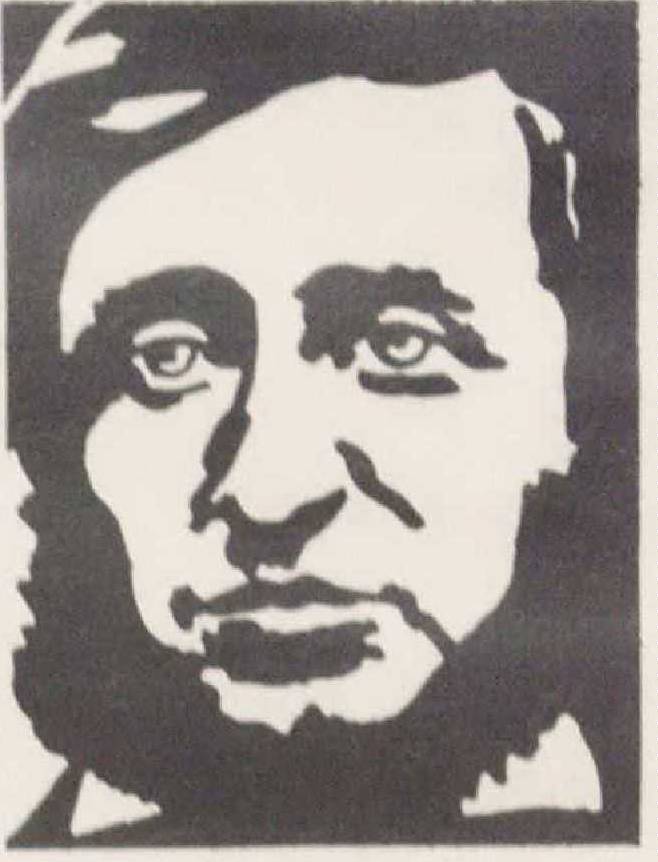
by Alfred Kazin
But above all. Nature was himself revealed in Nature, it was the great permissive spate in which he found himself even day. Nature was perfect freedom; Nature was constant health and interest; Nature was the perfection of visible existence and the only link to an invisible one; Nature was the ideal friend, the perfect, because always predictable, experience it was east and hope and thought such as no family, certainly no woman, not another writer, would ever provide. Nature was the divine principle disclosing itself, for God to Thorcau meant not the Totally Other, what is most unlike us, but perfect satisfaction,
This is what God had begun to mean to Emerson and other proud evangels of the new romantic faith that God lives in us and as us—that God is manifested by the power and trust we feel in ourselves. Emerson was the oracle of a faith that only he could fully understand, for it rested on his gilt for finding God in and through himself alone. Emerson’s faith was pure inspiration; without Itis presence to give testimony, the intuition’s access to the higher mysteries had to be painfully approximated by secondary faculties. Emerson was thus the unique case among modern writers of a spiritual genius whose role was essentially public, such as the founders of new religions have always played. Without his incomparable face, Itis living voice, Emerson on the printed page was never to inspire in later generations what the magnetism ol his preseme had created in his own day—a grateful sense on the part of many listeners that here was the founder of American originality, the oracle, the leat her of his tribe. Emerson, actually a very subtle writer, was face to face a living myth—the appointed leader who tomes in at the beginning of a new civilization, sounds a collective hope and purpose, out of himsell passes spiritual strength to the people.
THOREAU’S life was entirely private and was lived, he insisted, for his own higher purposes. Except for his explosive anxiety about the growing power of the slave interest, which was getting such an influence ovci the United States government that Thorean discerned in it a threat to his own absolute freedom as well as an affront to his wltollv personal Christianity, he was not merely imlillerent to the State but contemptuous of it. He was interested in society only as an observer of different species taking notes on his Concord neighbors and their peculiar ways His God was private to himsell and really not to be taught to ot shared with anyone else. It was imaginai ive pure power, Henry I hoi can’s most perfect acquisition in a narrow life that sought only a lew acquisitions, and these the brightest and purest pure morality, pure love, pure creation in the pages he wrote each night in his journal from the notes taken on his walks.
God was not even a name; He was the fulfillment you sensed in the woods as vou passed. But of course other poets of nature weir saying this in the first halt of the nineteenth century in England, Germain, and the United States. What Thoreau was saying, in prose of exceptional vibration, was that he had this fulfillment, this immanence in the woods, for and to himsell whenever he wanted it; that he had only to walk out every afternoon (having spent the morning writing), to walk in the woods, to sit on the cliffs and look out over the Con cord River and Conantuin hills, for the perfect satisfaction to return again. As late as 1857, he would write in his journal: “. . . cold and solitude are friends of mine. . . . I come to my solitary woodland walk as the homesick go home. This stillness, solitude, wildness of nature is a kind of thoroughwort or boneset, to my intellect. This is what I go out to seek. It is as il I always met in those placcs some grand, serene, immortal, infinitely encouraging. though invisible companion, and walked wills him.”
The satisfaction lay first of till in the daily easy access to revelation. Sauntering about-Thoreau playfully derived the word from à la sainte terra, to the holy land his mind dreamily overran what he saw, made nature incandescent, even when he was most assiduously playing the inspector ol snowstorms and rainstorms, He filled up every space in nature with evidence ol design, growth, meaning. If you live with a perfect attachment to the world outside your door, constantly note the minute changes in plants and animals, you create the figure of nature as a single organism with the irresistible tendency to explain herself to you. The visible surface of things then glows with the relationship to man that Emerson had so rapturously felt at the Botanical Garden in Paris on july 13, 1833 Not a form so grotesque, so savage, nor so beautiful but is an expression of some property inherent in man the observer,—an occult relation between the very scorpions and man. I feel the centijn’ife in me,— cayman, carp, eagle, and fox. I am moved by strange sympathies; I say continually I will be a naturalist.'" Thoreans sympathies with nonhuman living forms were so intense that they arranged themselves to please an eve that could not have been more unlike the professional scientists even when he searched details to exhaustion. Thoreau sought ecstasy: union only with the invisible.
This perfect satisfaction could not always be found; there were inevitable days of bleakness, dissatisfaction, and weakness. But Thoreau, using nature’s revelation of God as an instrument of personal power and happiness, was able to create on paper his own life of satisfaction, to retain in words the aura of this perfect attachment. He was able to make this life by writing it. Writing was his great instrument, a prose that always took the form of personal experience, created wholly out of remembrance and its transfiguration, writing in which the word sought not only to commemorate an experience but to replace it. “I long ago lost a hound, a bay horse, and a turtle-dove, and am still on their trail.”The ecstatic real thing was always getting lost. But what had been lost could always be lound again on the page, and what bad merely been wished for could be remembered as if it had happened. A memory more than his own was Thoreau’s imagination to the point where this “memory" relived the original so intensely that ii replaced it. The dreaming mind of the writer, imagining his life as if there were nothing else in the world to imagine, at last created it.
But this called for the most relentless control of the page by style, by an attentiveness to the uses of words that quite wore him out, by a constant show of epigram, pun, paradox, jeu d’esprit, ingenious derivation, that he recognized as Ids characteristic fault of style. He practiced this until he became weary of his own strategy, as even the most devoted reader of Thoreau is likely to see through his literary tricks. But these are the essence of Thoreau’s genius and the reason lor Ids enduring appeal. They have an extraordinary ability to evoke the moment, the instant flash of experience, to give us the taste of existence itself. They hold us to the glory of a moment—single, concrete, singidar.
Thoreau was always, I think, a young man, and certainly oriented, as Thornton Wilder put it, to childhood. He addressed his most famous book to “poor students,”and his most admiring readers, whether they are young or not, respond to the inner feeling of youth in his pages the absoluteness of his impatience with authority, the natural vagabondage. the expectation of some different world just over the next horizon. Students recognize in Thoreau a classic near their own age and condition. All his feelings are absolutes, as his polithal ideas will be. There is none of that essential complexity, that odd and winning ahilitx to live with contradiction, that one finds in Emerson’s obligation to both his “soul" and the social world he thinks in. Thoreau wrote in his journal for 1851 that “no experience which I have today comes up to, or is comparable with, the experiemes of my boyhood....As far back as I can remember I have unconsciously referred to the experiemes of a previous state of existence. . . . Formerly, met bought, nature developed as I developed, and grew up with me. My life was ecstasv. In youth, before I lost any of my senses, I can remember that I was all alive, and inhabited my body with inexpressible satisfaction.”
This happiness is what Thoreau’s readers turn to him for-it is a special tonsonance of feeling between the pilgrim and his landscape. And it was not so much written as rewritten; whatever the moment was, his expression of it was forged, fabricated, worked over, soldered from fragmentary responses, to make those single semem es that were Thoreau’s highest achievement, and indeed, his highest aim. For in such sentences, and not just by those sentences, a man could live. Transcendentalism was a church of the world, Each of Thoreau’s sentences is a culmination of his life, the fruit of his hallucinated, perfect, all-too-perfect attachment to his local world; each was a precious partic le of existence, existence pure, the life of Thoreau at the very heart. Each was victory over the long unconscious loneliness— and how many people, with far more happiness in others than Thoreau ever wanted or expected, can say that then life is all victory, how many can anticipate a succession ol victories? In the end was the word, only the word:
When I was four years old, as I well remember. I was brought from Boston to this my native town, through these very woods and this field, to the pond. Ii is one of the oldest scenes stamped on my memory. And now tonight my flute has waked the echoes ovet that very water. The pines still stand here older than I; or, il some have fallen, I have cooked my suppei with their slumps, and a new growth is lisiug all around, preparing another aspect for new miaul eyes. Almost the same johnswon springs from the same perennial root in this pasture, and even I have at length helped to clothe that fabulous landscape of my infant dreams, and one of the results of my presence and influence is seen in these bean leaves, corn blades, and potato vines.
A student once wrote in a paper on Ihoreau: “This man, too honest, too phvsicalh aware to lashion an imagined scene . . . searched to exhaustion a scene that sometimes appeared empty.”But years later another student, as it to answer the first, noted that after writing Walden, Thoreau could look about him, as we do today when we visit Walden Pond, with the feeling that this environment has been changed by his writing the book. Thoreau did create Walden Pond; the hut along its shores became, Ellery Channing said, the wooden inkstand in which he lived, and the attachment to Walden itself became as total and single in its all absorbing attentiveness as a baby’s to its mother, as a prisoner to his cell. Walden is the record of a love blind to everything but what it can gather from that love, to everything but the force of its will. That is why we can recognize in Wahim the beauts of southful feeling that is haunted by doom but not by tragedy, to whom death seems easier than any defeat from the social compact.
For youth the center of the world is always itself, and the center is bright with the excitement of the will. There is no drama like that of being young, for then each experience can be overwhelming. Thoreau knew how to be young. He knew how to live deep and suck all the marrow out of life. “I went to the woods because I wished to live deliberately, to front only the essential facts of life, and see if I could not learn what it had to teach, and not, when I came to die, discover that I had not lived. I did not wish to live what was not life, living is so dear; nor did I wish to practice resignation, unless it was quite necessary.”That is youth speaking, for only youth thinks that if: can live “deliberately,” that a man’s whole life can be planned like a day off, that perfect satisfaction can be achieved without any friction whatever, without friends, without sex, with a God who is always and only the perfect friend—and all this in relation to a piece of land, a body of water on whose shores one practices the gospel of perfection. Yet only youth ever feels so alone, and being alone, burns to create its life, where so many people merely spend theirs, Thoreau’s greatness lies in his genius for evoking the moment, in sentence after sentence each of which is like a moment. Only the individual in the most private accesses of his experience knows what a moment is —it is a unit too small for history, too precious for society. It belongs to the private consciousness. And Thoreau’s predominating aim was usave his life, not to spent! it; he wanted to be as economical about his life as his maiden aunts were about the sugar in the boardinghouse they ran (they kept the sugar spoon damp so that sugar would cling to it). He wanted to live, to live supremely, and always on his own terms, saving his life for still higher things as he went.
HERE is where the State comes in. Nature, as we know. Thoreau could alwavs transcendentalize. No storms or solitude or discotnlon could turn him out of his fanatical control there, He felt at home in i he world of savages. If he was in any sense the scientist he occasionally wanted to be, it was when he felt superior and untouched by dumb things in nature. The only objec t in nature that seems genuinely to have frightened him was Mount katalulin in Maine, describing tlu’ night he spent on the summit, he significantly confessed, “I stand in awe of my body, this matter to which I am hound has become so strange to me. I fear not spit its, ghosts, of which I am one . . . but I fear bodies. I tremble to meet them. What is this Titan that has possession of me? Talk of our life in nature—daily to be shown matter, to come in contact with it—rocks, trees, wind on our cheeks! the solid earth, the actual world! the common sense! Contact! Contact! Who are we? where at e’ we?”
Still, he could always get off that mountain and return to the village of which he said, “ I could write a book called Concord,”and which he began to sec wholly as the book he was writing in his journal. But tinState, which to begin with was represented by other men liecould not always ignore, this was to become the Other that he could not domesticate: as he did Cod, Nature, and other men’s books. In Chapter VIII of Walden, “The Village,” he describes his arrest (July, 1846) as he was on his way to the cobbler’s. He was arrested for not paying the poll tax that in those days was still exacted by the slate in behalf of the church. Thoreau’s lather had been enrolled in the chinch, and Henry’s name should not have been on the roll. He spent one peaceful, dreamy night in jail. In Civil Disobedience he reports that “the night in prison was novel and interesting enough. ... It was like travelling into a far country, such as I had never expected to behold, to lie there Ini one night. ... It was to see my native village in the light of the Middle Ages, and out Concord was turned into a Rhine stream, and visions ol knights and castles passed before me.”At the suggestion of the Concord selectmen he fded a statement alter he had demanded that his n.limbe dropped from the hurt’li mils “know All Men by These Presents That I, Henry Thoreau, Do Not Wish to Be Regarded As a Member ol Any Incorporated Society Which I Have Not Joined.” The experience was not a traumatic one, and on being released, he “returned to the woods in season to get my dinner of huckleberries on Fair Haven Hill.” But he says truly, “f was never molested by any j>erson but those who represented the state.”
Thoreau was to say of his prison experience in Walden that it showed the inability of society to stand “odd fellows” like himself. In the essay Civil Disobedience, 1849, he was to say in a most superior way that the State supposed “I was mere flesh and blood and bones, to be locked up,” and since it could not recognize that his immortal spirit was free, “I saw that the State was half-witted, that it was timid as a lone woman with her silver spoons . . . and I lost all my remaining respect for it, and pitied it.”
But what gives Civil Disobedience its urgency is that between 1846, when I horeau was arrested for a tax he should have paid in 1840, and 1848, when he wrote it, the State had teased to he his friend the Concord slier ill, Sam Staples, who so pleasantly took him of! to the local hoosegow, hut the United •States government, which, under the leadership of imperialists like President fames Polk and the Southern planters determined to add new land for their (triton culture, was making war on Mexico, and would take away half its territory in the form of California, Texas, Arizona, New Mexico. The Mexican War was openly one for plunder, as Congressman Lincoln and many other Americans charged. But it was the first significant shock to Thoreau’s rather complacent position that the individual can be free, as free as he likes, in and for himself, though his neighbors think him odd. Oddity, however, was no longer enough to sustain total independence from society. Despite Thoreau’s opposition to slavery in principle he knew no Negroes and had never experienced the slightest social oppression. He was a radical individualist very well able to support this position in (ioncord: he had a share in the family’s pencil business, but was not confined by it, and he was indeed as free as air-free to walk about all day long as he pleased, free to build himself a shack on Walden Pond and there prepare to write a book, free to walk home any night for supper at the family boardinghouse. Up to the Mexican War and even more urgently, the Fugitive Slave Law of 1850, and finally John Brown’s raid on Harper’s Ferry in 1859-Thoreau’s only social antagonist was the disapproval, mockery, or indillerence o! his neighbors in Concord. He never knew what the struggle of modern politics can mean for people who identify and associate with each other because they recognize their common condition. Thoreau was a pure idealist, living on principle: typical ot New England in his condescension to the Irish immigrants, properly indignant about slavery in far-off Mississippi, but otherwise, as he wrote Walden to prove, a man who proposed to teach others to be as free of society as himself.
Civil Disobedience is stirring, especially today, because of the urgency of its personal morality. As is usual with Thoreau he seems to be putting his whole soul into the protest against injustice committed by the state. He affirms the absolute right of the individual to obey his own conscience in defiance of an unknown law. But despite his usual personal heat, he tends to moralize the subject wholly and to make it not really serious. He makes a totally ridiculous object of the State, he turns its demands on him into a pure affront and is telling it to stop being so pretentious and please to disappear. This is certainly refreshing. But anyone who thinks it is a guide to his own political action these days will have to defend the total literary anarchism that is behind it. And it is no use. in this particular, identifying Gandhi with it, for Gandhi as a young leader of the oppressed Indians in South Africa was looking for some political strategy by which to resist a totally oppressive racist regime. There were no laws to protect the Indians. Thoreau’s essay is a noble, ringing reiteration of the highest religious individualism as a self-evident social principle. The absolute freedom of the individual like himself is his highest good, and the State is not so much the oppressor of this individual as his rival. How dare this Power get in my way? For Thoreau the problem is simply one of putting the highest possible value on the individual rather than on the state. This is urgent because we are all individuals first, and because it is sometimes necessary to obey oneself rather than the State. But for the greatest part, Thoreau is not aware that die individual’s problem may be how to resist his state when he is already so much hound up with it. He can hardly just turn his back on it.
The significantly political passages in the essay have to do with what Thoreau calls “slavery in Massachusetts.” He of all people could not grant that property is the greatest passion and the root of most social conflicts and wars. But he insisted that “if one thousand, if one hundred, if ten men whom I could name—if ten honest men only—ay, if one HONEST man, in this State of Massachusetts, ceasing to hold slaves, were actually to withdraw from this copartnership, and be locked up in the county jail therefor, it would be the abolition of slavery in America.”With his marvelous instinct for justice, for pure Christianity, for the deep-rooted rights of the individual soul, he said: “Under a government which imprisons any unjustly, the true place for a just man is also a prison.”But morally invigorating as this is, it would perhaps not have helped the fugitive slave, and the Mexican prisoner on parole, and the Indian come to plead the wrongs of his race when, as Thoreau said. they came to the prison and found the best spirits of Massachusetts there. Thoreau estimated the power of individual example beyond am other device in polities, but he did not explain how the usefulness of example could communicate itself to people who were in fact slaves and not free.
By 1850 the fury of the coming war could already be felt in Massachusetts, The Fugitive Slave law was made part of the Compromise of 1850, and now Thoreau really exploded. “There is not one slave in Nebraska; there are perhaps a million slaves in Massachusetts. With all his utuompromising idealism he attacked every possible expediency connected with politics: “They who have been bred in the school of politics fail now and always to face the facts. They put off the dav ol settlement indefinitely. and meanwhile, the debt accumulates.”The “idea of turning a man into a sausage is not worse than to obey the Fugitive Slave Law. Rhythmically, he pounded away at the State, the Press, the Church, all institutions leagued, as lie felt, by this infamous conspiracy to send ruuawav slaves back to their masters. Me mimicked the attitude of the timorous law-obeying citizen: “Do what you will, O Government! with my wife and children. I will obey your commands to the letter. ... It will indeed grieve me if . . . you deliver them to overseers ... or to be whipped to death. ... I will peaceably pursue my chosen calling on this fair earth, until perchance, one day, when I have put on mourning for them dead, I shall have persuaded you to relent.”
Each sentence is, as usual, an absolute in itself; each is a distillation of Fhoreaus deepest feelings. Yet it is impossible to imagine the most passionately anti-Vietnam writer saying today that in the fate of such evil, “I need not say what match I would touch, what system endeavor to blow up.” We have all lived too long with violence to be persuaded by the violence of language.
THOREAU’S greatest affirmation in politics (something different from a great political utterance) is, I think, A Plea for Captain John Brown, delivered in the Concord Town Hall on the evening of October 30, 1859. Emerson’s son F.dward, who heard Thoreau deliver it. said that he read his speech as if “it burned him.”There is nothing quite so strong elsewhere in Thoreau’s work; all the dammed-up violence of the man’s solitary life has tome out in sympathy with brown s violence. It is dear that Brown’s attac k on Harper’s Ferry roused in Thoreau a powerful sense of identification. Apocalypse had come. Joint Brown’s favorite maxim was: “Without the shedding of blood there is no remission of sins.”Brown’s raid was exactly the kind of mad, wild, desperate, and headlong attack on the authority ol the I’nited States, on the support it gave to the slave system, that Thoreau’s ecstatic individualism sympathized with. It was too violent an act lot Thoreau to commit himself; he had long since given up the use ol firearms and was mote or less a ve getarian, But Brown represented in the most conyulsively personal way the hatred ol injustice that was l horeau s most significant political passion ami this was literally ,1 hatred, more so than he could acknowledge1 to himself, a halted ol anyone as well as anything that maned the perfect design of his moral principles.
All his lile Thoreau had been saving that there aie onlytwo realms. One is of grace, which is a gift and so belongs only to the gilted; the other is of mediocrity. One is of treedom. which 1 s the’ absol ule value because only the gilted can lollow it into the infinite, where its beauty is made fully manifest: the other of acquiescence and conformism, another word for which is stupidity. One is of God, whom Mis elect, the most gilted, know as no one else can ever know Him; the other is ol the tyranny exacted by the mediocre in society folut Brown, whom all the leading historians, judges, lawyers, and respectable people have solidly denounced as mad: joint Brown, who indeed had so much madness in his background, nevertheless represented to Thoreau the gilted man’s, the ideal Puritan’s, outraged inability to compromise between these two realms. What is worse than evil is the toleration of it, thought John Brown, and so he tried to strike at evil itself, lo I horeau, this directness proved Brown’s moral genius. Then, as the state of Virginia and the government ol the United States tallied all its lorces to crush ibis man and to hang him, it turned out, to Thoreau’s horror, that this exceptional man was not understood. IluState, which would do nothing to respect the slave’s human rights, and had in deference 0 Southern opinion acknowledged its duty to send back every runaway slave, would indeed obliterate John Brown with an energy that it had nevet shown in defense of helpless blacks.
It was this that roused Thoreau to the burning exaltation that fills A Plea for Captain John Brown. Me had found his hero in the man of action who proclaimed that his action was only the* Force ol the highest principles. Thoreau’s “plea” indeed pleads piinciple as the inesistible force. Fite pure vehement personalism that had been I hoieau’s lile, in words, now sees itsell turning into deeds. The pure love of Glnist, sinking against obstinately uncomprehending, resisting human heads, turns into pure wrath. God has only certain appointed souls to speak and fight for Him, and that is the secret of New England. “We aspire to be something more than stupid and timid chattels, pretending to read history and our Bibles, but desecrating every house and every day we breathe in. . . . At least a million of the free inhabitants of the United States would have rejoiced if he had succeeded. . . . Though we wear no erajxr, the thought of that man’s position and probable fate is spoiling many a man’s day here at the North for other thinking. If anyone who has seen him here can pursue successfully any other train of thought, I do not know what he is made of. If there is any such who gets his usual allowance of sleep, I wi11 warrant him to fatten easily under any circumstances which do not touch his body or his purse. Hut for himself, Thoreau added, “I put a piece of paper and a pencil under my pillow, and when J could not sleep I wrote in the dark.”
He wrote in the dark. Writing was what he had lived for, lived by, lived in. And now, when his unseen friend was being hanged in Charlestown prison, he could only speak for him. The word was light, the word was the Church, and now the word was the deed. This was Thoreau’s only contribution to the struggle that was not for John Brown’s body but for righteousness. He called the compromisers “mere figureheads upon a hulk, with livers in the place of hearts, He said of the organized Church that it. always “excommunicates Christ while it exists. He called the government this most hypocritical and diabolical government, and mimicked it saying to protesters like himself, “What do you assault me for? Am I not an honest man? Cease agitation on this subject, or I will make a slave of you, too, or else hang you.” He said, “I am here to plead this cause with you. I plead not for his life, bur for his character—his immortal life; and so it becomes your cause wholly, and is not his in the least. Some eighteen hundred years ago Christ was crucified; this morning, perchance, Captain Brown was hung. These are the two ends of a chain which is not without its links.”
There was nothing Thoreau could do except to say these dungs. Brown, who was quite a sayer himself, had said to the court: “Had I so interfered in behalf of the rich, the powerful, the intelligent, the so-called great ... it would have been all right. . . . I am yet too young to understand that God is any respecter of persons. I believe that to have interfered as I have done-as I have always freely admitted I have done-in defense of His despised poor, was not wrong but right.”
Yet we in out day cannot forget that Brown was punished for a direct assault on the government, for seektng to stir up an actual insurrection. He did as much as any man did to bring about the Civil War, which Thoreau himself thoroughly rejected as immoral. By contrast, our martyrs, in the age of the Big State, the War State, the All-Demanding and All-Punishing State, have been the self-sacrifiers like Arthur Ziegelbaum, who as a minister in the Polish government in exile took his life in order to call the world’s attention to the massacre of the Jews and the indifference of the Allied governments; an isolated German soldier, Franz fagerstätter, beheaded because he would not kill; the theologian Dietrich Bonhbffer, executed because he made himself a center of opposition to the Hitler regime; the Polish priest Maximilian Kolbe, who took another prisoner’s place in one of the “starvation cells" at Auschwitz, and died after weeks of agony, if we have any moral heroes and martyrs today, it is not men of violence, no matter how holy their violence seems to them, but Martin I.uther King, Russian writers and poets who are locked up for decades in Arctic camps, American scientists who refuse to aid in the destruction of Vietnam and its people, students who believe in peace, live by peace, and act for peace. Thoreau said that “the cost of a thing is the amount of what I will call life which is required to be exchanged for it, immediately or in the long run.” By that test Thoreau paid much to become the writer he did. But the cost of nonviolence—which Thoreau took for granted—is now so great in the face of the all-powerful twentieth-century state that Thoreau, who identified power only with individual spiritual power, does not help us in the face of the state power which we supplicate for the general “welfare" and dread for its growing power over our lives.
Thoreau did not anticipate the modern state. He distrusted all government and understood it far less than did Jesus when He counseled the Jews under the Roman heel-Render unto Caesar the thing’s that are Caesar’s. Thoreau could not deal with the State at all, for he would not recognize it. Near his end, when the Civil War broke out, he advised an abolitionist friend: “Ignore Fort Sumter, and old Abe, and all that; for that is just the most fatal and indeed, the only fatal weapon you can direct against evil, ever.” In short—Be ye perfect, even as your Father in Heaven is perfect. That was the only power Thoreau knew and believed in-outs,Me the writers power that made him a life. He would not have believed it possible that the United States could become the most powerful state in the world and that people in this state would be reading and applauding Thoreau in order not to do anything about the government. The final irony is that the government itself has become even more self-righteous than Thoreau thought the individual soul should be.