Reunion at Los Alamos
The nuclear age turns 30
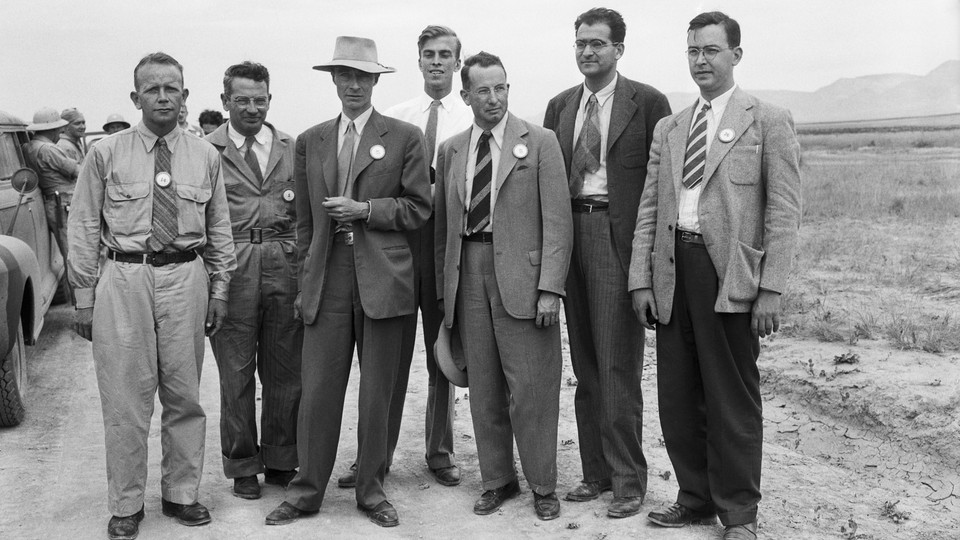
On a recent day in late June, a warm day under clear, deep-blue skies, the city of Los Alamos, New Mexico, “The Atomic City,” hung its banners out. Red, white, and blue, blown by the high mesa wind, they waved across Trinity Avenue, the city’s main thoroughfare, named tor the site of the first atomic explosion, the site most of us call Alamagordo; they waved at the east gate, where a Mexican restaurant now occupies the gatehouse that formerly controlled the secret comings and goings of famous men; they waved from the county municipal building that has replaced with stylish glass and stone the jerry-built, pale-green barracks of Main Tech, where the bomb was dreamed and designed. Thirty years after the beginning of the Atomic Age, thirty years after a few thousand men and women, working in secrecy against a deadline they measured not in dollars but in lives, changed the history of the world, Los Alamos was welcoming what the banners called its “veterans and pioneers” home for reunion.
The 30th Reunion of Los Alamos Veterans and Pioneers received little national attention. The President of the United States wasn’t there, nor the Secretary of Defense, nor even New Mexico’s two senators, though both wired messages of congratulations. The Canadian Broadcasting Corporation and the BBC sent commentators and camera crews, but ABC, NBC, and CBS passed the occasion by. Veterans and pioneers came anyway, nearly a thousand of them, cooks and scientists, MPs and lab technicians and engineers, men and women who remembered their years at Los Alamos as the most significant years of their lives and wanted to recall them again.
To the politicians and media who stayed away, the reunion must have seemed as private a celebration of nostalgia and longevity as a local assembly of the Veterans of Foreign Wars, but it was much more. At Los Alamos in late June of 1975, not for the first time but possibly for the last, the men and women of World War II laid markers on the grave of a more heroic age. In that spirit of innocence, or in Disneyesque imitation, Los Alamos was named a National Bicentennial Community, a distinction it shares with the early cities of the American Revolution. Like the Declaration of Independence and the Liberty Bell, the atomic bomb thus took its place as a patriotic artifact.
The bomb that shriveled the scorpions and tarantulas on New Mexico’s Journada del Muerto— the desert of the conquistadores’ “Journey of Death”; the bomb that vaporized the 100-foot steel tower at Trinity site, the site that J. Robert Oppenheimer named in allusion to one of John Donne’s holy sonnets, in the hope that upon it the three-personed God would batter our hearts free of the evil of war; the bomb that, in his ignorance, a rancher on the other side of the mountains took to be an early and extra and miraculous dawn, was a crude, primitive machine. Fat Man, it was called. It contained two hemispheres of plutonium surrounded by shaped charges of high explosive. Its joints were firmed with Kleenex and its charges tightened with Scotch tape. It weighed, in its spherical steel casing, 10,000 pounds, but only one gram of its eighty-four pounds of plutonium completely fissioned to produce its nuclear explosion; one gram, m, times the square of the speed of light, c2, equals E, 20,000 tons of TNT equivalent. So a few grams of heavy metal marked the end of a long and destructive war. We live in a time, Sϕren Kierkegaard wrote in Either/Or, when the smallest causes produce the most immense effects, and large causes produce hardly any effect at all.
Those who count the atomic casualties and forget the dead of Normandy and Bataan, of Bergen-Belsen and Guadalcanal, count by a system different from that of the people of the reunion. The people of the reunion count back, not forward; for them, the outcome of their three years of work was an end, not a beginning, which is why they could gather in good conscience to commemorate it. “I think it’s grotesque,” said the CBC’s Mike Maclear of the reunion, and to the extent that the people gathered there had the blood of Hiroshima and Nagasaki on their hands, it was, but they didn’t see it that way, and perhaps they had reason.
“It was a war,” said the widow of a veteran, “that you took personally, because you had brothers or a husband or friends who were off fighting it, risking their lives.” It was also a war gone fetid with the stink and the fear of death, a war of death marches and final solutions, of black headlines in the morning paper and gold stars in the windows down the block, of seemingly endless lines of Panzers and of Japanese soldiers who preferred, rather than surrender, to fold themselves over grenades. “Soon after firing ceases,”a Japanese wrote before a banzai charge on the Aleutians in 1943, “birds are singing and flving around about the quiet and frozen ground. I will become a deity with a smile in this heavy fog. I am only waiting for the day of death.” After three years of such a war, the atomic bomb seemed to those who devised it not a weapon of doomsday, but a weapon of deliverance. That it would burden mankind with the knowledge of the possibility of its annihilation they can be forgiven for not having known. Only a few seem to have been granted that vision before the fact, the subtle and melancholy Oppenheimer first among them: he named the test site Trinity as a code, so that we would know he knew.
The veterans and pioneers of the 30th Reunion remembered, as they gathered together again, another war. “You hear a lot of talk about World War II as a kind of holy war,” said one of the most perspicacious among them, “but you know, most of us, most Americans, had spent the previous ten years, the Depression, bored out of our minds, and one of the things the war was was something to do.” That statement was the most candid, or perhaps the most realistic, I heard; the people I talked to at the reunion were unanimous in their evaluation of their war work: it was necessary, they said, and important, and good. If we hadn’t built the bomb, they said, the Germans would have. “We only did our duty,” one man, an engineer, told me, echoing them all.
Some people attend reunions, others stay away. Few of the men whom Los Alamos made famous attended the reunion. Many were dead—Oppenheimer, his ashes scattered on the ocean east of the Virgin Islands; Enrico Fermi, a cancer victim; Louis Slotin, the first to go, killed in a radiation accident in 1946—but most of those still living had long ago left their Los Alamos years behind. Edward Teller, out in California, announced his retirement a fewweeks after the reunion, but he had left Los Alamos decades before to found his own weapons laboratory under government sponsorship at Livermore, east of Berkeley, over the hills; embittered, some say, at Oppenheimer’s stand against the development of the hydrogen bomb of which Teller was the leading theoretician, convinced that the workers at Los Alamos were dragging their feet.
It was the hydrogen bomb more than the atomic bomb that had divided the men who worked in such enthusiastic concert during the years of the Manhattan Project. Before President Harry Truman announced the decision to go ahead with its development in 1950, twelve leading scientists, including a number of Los Alamos men, had issued a declaration against such a terrible weapon: “This bomb is no longer a weapon of war,” the declaration had said, “but a means of extermination of whole populations.”
Prominent among the names on the declaration was that of Hans Bethe, the physicist who had been responsible for the design of Fat Man’s plutonium core. Bethe visited Los Alamos during the days of the reunion, but he attended few of the ceremonies. “It was disturbing to see the atomic bomb celebrated quite so patriotically,” he told me. “Even during the war, I would say the majority of us had regrets. We felt we would be much happier if this had not succeeded, if we could have proved it could not be done. But I no longer have any regrets, because there was a chance that the Germans could do it. They were actually ahead of us in the early years of the war, and then they lost their lead through mismanagement. So our fear was justified. Fission, after all, is a force of nature.”After his initial hesitation, Bethe found similar reasons for working on the hydrogen bomb. “I originally decided not to work on thermonuclear weapons,” he says today. “The main point that made me change my mind was Teller’s discovery of a method that could make it work. I realized that if we could do so, then the Russians could do so. and I didn’t like that.”
One sensed, among the people of the reunion, their feeling of survivorship, the common coin of reunions, but behind that, one sensed their feeling of privilege, privilege not only to have participated in one of history’s most significant events, but also, by doing so, to have been spared more direct contact with the ravages of war. They did not fight on the front lines of World War II; they fought on a mountain-surrounded mesa of the high New Mexican desert, the alpenglow putting on a show every night as it turned the Sangre de Cristo Mountains, across the Rio Grande Valley to the east, the blood-red of their Spanish name, “Blood of Christ”; the snow a fine powder through the cold winter days on their homemade ski run, Sawyer Hill; steak one night a week at Fuller Lodge and first-run movies at the two theaters that doubled as halls for square dancing and chapels for Sunday morning worship. The siren, “Oppie’s whistle,” sounded six mornings a week at 7 A.M., and they worked long, hard days, but there were weekend excursions with extra gasoline coupons that General Leslie R. Groves, who commanded the Manhattan Project, insisted be set aside for them. When Oppenheimer traveled the United States in late 1942 to recruit the country’s best young scientists, he told them the war would end the day their work was done: they came to the dusty mesa of Los Alamos, where the Corps of Engineers was still hammering up its rickety labs and apartments, with that high a sense of purpose. Physicists before World War II were as undervalued and poorly financed as astronomers are today, and built their experiments out of home-soldered copper tubing and sealing wax; at Los Alamos they would have the best that money could buy, as befitted the importance of their work. So also would those who supported them.
The MPs at the Trinity base camp might prove their isolation by winning the Army’s award in 1945 for the lowest VD rate of any company in the world; the secret city on the mesa might carry on its activities surrounded by cyclone fences and barbed wire; but live the men and women did, dating and dancing, marrying, producing so many babies that Groves asked Oppenheimer to call a halt (a responsibility that the mesa’s scientific director wryly declined), riding horses up the Jemez Mountains to the broad meadows of the Valle Grande, the volcanic caldera below which Los Alamos was built and the largest extinct volcano in the world, fishing, hiking, working out their tensions in tennis and baseball and football and volleyball and soccer games. And partying, drinking whiskey brought up on booze runs from Santa Fe and the Army’s Greisedick beer, the bachelors invading the WAC quarters, the married couples taking turns at progressive dinners while Edward Teller sat in the corner reading to the children from Alice in Wonderland and Klaus Fuchs did his somber best at “Murder” and charades.
The water supply was never adequate, and toward the end they brushed their teeth with CocaCola; the coal furnaces filled the apartments and the barracks with soot; a polio scare temporarily closed the schools and frightened the mothers, who wondered if they would be allowed to take their children and leave if an epidemic broke out; their mail was censored; they could not visit relatives, nor could their children away at school visit them; but the difficulties only keened their appreciation of the privileges, and many of them came away saying that the Los Alamos years had been the best years of their lives.
“There’s old Greasy Groves,” said a veteran at the slide show the reunion committee had put together, and in a dozen scenes of wartime far behind the lines, General Groves clicked past, the man who built the Pentagon, the man who shepherded the building of the bomb. And Oppenheimer, looking boyish and almost cachectically thin, looking not at all like the fiercely tragic figure he would later become, and Norris Bradbury, who became the Lab’s postwar director, who guided it through the years of nuclear buildup and who was that day in Washington, unable to attend the show. And GIs posed together in groups, draped over jeeps or grinning together in civvies on leave in Albuquerque in 1945, and WACs in hairstyles that made the women laugh, and physicist I. I. Rabi, “the rainmaker from Hoboken,” conferring with Ernest Lawrence, the inventor of the cyclotron, and Enrico Fermi in his ubiquitous windbreaker; but nowhere in the slide show was there a photograph of the bomb. The Army’s grocery store, where wilted lettuce was shipped from Texas when it might have come up fresh from the truck gardens in the valley below; the drugstore where, over chocolate sodas, dates were arranged; but not the black desert tower and not the bomb. The unctuously cheerful narrator, a voice on a reel of tape, chattered on— “Hey, guys, remember this? Whooee, didn’t we have fun?” but failed to mention the purpose for which the fun was compensation and from which the fun was relief, and perhaps it is asking too much that he should have. The bomb that the veterans and pioneers of Los Alamos built is today an antique; the Lab moved on long ago to other work.
George Kistiakowsky, who was responsible for Fat Man’s revolutionary implosion mechanism—the shaped charges of high explosive that squeezed its plutonium to critical mass-and who later became Lyndon Johnson’s chief science adviser, remembers being surprised by the development of Los Alamos after the war. “I didn’t go eagerly to Los Alamos,”he says. “I went hesitantly, because I didn’t think the work could be finished in time. But I had no moral scruples then, because we were at war, and anything that could shorten the war made sense. I knew the implosion mechanism would work, but I was less confident of the nuclear reaction. That’s why I stood on top of the control bunker when the Trinity bomb went off, which wasn’t a very wise thing to have done. I regretted very much our dropping the bomb, but I was very influenced by Naval Intelligence estimates that the Japanese would light on for six months or more and that invasion would be necessary. I know now that wasn’t so, that Intelligence had argued the worst possible case. We shouldn’t have dropped the bomb over populated centers.
“I didn’t anticipate nuclear proliferation,” Kistiakowsky recalls, “partly because I didn’t believe that nuclear power reactors would ever be economically feasible. I thought they were something exotic. I declined involvement in the thermonuclear. Disillusionment had set in by then. I don’t trust statesmen, specifically including Kissinger, to have good judgment. The arms race horrifies me. With tens of thousands of nukes in our hands, in Soviet hands, and in other hands, miscalculation or accident is practically certain to happen. Let me remind you of the worldwide alert in 1973 that Schlesinger and Kissinger cooked up on the flimsiest of evidence.”
I’ve talked to many of the Lab’s leaders during my visits there. Two of them—Norris Bradbury, now retired, and Louis Rosen, a graduate student during the war who worked on implosion and is now the director of the Los Alamos Meson Physics Laboratory—have described the changing fortunes of Los Alamos to me.
“When I took over as director,” Bradbury says, “the place was certainly in disarray. After all, there was a certain amount of argument that the place should be abandoned. Crimes against humanity. Even then the argument was going around that this should not have been done and Los Alamos should be left as a monument to man’s inhumanity to man. They were difficult times. Science was in the ascendancy. Lots of people here hadn’t finished their formal education. We were losing our senior staff, and there were a great many people just standing around waiting for the best job offer from somewhere else. Nobody was being mean, they were just being human.
“One has to be very proud,” Bradbury continues. “Things that seemed quite impossible in 1945 had become very possible by 1950. The success of the hydrogen bomb itself was a major triumph. Getting that thing from whatever it was, twentyone tons, down to some usable device was an occupation of the next half-dozen years, which people carried out with enormous dedication. We added other fields to weapons research. We managed to have a laboratory that earned for itself the reputation of a major scientific installation. The nuclear physics that was done here was as well done as it was anywhere. The nuclear chemistry was beautiful. The publication record of the laboratory is, I think, extraordinary.
“I would hope that someday the whole world would get out of weapons research,”Bradbury concluded. “I’m surprised that it’s gone on so long. thirty years, and nothing’s happened. Thank God. I felt very strongly and still feel very strongly that the weapons business has to go on until we find something better. I don’t know that today you’re getting the same technical results for your dollar that you were getting in 1943-1944, when we changed the whole course of history for a relatively few million dollars. You certainly did something like that in ‘51 and '52. You’ve not done anything like that in the last twenty years. And of course you’ve got enough. The emphasis is much more on the improving of systems. Delivery systems. But eventually the world has got to get out of it.”
Louis Rosen sheds light on the question of how Bradbury turned Los Alamos from a war project to a permanent installation. “After the war.” he says, “this place started to fold, to fall apart. Fortunately, Bradbury reversed the downhill trend on the rationale that this war’s over, but things are not calm in the world by a long shot, and we could all see, looming on the horizon, a tremendous confrontation between the two political ideologies in the world. It became obvious that the USSR had embarked on a tremendous effort to develop thermonuclear weapons. Well, we’d done some of that during the war, and when it became obvious that they were actively pursuing it, quite a few of us became concerned that we not be placed in a situation where we could be blackmailed. Now, we were in a position where we could have blackmailed anybody, but it was not in our moral code to do so. We were not at all sure that it was not within the moral code of other nations, had they been and were they to get into our position, to do what we felt we should not. And so we began a rather intensive effort to see whether it was possible to produce weaponry using the fusion reaction rather than the fission reaction.”
Rosen implies that even fusion weapons, hydrogen weapons, are developed today to the point where they are more a matter of engineering than of physics. “More recently,” he says, “we began to think and talk about evolving beyond the weapons work. We felt that if we wanted to serve society, we’d better start paying some attention to things other than nuclear weapons. Because we were getting into a very powerful position as far as weapons were concerned. Hardly anybody in their right mind would dare to risk the destruction that would befall them if they fell upon us. And so, in the decade between the sixties and the seventies, were born many other initiatives. The Meson Physics Laboratory, the nuclear rocket program, the controlled thermonuclear fusion program, the hightemperature reactors, the program for geothermal energy. I think in some respects, that was the golden era of conception. The golden era of accomplishment we haven’t achieved yet.” Rosen is largely out of weapons work today, and has been for a decade or more, but the Lab is not.
The work of unlocking nature to create categorically new weapons of war came to an end long ago; in a sense, the veterans and pioneers at their 30th Reunion, men and women of middle and late-middle age, were gathered to memorialize that end and to celebrate their part in it. More precisely, the work of unlocking nature came to an end sometime after 1952, after the United States exploded the first hydrogen bomb at Eniwetok and subsequently learned how to build a “dry” hydrogen bomb to replace the twenty-one-ton monstrosity, complete with its own cryogenic cooling system, that so frightened the Eniwetok observers that Norris Bradbury considered keeping its explosive yield a secret from the very scientists who had designed it. The test of Mike I at Eniwetok was reminiscent, in the surprise of its violence, of the test at Trinity. In both cases, as if protectively, the scientists who built the weapons underestimated their destructive force. Oppenheimer thought Fat Man would yield only 3000 tons of TNT equivalent, and Bradbury thought Mike I would yield a million tons, and both men were wrong by an order of magnitude: Fat Man yielded nearly 20,000, and Mike I more than 10 million. Men who observed both tests expressed their sense of terror in identical words: “I thought the fireball would never stop expanding,” one of them said on each occasion. “I thought it would keep on going until it destroyed the world.”
The effort that has continued since those early days has been a work more of refinement than of breakthrough. New bombs are still being designed, but they are new adaptations, not new types. At the Sandia Atomic Museum in Albuquerque, a place few Americans bother to visit and a display as chilling as anything offered at Madame Tussaud’s, one can see the subtleties of packaging our designers have achieved. The two original bombs, Fat Man and Little Boy, are dwarfed by the first hydrogen weapon, a bomb nearly as big as a railroad tank car, painted a dark, gloomy green. One walks down a row of atomic and hydrogen bomb casings watching them magically shrink in size and diversify in purpose, first bombs only slightly smaller than the behemoth hydrogen weapon of 1952, then the much smaller “dry” bombs, their shapes increasingly aerodynamic, then rockets, torpedoes, anti-aircraft missiles, modest cannon shells.
The later bombs are painted white; they look almost cheerful. There is even, in a case the size of a steamer trunk, a device intended for military demolition rather than military slaughter; it can be carried by two men, and would fit in the back of a jeep. Theodore B. Taylor, the former bomb designer whom John McPhee chronicled in his book The Curve of Binding Energy, once designed a bomb, never built, that would have weighed only twenty pounds, far less than even the plutonium core of Fat Man. Pointedly, the Sandia display is not duplicated at Los Alamos; the science museum there devotes most of its rooms to demonstrations of safety systems and the peaceful uses of the atom.
We hardly need new breakthroughs in weaponry, and today the design of delivery systems takes precedence over basic research. Today our designers of war, or forestallers of war, work to increase the accuracy of our delivery systems, accuracy of delivery allowing, as it does, for weapons of smaller yield, weapons more portable and harder to track.
The latest of their visions, revealed recently by Secretary of Defense James Schlesinger, is the cruise missile, a device no larger than an ordinary torpedo, which can travel 2500 miles and find its target within an accuracy of thirty feet. Hans Bethe, for one, finds the cruise missile disturbing: “We don’t need it. We have plenty of weapons as it is, and the idea of a far more accurate missile is very alarming, because it destroys our land-based missiles as a deterrent.” Nevertheless, the cruise missile could be, and probably will be, deployed throughout the world by 1980. It will confirm to certainty that ours is an age of missiles more than a nuclear age, because to control the proliferation of cruise missiles, we will have to negotiate new treaties, not banning atmospheric or underground nuclear testing those treaties are already at hand— but limiting or banning the testing of missiles, a proposal that George Kistiakowsky, among others, made several years ago. “The arms race,” Kistiakowsky says, “cannot even be slowed down without restrictions on research and development, specifically restrictions on the field testing of missiles. All missile firings should be reduced by a gradual, programmed reduction over the next five years or so, reduced to a minimum consistent with maintaining existing systems. That will take out the most dangerous element of the arms race, the fear of the unknown, the fear of what the other guy’s going to do.” But the nuclear nations have not yet even begun examining such a proposal. When they do, the SALT talks will have to begin all over again.
A Yankee people first and last, we celebrate breakthroughs more than sophistications, and the increasing sophistication of our missile systems is a change in the fortunes of war that we have largely overlooked, dangerous and threatening though it has now become. How to keep those missiles out of the air is the central problem of the last quarter of the twentieth century, as certainly as unlocking and then restraining the destructive force of the atom has been the central problem of the middle half of the twentieth century. It is as if, confronted by the truly irrational, confronted by the power to use forces of nature so destructive that they can hardly be imagined, we have concluded that the only way to control them is to shape them to as many diverse purposes as we can conceive, seeming thereby to give them order and organization. So we confine the irrational, keep the fear at bay, by rationalizing; these are not what they seem, much thought has been given to their purpose and their design, these are merely more efficient weapons, these are merely counters we reserve in the game of international affairs, and because we have them we will never have to use them.
But they are what they seem, our tens of thousands of nuclear weapons, for all their increasing sophistication, as the men and women of Los Alamos who built the first crude models knew. They are fire and death and the end of the human world, and they brood in their dark silos and tubes and racks and bays in a silence so shrill it has almost deafened us. Unless momentarily roused by crisis or threatening alert, who among us thinks of nuclear war any more? The bomb shelters are dismantled, the survival biscuits shipped off to feed starving Africans, and even at Los Alamos the civil defense signs have been taken down. No people can live eternally threatened by doom, but whether we think about it or not. we still feel the threat, down at the bottom of our nightmares, and in subtle ways it has changed us. We are not the same people we were in 1944; we cherish less hope for the future; our patriotism sours; at times of tragedy and in times of conflict our mouths go dry, because we have fashioned at last the means of our suicide, and having fashioned them, must look at the wicked things there on the table before us, must remember the thoughts we have thought about them and the fears we have felt, forevermore. “I am become Death, the Shatterer of worlds.” Oppenheimer thought he heard Fat Man say; now death is everywhere, death is manufactured in quantity and shipped around the earth. Somewhere in a museum is preserved a sealed jar that, legend has it, contains a portion of the original darkness that Jehovah visited as a plague upon Egypt to force the freeing of the Israelites. The jar cannot be opened, or the darkness would escape. In each of our nuclear weapons, similarly sealed, is a portion of death itself. Style them as we may, rationalize them as we will, we only seem to forget: we know, and never forget.
The veterans and pioneers of Los Alamos met, the second day of their reunion, for a barbecue at the city’s Knights of Columbus Hall, and drank Coors beer and talked of old times. Then, at seven in the evening, the sun still shining over the Jemez Mountains to the west, they walked in couples and small groups to the green park around Ashley Pond, the pond that the masters of the prep school that originally occupied the mesa had comically named for the school’s founder, a man named Ashley Pond. The pond is completely walled with masonry now, another historical artifact, and through the evening’s ceremonies ducks worked its waters, chasing down popcorn that the children threw in. Above the pond, on the plaza before the community building, a band made up of Los Alamos students began a medley of patriotic tunes, faltered, and then struck up with enthusiasm “The Way We Were,”Hollywood’s nostalgic tribute to World War II.
The people of the reunion settled on the lawn on cushions and blankets, some of them dressed casually in pantsuits, slacks. Hawaiian shirts, some of them dressed in suits and floor-length gowns for the dance that would follow the evening program.
I heard the group seated nearest me talking of retirement. People still sought each other out, waiting for the program to begin; they shook hands and tilled in the missing years. There had been bus tours of Los Alamos during the day, and they spoke to each other of buildings torn down and events now become history. It should not seem curious that most of them remembered the scientists with whom they worked as celebrities more than as men, celebrities with interesting quirks and possessed of great authority: they were as susceptible to the postwar fame of Los Alamos, across the gulf of thirty years, as the rest of us have been. The price of meat and the ordeals of flower gardening occupied them more than the consequences of their war work, as they occupy us all. Even living, we forget what Lionel Trilling once called “the great hum and buzz of implication” that surrounds our lives.
A team of teen-aged boys played basketball against the side of the community building. Several hundred resident Los Alamos families had turned out for the program; they sat with their young children on the north side of the pond, the reunion people on the south. Civil Air Patrol students kept the sidewalk that circled the pond clear. Three hawks soared overhead on their last hunt of the day; the children ran lithe and healthy through the grass; the band played “God Bless America”; and then a costumed trio, the patriots of the American Revolution with fife and drum and flag and bloodied bandages, marched around Ashley Pond, cutting across the lawn to pass between the comfortable groupings of people, and as the thirteen-star flag went by, a number of the reunion men almost involuntarily stood to attention, still remembering that reflex from three years of war thirty years ago. “The contributions made by our community to the nation are considerable,” said the chairman of the county council. The understatement seemed both ironic and extreme.
The Lieutenant Governor of New Mexico presented the city with a state flag, and he had hardly begun to speak when one of the boys on the basketball court set off a powerful firecracker that startled and even frightened the crowd. The police chased the boys off, and after that the Lieutenant Governor spoke to silence. He talked about the privilege of freedom and the work we would have to do in the future to keep that privilege. “In my own opinion,” he said, “I think that our enemies are doing everything they can, day and night, to destroy our system of government.” It was remarkable to hear Cold War rhetoric tit Los Alamos, where most are liberal in politics despite the military nature of their chosen work.
At fourteen minutes before eight the sun touched a peak of the Jemez Mountains and the air began to chill, but by then Los Alamos had been presented with three flags, and the Boy Scouts of Los Alamos raised them on their flagpole in front of the municipal building while we stood and sang, timidly, the national anthem.
By such ceremonies Los Alamos became a National Bicentennial Community, although before April of 1943 it did not even exist. The regional director of the Bicentennial Administration said the Bicentennial was “giving Americans a chance to take a new look at America, to look at the things that have made us grow to the strongest, most powerful, most envied nation in the world.” He didn’t say he meant the bomb—centrally important though it has been, when we are being spiritual we don’t mention our nuclear arms but what else could he have meant in that city on that day? And playing on the sidewalk in front of me I saw a small blond boy, slim and tanned, wearing a Tshirt with the words “Endangered Species” printed across the front.
The reunion program that followed was perfunctory. The air turned cold and people drifted away to their cars and their homes. Harold Agnew, the third and present director of the Lab, a hardline weapons man, talked about improvements he hoped to make, but the most he came up with was a meeting place for visiting scientists that would have to be built with contributed funds, whereupon he proceeded to ask for contributions. Agnew also said that the Lab was supported today 55 percent by nondefense spending and only 45 percent by defense spending, implying that Los Alamos is getting out of the weapons business; and in a sense it is, but only because it and the other weapons labs have already polished off most or all of the weapons we presently believe we need.
Los Alamos is not what it was, is no longer what Oppenheimer called “the finest laboratory in the world.” “Los Alamos,” says Kistiakowsky contemptuously, “is a rather pathetic, isolated community, a strange never-never land.” Nobel prizewinners, though they visit it from time to time as consultants, choose not to live and work there, nor are they needed there anymore. The labs have been moved from Los Alamos mesa to mesas farther south, the better to guard them, and by a transformation so commonplace in the United States as to seem almost banal, the town has become a typical American community, with band concerts and patriotic speeches and songs—as typical, at least, as a community of weapons designers and scientists can be.
But during its days of reunion, when the people who made its name feared throughout the world returned to remember the living they had done, Los Alamos was recalled to what it had been, the American prelude to Hiroshima. The two cities, Los Alamos and Hiroshima, exemplify the extremes of the Atomic Age, extremes of brilliant technology on the one hand and terrible suffering on the other. Significantly, both peoples believe themselves chosen, chosen to bring a message of the brute necessity of peace to the world.