The Battle for Long Island
Suburban development has sprawled inexorably across the face of Long Island for decades. Now a new farmland preservation program offers hope for the vanishing seaside fields—and a model for rural areas elsewhere.
THE Atlantic FOUNDED IN 1857
The local Indians, who were of the Delaware Nation, called Long Island “Paumanok”: “the island with its breast long drawn out and laid against the sea.” A fish-shaped finger of land, 118 miles long, nowhere more than twentythree miles wide, it stretches eastward and seaward from Manhattan, its neighbor to the west. Accounts left by early Dutch and English settlers mention mirror lakes and tulip trees with girths of thirty feet in the island’s forests. They speak of marvelous oysters more than a foot long in its extensive bays and estuaries. Henry Hudson, who went ashore on Long Island in 1609, landing at the spot now known as Coney Island, wrote, “It is the finest land for cultivation that ever in my life I have trod.” Naturally, over the centuries, settlers made great inroads on this enticing piece of real estate. But development on a grand scale began fairly recently. The western counties of Queens and Brooklyn urbanized early, becoming extensions of New York City, but in 1920 the combined population of Nassau and Suffolk, the eastern counties which contain most of the island’s acreage, was only 230,000. By 1970 it was 2.5 million, 1.3 percent of the entire country’s population, and the figure was still rising.
Between the grim cities of the western end and what remains of Long Island’s countryside, there is now a stretch of suburbia about fifty miles long, a land of low-roofed factories, open sandpits, and vast tracts of single-family houses laid out as if on graph paper. A few of the old, absurdly elegant Long Island estates have survived and there are wooded, fashionable residential areas within twenty miles of New York City. But in the middleand lower-income areas, taxes are high and amenities scarce. There are parks but little open space elsewhere, and unplanned development has not only begun to endanger the supply of naturally sweet drinking water in some densely settled regions, but it has also spoiled bays and inlets, gobbled up wetlands, and closed many of the lakes and ponds to swimming. Towns have grown amorphous and the best that many of them have to offer in the way of cultural centers are asphalt shopping mails. The automobile reigns. A superhighway, the Long Island Expressway, traverses the region. Heading east on it from Manhattan one day in the spring of 1976, I notice the road is sporting a new concrete median divider. Already there are scrape marks and even tire tracks on the wall’s vertical face. Traffic, as always, is heavy. I drive with both hands on the wheel. It is a couple of hours’ drive to what is left of the country.
I grew up in the 1950s on a part of Long Island that was still bucolic but in the throes of rapid change. I remember running through a woods near home with my older brother and a neighborhood pal, crashing through the leaves, ripping down the ribbons that surveyors had tied to the dogwood trees. We did it mostly for fun, but also with a dim sense of purpose. We were entertaining the selfish, futile hope that our homes would be the last ones built in the area. We were exhibiting symptoms of what is known as “the last house syndrome.” Of course the surveyors and the builders prevailed. Twenty years later, they still do.
Last year I moved back to Long Island, to a spot just beyond the leading edge of development, forty miles from where I grew up. A quarter-mile down the road there are some large potato fields which are being rezoned for light industry. Across the street from my house there is a dense piney woods owned by a local contractor.
The woods hadn’t been touched when I moved in. But one morning a couple of months ago, when I was sitting at my desk, I heard my wife downstairs, saying, “Uh-oh. He’s going to knock down the trees.” A young man had driven up in a truck, towing a flathed trailer with a yellow bulldozer perched on it. He had parked on the side of the road near our driveway, climbed into the bulldozer, and set off toward the woods across the street. Snorting and butting into things the way they do, bulldozers remind me of pictures of aroused rhinoceroses. We watched from the front door, awed by the fact that a lone man with a truck and bulldozer could make such swift progress in the woods. He appeared to be cutting an access road. Every so often the machine would hit a snag, retreat a little, seem to paw the ground, and then charge in again. The pine trees gave. Soon he was out of sight. When the bulldozer re-emerged about half an hour later, the young man put it back on the trailer and loafed a few minutes, drinking a beer in the cab of the truck. Then he tossed the beer can out the window onto our driveway and took off.
Old Long Island, the island I had a passing glimpse of as a boy, is shrinking into the far eastern corner of Suffolk County. This region, known as the East End, consists of the town of Riverhead, which looks as if it were in Iowa, and of the island’s easternmost extremities, the North and South Forks. There are motels, fast food restaurants, and trailer parks out here, but the atmosphere is rustic. Old farmhouses attached to potato fields, greenhouses, roadside fruit and vegetable stalls dominate the scenery. But the bulldozers approach.
Once there were three hundred thousand acres of prime farmland on Long Island. Virtually all that remains of it are Suffolk County’s fifty-five thousand acres of cultivated fields, most of which lie in the East End, not all of which are prime. The East End fields are a sort of last preserve. Farm tractors inch across them. But more than half the land does not belong to the men out plowing in the spring of 1976: about 10 percent of Suffolk’s cropland belongs to retired farmers, and 46 percent has already fallen into the hands of speculators, who did not buy the fields for raising crops.
On the East End of Long Island an acre of farmland is worth about $2000 when it is used for growing potatoes, but speculators, with visions of houses, shopping centers, and gas stations replacing the crops, will pay roughly $6000 an acre. This disparity between the agricultural and the development, or full market, value of the land exists wherever farms sit in the paths of expanding suburbs, and the disparity creates important tax problems for the farmer. Local property taxes are often based on the farmland’s full market value. Federal inheritance taxes are similarly calculated, although the 1976 tax reform bill provides relief in certain cases. Taxes alone have driven many farmers or their heirs to the nearest real estate office. The farmland is sold to the highest bidder, and on Long Island that has usually meant a developer. At the same time, the high development values represent a great temptation for the farmer. If a man owns one hundred acres of East End cropland and sells it to a developer, he finds himself well on the way to becoming a millionaire. And farmers need other farmers for neighbors; when one cashes in his land, the temptation increases for those who remain.
For decades there has been no stopping the march of suburbia across cultivated fields, not on Long Island nor in the dozens of other suburbanizing regions of the United States. Traditional and even rather newfangled methods of controlling land use haven’t halted the process. But in 1976 Suffolk County came up with a farmland preservation program that attacks the fundamental cause of attrition.
In the United States a number of distinct rights go with the ownership of land, among them the right to subdivide one’s property and build things on it. Under Suffolk’s program, which has been in the planning since 1972, the county would pay farmland owners the difference between their land’s agricultural value and its development value. The land would remain with the private owners, who would have the right to farm it. But the right to develop the land would be surrendered forever. In theory, speculators who own farmland and decide to sell development rights to the county would have no further use for their farm property and would be anxious to sell their holdings back to farmers. The farmers would be eager to buy the cropland, which would then be priced and taxed only at its agricultural value.
According to the plan, the county would spend some $55 million, not including financing costs, to purchase the development rights to about twelve thousand acres of good East End farm property. Some of the other land would probably be lost no matter what the county did. But the program would give East End towns and farmers an incentive to work on saving some of the prime land not included in the program. At best, twenty or maybe even thirty thousand acres would be preserved. At the very worst, ten thousand acres of open, fertile East End fields would lie fallow, available, never to be subdivided or paved.
About half the acres involved in the preservation program belong to speculators, but working farmers own many of the choicest parcels. Take for instance the cropland around the little town of Water Mill, out east on the South Fork. I drove there to visit a farmer named Tom Halsey one day last March, a couple of months before the county legislature was going to vote on the plan for the first time.
South Fork towns, especially the Hamptons, are famous watering spots for affluent New Yorkers; local folks like to say that the summer residents own “most of the money in the western world.” And like the Hamptons, Water Mill has a slightly precious air about it. But I am partial to the old restored windmill that sits on the village green.
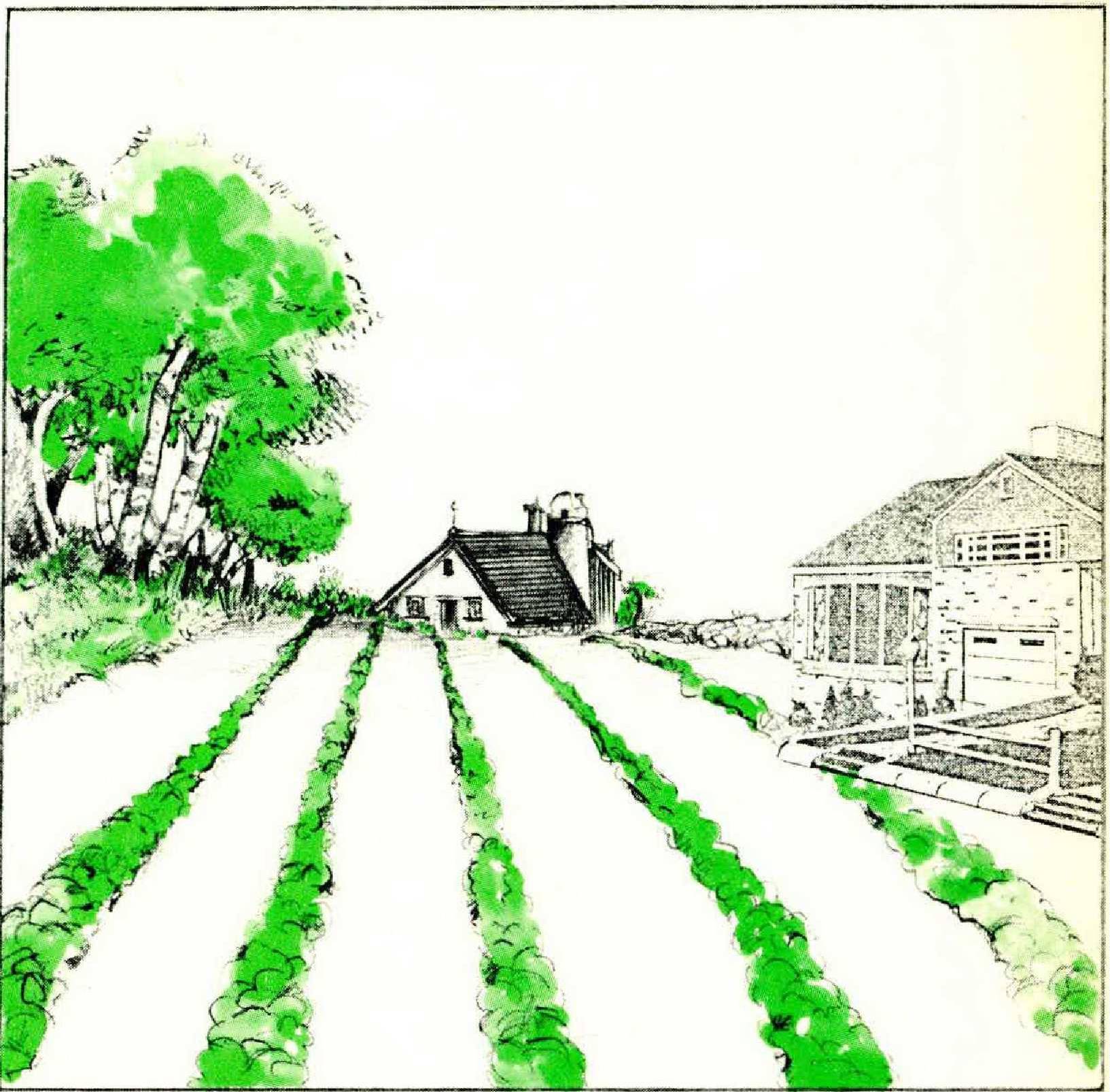
Just outside the town, off Montauk Highway, a narrow road leads north, winding past a cluster of barns, some new ranch houses, elderly farmhouses, past a pond fringed with willows. Then the road straightens and on either hand lie spacious fields. In the distance stands a line of hills and woods, which mark the place where the last Ice Age glacier started to melt. The glacier left a fertile outwash plain and Halsey’s farm lies on it, just up from the pond, on the east side of the road. His place consists of a gray, shingled farmhouse, a couple of barns, and, a few hundred yards down the road, a long building like a warehouse known as a potato storage. There is no barnyard clutter, no peeling paint on the Halsey farm. Out front is a manicured lawn, and out back fifty acres which the family has been working since before the Revolutionary War.
It was drizzling and cold when I drove up, a day unfit for plowing, and I found Halsey inside his potato storage. Michigan-grown seed potatoes were clunking out the back of a dump truck into the Dilts-Wetzel machine, which was cutting the potatoes into pieces suitable for sowing. Tom and his brother and the hired man were standing at the end of the conveyor belt, armed with knives, slicing up whatever expensive brown tubers the machine happened to miss. Halsey was discoursing meanwhile on reproduction in potatoes, to the amusement of his brother, who muttered now and then about “college educations.” Halsey studied at Cornell. He is short, has ruddy cheeks, and the ski cap he was wearing gave him an elfin look. He put down his potato knife and took me and his Labrador, Smudge, for a sightseeing trip in his pickup, over the back roads of Water Mill. Smudge whined when I sat down beside him, and, smiling, Halsey said, referring to me, “You don’t like the smell of this city boy, do you, Smudge? Just be patient, Smudge. I’ll get you your doughnut.”
Halsey had been the farmers’ spokesman for the preservation program, and as he drove slowly past his neighbors’ fields he rehearsed some of the arguments. He mentioned the various studies which show that the typical suburban housing development ends up raising taxes in the community; new revenues don’t equal the costs of the services the new settlers require. Farms, on the other hand, provide tax revenues and require very few services. “Farms send virtually no children to school, my friend,” was how another farmer had put it. Halseypointed out that farming is a valuable industry in Suffolk County, producing about $80 million worth of crops a year. He also felt that it was mainly the farms that kept the area attractive to refugees from August in the city. So farming helps protect the East End’s other lucrative industry, which is tourism. Moreover, farms use only a small amount of the rain that falls on them. They generate little sewage. In the long run, keeping them around could prove an inexpensive way of protecting the East End’s fragile underground water supply.
But certainly there were things to dislike about the farmland scheme, in particular the distribution of benefits. West End towns would pay most of the cost, while East End towns would get most of the spoils. Although all East Enders stand to gain and they are not in general wealthy (incomes in eastern Suffolk fall below the county average), the individuals who would reap the largest benefits from this publicly financed project are rich: the summer folk with large estates, and the land speculators, who were hit hard by the recession and are eager to sell their farm properties. They might not be so willing when the construction industry revives, so this is a good time to buy them out, and of course the whole point of buying development rights is to get farms out of the speculators’ reach. But the fact remains that public money would be going to the rescue of these wheeler-dealers.
Then there are the farmers. “Farming hasn’t been a terribly bad livelihood around here in the past twenty-five years,” said Halsey. “If you look at the houses . . .” Through the windshield, his neighbors’ houses looked like his, well-kept, even elegant. There is no mistaking East End farmers for downtrodden sharecroppers. Halsey, for instance, is president of the Southampton Town Planning Board, drives a Stingray sports car, and will make a fast quarter of a million dollars if the county buys the rights to the land he has offered. Other farmers stand to make much more. The ones I talked to are obviously attached to their land; they bragged about its ability to grow things. On the other hand, they weren’t about to give away their development rights to ensure that the land would always stay in crops. That is understandable. But they seemed to think that under the county plan they’d be doing the public a great favor. “We’re saying, ‘If you want farming you’ve got to help us,’ ” said Halsey. I think he had it backwards. It is hard to imagine a sweeter deal for farmers. They’ll get to cash in their development rights and continue raising their profitable crops.
Why should the general public, already overburdened with taxes, pay to keep wealthy farmers in business? For me, one of the best answers lay outside the pickup’s windows. Halsey drove north and stopped on a little rise, which looked out over hundreds of acres of fields, still green in winter cover crops of rye, disappearing in the misty rain. From there we went south, and stopped again at the edge of Mecox Bay, beside a large potato field, also still in rye. There were seagulls on the dripping field. Another day I visited the Wickham fruit farm on the North Fork, where peach trees march down from the barn to the edge of salt marsh. At the Talmage place, north of Riverhead, the vistas were impressive. Behind the farm buildings there are crops of several colors, and the fields are so broad that tractors out on them look tiny. The view ends at a wall of billowing oaks and maples on the bluffs overlooking Long Island Sound. it was easy to see why Halsey had never found a place he liked better, and why he looked forward to spring and “getting out at five A.M., seeing that beautiful earth turn over.”
No farms have ever been better situated than Long Island ones, of which these are almost the last. They date back to square-rigger days. Since the probable alternative to public purchase of development rights is rows of roofs and yards of asphalt where one now sees rye and seagulls, I find it impossible to disagree with Lee Koppelman, the executive director of the Nassau-Suffolk Regional Planning Board, who said, “Fifty-five million dollars? Here we’re talking about peanuts to save something priceless.”
The farm plan’s chief engineer, the person who brought its architects together and directed their discussions, is the forty-fouryear-old Suffolk County executive, John V. N. Klein. A man of impeccable grooming and excellent posture, he presides over the county’s affairs from a spacious but not especially plush office in Hauppauge. The outer door is locked from the inside. A secretary guards it. A bodyguard shadows him and acts as his chauffeur. But Klein is the accessible variety of politician. He is cordial with the press, rarely refusing an interview, even a late-night one. And he has a knack for publicspeaking which he exercises regularly on the local civic-group lecture circuit. His speeches are always fluent, on occasion witty, and when he talks through slightly pursed lips, his pronouncements have an air of thoughtfulness.
Klein was raised in Suffolk County. A lawyer’s son, he is a graduate of the University of Virginia and its law school. He has been a fixture in county politics for years, and in 1972 he made it to the top. Suffolk’s government has a yearly operating budget of about $500 million, which goes for such items as social and health services, police, roads, and courts. The government also has authority to float bonds to pay for capital projects like sewers and parks. The legislature controls appropriations. County Supervisor Klein runs the bureaucracy. He is the most powerful elected official in the county. During his first term, he was also the most popular.
In the last twenty years political scandals have become as characteristic of Suffolk County as potatoes. But by the end of his first four years in office Klein was still able to say without contradiction, “It’ll be a cold day in July when any mud sticks to John Klein.” He was getting good notices. The New York Times called him “a remarkably independent Republican.” Klein bucked the county leadership, to its dismay, by refusing to engage in wholesale patronage appointments. He expanded the power of his office, at the same time earning a reputation as an adept administrator. He describes himself as “a nuts and bolts man,”“a technocrat.”
The gem of Klein’s administration was the farm program. “I raised the issue and put the machinery together,” he told me, and it was true. The idea of saving Suffolk County’s cultivated fields had come to him one fall day in 1971. It was the kind of day when the snap in the air seems to clarify objects seen at a distance. He was flying over the East End in a helicopter, and as he looked down at the farms, he was moved. “I said, ‘We’ve gotta do something for that.’ ” And then he spent years getting a plan devised, nursing it along, selling it to the press.
There were objections, of course, from the county legislators and private citizens and at least one local paper. But the weight of opinion favored the program. The county’s dozens of environmental groups embraced it. In the New York Times and Long Island’s large daily, Newsday, editorialists hailed it as the scheme that would show the rest of the country the way out of the suburban wilderness. Officials in forty states wrote to the county for information. Eight states asked Klein to come at their expense and tell them about his program. Meanwhile, his name began popping up in discussions about future candidates for lieutenant governor; it wasn’t farfetched to think of him as a likely candidate for governor one day.
But just a few months into his second term, both Klein and his farmland program began to run into trouble. The most important reason for his landslide re-election probably wasn’t the farm scheme, or his image of integrity and competence, but the fact that he had been able to tell the voters that Suffolk County had a $3.6 million operating surplus in 1975. If they re-elected him, he said, he’d give them just a small tax increase and a 10 percent increase in spending. In the spring of 1976, however, Newsday began running a series of welldocumented articles which revealed that part of the 1975 surplus had been the result of a computer error. The stories also suggested that Klein had deliberately underestimated 1976 operating expenses during his campaign. Whether or not that was true, the county was facing a $32 million operating deficit for 1976. In order to avoid a substantial tax increase, Klein was putting the county on an austerity budget, one that included drastic cuts in such sensitive areas as public health care.
Meanwhile, even worse news was beginning to hit the papers. Several hundred thousand people live in the southwest corner of Suffolk County, in sprawling tracts of ranch and two-story houses. In spite of the facts that all drinking water on Long Island is drawn from underground and that the water table lies close to the surface in southwestern Suffolk, each house was built with its own private cesspool; each family was discharging its raw sewage straight into the ground. “Sooner or later,” as one legislator from the southwest put it, “neighbors were gonna be sharing more than cake recipes.” In 1970 construction of an enormous sewer system began, but by March 1976 the cost had burgeoned. Residents of the Southwest Sewer District, who were paying for what ranked as the largest sewer project in the country, were facing the prospect of a ruinous yearly sewer tax, and it wasn’t at all certain that the county would be able to avoid defaulting on its notes for the project. These problems now became the main obstacles to the enactment of the farm program.
Suffolk County has eighteen legislators, a motley crew which includes a practicing funeral director, a working accountant, a former high school football coach, a dentist, a former English teacher who can quote John Ruskin on architectural matters. One legislator is a police buff who packs a pistol and keeps his trigger finger in shape in his basement firing range. Another likes to do such shocking things as wear a necktie with “Male Chauvinist Pig” emblazoned on the front. One of the four women sports a Phi Beta Kappa key. Eleven are Democrats, seven Republicans. Political philosophies range from conservative to liberal. But in the first vote on the farm proposal, geography was the crucial factor.
A Newsday poll, conducted in 1975 before the onset of hard times, had indicated overwhelming support for farmland preservation throughout Suffolk County. But the legislators from the Southwest Sewer District believed that most of their constituents now stood opposed not to farms but to the imposition of new taxes for any purpose. Millie Sarlo felt that way. A housewife who describes herself as “over forty,” she lives in Bay Shore in the heart of southwestern Suffolk where houses have long since replaced farms. When I visited her, she was already paying about $1400 in property taxes on her mortgaged $30,000 home, and the sewer project threatened to add between $600 and $800 a year to that figure. Millie told me, “I would like to see them save the farms. I like open space. It’s all great. But I don’t want any more taxes or to pay anything else out.” There was also the question of fairness. Legislators from the southwest could say with some justice, as forty-three-year-old Democrat Richard Lambert did, “I hate to be provincial, it sounds parochial, but if we have to pay for our sewer by ourselves, maybe they should pay for this program out there in the East End.”
A two-thirds majority was needed to enact the program, so seven negative votes would kill it. On May 10, 1976, when the plan came before the legislature for the first time, all six representatives from the sewer district stood opposed. They had more than enough support to get the plan blocked; several northwestern and central Suffolk legislators said, “We can’t afford this program now.” The meeting took place in a windowless, theaterlike auditorium in Hauppauge, located in suburbanized west central Suffolk. The discussion turned into a shouting match between East and West End legislators. Then one of the program’s supporters shut down the debate. Accepting the inevitable, he moved that the program be neither voted down nor approved but tabled indefinitely. And that is what happened. At last the legislature had fixed on a course of action. They had chosen not to decide.
Over the summer, driving past the East End farms, where violet potato flowers were in bloom, I found myself already feeling nostalgic for the fields. It seemed just a matter of time before the bulldozers got there. But the program wasn’t dead. It still had strong advocates. Chief among them were Floyd Linton, the Democratic majority leader, and East End legislator Joyce Burland, also a Democrat. Burland had reason to believe that she’d lose her next election if she didn’t find a way to get the program through. She and Linton already had the support of five other Democrats. They worked on the others all summer, mostly in party caucuses, behind the scenes.
In midsummer Klein managed to float $150 million worth of new sewer bonds. So although the budget and sewer crises remained largely unresolved, the threat of imminent default had been eliminated. And the advocates now had evidence that the county could raise the money for the farm program. Several local papers also helped, by denouncing the tabling and blaming the Democrats. Burland argued that if the Democrats would come together and vote in a group for farms, they would not only silence such criticism but would steal the show from the Republicans. They’d make farmland preservation a Democratic program, not just John Klein’s. The Democrats had gotten numerical control of the legislature for the first time in the last election and had yet to establish themselves as a functioning majority. Linton and the party’s county leadership said it was time to face John Klein and the Republicans as a united front and farmland was just the right sort of high-minded, well-known issue with which to begin. Some small trade-offs were also arranged, a few political muscles flexed.
Linton and Burland could be certain of only two Republican votes. So they had to round up at least ten from their own party. By September 3, they had the ten votes. Immediately, Linton called for a special session of the legislature. And on September 10, five years after Klein had begun thinking about saving farms, the first phase of the preservation program was approved. The geographic rule held. Of the six representatives from the sewer district, two voted in the negative and three abstained. The thirteen other legislators voted for the plan. They didn’t mind telling each other that in their opinion something historic had occurred.
John Klein played only a bit part in this final act. He hadn’t even known what was happening until several days before the vote. “A week ago Tuesday I was so convinced this wasn’t coming I spent the entire day in Washington begging for money at the Department of Agriculture,” he told me. But of course he was pleased. “My reaction?” he said the day after the vote, declaiming in his best public speaking voice, “A combination of joy, incredulity, and great satisfaction. In equal quantities.”
All the maneuvering and politicking tended to obscure the real issue. Describing the party caucuses in which the votes had been laboriously rounded up, one of the Democratic legislators told me, “We never even discussed the virtues of the program.” But in the end the program is what counts. Its potential significance extends well beyond the county line.
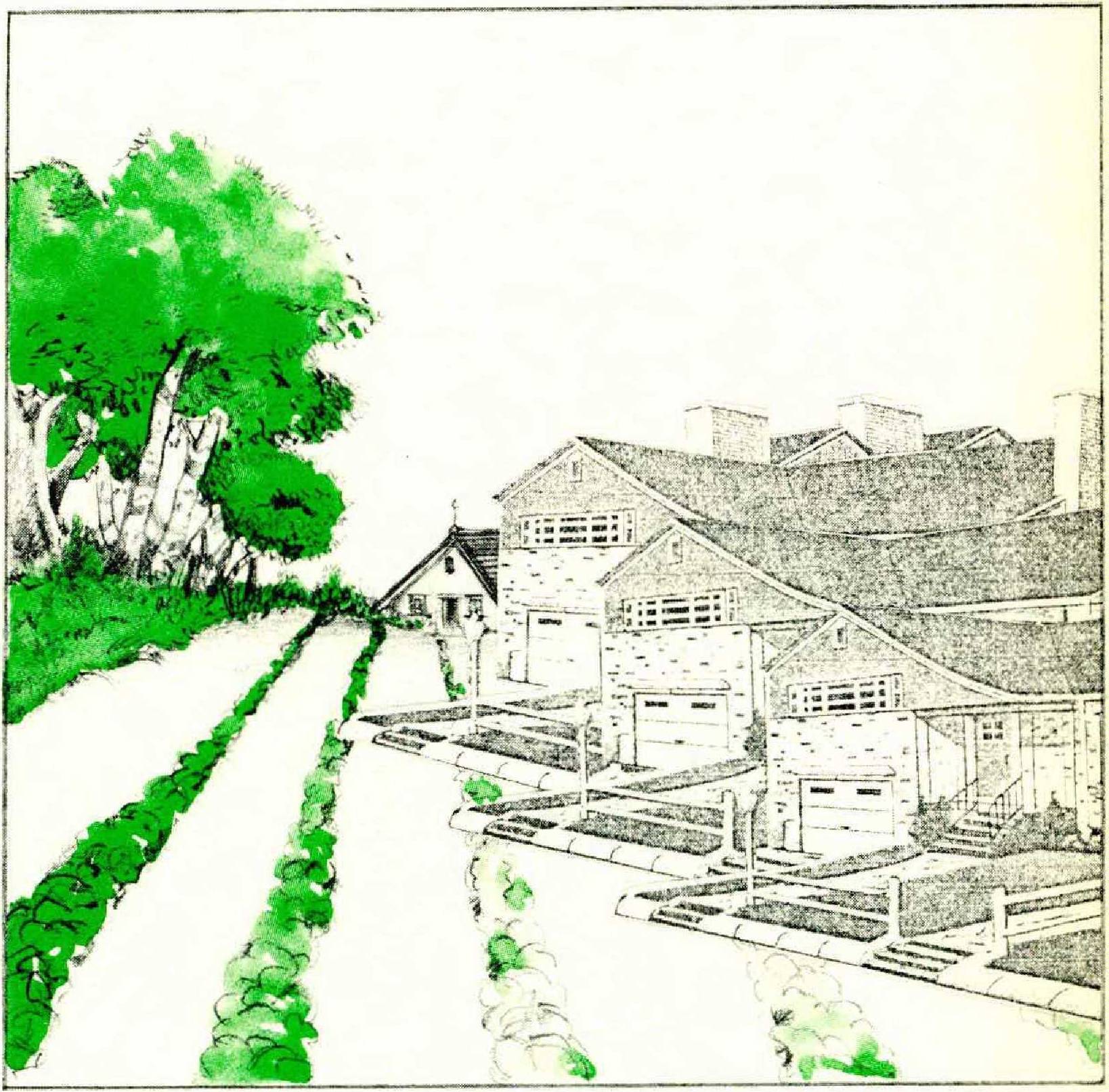
Western Long Island was the birthplace of a phenomenon known as “unplanned low-density sprawl,” the basic ingredient of which is tracts of houses, arrayed in rows like barracks, spreading across the countryside. Sprawl has been the typical pattern of post-World War II suburban growth throughout America, and it has been costly. In its fifth annual report, the U. S. Council on Environmental Quality compares the sprawling kind of development with a rarer form that consists of highdensity housing. Sprawl turns out to be far more expensive in terms of the public investment required for installing roads and utilities and for providing essential services like police protection. With sprawl, far more energy is used for heating and transportation. Sprawl makes air and water pollution harder to control. It leads to greater use of fresh water. And by definition it maximizes the amount of earth that gets developed, and thus it has contributed greatly to the irretrievable loss of some of America’s best farmland. The amounts of land involved are huge. A U. S. Department of Agriculture study shows that between 1960 and 1970 suburban growth consumed something on the order of three million acres of cropland, which is approximately the acreage of the entire state of Connecticut. Clearing, irrigation, and drainage put three times as much land into new cultivation, but often this amounted to replacing good farmland that was close to market with bad. The United States still has far more than enough growing land to feed its own, but clearly the country shouldn’t keep squandering prime acreage, in the face of world food and fertilizer shortages.
It seems inevitable that the suburbs of America will keep growing. More and more housing is needed. The question is how to provide it without making all the old mistakes, and the answer, according to the Nassau-Suffolk Regional Planning Board’s Comprehensive Development Plan, is something called clustering. Imagine a one-hundred-acre plot of land which is zoned for one-acre residential development. The traditional blueprint would have about eighty new houses occupying eighty acres, and the other twenty acres would have to go for roads. A clustering plan might put the eighty houses on forty acres. Then only ten acres would be needed for roads, and the remaining fifty could be left alone, preserved as communal open space. Applied on a grand scale, to eastern Suffolk County or any other suburbanizing region, clustering would mean a series of compact communities surrounded by abundant open space. There would be room in the suburbs for woods and wetlands and farms.
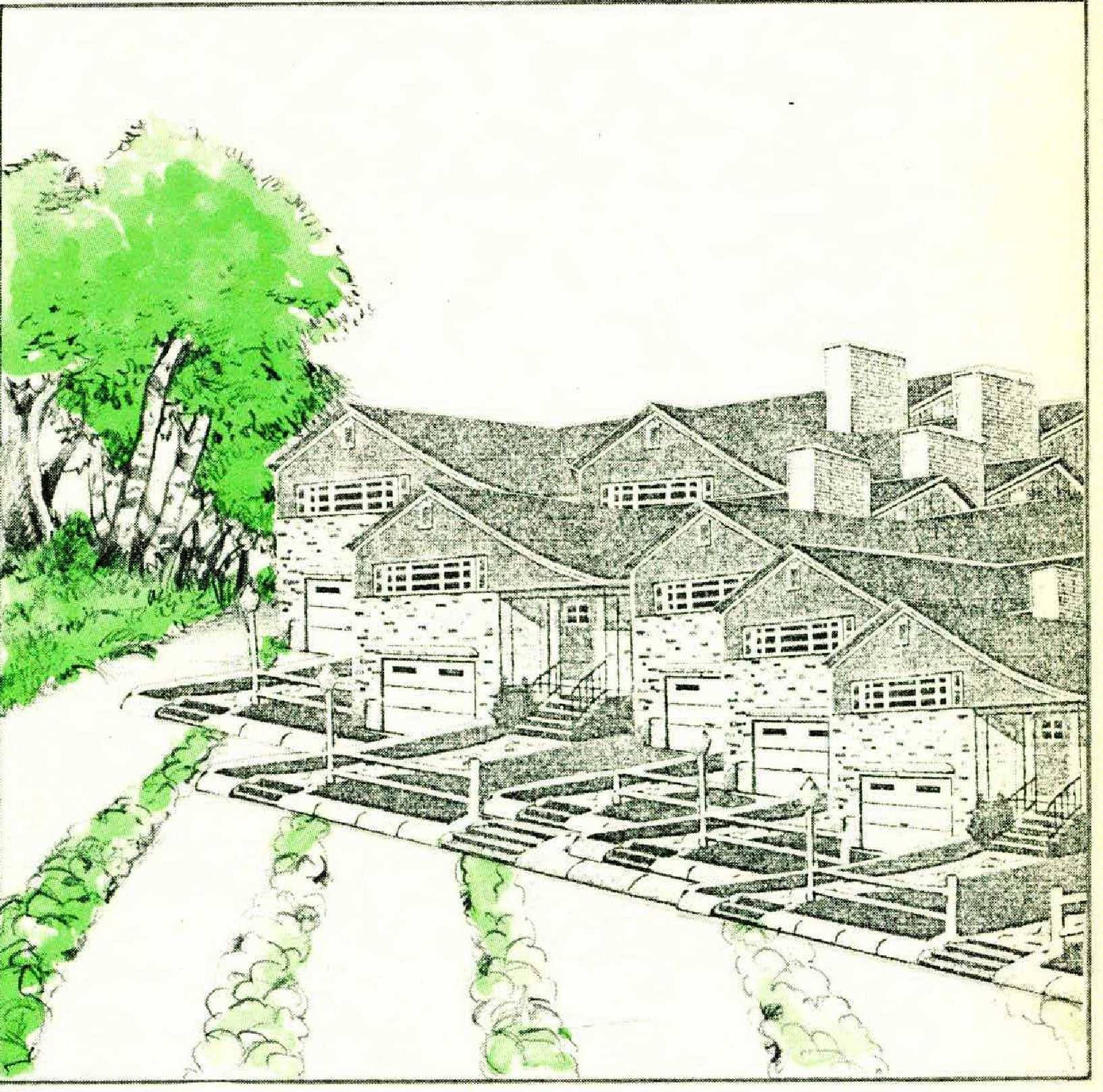
The concept is old, predating the automobile by a few hundred years. As William H. Whyte, an eminent student of clustering, writes, “It was the principle of the New England village green.”Since the late 1950s land planners in America have been touting cluster housing with virtual unanimity. By the late sixties there were roughly a dozen largescale and a couple of hundred smaller communities being built along planned, clustered lines. One of the most successful cluster developments is Heritage Village in Connecticut, a small, self-contained, retirement community with abundant open space. Any list of notable large-scale developments would have to include Columbia, Maryland, a planned community with clustered residential villages. A huge tract is being developed near the University of California in Irvine; housing is being built to coexist with agricultural land. But developments like these are exceptional. Sprawl remains the dominant motif in new suburbia.
Perhaps the largest barrier to cluster development is diffuse ownership. The problem is how to effect comely, efficient growth over a large area when the land is owned by thousands of different people, all with their own ideas about what to do with their property. How, for instance, to imple-, ment the Comprehensive Development Plan in eastern Suffolk County?
Lee Koppelman, a short, feisty man with a national reputation as a land-use planner, was the principal designer of the Comprehensive Plan. In his view, “the farmland program is the key to it all.”
The Suffolk farm program is versatile compared to the traditional open-space project. The fine parks of western Long Island are not integral parts of the concrete communities around them. For me, something is missing; when I visit those parklands I often feel that I’m on artificial ground, or in a museum. The farm plan would resemble a park project in that it would ensure the survival of open space, of thousands and thousands of acres of the always changing fields that make eastern Suffolk such an agreeable contrast to the rest of Long Island. But unlike parklands. the fields would be in productive use, part of the area’s daily life, turning out potatoes and the crops that are sold at the roadside stalls. And farm preservation could be more than an agricultural and open-space project. Koppelman asserts, “If we achieve preservation, it will force growth toward clustered communities.”
There are a number of precedents for using open-space programs as tools for influencing growth. Probably the best known is the greenbelt which surrounds London. This is a ring of land, much of it privately owned, on which development is prohibited. More pertinent to what Koppelman has in mind is a 1968 study of the San Francisco region, which concludes that public acquisition of strategically located open space would limit the areas open to development in such a way as to force growth into compact shapes. The twelve thousand acres contemplated for the Suffolk County farm program probably wouldn’t be enough to work that kind of magic. But in Koppelman’s scheme, the towns and the farmers supplement the county program. The towns use their zoning powers to discourage development on farmland, and the farmers create agricultural districts which give them preferential tax assessments in return for pledges to keep their land undeveloped for a specified number of years. In fact, the mere possibility of a county farm preservation program has already helped lead one town and one group of farmers to take those steps.
The preservation program may save much more than twelve thousand acres, and Koppelman’s vision of clustered growth may have a chance of becoming reality on eastern Long Island.
Elsewhere, similar legislation could have the same effect. Massachusetts and Howard County in Maryland are already working on preservation programs derived from Suffolk County’s. Agricultural officials in Michigan and Connecticut have tried to launch programs also. So far the mid-70s recession and the difficult question of financing have stood in the way. But those states and many others are watching Long Island now to see how the landmark Suffolk County Farmland Preservation Program will turn out.
The Suffolk County program isn’t the answer to all the awesome problems of suburban growth in America. Yet it could serve as one barrier against the reckless sort of building which for years has been running roughshod over one of America’s most precious resources.