In Search of Beckett
What living writer do you most admire? When the New York Times Book Review put that question to a group of well-regarded American authors last winter, Samuel Beckett emerged as the majority choice—but no library or bookstore run on his works ensued. Dublin-born, now in his early seventies, this Nobel laureate has a reputation for difficulty that Sunday paper polls can’t change. His chief popular success, Waiting for Godot, was nearly as famous for impenetrability as for dramatic power. His most accessible novels, Murphy and Watt, are without plot interest. The best-known fact about his life, his close association with James Joyce, arouses suspicions of remoteness. The same holds for his habit, contracted in middle years, of writing and publishing his books in French, translating them into English only as a sort of afterthought.
And Beckett has never been chummy with readers. Bursts of Rabelaisian hilarity turn up in his works, and laughing with him produces an uncommon feeling of companionability—closeness to the real Samuel Beckett. But he’s seemingly without enthusiasm for personal contact. Reclusive, he avoids interviews and promotion tours. He advises would-be biographers, with icy politeness, that he’ll neither help nor hinder them (“You’re free to do as you wish”). To the invitations that poured in during the seventies at his homes in Paris and Ussy—Zero Mostel wanting to make a film of Godot, Estelle Parsons and Shelley Winters wanting to mount a new production of the play with themselves as stars—the answers were stiff and stern: “Definitely NO.” As for photo opportunities . . . The faces staring out from his book jackets are all blasted doom and fury, and the implicit statement is a menacing Don’t mess with me.
Where public relations problems exist, some say, public relations solutions can be sought and found. Deirdre Bair seeks such a solution in SAMUEL BECKETT: A LIFE (Harcourt Brace Jovanovich, $19.95). Her hope, announced in a preface, is to “encourage many more people to read Beckett’s novels and see his plays.” And she’s certain that, to realize this hope, the writer-critic must shun the ways of coteries. In the past, she declares, “Beckett interpreters substituted their own brilliant intellectual gymnastics for what should have been solid, responsible scholarship, [creating] studies that told more about the quality of the authors’ minds than about Beckett’s writings.” As a result we still lack “a factual foundation for . . . critical exegesis,” means of placing the poems, novels, and plays “within the framework of [Beckett’s] daily life.” Not until factual foundations are firm can an author be humanized. And not until this particular author is effectively humanized will the great audience begin to come round.
These aren’t, on their face, silly notions. The obvious although unnamed target of Ms. Bair’s animadversions on intellectual gymnasts, Hugh Kenner’s Samuel Beckett, is a splendid critical study, beautifully tuned to Beckett’s mind, but about dailiness it couldn’t care less. (Kenner is in wild flight from page one, Latinizing, scatologizing, pun-jousting, re-Joyceing in Beckett’s playfulness as theoretician and linguist; in 200 pages he touches details of Beckett’s life maybe thrice.) And the plain truth is that Beckett has lived and suffered and triumphed in a manner not without human interest. The story of his struggle for mastery of his craft and for recognition is, indeed, highly affecting. Fearful inner and outer obstacles had to be overcome. Furthermore, Beckett appears to be an exceptionally various litterateur, blessed with a range of nonliterary skills and appetites sufficiently wide to engage people ordinarily unimpressed by highbrow authors. And, equally helpful to a biographer concerned with enlarging a writer’s audience, the man has character. A number of passages in this life— none publicized by Beckett himself— attest that he possesses greater gifts than genius: courage, generosity, a sense of honor.
Ms. Bair exploits these advantages thoroughly and devotedly, drawing on interviews with scores of the author’s acquaintances, and upon hundreds of letters from Beckett to Thomas McGreevey, a poet, critic, and scholar who befriended Beckett in Paris in 1928 and remained “for the rest of his life Beckett’s only confidant.” (Suzanne Deschevaux-Dumesnil, whom Beckett lived with for decades and married in 1961, seems to have been primarily a guardian of privacy and manager of literary business; the couple has no children.)
We meet, to begin with, the familiar figure of the would-be artist at bay in his own family. Beckett’s father, a prosperous building contractor, knew early on that young Sam wouldn’t be joining the firm, but he expected the lad to become something decent, like a professor, and was shaken when this didn’t occur. (Beckett did time—a year—as lecturer in French at Trinity College, Dublin, from which he graduated, but he despised the work; turning wanderer for several years in Europe, he settled at last in 1936—for life, the sequel proved—in a Parisian Bohemia.) His mother, frozen in Anglo-Protestant propriety, was enraged, not disappointed, by her son’s literary commitment. Hounding him ceaselessly in the name of respectability, she periodically shut off allowances after his father died, and occasionally feigned illness and breakdown with the intention of shaming him into repentance.
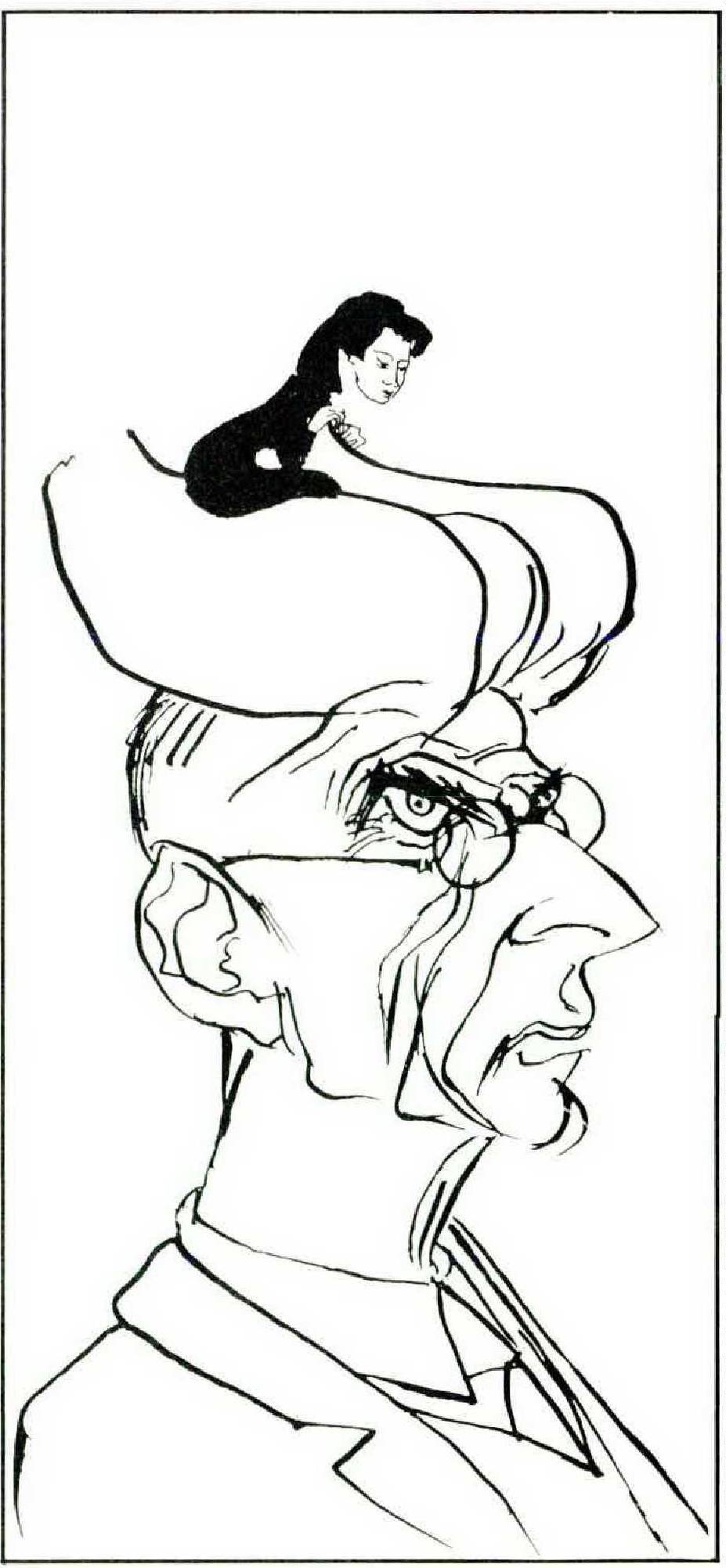
Unacceptable career choice wasn’t, to be sure, the only cause of conflict between parent and offspring in this household. As a child the author of The Unnamable evinced qualities of impermeableness that maddened his mother; she beat him often. And the tormented relationship that developed never was worked through. In his mid-thirties Beckett was forced, by lack of funds, to break off a psychoanalysis that might have toughened him, and for decades he was racked, intermittently, by physical agony (cysts, boils, tremors), not to mention overwhelming assaults of guilt (his mother’s single solace for his truancy). When the prime context of an alienated artist’s anguish is familial, as in Beckett’s case, the resonances are richly human; Ms. Bair’s Life does them proper justice.
Her book is also admirably responsive to professional defeats and disasters. Creating even the tiniest audience for his work seemed to Beckett, for years, utterly impossible. (Murphy, which Beckett correctly estimated to be a delectable book, was rejected fortytwo times; regularly he opened publishers’ statements to learn that annual sales of one or another of his works totaled two copies.) The friendship that should have helped him went sour: Beckett was thrown out of James Joyce’s household when the great man’s demented daughter wrongly charged Beckett with misusing her. Happy events seemed to carry within them the seeds of their own abrupt cancellation. Barely a month after Murphy finally found a publisher, thanks to the critic and poet Herbert Read, Beckett was knifed, almost fatally, on his way home from a movie, by a pimp demanding money. (The pimp’s name was Prudent; seated beside Prudent at the trial, Beckett asked what he’d done to insult the fellow, and Prudent, drawing his shoulders up “with a Gallic shrug replied indifferently, ‘I don’t know.’ ”) Even as international fame was dawning, bad breaks multiplied. An agent selling Beckett’s original manuscripts to American universities cheated him shockingly. During rehearsals for the first production of Godot, three sets of actors in succession quit the show. The producers of Oh! Calcutta!, after begging him for a contribution, rewrote it in a manner traducing the author.
So it went. If Beckett had been a natural victim, a spirit too rare for our coarse kind, a stereotype of quivering sensitivity, his troubles might seem more bearable in the reading. But, as it happens, that stereotype is irrelevant. Beckett was a strikingly handsome man in youth, attractive to women; not a mooner or a whiner but a blade who won matches, had escapades, got into scrapes with motorcycles and fast cars which (on paper) are hilarious:
Beckett drove [his father’s Swift] around Trinity very badly but with enormous style. He shifted gears with sweeping, dramatic arm movements, involving his entire torso in negotiating turns. He made blowing the horn a musical art and parking was an exercise in dance and mathematics with an occasional fillip from the latest Mack Sennett comedy. One evening, after several hours in a favorite pub, Beckett was negotiating the Swift through the streets around Merrion Square with more difficulty than usual .... The Swift rolled over a curb and stopped only inches from one of Dublin’s leading legal figures, Judge Eugene Sheehy, out for a stroll to escape his wife’s regular Thursday “evening.”
He was first-rate, in youth, at games, the only Nobel winner to earn a place in cricket record books (batted lefty, bowled righty), keen at golf, boxing, rugby, tennis, billiards, chess, and bridge. When writing seemed a dead end, his thoughts turned not to insurance or accounting but to aviation and moviemaking (he wrote to Eisenstein offering himself as an apprentice; no answer). From his teens onward he had a taste for all the superior entertainments—drinking, singing (Gilbert and Sullivan), parody, piano duets, Chaplin, Laurel and Hardy, Harold Lloyd . . .
And, to repeat, he’s demonstrably a man of character. De Gaulle awarded him a Croix de Guerre with a gold star for daring service in the Resistance. Stories abound of his kindness to people in need—bums, convicted murderers, troubled Red Cross matrons, others. He’s no goody, obviously (survival as an artist meant dumping family responsibilities on his brother Frank), and his stern reserve with Establishment types has struck many as oppressive. But Ms. Bair’s evidence suggests that Beckett doesn’t easily forgive himself for the patches of “necessary” selfishness in his past, and, if he has held his feelings in check, it has been otherwise with his property. (Virtually the whole of Beckett’s Nobel money has gone into subsidies for younger “artists, painters, printers, scholars,” or into the financing of “new experimental productions,” or into Parisian junkets for old Dublin acquaintances.)
We’re dealing, in sum, with a fully human being, limited by instincts for withdrawal and isolation, but humorous, passionate, and brave. And Samuel Beckett: A Life keeps this fullness in sight from the start, despite its earnestness about the pledge of the preface —namely to connect the life with the work.
That pledge is, however, Ms. Bair’s main preoccupation. She establishes a dozen links between, for instance, Beckett’s London days and his first novel, Murphy, a book that’s set in that town. In the central chapters the hero is an orderly in a mental hospital; Ms. Bair notes that Beckett used to visit a doctor friend who was psychiatrist-in-residence at an institution in Surrey. At the end of the tale we’re at Round Pond watching kite flyers; Ms. Bair notes that in the fall of 1936 Beckett spent his afternoons doing the same. Murphy carefully details the perambulations, about the four corners of a bed-sitter, of a character called “the old boy”; Ms. Bair notes that, during his stay in Gertrude Street, Beckett observed a neighbor who fits “the old boy’s” description. What happens in Murphy, broadly stated, is that the title character moves “out of West Brompton . . . into his [own] mind”; Ms. Bair notes that, while the book was being written, Beckett attended a lecture by Jung, at the Tavistock Clinic, which described patients sinking “into their unconscious altogether and [becoming] completely victimized by it.”
It’s the same story with Waiting for Godot. Ms. Bair argues that the conversational antics of Vladimir and Estragon owe everything to those of Beckett and Suzanne Deschevaux-Dumesnil. The pair chatted in a peculiar, vaudeville-like lingo, and “It would seem that Beckett took ordinary conversations between [them] and incorporated them verbatim in Godot. . . .” What’s more, Ms. Bair thinks she has a source for the pointless peregrinations of the play. When their Resistance network was discovered, Beckett and Suzanne fled Paris, later walking 150 miles from Lyon to a small village in the Vaucluse:
[They] took turns cajoling and pleading with each other on their trek into Roussillon as first one and then the other despaired of ever coming to the end of their walk. In Waiting for Godot Vladimir and Estragon do the same:
Vladimir: Come here till I embrace you.
Estragon: Don’t touch me.
Vladimir: Do you want me to go away?. . .
Estragon: Don’t touch me! Don’t question me! Don’t speak to me! Stay with me!
Nobody fond of Beckett will read any of this without interest; even the snippets adduced as proof that Malone Meurt is “the most autobiographical of all Beckett’s fiction”—an extremely unlikely proposition —are piquant. But there is a problem. It’s true that knowledge of the models drawn on for a character can deepen understanding of character and author alike. We’re better readers of some books for having a sound grasp of relationships between their authors and their heroes—for example the relationship between Scott Fitzgerald and Gatsby.
Still . . . models—and experience itself—mean different things to different writers, and critics and biographers are obliged to register and respect those differences. With some authors, knowledge of links between art and life yields only modest benefits, and I’m afraid Beckett’s works are of this kind. The creator of Molloy and Malone wasn’t hugely concerned about the world out there—“real people,” the onset and development of love affairs, social ambition, the rearing of children, class difference, regional difference, consumer products, and so on. His focus was a series of questions: What is language? What is consciousness? What do we know? What is out there? In a typical Beckett page the eye may begin by following a human action, but it’s quickly diverted toward other items— toward parodies, for example, of verbal fastidiousness; toward jokes about language-learning and -teaching that hold the mirror up not to particularized individuals but to the processes by which Everyman spins himself out in words. Persons, places, things tend to dissolve.
“. . . they sat down beside him, the lady on the one side, the gentleman on the other. As a result of this, Mr. Hackett found himself between them.” (Hugh Kenner, to speak again of Ms. Bair’s nemesis, has spirited fun with this not dazzlingly dramatic passage from Watt.) The subject here—the ways of our language—is undeniably human. (Nothing on earth more human than human language.) One may or may not be amused to observe the pretenses of precision built into our betweens and besides, our elegant sentence forms— the sleight of hand of our circumlocutions, the primness of our prepositional politesse. But regardless of your taste, it should be evident that you can’t get far toward comprehension or enjoyment by scratching about after the original of Mr. Hackett, the benchsitter; the passage hasn’t to do with missing persons but with verbal manners.
And because Beckett idolators know that a very great deal of their man’s stuff isn’t finally about the ordinary novelistic dimensions of people, they are likely to respond sniffishly to Ms. Bair’s investigative reporting. They’ll explain her concentration on “real life equivalents” as an aberration stemming from incapacity to appreciate either Beckett’s characteristic subjects or his best self—his sinuous wit, purity of diction, syntactic ballet, epistemological subtlety. And they do have at least one clear point on their side, namely Ms. Bair’s somewhat leaden performance as a writer. The right match for Beckett is a critic with a feeling for the “other harmony” of contemporary prose—love of its special rhythms, a sense of its homely grace. Ms. Bair’s pages, I’m sorry to say, are clichestrewn (“occasional fillip,” “Gallic shrug”). Worse, there are hints of a tin ear: “Though the present-day reader is almost constantly aware of Beckett’s presence in this essay as phrases illustrative of his mature writing seem to leap off the printed page, there is a constant, clear-sighted view of Proust.” And too often you catch a hint of unseemly condescension that approaches the borders of anti-intellectualism. (Ms. Bair remarks down her nose that being introduced to Joyce “was all very thrilling for Beckett,” as though anybody sensible would have stayed home.)
Yet despite these reservations I don’t think, on balance, that we’re poorly served by this Life— and neither is Beckett’s cause. It’s better to have been overhumanized, if you’re an abstractionist, than never to have been humanized at all. The ideal book on Samuel Beckett would combine “factual foundations” with perfect alertness to their limited relevance, bearing in mind the intricacies of the intercourse, for some artists, between gross dailiness and high intellection, and aiming everywhere at the whole story. But in this world whole stories are hard to come by. If we’re complex persons like Samuel Beckett, we can’t expect total illumination when biographers and critics sit down beside us—“the lady on one side, the gentleman on the other”—intent on interesting people in our days. We have to assume that, like Mr. Hackett the bench-sitter, we’re going to find ourselves between.