Crazy Janie & Joe the Milkman: Notes on Class Attitudes Now
In theory, “class” is an unmentionable; in fact it comes up a lot. A friend explains a third party to you by talking about social origins. (“Ned’s Dad was a big orthopedic surgeon in St. Louis, did you know?” “Susie’s an Arkansas girl, did you know? Left for college right off the farm.” “Ted’s from a Catholic family in Eau Claire, did you know? Seven kids and the mother was a nurse.”) Or the stylish talk-show host builds half a monologue on an account of the pastoral mores of Nebraska as viewed from a Bel Air salon. But while class chatter is pervasive, it’s usually unsatisfying—not grating, seldom downright snobbish, but lacking substance or point. Matters of consequence are in view—in a democracy the character of class relationships is hardly a trivial issue—but they’re not faced up to. The understanding, or convention, is that class leads nowhere, doesn’t have a future as a subject. It’s a telling detail—something brought up, taken in, nodded at wisely . . . abruptly dropped.
And the abrupt dropping feels wrong.
What prompts these ruminations is a random assortment of events, conversations, entertainments. A new book about social class in America by a pair of established professionals in the field of sociology. A movie about life on the assembly line—the first American “working-class” film that I’ve been to in years. And some exposure to a rock music performer who, unless I’m mistaken, sings about class every time he opens his mouth.
It’s the book, oddly, that leaves the strongest impression of incompleteness—of themes insufficiently worked through. The title is SOCIAL STANDING IN AMERICA: NEW DIMENSIONS OF CLASS (Basic Books, $15.95), and the authors are Richard Coleman and Lee Rainwater, associates at the Joint Harvard-MIT Center for Urban Studies. The Coleman-Rainwater specialty is I the connection between two kinds of “indicators” of class—objective (salary: $22,000) and subjective (“I think the couple across the street are a little below us—he’s just a bank teller”). And in pursuing it the researchers are extending, by their own assertion, the notable sociological tradition begun a half century ago by the Lynds with Middletown and by Lloyd Warner with Yankee City. Like those trailblazers, Coleman and Rainwater are alert to the acuity of amateur social observers— and they’re admirably critical of pollsters who “hide the complexity of people’s views” by framing simpleminded questions and publishing the answers. The foundation of Social Standing is a collection of 900 in-depth interviews on attitudes about class conducted in Boston and Kansas City with a demographically sound sample of the citizenry. And it’s clear, from the responses liberally quoted in the book, that the interviewees were encouraged not to shoot from the hip but to state themselves carefully and expansively.
Accept their opinions as representative, and Social Standing qualifies as an impressive, if depressing, study of the content of this country’s social mind. The book is not, to be sure, teeming with revelations. I didn’t find it astonishing, for instance, that most Americans still believe—despite the palaver about unmeltable ethnics—that the ideal model of ethnic integration for this country remains the melting pot. Or that blue collar versus white collar has ceased to rank as a significant social distinction hereabouts. Or that the prestige of education as a symbol of higher status is in decline.
I wasn’t amazed, either, that most Americans believe income and standard of living to be the main determinants of class, but at the same time selectively associate with each other in a fashion indicating that money is by no means the key to the sense that our gang’s just one grand bunch of equals. Class unities develop from “the entire fabric of. . . daily existence,” including occupation, ancestry, church affiliation, cultural level, and language patterns.
But several other Coleman and Rainwater conclusions are piquant. It appears that well over two thirds of the citizenry think “social class is getting . . . less important in America these days than it used to be,” and that for some of these people the corollary is that the folks at the top have “less class.” It is, by the way, in casual comment on contemporary elites that many interviewees showed their observational power. “The people you used to think were marvelous,” said a Kansas Cityite ruefully, “aren’t marvelous anymore.” The conviction that attitudinal change is in progress isn’t accompanied by enthusiasm for legislation aimed at altering the social system. The idea of automatically according higher status to a person simply because of the standing of his profession or the reputation of his fortune vaguely bothers people, and a third of us want to see “reputational inequality” abolished. (The innocent idea seems to be that this could be done without altering income differentials.)
But there’s deep and broad opposition to “a major change in the American class system.” And the heart of that opposition is belief in the American record of social mobility; there’s nearly universal certainty that, in this country, the success myth—the myth of The Rise—is no myth at all. Only one person in ten saw himself as holding lower status than his parents, and the interviewers heard endless panegyrics on upward social leaps taken in postDepression America by the interviewees, their relatives, and their friends. Belief in the openness of the recent American past, however, is accompanied by “deep worry . . . that mobility will not be so commonplace in the future . . . and that perhaps as much of it—or even more—will be downward instead of up.”
My shorthand summary of the conclusions of Social Standing sets them forth less tentatively than the book does. Coleman and Rainwater are responsible analysts of the body of opinion they’ve amassed. They provide a survey of popular thinking about connections between income and education that’s a model of patience with ambiguity and contradiction. They’re conversant with the messy human habits that muck up arithmetical neatness, as for example our practice of measuring class one way when we’re looking up and another when we’re looking down. And they and their staff have good ears. They pick up, at the bottom-dog level of society, the characteristic mixed accents of indifference, matterof-fact realism, and defiance: “. . .
when asked where he would place himself, [one young Boston black] spat out: ‘Shit, man, I’m lower class; I’m black; I live in this slum. What else do you need to know?’ ”
Yet there’s the feeling of something missing. This is partly attributable to
the necessity of abstracting class from its surroundings. In the sections of the book on public faith in The Rise, the theme of class is believably embedded in a whole human context that includes patriotism, family piety, plain pleasure at possessing a good story and a caring listener—the wide range of “nonclass factors” that breathe in every moment of life as lived. Elsewhere, though, class is sealed off from dailiness and common entanglement, and often feels more like a concept than a nerve.
But the real problem isn’t abstractness, it’s permissiveness. Treated as Coleman and Rainwater treat it, the subject of class relationships—both their quality and the question of whether anybody ought to agonize about that quality—becomes neutralized, almost nonexistent. As scientists, the authors have an easy out, meaning a professional justification for detachment from the worlds of morals and politics. Time and again the excerpts from interviewees’ comments flood with envy, fantasies of total self-absorption (flight, travel, “getting away”), a conception of life as a competitive game that “Americans play against one another”—outpourings of the meaner longings that shout for judgment, or for some gesture of regret by those who induce them. And the only judgments offered are technical. (Envy is a deflector of perception, not a force bad in
itself; it causes interviewees to discount nonmaterial differences between themselves and those “above” them.) But we understand: science is science.
The trouble is that few of the interviewees are scientists, yet all of them, it seems, are adept at aping the scientific stance. Well before the end of Social Standing, researchers and interviewees are talking the same language with such absence of compunction, indeed with such happiness, as to leave the impression that approving a class society comes as comfortably to us—despite a little fretting about the mysterious “reputational inequality”—as liking baseball and blueberry pie. The voice that predominates in this book is confidently distancing, categorizing, and its sound is more disquieting even than that of envy and resentment. Farmhand, teller, cesspool cleaner, “Joe the Milkman”—the respondents readily package these and a hundred others for status display, neighbors and strangers alike, with no strain (“The people lower than me . . .”).
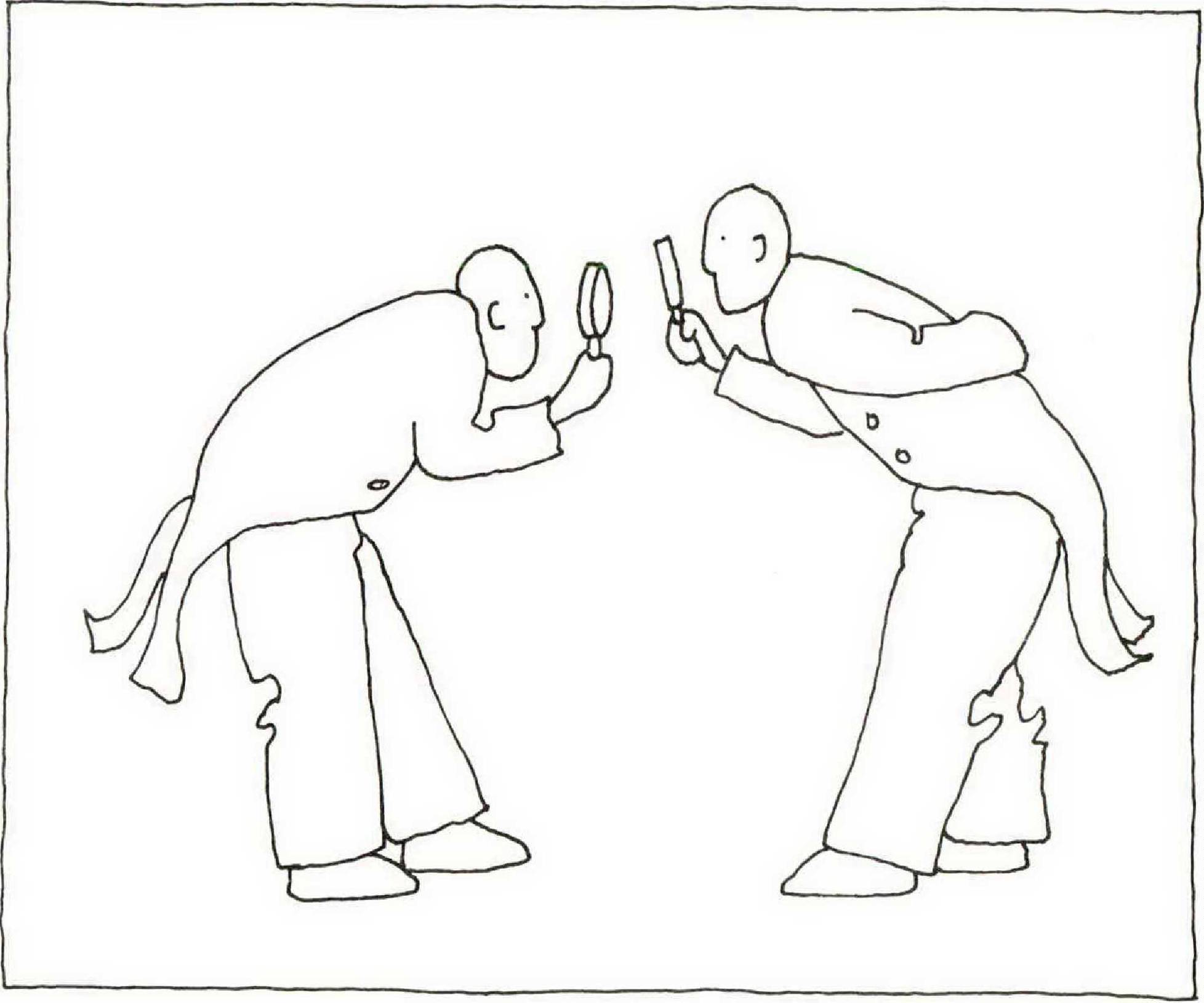
Is strain obligatory? I remember being set straight, in youth, abroad, by various and knowing characters—a university don at York, a psychiatrist in Amsterdam, an editor of a Lisbon weekly—about American social reality. Now of course, tut-tut, you know, Yank, don’t you, that you’re living in a class society too—just like every other bloke in the West. One stumbles and trims in such conversations. One thinks grimly, defensively: Well, at home when we diminish somebody by “placing” him, we at least have the decency to blush — to sense that an ideal is being traduced. Our capacity for dismay remains intact. We know what is and isn’t in the true American grain.
But reading Social Standing, one has to wonder what that grain is. Everything is permitted, the book seems to say, including social put-downs. Evaluations by class, stoniness about “inferiors,” helpless envy of “superiors”—all of it is, in this text, as right as rain. We’re dealing, in sum, with a work that has the look and feel of a solid piece of research, that may well be a trustworthy anatomy of the social thought of Everyperson, but that’s all too poised and complacent, finally, about a moral and political disaster.
The movie I spoke of about life on the assembly line is Blue Collar, written and directed by Paul Schrader, best known hitherto for Taxi Driver. As the title suggests, it’s no more averse to packing and categorizing by class than the average Coleman and Rainwater interviewee. The thin story is about a trio of auto assembly line workers (two blacks, one white) who crack a safe at union headquarters and come up not with big money, as they’d hoped, but with evidence of financial dealings between union officials and The Mob. Corporate management and union officialdom work together, in a spirit of realpolitik, to attack the trio where it’s most vulnerable—its members’ shaky trust in each other—and, naturally, the big shots win. The ease of the victory, intermittent saggings into sitcom, dope-blowing and obscenity-braying, and the embrace, in the work scenes, of Good Guy-Bad Guy formulas (noble workers versus corrupt supers), all combine to weaken Blue Collar’s impact.
But occasionally the stereotypes enter contest with something subtler— odd reversals wherein victims become victimizers and vice versa. Private codes of manners invented by the oppressed as means of asserting their natural superiority to their masters— black handshakes, “slapping fives”— are slyly annexed by white supers, and used with falsehearted bonhomie to close otherwise unbridgeable ethnic gaps. A worker (Richard Pryor), saddled with a big-ticket color TV, winces at such programs as The Jeffersons— but resists, with comic doggedness, efforts to turn them off, on the ground that, since he’s paying, it’s his right to force the entire household to endure all the incoming garbage. Working-class heads of households are haunted, not only by their own and their children’s unslakable appetites for objects judged needful for a “good life,” but by dark suspicion that what they’ve been taught to hunger for is junk.
And, more important, one performer achieves life and interest not as A Worker but as a human being. Brandos, De Niros, and Travoltas—aces of glamour, superheroes whose brows and bodies on the screen obliterate thought— are bad news in films like Blue Collar. Nobody’s right except an actor who inhabits his person unflamboyantly, and can conceive of himself thinking. Harvey Keitel, cast as an informer in Blue Collar, is such an actor. In one sequence we watch his face as he stares unbelievingly at his daughter, having discovered that she has mutilated her mouth with homemade wire braces. The child, supercharged with dreams of drum-majorette stardom, has been rejected because of buck teeth by her school marching corps. (No money in the budget for an orthodontist.) Feelings come in a rush—helplessness, pity, confusion, anger, awe. But in the corners of the actor’s eyes, or in the frown, you also sense determination—a refusal not to attempt to understand. —The System is responsible, but still . . . mydaughter did this to herself. So what is the System? Is the System us?
While the moment lasts, you’re engaged by the person, not by the category. Few actors move as naturally and swiftly from a class-defined “slot” into full humanness as Keitel does throughout this film. If the rest of the picture had been up to him, it would have qualified as a useful corrective to overintellectualized versions of caste and class.
At present the closest thing I know to such a corrective is the voice of a current rock hero, namely Bruce Springsteen. Harmonica man, lead guitarist, and singer, Springsteen takes some getting used to, speaking mildly. The voice is barrelhouse raw (it often sounds simultaneously desperate and exultant). The songs are short on melodic invention and the lyrics offer no Bob Dylanesque wit. And coming to terms with his performances involves, for me, thinking about them as a form of social action.
But there’s something here, I’m positive—an alternative of a valuable kind to standard-form neutralism or impassivity about where people are headed, socially, and where they came from. This is so not because Springsteen is a conscious spokesman for a class—the country’s white working-class youth— but rather because his songs convincingly evoke the imaginative life of the people in question. There are, admittedly, observers who doubt that “greasers” have imaginative lives, just as there are people so chained in class or in culturecritic condescension that they can’t see anything in, say, a Junior Miss competition except yet another incitement to elegant disgust with “popular culture.” But the only help for such observers is the advice that they listen a while to Springsteen, and then perhaps look a shade more attentively the next time Springsteen’s “kind of people” roar by in a souped-up late-sixties-model Chevy.
A place to start might be with a song called “Spirits in the Night” from the Springsteen album Greetings from Asbury Park, N.J. Not a pretty item on its face—all greaser squalor, in fact—and not a rich narrative line. Three young men (Wild Billie, G-Man, and the “I” of the song) and one young woman (Crazy Janie), “all duded up for Saturday night,” take off, as a lark, in a hot rod, for a spot they call “Greasy Lake.” There, while the others drink and cavort in and out of the water, fully clothed, the singer and Crazy Janie make love on the dirt beach, “singin’ our birthday songs.” The surprise lies in the intensity of the will—expressed in the words and in the sound of the singer’s voice—to wrench some kind of poetry and grace out of a world we never made but that happens to be what we’re granted. Before the song ends, place and occasion are transformed by a kind of embattled lyricism. Tenderness conquers raunchiness; “Greasy Lake” becomes “gypsy angel row”; the lovers are believably etherealized into “Spirits in the Night.”
Sentimental? It depends on what you hear in the music. What I seem to hear is a variety of reminders about how it goes for the kids who disappear into “shop” at grade nine and thereafter aren’t in the picture. Like the rest of us, greasers are teased and raddled by false promises, crazy aspirations, and media hype. Unlike the rest of us, they’re never awarded a minute’s playing time in the great American upwardmobility match. And Springsteen seems to sing from the dead center of their sense both of possibility and of possibility frustrated. The longings (gonna win, gonna be Somebody) are, God knows, commercially contrived — but they’re undeniably vibrant. As is the singer. His voice is full of cocky, choked, brazen-it-out fury—the anger of the unfashionable and unremediated and unknown, leaderless, lobbyless people on whom, as they cruise and booze, it’s just now dawning, in the songs at least, that they’ve been sold out. Who’s guilty? Who sold them? Teachers, testers, “guidance counselors,” principals, you and I, Everybody Nice. How exactly did it happen? Why, they were suckered—suckered by shop, by voc. ed., by legends of The Stars, legends of good ol’ boys, by Speed stores and Dallas Cowgirls and stock car racing flicks and ten thousand country and western “hits” . . . in a word, they were had by The System. And, boy and girl, they’re going absolutely nowhere.
If you try imagining James Agee’s Let Us Now Praise Famous Men as it might have sounded were it composed not by a Harvard poet down south for Fortune but by a bardic member of the sharecropping Gudger family itself, you’ll have an inkling of the kind of experience Springsteen offers. It has connections, this experience, both with the past that extends back beyond thresher poets and water poets, and with the long march of democratization. But what matters more is that items like “Spirits in the Night” and most of his new album, Darkness on the Edge of Town, burn off imperviousness that talks, de haut en bas, without shame, about “Joe the Milkman” or Eau Claire Catholic ladies with seven children and jobs as nurses, or “guys on the line.” In place of imperviousness comes curiosity. (What are they like? What in fact do I feel about them—and they about me? In our kind of society—if it is a genuinely unique kind—what are the right relations, socially, among men?)
Springsteen’s gift is his ability to make his audience care about people whom most of us—I’m afraid this may include the sociologists—can’t even see. In his work, “seeing” and “caring about” are opposite sides of a single coin, and I’d say the stuff is gold.