Muscle-Bound Superpower: The State of America's Defense
Some $1 22 billion—$600 for each American—goes into the defense budget this year and the expenditures will grow larger in years to come. Yet critics on both sides—those who would spend more and those who would spend less—share a nervous concern that the nation’s military security is inadequate, and some experts fear that the United States has become shackled to high technology that may fail when put to the ultimate test. A crucial debate is under way, not only about how much to spend but about how better to spend it.
Deep within the Pentagon, on an inner hall of a lower floor, the retired colonel came to the end of his “brief.” In military fashion, it had been punctuated by charts highlighting “Key Points” and “Idea Expansions”; there were more than 100 of the charts, and the brief lasted nearly three hours. Having reached the one marked “Wrap-Up,” the colonel stacked the charts in a pile, rapped their edges on the table, and turned to glare at his guest. “I’ve been talking about war, waging it and winning it,” he said. “People don’t discuss that subject very often in this building.” His associate chimed in, “It’s really the Department of Technology, not the Department of Defense.”
One mile north across the Potomac, in an ornate, high-ceilinged room just off the Senate chamber, Gary Hart took a break from floor management of a military construction bill. It was a noncontroversial bill, and a bit of pork for his constituents in Colorado; but it had been caught in the cross fire of an unrelated anti-union debate and was dragging on hours longer than expected. “The trouble with Congress,” he said, “is that we get trapped into looking at military matters in a quantitative, rather than a qualitative, way. We let ourselves get sucked into arguing on the admirals’ and generals’ terms, and we always lose.” He looked toward the door for the dozenth time, where the other backed-up appointments stood waiting to see him. “Since the death of John Kennedy, there hasn’t been any serious thought about defense from the progressive wing of the Democratic party. Maybe from anywhere.”
In one of the steel and glass skyscrapers that dominate the Washington skyline from across the river in Virginia, a defense analyst interrupted his brief. He had been discussing military aircraft, why their costs keep going up when their capabilities do not. “You hear a lot about the defense lobby. It’s true that the aerospace industry is out of control. But I will tell you this: there is no smaller lobby in this nation than the lobby for real defense.”
I recently spent three months talking with people like these, trying to find out the meaning of “real defense.” The contours of this landscape have long been obscure to those of us unschooled in the nature of AWACS and unused to speaking of CONUS. (An AWACS is a converted 707 jet, packed with radar systems and designed to guide other planes during combat. CONUS means simply “continental United States.”) The terrain has been left to those who deploy such terms with authority, and who trade assertions about the nation’s strength.
The assertions have come especially fast and thick as the debate over the strategic arms limitation treaty has changed course. What started out in the spring as an argument about “throw-weight” and “verification” turned by summer into a gloomy evaluation of America’s military place in the world. Henry Kissinger said we had grown weak and must place steel in our spine; Senator Sam Nunn of Georgia, invariably described as a “respected expert on defense,” said that he would hold his vote on the treaty hostage to a promise to spend much more on defense. Others were quick to add their assents; very few were specific about what the money should be spent for, or how more spending would correct the weaknesses they perceived.
Beneath the sloganeering, the Pentagon grinds on, an institution like any other. As I spoke with soldiers, analysts, and politicians, I was most impressed by those who understood that the nature of the Pentagon’s internal machinery is far more important than the amount of money that is poured in. William Lind, an assistant to Senator Gary Hart of Colorado, used the parable of Charles de Gaulle and Leon Blum. During the 1930s, when Blum was premier of France, De Gaulle is said to have warned him about the risk of military disaster. Nonsense, Blum supposedly replied; we are spending more for defense than ever before. Yes, said De Gaulle; and it is what you are spending it for that concerns me. Nearly ten years ago, the government committed itself to building the Trident submarine, a vessel as long as the Washington Monument is tall, which will carry nuclear missiles and replace the smaller Poseidon model. Almost everyone except the Trident’s sponsor. Admiral Hyman Rickover, would like to undo that decision, for, at a cost of more than $1.5 billion apiece, each Trident means scores of ships and planes that cannot be built, supplies that won’t be bought, spare parts that will not be on hand. Many recognize the Trident as a classic decision made for institutional and political reasons rather than the needs of defense. “The go-ahead was given at a time when the attention of the political leadership was directed elsewhere,” says Robert Ellsworth, who was deputy secretary of defense during the Ford years and later ambassador to NATO. “They were concerned with Vietnam, with desegregation in the South. So the decision just made itself.”
As I tried to understand the decisions that made themselves, I came to think that three men and three ideas figured especially large. These men and their ideas have molded today’s defense; where it is strong, they deserve much of the credit, and where it is weak, they must absorb much of the blame. Only one of the three still works for the Pentagon, and he will soon be gone; yet their ideas continue to dominate the inner logic of defense. If the Congress decides to spend more money on defense without paying attention to how, these ideas will determine where the money is used, and will guarantee that we create nothing more than larger versions of our strengths and weaknesses. The men are Robert McNamara, who brought the management ethic to the Pentagon; Hyman Rickover, who personifies high-technology defense; and Paul Nitze, who warns about the perils of being second best. In their stories is the story of the muscle-bound superpower; in their shadows is our neglect of real defense.
I. Robert McNamara and Managerial Defense

Eleven years have passed since Robert McNamara left the Pentagon; five other secretaries have come and gone, but there is still no name cited more frequently than McNamara’s when the talk turns to the roots of modern defense. McNamara was intent on bending the department to his will. He would end mindless rivalry among the services; there would be no more overlap and duplication, no more budgeting by the Eisenhower and Truman approach of picking a figure for total military spending and letting the services spend it as they pleased. The essence of McNamara’s approach, two of his “whiz kids,” Alain Enthoven and K.Wayne Smith, wrote in How Much Is Enough?, was “decision making based on explicit criteria related to the national interest in defense programs, as opposed to decision making by compromise among various institutions and parochial interests.”
It is hard, in the abstract, to imagine any quarrel with such sound managerial principles. Indeed, some of McNamara’s causes remain sensible causes today. The Navy, for instance, knows that the Trident submarine is a top national priority, but does not want the enormous cost to devour all of its budget; when zerobased budgeting time rolls around, the Navy puts Trident fairly low on its priority list and its more cherished projects higher up, confident that the secretary, the President, the congressional chairmen, will intervene to find room for Trident to be built. Well-meaning administrators in all the services learn to pre-distort their budget requests to guard against capricious change by the Congress. “That means,” said one in anguish, “you can’t make an honest defense of your original request.” In this circus of irrationality, it is hard to fault any attempt at a reign of reason.
Nor is it easy to dismiss the manager’s attempt to think systematically about where and how military force might be used, and about how much force will be enough to carry out each mission. Both inside the Pentagon and out. such analyses are a boom trade in the post-McNamara years. Perhaps the most ambitious example, and certainly the most accessible and informative from the layman’s point of view, is The Price of Defense, published earlier this year by an assemblage of academics and scientists called The Boston StudyGroup.
In their deportment and life-styles, the six members of this group torment the mainline military as thoroughly as the early Nader’s Raiders tormented businessmen; one has an Old Testament beard, another natters about the “insanity” of the arms race. (When I asked Elmo Zumwalt why his view of the world differed from the view of a group like this, he said, “They’ve never been there. They’ve never stared the Russians in the eye. They live in their academic environment and assume that everyone thinks the way they do. When you’ve been through a nuclear confrontation, as I have several times, you’re different.” To which the Study Group’s Philip Morrison, a physicist at MIT who took part in the development of the nuclear bomb, snorted in reply: “What nuclear confrontation has he been through? I’ve seen as many bombs explode as he has, and I’ve built more.”) Their book proceeds from one central technical assumption: that new antitank and antiplane weapons give an overwhelming advantage to the defense, so that NATO, for example, can get by with more modest resources and still hold off the hordes of Soviet tanks. When combined with their strategic judgments (that the nuclear missiles on our submarines can do most of the work of deterrence) and political views (that if the United States has intervention forces, it is likely to misuse them), this leads to the group’s conclusion that the United States could defend all its interests with a defense budget only 60 percent as large as today’s.
But a manager’s logical analysis arises from the world of economic competition, not physical combat. When a businessman’s methods are applied to planes, tanks, and guns, they can lead to fatal mistakes. A new missile named TOW (for “tube-launched, opticallytracked, wire-guided”) is the manager’s dream, the long-hoped-for breakthrough against the brute power of the tank. One soldier stands and fires a TOW; bykeeping his missile sight aligned on the tank during the ten seconds or so of the missile’s flight, he can adjust its course as the tank maneuvers and attempts to escape, theoretically ensuring a hit. This is one of the “precision-guided munitions” that many people, including The Boston Study Group, herald as revolutionizing the battlefield.
★
★
“Anyone who likes the TOW has never seen a battlefield,”says one of McNamara’s former associates, a skeptic of “efficiency” then and now. “To guide the thing, you have to stand exposed from here up” he gestures to the lower chest—“for about ten seconds. The people who think these things up don’t realize that there’s all the difference in the world between a twosecond exposure on the battlefield and ten seconds.” Another missile, the Dragon, can’t be fired by a soldier who is lying down, since the blast out the firing tube “burns your ass off,” in the words of a man who has seen them. The radar-guided missiles that many planes carry have the same drawback as the TOW. The plane must stay locked on its target until the missile hits, leaving itself, for a few crucial seconds, completely vulnerable to attack by other planes.
In this way, apparent rationality—of bang for the buck, of the body count—can lead to real irrationality. When McNamara attempted to end chaos by fixing the force sizes— 13 aircraft carriers, 16 Army divisions—he only guaranteed that waste and technological excess would reign. “Once they were sure they had their 13 carriers and didn’t have to fight it out every year, the lid was off,”one former Pentagon official said. “They crammed everything they could onto those carriers; that’s when the industry took over defense. Eisenhower managed to keep some lid on; it blew off with ‘rational’ defense.”
Management “rationality,” so noble in intention and benign in apparent effect, is, in the minds of many people, the greatest enemy of real defense. What we need, they say, is a different calculus, based not on computer printouts but on the realities of the battlefield, so different from any other form of human behavior. Its premium must be placed on flexibility in equipment, people, and ideas. “I get a little uneasy when I hear people talk about which battle scenario we’re going to be fighting twenty years from now and which ship we need for it,” says the undersecretary of the Navy, James Woolsey. “Given how long it takes to build our forces, our main goal should be to build in flexibility, with platforms we can adapt to different needs rather than being designed for one narrow purpose.” The element of confusion and sheer human weakness figures prominently in this scheme. Boyd cites countless reports from World War I and the Battle of the Bulge in World War II about the terror of Allied soldiers when German infiltrators suddenly “loomed up out of nowhere” from the fog. He quotes the ancient Chinese military theorist Sun Tzu as saying that, of the four ways to destroy an enemy, the most desirable was to disrupt his plans (by confusion or surprise), the next best was to disrupt his alliances, worse was to fight his armies, and worst of all was to attack his cities. This is Douglas MacArthur leapfrogging up the chain of Pacific islands rather than storming the Japanese stronghold; it is guerrillas destroying a far mightier foe by making it impossible-too costly, too painful—to persevere. In general, this approach to combat dictates simple equipment-weapons that can be produced quickly, that can change functions rapidly, and that soldiers can learn to use right away.
“In a sound military, you need three talents,” says William Lind of Senator Hart’s staff. “The manager, the leader—in the sense of “a leader of men’—and the theorist. Right now the manager totally dominateslook at who’s in charge at the Pentagon; the leader is tolerated up to field grade; and there is no place at all for the theorist. Clausewitz would not have lasted two weeks at West Point.”
This contention—that the military needs more leaders and thinkers, and fewer “rational” managers—is the heart of Crisis in Command, a penetrating book by Richard Gabriel and Paul Savage about the Army’s failures in Vietnam. I found the same contention bubbling up more and more often as I left the respectable mainstream of defense analysis and moved toward the fringe.
There is a certain kookiness to many of its proponents. Bill Lind, described by another congressional staffer as “a guest on the Joe Pyne show,” is a tall, austere figure in his early thirties who keeps a portrait of Mussolini hanging on his office wall, drops allusions to French and German military history at a threea-sentcnce rate, and is always proclaiming “ridiculous” or “insane” the latest announcement from the Pentagon. (“What did you, uh, think of Bill?” Gary Hart asked with evident apprehension after I’d spent an afternoon with his assistant.)
Then there is John Boyd, who spends afternoons in his small consulting office at the Pentagon making endless refinements in his hundred-chart brief on “Patterns of Conflict.” “I’ve got to find some way to work Napoleon in here,” he said at the end of our talk, embarrassed at the lapse. “I’ve been unfair to him.” Boyd was a renowned fighter pilot and instructor; during his years at Nellis Air Force Base he was known as “40-Second Boyd" because of his standing offer to pay $40 to any other pilot he could not beat in the first 40 seconds of a dogfight. (He never lost.) Now, in his early fifties, he calls himself “the ghetto colonel” (he is white), for he lives with his wife and four children in a small apartment “not exactly in the plush part of town.” Unlike most retired officers, he lives almost exclusively on his retirement pay, having resolved not to take the usual path of signing on with an aerospace contractor. (He accepts one day’s pay every two weeks for his consulting work at the Pentagon.)
Zany they were, yet it seemed to me that the quirks of men such as Boyd came from railing too long against the conventional wisdom; and I came to respect and value them more than anyone else I met. They gave the clear sense of having thought fresh thoughts, and of being willing to take the risk, impossibly rare in the world of defense intellectuals, that because of their fresh thoughts others might call them fools.
Boyd’s theory, which is studded with historical references from the Battle of Leuctra in 371 B.C. to Clausewitz, the Blitzkrieg, and the Vietnam War, is the product of three years of starting-from-scratch selfeducation in the nature of conflict. It contends that the outcome of combat is determined not by the bigger cannon or even by the larger force, but by the shrewdest combination of equipment, training, and ideas, toward the end of adaptability. Boyd began his investigations when he reflected on the air combat records from the Korean War. There, American F-86s had consistently gunned down Russian MiG-15s, even though the MiGs were “better” planes. They could outclimb, out-turn, and out-accelerate the F-86s, but the F-86 could change from one maneuver to another faster than the MiG. Having lured the MiG in one direction, the F-86 could dodge the other way and cut back from behind.
This was the germ of Boyd’s general theory: that all levels of conflict, from the boxer in the ring to the general in his tent, consist of endless cycles of “observation-decision-action.” Whoever goes through these cycles the more quickly will prevail, because his adversary’s actions will become “more and more irrelevant, since they are responding to actions you have already changed.” The enemy will shell the left, but you will already be moving to the right; when he launches his attack, you will strike the soft spot his attack exposes.
This approach also dictates strategy and tactics—a strategy of striking at the head and heart rather than hacking away at the limbs, and tactics of giving each low-level unit maximum freedom to adapt and exploit the opportunities that open up as the battle progresses. This was the theory of the Blitzkrieg; but not since the Revolutionary War has it been part of American military theory. As Steven Canby, a RAND veteran and fellow apostle of this cause, has written, “The problem with our tactical forces is their predilection toward firepower—their desire to destroy the enemy pieceby-piece . . . instead of aiming to collapse the integrity of the system. The first predilection is like that of the novice at the game of chess; the second is that of the expert who aims immediately for the king and his entourage in order to terminate the game in few moves.”
To the layman, this may all sound like common sense, but it is a heretical departure from the doctrine of managerial defense. “We have generally depended on our tremendous manpower and materiel to overwhelm forces that were better unit by unit,” says Bill Lind. “We gin up the production lines and crush the enemy with steel safes. That is no longer the circumstance—we are the smaller force—and our doctrine and training must change to reflect it.” Robert Ellsworth says that our military heroes have been heroes of logistics, not maneuvers; our military tradition is long on replicas of Ulysses Grant, the champion of the ponderous, crushing attack, and short on Douglas MacArthurs and Stonewall Jacksons, who made their way around the enemy rather than ramming into him headon. “Almost nobody is trained for combat anymore,” says Pierre Sprey, a defense analyst during the McNamara years. “They’re businessmen. Until we change that, nothing else will count.”
“A severe reduction in defense spending could lead to re-emphasis on the traditional functions of the military,” says another defense analyst. “But you would have to make it clear that the cut was going to be permanent, and that no razzle-dazzle skill or sales job would bring the money back. Then they could go back to being soldiers.”
II. Hyman Rickoverand the World of High Technology

The second figure hanging over the debate is Hyman Rickover, the seventy-nineyear-old admiral who has received a series of special exemptions since he passed the Navy’s retirement age fifteen years ago, and who is known as the father of nuclear-powered ships; in his shadow is military technology run wild.
Rickover’s story is that of the nuclear Navy: his insistence thirty years ago that nuclear reactors be tried on long-range submarines, his success since then in fitting ever more powerful reactors into ever larger carriers, cruisers, and submarines, at ever greater cost. “I knew that he would stop at nothing, bureaucratically speaking, to ensure that nuclear-powered ships received priority over vessels of any other kind,” Admiral Elmo Zumwalt (ret.) says in his book On Watch. “I knew that he had enormous influence on Capitol Hill ... so great that one student of the scene remarked to me, ‘Congress doesn’t really think of Rick as an admiral at all. but kind of as a Senator.'” When we spoke, Zumwalt said, “He is permitted to be an anarchist as long as he is alive, and even when he passes on—he says he’ll only be gone three days—you will have the same mentality.”
Rickover’s great insight was that nuclear power plants might allow submarines to cruise for thousands of miles, to remain submerged for months, even years; they could appear in unexpected places at unexpected times, free of the reliance on diesel fuel tankers. His great achievement was a personnel system for the submarine service that even his enemies praise. His great failing (apart from opposing what has proven to be the single best defense idea of the last generation, placing nuclear missiles on submarines) was to let the propulsion system determine the shape of the Navy. Nuclearpowered carriers did not need to stop for refueling, but all the airplanes they carried did; nuclear attack submarines were so much more expensive (now running about $260 million apiece) than normal diesel-electrics that the Navy could afford to build and operate only one third as many of the nuclear ships. Nuclear attack subs are faster, but speed rarely counts for much with a submarine, which is essentially a stalking vessel. The diesel-electrics, although slower, could actually travel more silently than nuclear submarines, by running for limited periods on battery power.

This trend was carried to its extreme with the two most expensive vessels ever built, the nuclear aircraft carrier (at $2.2 billion apiece) and the Trident submarine ($ 1.59 billion each, about twelve times as much as a modern destroyer). Each is technically awesome; each is so costly that it threatens to reduce the Navy to a handful of muscle-bound ships. “Let me tell you about the Trident,” Elmo Zumwalt said. “Paul Nitze got in touch with me from Moscow, when he was negotiating the first SALT treaty, and said that we needed something strong to get a decent deal out of the Russians. I fear the Russians even more than I fear Rickover, so I got in bed with him on a bad project. It should have been a much smaller ship, so we could have more of them. If it hadn’t been for the Russian threat, I would have stood immobile.” These arc Rickover’s creations, but more fundamentally they are technology’s; what can be built, will be, even at the cost of bad military sense.
Eight years ago, Pierre Sprey went before the Senate Armed Services Committee to explain how this phenomenon touched every corner of the Defense Department, and the harm it did. In the years since World War II, he said, the cost of a tank had gone up by a factor of ten, the cost of an airplane by a factor of 100, and the cost of anti-air weapons by a factor of 2000 (all of these were in constant dollar figures, with the effects of inflation removed). “The same type of picture could have been presented in almost any other major weapons system,” he said. “When this ... is compared with the fact that the defense budget has increased only about 15 percent in constant dollars since the post-Korean Eisenhower budgets, it becomes apparent that the weapons cost explosion is causing, and will continue to cause, an alarming decrease in the size of our combat forces.”
The trend toward high technology has almost nothing standing in its way. But one clear disadvantage of the high-technology approach is that there aren’t enough ships, tanks, and planes, or as many as there could be if each unit were simpler and cheaper. “Our naval aviation is based on 12 large platforms,”says Jeffrey Record of Senator Nunn’s staff, speaking of the aircraft carriers, “and they’re all so expensive that we can’t afford to lose a single one.” Submarines carrying nuclear missiles are supposed to be our last-ditch, always-invulnerable deterrent force. If the missiles are divided among a dozen big submarines (as in the Trident program), the loss of one vessel is more harmful than if they are spread among a larger number of small submarines, today’s Poseidon submarines, for example, or several hundred of the miniature subs proposed by Richard Garwin, a physicist at IBM, teacher at Harvard, and consultant at the Pentagon.
Quantities matter in air and land combat because of the mounting evidence that military effectiveness depends more on the numbers of weapons than on their individual quality. In a series of air combat tests held recently at Nellis Air Force Base in Nevada, the Air Force matched a relatively cheap and simple plane against a fancier and more complex model which cost above five times as much. In one-on-one lights, the more expensive plane was dominant and clearly worth the money; but when it was four-on-four, the results were much more equal. In massed lighting, similar to the swarm warfare nearly everyone says would be likely in any European battle, confusion played a much larger role and exotic weaponry a much smaller one; most of the “kills” came from visual sighting, as they had in the dogfights in World War I (and Vietnam), rather than from the elegant, computerized “fire-control” systems. Sophisticated systems have contributed most to wild military inflation. The “avionics” system of radar and electronics for a modern fighter costs 1000 times as much as in World War II; the highpressure, high-temperature engines cost 50 times as much, all in constant dollars. But their high performance capabilities, so impressive on paper, are blunted by the disorderly circumstances of war.
Russian tanks now cost about one third as much as ours, and, tank-by-tank, they are less capable. But after inspecting a captured one, the late General Creighton Abrams told Zumwalt, “I got in the goddamn tank, and it didn’t have all the fancy things the colonels want in our tanks, you couldn’t push a button on the joystick and make the thing turn around, but it could do every damn thing you want a tank to do.” “Why buy 353 XM-I tanks for $711 million,” says Paul Walker of The Boston Study Group, “when you can get three times that many” of a cheaper model.
Another disadvantage of the modern, high-technology military is its resemblance to a Rube Goldberg illustration; things will be fine as long as every single part of the system works exactly right every time. (In the case of nuclear weapons, this means working exactly right the first and only time.) The cruise missiles will hit their targets as long as their radar matches the terrain below to the maps stored in their computer memories; one man will run a complicated fire-control system and shoot down dozens of planes as long as the radar is not jammed. Breakdowns are theoretically impossible, as they are in the nuclear power industry.
“It has been pointed out,” the Office of Technology Assessment said in a recent report, “that if plans worked, people behaved rationally, and machinery were adequately maintained, there would be no peacetime deaths from traffic accidents.” The Nuclear Regulatory Commission, in its report on how the impossible happened at Three Mile Island, said (according to the Washington Post) that one crucial dial was obscured because the operator was “a big man with a large belly that hung over the instrument panel,” and after the operators put on their safety masks, as required by law, they could no longer talk to each other.
Some similar slipups have interrupted the theoretical perfection of the modern military:
*The new XM-1 tank has the finest engine in the history of armored warfare, a high-performance gas turbine instead of a sluggish diesel. But gas turbines, usually employed on aircraft, can tolerate only the slightest amount of dirt and dust; otherwise they break down. “No place in the world is dustier than the battlefield,” says a defense consultant. “A diesel is designed to take it, but this tank never will.” The Army has recently begun thinking of replacing the gas turbine with a diesel, at considerable cost and delay.
★
★
*The radios and radar used by commercial airliners average about 800 hours between breakdowns, according to Pierre Sprey’s report. Their military counterparts, which cost between 10 and 100 times as much, average 5 to 10 hours.
*Fighter planes are built with exotic materials to withstand the stress of (lying twice the speed of sound; the cost of their engines zooms out of sight to meet those same performance standards. “The pilots I know say they’ve spent about three minutes in their whole lives flying at Mach II,” a Defense official says. “You hit that speed and sluuurp, you’re out of gas.”The price they pay is poor performance at Mach I, where they actually fight.
*The military has invested $10-$15 billion in the World Wide Military Command and Control System, a computer network designed to keep the “national command authority” (the President or whoever is around to give orders) in touch with the forces in the field. When the system was tested two years ago, attempts to send messages led to “abnormal terminations”—that is, breakdowns—62 percent of the time. One element of the system, the Tactical Air Command, had computer breakdowns 70 percent of the time; another, the Readiness Command, on guard to detect and respond to Soviet attacks, had an 85 percent breakdown rate. Bob Woodward of the Washington Post served for two years during the 1960s on the President’s “floating command post,” the ship from which he would direct a nuclear war. “Every so often we’d send out test strike orders to all the different commands around the world,” Woodward says. “I can’t remember one occasion when all of them got the message on time.” During the evacuation of Saigon, orders poured in so quickly over the computer that they piled up and became utterly useless. One study of the NATO central command bunker in Europe, the place from which a defense of Western values would be directed, pointed out that to keep up with the flow of information and orders coming over its computer systems, the commanders would have to keep reading 790 words per minute, 24 hours a day.
As these systems grow more complex and vulnerable to failure, reliable testing becomes more important; yet, even for low-technology systems, honest tests are hard to find. In the days before World War II, the torpedo was a familiar, low-technology item; it had been around for nearly fifty years. But as the war began, submarine commanders in the German, Japanese, and American navies found that the torpedoes they had been issued did not work. Some had faulty fuses and would not explode; others had defective depth-control systems and could not hit the target. In all three countries, the torpedoes had been developed by small, self-contained bureaucracies whose tests were not subject to outside scrutiny. Today’s intercontinental ballistic missile is a thousand times more complex than a torpedo, but tested far less often. (One of the major worries about the missile, in fact, is the reliability of the fuse.)
Sophisticated air-to-air missiles, such as the Falcon, were developed at a cost of $2 billion before the Vietnam War. To judge by the bureaucracy’s tests, the missile was fantastic; it had theoretical kill probabilities of 95 or even 99 percent. But in combat, it did not work. Seven or 8 percent of the missiles hit their targets; the rest did not. U.S. planes in Vietnam stopped carrying the Falcon; eventually the Air Force let it go. Its successors are missiles such as the Sparrow—much more expensive, much more complex, possessed of even more breathtaking capabilities on the test sheets, but almost as unsuccessful in Vietnam as the Falcon was.
“I’m not anti-technology, only anti-complexity,” says one Defense official. “There are going to be only so many dollars for the military to spend, and if we insist on complexity, we’re going to end up with systems we can’t rely on to work.”
While the military pursues the grail of technology, the tedious, the mundane, the low-technology issues are ignored. Gunners who are supposed to use sophisticated Maverick missiles get to fire them only about once a year; the missiles are too expensive to waste on practice. Operating with the same protect-the-equipment mentality on the eve of World War II, Britain trained its fighter pilots in one-on-one encounters and threatened stern measures against any pilot who damaged a plane. The Luftwaffe trained its pilots in more realistic and demanding swarm encounters, and told them not to worry about hurling the machinery. The factories could always turn out another Messerschmitt, but the pilots would never have another chance to prepare for war.
“Not only do new systems not give us true qualitative advantage,” Pierre Sprey and Jack Merritt wrote in 1972, but they hurt “quantity and even more the tactics and training that our historical analysis shows to be so central to ‘winning the war.’ ” The harmful effects of technology, they said, included “a plethora of ‘safety’ rules which inhibit essential realistic training, for the loss or damage of a unit of equipment is prohibitively expensive. Many pilots and soldiers are already familiar with the problems of being allowed less than one live firing of their principal weapon per year.”
“I think we may have to spend more for defense,” says a lawyer who served in the Pentagon during the Johnson years, “but I’d spend it for things like training, bullets, and beans; they’re always the victims when some glamorous project comes over the horizon.”
III. Paul Nitze and the Appearance of Strength

The third figure, and the one now most prominently in view, is Paul Nitze; in his shadow is the thought of nuclear war.
Thought of nuclear war enters only sporadically into our popular consciousness; but in the world of defense analysts, it has never gone away. There it is an obsession, a disease. Because it is intellectually neater, more engrossing to the mind, to speculate on theories of first strikes and limited nuclear war than to fret about engines for tanks, the “best” minds in the business are drawn toward this flame. “Strategic analysis is a dream world,” says Pierre Sprey. “It is the realm of data-free analysis. There’s no test data, no combat data.” Conclusions about fighter aircraft are always subject to factual substantiation or disproof; but theories about how the Kremlin might react to a nuclear alert can be proposed, can make their author’s name, and can finally be debunked without once touching ground. It is the modern equivalent of medieval theology, and it determines much of our defense budget; with the construction of the Trident and the MX it is about to determine even more.
Paul Nitze has become the symbol for this kind of thinking because, in leading the fight against the strategic arms treaty, he has forced his view of this world on the public. His present role is (in his eyes) the fulfillment and vindication of a life devoted, at the State Department and the Pentagon, to the defense of a not always grateful nation. His prominence at age seventy-two is, his associates say, sweet balm for the discouragement of never having held a position more powerful than secretary of the Navy during the Kennedy and Johnson years. He spent five years in Geneva negotiating the first SALT treaty under the Nixon Administration before resigning in protest against the Administration’s approach. Institutionally, Nitze leads his fight from the Committee on the Present Danger, established on Armistice Day, 1976, to awake the nation to “Common Sense and the Common Danger"; geographically, he leads it from his office on the top floor of a skyscraper in Rosslyn, Virginia.
As Nitze showed me his view of Washington from this office, he lamented the erection of a newer building that would someday obscure his view. In a clubfooted allusion to his reputation as the leading hawk of the day, I suggested that a few small explosives, judiciously placed, might be the answer. Nitze turned on me with a look of scorn, for violence is not his cause; he is not excited by destruction. In his own eyes, his mission is that of rationality, persuading his countrymen to think carefully about unpleasant subjects. “Things never go the way they should, but you should make them more rational rather than less. The object of prior thought is to have rational bases for decision.”
Yet the subject he discusses is one that spins away from apparent rationality more quickly than most. It begins with two accepted premises. One is that, for at least ten years, the Soviet Union has been expanding its military force. People disagree about the size of the buildup. Admiral Gene LaRoque and David Johnson of the Center for Defense Information point out that dollar estimates of Soviet defense spending are almost always too high, for we calculate the cost of their soldiers by our own pay scales, and the cost of their tanks by letting an expert from Detroit look over captured models and figure out how much he’d charge to build the same thing. This approach made Soviet spending take a big jump when we switched to the volunteer Army; inflation in our weapons costs drives their supposed spending up and up.
People also disagree about the reason for the buildup. Some, like Kenneth Adelman of the Stanford Research Institute, say that the Soviet Union has nothing going for it but military force and is investing in its only source of respectability and leverage; others, such as George Sammaripa of The Boston Study Group, point to our own buildup of missiles in the 1960s and our installation of multiple warheads in the early 1970s and say that the Soviet Union is just trying to respond. Still others emphasize the slow, methodical grinding of the Soviet Union’s defense bureaucracy, plugging away at a steady growth rate of 3 or 4 percent a year. Only the result is undisputed. “When we build, they build,” Secretary of Defense Harold Brown says. “When we cut, they build.”
★
★
The second agreed premise is that, with the larger and more accurate rockets they are expected to install in the next five years, the Soviet Union would have the theoretical ability to launch a surprise attack and destroy a substantial portion of the 1000 Minuteman missiles located in silos in the Midwest. This phenomenon is known as “Minuteman vulnerability,” and the disagreement begins with what to make of it.
By the time the strategic arms debates run their course, Nitze’s own “nightmare scenario” of Minuteman vulnerability should be as familiar as the speculations about breakdowns in communications were in the era of Fail-Safe. The Soviet Union, according to this hypothesis, would launch a surprise attack, destroying 90 percent of our Minuteman missiles and killing a few million people on the side. They would then offer the American President a choice; he could, of course, retaliate with the thousands of nuclear weapons left on his submarines and bombers and reduce Soviet cities to rubble; but if he did, they would fire back with the missiles they had not yet used, and kill at least 100 million Americans. Facing the choice between suicide and capitulation, the President would give in; he would abstain from retaliation, would accept the deaths of 2 or 5 or 10 million people and the devastation of the Midwest, and would grant the Soviet leaders whatever they had in mind. Even if the attack never came, Nitze and his friends suggest, a President fearing Minuteman vulnerability would know that it could come, and knowing that, would ever afterward lack spine.
This is an argument of vast political moment, but it turns on several purely technical points. One is accuracy—whether missiles fired at the Minuteman silos would be likely to hit. Through the last year, the newspapers have been full of reports about newer, more “accurate” missiles on both sides—the Soviet SS-18, with a theoretical accuracy of better than one tenth of a mile, or our own proposed MX, with similar capabilities. These accuracies are important because of the targets involved. Nuclear explosions do much of their damage through shock waves, or “overpressure”; a 1.2megaton bomb, the size carried on B-52 bombers, can (depending on the height of the explosion) create overpressure of 5 pounds per square inch—enough to crush a house—for nearly 5 miles in every direction. Missile silos are designed to endure overpressures of 1000 pounds per square inch or more. A nuclear explosion can create that kind of pressure; but only if it scores a virtual bull’s-eye on the silo, falling within a few hundred yards (depending on the warhead size) after its flight of many thousands of miles. Published accuracy figures suggest that this can happen; the technical realities practically guarantee that it can’t.
★
★
The usual technical measure of accuracy is “circular error probable,” or CEP. If you fire off a dozen missiles and draw a circle in the middle of their impact pattern that contains half their impact points, the radius of that circle will be the CEP. What this tells you is the consistency of the weapons; if applied to a shotgun, it would measure how tight the pattern was. What it does not tell you, at least not in the form most often published, is how close the weapons came to what they were supposed to hit.
For that, another measure is required-“bias,” a term certain to make nuclear analysts wince. Bias is the distance between the center of the impact pattern and the intended target; if you aim at Moscow and rain death on a village 20 miles to the east, you have a bias of 20 miles. No one knows all the causes of bias, but some of them are gravitational quirks, unexpected winds, the varying densities of the air, anything that disrupts the calculated perfection of the ballistic path. It is a measure of reality, not theory, and it is almost impossible to predict in advance. “In almost every case where we’ve fired a missile over a new range,” Richard Garwin says, “we’ve discovered a new element of bias. People make the adjustments and say they’ve got the bias under control, and then they try a different range and it starts all over again.” The descent of Skylab is an extreme example (since it encountered bias over many orbits, while ballistic missiles don’t fully orbit the earth even once), but the uncertainty about just where Skylab would fall illustrated the kinds of errors that can occur.
When missiles are fired at the same target over and over again, as they are from Vandcnberg Air Force Base in California to Kwajlein in the South Pacific, and on Soviet ranges in Central Asia, the bias for that particular flight path can eventually be worked out by trial and error. The process is similar to a howitzer bracketing its target—the first round too long, the second too short, the third dead-on. But in a first-strike nuclear attack, there would be no chance to bracket; the first shot is all you would get. That shot would have to hit—even though there has never been a test flight over the path the Russian and American missiles would take, and thus the anomalies and bias that would certainly occur can in no way be predicted. On the test range, a missile with 300-yard “accuracy” can be counted on to come within 300 yards of its target about half the time. In combat, those missiles could be like a fine shotgun: its pattern tightly bunched, but not a single piece of shot hitting the bird.
Every weapons technologist I spoke with clearly distinguished theoretical “accuracies" of the missiles from likely performance. “Uncertainty about performance of these weapons has kept the peace for thirty years,” one said. No one doubts, despite all the inaccuracies and foibles, that the United States and the Soviet Union, with 15,000 strategic nuclear warheads between them, could come close enough to destroy cities and annihilate people. But very few who understand the mechanics of nuclear weaponry consider the perfect timing, precise coordination, and pinpoint accuracy of the first-strike scenario as anything more than a frightening but unrealistic fantasy.
The technical journals are full of other reasons that prudent leaders might well pause before launching the theoretically possible first strike. Will the missiles get off the ground? The United States has never successfully fired a Minuteman from a normal, operational silo; after four unsuccessful attempts, the Air Force stopped trying. The Soviet Union does test its missiles from regular working silos. What about “fratricide”? To destroy the enemy’s silos, a lot of missiles have to be aimed at roughly the same area at roughly the same time; but when one of them explodes, it can destroy or deflect the others coming in. And what about the reaction from the leaders whose nation is under attack? Will they sit calmly and let their missiles be destroyed? Official U.S. policy has always claimed we would do just that. When James Schlesinger, then secretary of defense, explained this theory to a Senate committee in 1974, the senators hooted in disbelief. Might the leaders be tempted, in the thirty-minute warning period before the enemy missiles hit, to go ahead and fire their own missiles while they still exist? (This is known as “launch on warning,”or “use or lose.”) The United States, which has only 25 percent of its nuclear force on Minuteman missiles, could theoretically absorb this first strike and still have weapons to strike back with. The Soviet Union, which has nearly all of its nuclear weapons in land-based missiles (and whose submarines are so unreliable that only one in nine is said to be at sea at any given time, as opposed to nearly two in three of ours), would almost certainly have to launch on warning rather than suffer their main force to be destroyed.
The further refinements of this debate could (indeed, do) fill volumes; two other points will suffice here. One is that the stark choice suggested in the nightmare scenario—a suicidal attack on Soviet cities or craven capitulation-is not the choice at all. Five years ago, in his “posture statement,”James Schlesinger publicly reported what those in the business had known all along: that our targets in a retaliatory strike would be not the residential areas of Moscow or Leningrad but the same military and economic targets (silos, airfields, railroads, major industries) we assume the Soviets would try to hit. If one suspends skepticism long enough to allow that the nightmare first strike might happen, it takes no further leap of credulity to imagine that our response would be aimed, nonsuicidally, at their airfields and refineries.
Second, there is the question of whether any such strike could ever be containedwhether suicide would not be the necessary outcome of even a “controlled" or “surgical” nuclear attack. Last spring, the federal Office of Technology Assessment released a study called The Effects of Nuclear War which, in its more precise and reasoned way, could shape the public consciousness as profoundly as Dr. Strangelove and On the Beach did in their days. With its deadpan descriptions of the technical effects of a nuclear explosion, with its maps of cities—Detroit, Leningrad, Boston and its suburbs—overlaid with grids of destruction zones and likely casualties, with its understated novelization of life in Charlottesville, Virginia, in the first few years after a nuclear war destroyed most of the nation’s large cities and its economic base, the study presents a picture more horrifying than that of any ban-the-bomb group. As part of its calculations, the study group estimated the likely effects of a “counterforce” first strike against missile silos and bomber bases. Depending on conditions, somewhere between 2 and 20 million people would be killed by the 2000 nuclear explosions necessary to destroy the Minuteman silos. A vast amount of fallout would be produced by these explosions, and the prevailing winds would carry it to the major cities of the East.
What the Billions Buy
The United States will spend some $122 billion on defense next year, a little less than $600 per American. As the Defense Department never tires of pointing out, this is not as much as it sounds. Defense spending next year will claim about 4.9 percent of the gross national product, compared with 8.2 percent in 1964 and even higher percentages during the peak years of Vietnam.
There are about 2 million active-duty uniformed members of the military (one quarter of them stationed overseas, mainly in Germany), plus another one million civilian employees and nearly 800,000 in the reserves; the bill for their salaries and pensions now consumes about 60 percent of the defense budget.
The forces are divided into two categories, “strategic" and “general purpose.”The strategic forces are those designed to wreak nuclear devastation upon the Soviet Union—and, by always posing that threat, to deter nuclear war. They consist of 1054 nuclear missiles (1000 Minutemen and 54 Titans), buried in concrete silos in eight states (North and South Dakota, Montana, Wyoming, Missouri, Kansas, Arkansas, and Arizona); 41 nuclear submarines, carrying 16 nuclear missiles apiece, each missile equipped with ten warheads; and some 500 long-range bombers, mainly B-52s, carrying nuclear bombs. Together, these three forces are known as the “Triad.”
Where the Dollars Go
MILITARY PAY
22%
RETIREMENT PAY
9%

OPERATIONS & MAINTENANCE (mainly civilian pay)
30%

WEAPONS PURCHASE
26%

RESEARCH & DEVELOPMENT
10%

CONSTRUCTION & HOUSING
3%

“There is an enormous gulf between what political leaders really think about nuclear weapons and what is assumed in complex calculations of relative ‘advantage’ in simulated strategic war,” McGeorge Bundy wrote ten years ago. “Think tank analysts can set levels of ‘acceptable’ damage well up in the hundreds of millions of lives. . . . They are in an unreal world. In the real world of real political leaders—whether here or in the Soviet Union—a decision that would bring even one hydrogen bomb on one city of one’s own country would be recognized in advance as a catastrophic blunder; ten bombs on ten cities would be a disaster beyond history; and a hundred bombs on one hundred cities are unthinkable.”
I do not doubt that Paul Nitze knows this in his soul as well as any other man; but that does not matter, for he and those like him are really arguing about something else. When questions are raised about the technical implausibility of the first-strike nightmare, the talk turns to perceptions; you and I may know that the scenario could never happen, but if other people think it’s a problem, then it is. (“It’s all a question of toughness,” says Jean Sharp of Harvard’s Center for Science and International Affairs. “The only way I can see the MX getting called oil would be for Big John Connally to stand up there and say, ‘You know, we really don’t need the thing.’”) The perceptions they mention are those of our enemies and our allies: the Germans will make desperate deals with Russia, the Russians will push us around, since both of them will think we lack the courage to stand up in a real test of wills. The perception that has Nitze and company worried is his perception of weakness in the modern American soul.
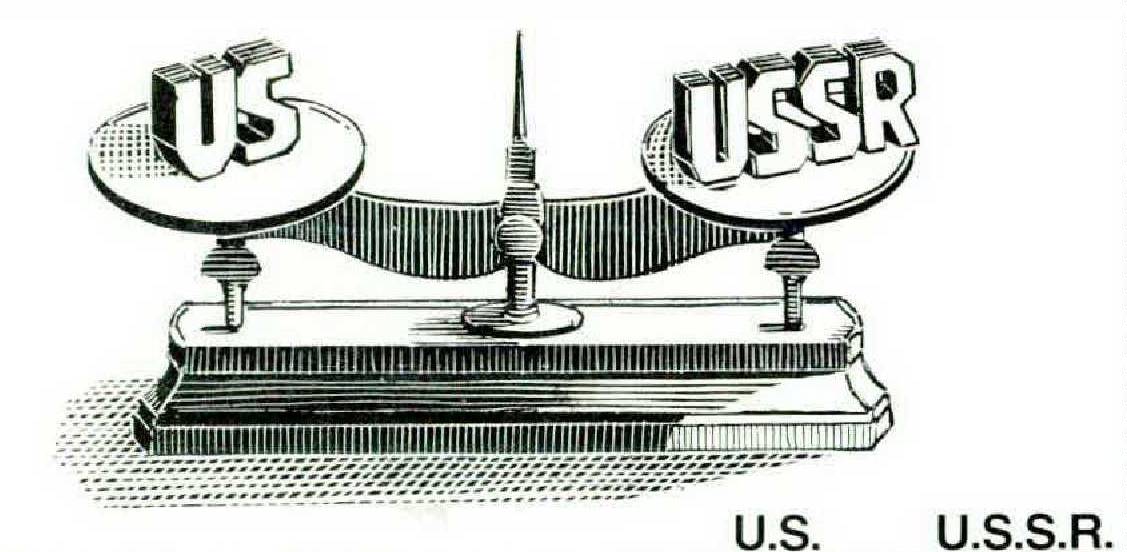
Comparative Strengths

MANPOWER
active duty military
2 million1
4 million
NUCLEAR FORCES
HEAVY BOMBERS
NUCLEAR MISSILE SUBS
ICBM
TOTAL NUCLEAR WARHEADS
574
41
1,054
9,200
156
62
1,398
5,000

COMBAT AIRCRAFT
5,026
5,262
SHIPS
MAJOR SURFACE COMBATANTS
ATTACK SUBS
175
81
230
234
TANKS
10,000
43,000
The general purpose forces—some 460 ships, including 175 destroyers, cruisers, and other “major surface combatants,” more than 5000 military aircraft, 10,000 tanks, tens of thousands of mines and missiles and the men and equipment to operate them—have a wider variety of functions. The 200,000 American troops stationed in Western Europe, with their tanks, missiles, and airplanes, are designed to prevent the Soviet Union and its allies of the Warsaw Pact from sweeping through France and Germany to the English Channel. The Navy has 13 aircraft carriers, each bearing nearly 100 planes. In addition to the nuclear-missile submarines, there are about 80 “hunter-killer” submarines, whose mission is to track, and if necessary destroy, other ships and submarines. Our tactical aircraft are variously designed to destroy other planes in the air, attack enemy ships at sea, bomb far behind enemy lines (“deep interdiction”), bomb and strafe near the battlefront (“close support”), and airlift large quantities of men, materiel, and fuel.
When Nitze testified against the SALT treaty before a Senate committee in July, the senators brushed aside many of his technical objections to the treaty. But it’s still wrong, Nitze ended up saying, because accepting it would “incapacitate our will" to take the steps that are necessary to improve our defense. Henry Jackson’s speech about “appeasement" was only the coarsest version of an allusion that is constantly made; the historical analogy that crops up in nearly all the writings of the Nitze camp is that of weak, complacent England before World War II.
Many others I spoke with said that the greatest obstacle to careful military thought was the end of America’s reign as undisputed Number One. “That moment really came many years ago, when the Soviet Union acquired its first deliverable nuclear weapon,” Robert Pranger of the American Enterprise Institute says, “but it’s aggravated now because of all the other irritations—economic, nationalistic—in the world.”Many people urging a strong defense admit that they do it for symbolic reasons as much as for technical reasons; Nitze’s argument against the SALT treaty boils down to nothing else. But the price for symbolic succor is steep. When plans for the MX missile were first announced last spring, the Administration estimated the total cost to be $30 billion. By the middle of the summer, congressional aides were displaying Pentagon working papers with figures of $50 and $60 billion. “That means it will come in at a hundred,” one of them said. Some of that money may come from the increased defense spending Nitze and Nunn are hoping to encourage; but most of the military men I spoke with were free of illusion that their share of national spending would significantly increase. Whether the MX costs $30 or $50 or $100 billion, most of that money will come from elsewhere in the defense budget, with the least glamorous items least likely to survive. The fantasy of Minuteman vulnerability, the scare talk of Paul Nitze and his acolytes, and the naked blackmail that men such as Nunn and Henry Jackson are demanding for their votes could do more harm to “real defense” than any weapon our enemies know how to produce.
★
★
IV. What Is To Be Done?
We have grown too familiar with the image of the closed frontier, the no longer limitless vista of American life. As applied to defense spending, it means that each path we choose eliminates several others. If we pursue complexity and high technology we give up reliability and numbers. I do not claim expertise in military matters or exposure to the realities of combat. But my talks with those who do left me with these suggestions about the ways to improve our “real defense.”
1. Forget about Minuteman vulnerability— and about the MX
To the 99 percent of us who know about nuclear weapons only what we read and dimly grasp in the press, Minuteman vulnerability seems the ultimate technical issue. Indeed, all sides admit that there are major technical issues to be resolved-the effects of “fratricide,” for example, or whether a phenomenon known as “pindown” might exist. (This is the possibility, suggested by Richard Garwin, that numerous high-altitude air-bursts of nuclear weapons over an ICBM field might prevent any of the missiles from being launched, even if they were not actually hit and destroyed.)
Yet I came to think that the main questions were not of technology but of politics, economics, and human nature. The tank and the machine gun changed warfare, but not warriors; and so with nuclear weapons. France and Germany used technical arguments, but were really talking about politics and tactics, when one decided to build the Maginot Line and the other opted for panzer divisions before World War II.
The Minuteman question is the most nakedly political, since almost no one contends that the devastating first strike against the Minuteman silos would ever occur. They worry, instead, about appearances—the sense of weakness that will be communicated at home and abroad. I was impressed by the arguments of nearly everyone I met that the appearance of strength does play a part, though only one part, in determining the affairs of nations. I was not impressed with the costly, cumbersome solution the Pentagon is proposing.
Over the last year, there have been several officially sanctioned remedies for Minuteman vulnerability suggested. Any one of these remedies really lumps together two separate components—a concealment system to protect American missiles from a Soviet first strike, and a bigger, more powerful American missile (called the MX) which is theoretically accurate and mighty enough to pose the same first-strike threat to the Soviet Union. One concealment system was called “multiple protective shelters" and proposed that 4000 silos be dug in the Southwest, among which 200 missiles would be shuttled randomly, under cover of night. (Inevitably, this was known as “the shell game.”) Another was the trench approach, burying each of the 200 missiles in a 20-mile-long trench, letting it shuttle invisibly from one hard point to another along the trench, so that the enemy would never know its whereabouts precisely enough to strike. By the middle of the summer, the Administration was endorsing a “racetrack" plan, in which missiles would ride around a large oval track; on warning of attack, they would “dash" (at 15 mph) to hardened shelters on spur roads off the oval.
Any means of concealment must attempt to satisfy two conflicting demands—keeping the missiles hidden at any given moment so they cannot be attacked, but allowing them to be inspected periodically so that the Soviet Union will be sure that we have not filled all 4000 holes with missiles. The tension between these ends creates problems with almost every proposed “basing mode.” The underground track system, the Pentagon’s favorite last spring, was undone by scores of technical obstacles, including a complaint from the cement industry that building the trenches would cause a nationwide shortage of cement. The “racetrack” leaves the missiles vulnerable to destruction except when they are in their hardened shelters; since a missile from a Soviet submarine could strike the racetrack six minutes after launching, it might catch many of the missiles on their slow dash to the shelters. To take care of that problem, and to soak up some of the extra money senators want to spend, the Air Force suggested in mid-August equipping each mobile missile with its own mobile anti ballistic missile, which would supposedly shoot down the Soviet rockets in (light.
Faith in the concealment systems is undermined most of all by their recent genealogy. Month after month, so it seems, the Pentagon has announced a new plan. Each time they assure us that this time they’ve got the answer, and that we should disregard the answer they were talking about before. This bothers politicians less than might be expected; the reason, I think, is that few of them expect that such a system will ever be built. Most of its ends are accomplished merely by its being proposed and discussed, for its purposes—to buy votes for the SALT treaty, to convince the Russians that we can threaten their land-based missiles if they continue to threaten ours—are those of symbolism and bargaining chips, not real defense.
But the very threat the MX poses to the Soviet Union is also the strongest argument against building it. If it did not lead to an arms control deal, it would force the Soviet leaders into a hair-trigger policy; they could not run the risk that we might fire first, so in moments of tension they might find their fingers edging toward the button. They might grow edgier still if they pay attention (as they certainly must) to papers like one from the RAND corporation in the summer of 1978, entitled “The Case for [U.S.] First-Strike Counterforce Capabilities.”
There are simpler, better, cheaper solutions, which avoid these complications. One approach, recommended by more and more respectable defense figures, is to acknowledge that the Minutemen are like an unfenced swimming pool in a neighborhood full of children—an attractive nuisance, more bother than it’s worth. “If land-based ICBMs will be so vulnerable and their replacements so costly,”Robert Pranger says, “why not abandon this leg of the Triad [which consists of land-based missiles, nuclear-missile submarines, and long-range bombers carrying nuclear weapons] or do nothing more to improve it?”2 Fred Kaplan, an assistant to Representative Les Aspin, points out that getting rid of the Minutemen would make the big Soviet rockets obsolete: retired General Maxwell Taylor has written that “the most elfective way to attain a higher degree of invulnerability would be to remove from American soil the most inviting targets for a surprise attack, our land-based ICBMs.”In giving up the Minutemen and relying on bombers and submarines, we would be giving up a few technical advantages, but we would also be giving up a disaster waiting to happen. “When military forces expose themselves to surprise attack,” says retired Admiral George Miller, “they encourage surprise attack thinking on the part of potential aggressors . . . . Move all U.S.-based nuclear weapons . . . to sea in subs and ships.”
Another alternative is simply to leave the Minutemen where they are, since maintaining them costs very little and would protect us against some unforeseeable, catastrophic discovery that might suddenly enable the Soviet Union to shoot our bombers from the skies and blow our submarines out of the seas. Unlike abandoning the land missiles altogether, this would force the Soviet Union to divert some thought, worry, and weaponry to coping with this challenge. By retaining 50 or 100 of the current 1054 (as The Boston Study Group recommends), we would have enough to do tremendous damage to the Soviet Union, but not nearly enough to make a surprise attack on our land-based missiles worthwhile.
2. Concentrate on submarines
Everyone agrees that nuclear-missile submarines are the least vulnerable weapon system—the “ultimate deterrent,” they are usually called. But they have two disadvantages when compared with land-based missiles. One is the accuracy of their missiles: because the sub’s location when it fires can never be determined as precisely as that of a fixed silo in the ground, an element of error is built in from the start. It is not a big enough error, according to specialists in submarine missiles, to affect anything except strikes against Soviet missile silos: when it comes to destroying air bases, railroads, factories, or cities, the submarine missiles are (theoretically) accurate enough.
The second problem is communication. Normal radio waves penetrate only a few feet into water, so it can be difficult to get in touch with a submerged submarine. Today’s solution is for the subs to trail a radio buoy, painted black and shaped like a stubby bomb with wings, which rides above the submarine, a foot or two beneath the surface of the water. Through the fiber-optic cable that connects it to the submarine, it transmits the radio signals it receives.
At the moment, no one is very worried that these small buoys would give away the location of the sub; but against that possibility, the Navy has tried to build its “extremely low frequency” broadcast system. While normal radio wavelengths are measured in the thousandths of an inch, these ELF wavelengths are measured in miles. They can penetrate deep in the water and reach submarines. They transmit information much more slowly than normal radio waves—it may take five minutes to get across a single word, half an hour to transmit a verifiable nuclear strike orderbut they will always reach the submarine. The Navy wants to use an ELF system as a “bell ringer”—a way to notify submerged vessels to come near the surface and get more detailed information through normal radio waves. Ten years ago, under the name Project Sanguine, the Navy proposed to dig up much of Wisconsin to lay down 5000 miles of blast-hardened transmitting antennas. Now, the proposed system involves only about 100 miles of buried cable, all but a mile or two of it to be laid along public rights-of-way.
The real advantage of the submarine is its ability to survive, which is why the Trident is such a bad idea. From the managerial, cost-efficiency point of view, it may make sense to put 24 nuclear missiles on one big ship, but to ensure deterrence, it is belter to divide those missiles between 2 ships, or 6, or 12. The Navy itself is having public second thoughts about the Tridents—largely because, at $1.59 billion apiece, they leave little money for anything else in the fleet-and Dr. David Mann, an assistant secretary of the Navy, recently made headlines in the defense world by reporting that Tridents could be simplified and built for two thirds the price. Richard Garwin has crusaded endlessly on behalf of small, numerous “submersibtes.” These would be tiny vessels (350 tons each, versus the Trident’s 18,500) carrying just one or two missiles, and patrolling the coastal waters of the United States, where communications problems would be least and protection against Soviet anti-submarine forces would be greatest.
3. Get more help from our allies
Beyond defense of the homeland, our least controversial military mission is protecting our allies in Western Europe and the Pacific from attack. These include Japan, Korea, and all the NATO nations, but at the moment NATO is in the spotlight. For the last few years, under the “Long Term Defense Plan,” all the NATO nations, including the United States, have promised to invest more in the defense of Europe. No one doubts that NATO has a sizable adversary to contend with, nor that all those tanks and soldiers stacked up in Eastern Europe have a potentially malign effect. But on the principle of marginal returns—of putting money where it will do the most good—it is hard to see why this is where our extra money should go. For one thing, it is difficult to conceive of the political and economic circumstances that would persuade the Soviet Union to attack. “If they invaded West Germany and made a unified, communist Germany,” says a Johnson Administration defense analyst, “the first thing the Germans would do after they got back on their feet would be to turn around and march on Moscow.” In the back of the Soviets’ minds, if not the front, is the long-standing American promise to retaliate with nuclear missiles as soon as the communists cross the line. If they did not believe that, they could contend with the more certain retribution of the French, who have developed their own, independent nuclear force precisely so they would not have to wait for help from the Americans.
in order to avoid letting crises turn into a game of chicken over nuclear retaliation, most defense experts think it is sensible to equip the NATO nations with a large, reasonably convincing conventional force. William Lind emphasizes the perils of the present forward-defense theory, so similar in its rationale to the Maginot Line; rather, he says, there should be reserves ready for action throughout the NATO nations, prepared to throw the invaders back. These or other steps may be useful to make NATO feel more secure—but if so, let the Europeans pay for them. Except for England, the NATO nations spend a little more than half as much of their national product for defense as the United States does. In 1977. for example, when (according to the Institute for Strategic Studies) the United States spent 6 percent of its gross national product on defense, France spent 3.6, Germany and Belgium spent 3.4, and Switzerland (theoretically “neutral,” but in practice defended by NATO’s force) spent 2.
★
★
Were the economic circumstances reversed, the deutschmark floundering against the dollar, we might consider it our proper role to bear the extra burden. With the dollar continuing to plummet and periodic lectures on fiscal responsibility coming from Zurich and Bonn, it is time for the nations of Europe to pay the extra cost of their defense.
The same is true of Japan, which spends less than one percent of its national product on defense. Steven Canby says that we should encourage the Japanese to reconstitute their Pacific battle fleet. “A Japanese fleet” he says, “would release U.S. assets that provide them less and less protection; it would constitute a far stronger conventional bulwark in the northwest Pacific; and, by increasing the resources devoted to defense from one to three percent of GNP, it would do much to eliminate the largest source of friction between Japan and the United States—the Japanese trade surplus.”
4. A modest policing force
Most U.S. forces are lined up for the big showdown with the Soviet Union, with a few left over for battles elsewhere in the world. This is known as the “war and a half” principle; before the split between Russia and China, when the Pentagon planned to fight them both, we operated on the “two and a half wars” plan. The forces opposed to the Soviet Union have so far succeeded in their main objective of deterring actual combat. The “half a war" remainder is harder to figure out.
Many of the woes afflicting the nation, many of the real threats to our security, now come from sources other than the masters of the Kremlin; oil—the most obvious example-terrorism, the pressure on resources and the environment, the possible contagious effect of conflict in faraway states. If we allocated force in strict proportion to irritation, we’d aim much more of the military toward the oil producers and other Third World countries; but most of these are problems the military cannot do much about.
During the dreadful week last February when American ambassadors were under assault in Iran and Afghanistan and the President was dressed down in Mexico, one congressional assistant said, “People think we’re losing ground to the Russians because all this stuff happens to us. The truth is that both superpowers have lost ground to all the other nations-and to terrorism, a different economic system, Third World nationalism. It’s bothersome as hell, but there’s not much we can do about it, at least not militarily.” Five years ago, Robert Tucker won notoriety for his proposal that we invade the Arab oil fields to break the OPEC boycott. The same scene comes to mind when quicker, more flexible intervention forces are mentioned. “If you want oil, attacking the fields is the last thing that will get it,” says a consultant to a Middle Eastern government. “It would take nothing for the governments there to destroy the major pumps from the fields. It would be years before you could get any oil flowing again.”
What force can still be used for is several discrete ends—making sure we can evacuate Americans when the need arises, serving a very short-term, limited policing and peacekeeping function, last done with some success in Lebanon in 1958. While intervention to turn the tide of civil wars or guerrilla actions seems doomed to catastrophe, outside forces might occasionally be useful to separate the combatants in local fights that threaten to expand (e.g., Arabs and Israelis in Jerusalem). If a neutral, international force such as the United Nations had the firepower and the spine to provide such a service, so much the better; until it does, this will remain the responsibility of the major powers.
Forces designed for this role should have quickness and adaptability as their cardinal virtues: get in, act calm, get out. This is what fJarold Brown says he is developing, under the name “unilateral force”; it is also what many in the Marine Corps think they arc providing, as part of their Marine Corps 2000 plan for the next twenty years. It may be the Marines or the unilaterals, but we don’t need both.
5. Use the triage system for weapons
If “marginal returns" sounds too much like costaccounting, military planners should be comfortable with the idea of “triage.”In war zone hospitals, doctors ignore those who are going to die anyway, and those who look as if they will survive, and concentrate their efforts where they will make the difference. So it should be with weaponry. One of the best ways to get off the high-cost, high-technology, high-vulnerability path would be to ask whether each new system makes a fundamental difference.
Consider the high-technology Navy, made up (as Steven Canby says) of “expensive planes to protect an expensive fleet built to support only the planes.”The mighty aircraft carriers of this fleet could be armed even further, with even more complicated aircraft on their decks and even more sophisticated missiles on the aircraft, the better to prepare the fleet for an assault on the Soviet navy in its strongholds on the Kola peninsula. But if the fighting should reach this level, would not the conflict already have become a nuclear war? The same is true of “tactical" nuclear missiles in Europe. The Pentagon will spend $145 million this year for the Pershing II missile, which can strike the Soviet Union from West Germany: from the Russians’ point of view, this will be little different from an attack with an ICBM. Fred Kaplan suggests the example of the AEGIS system -an elaborate radar designed to fend off aerial attacks on American ships. The system is more sophisticated than necessary to cope with lowgrade threats (such as the incidents involving the Pueblo or Mayaguez), but it could not hope to stand up to a high-grade attack in a war with the Soviet Union. In neither case would it affect the outcome: by the principle of triage, it is useless. The same money spent elsewhere in the Navy—for cheaper diesel submarines, especially, to match the Soviet Union’s large fleet of attack subs—might make a difference in protecting American vessels and destroying the enemy’s.
Long-range bombing, known as “deep interdiction" in the trade, is open to similar question. “After the first few attacks, people get used to it, and you just don’t kill many anymore.” says one official. From the London blitz to the bombing of North Vietnam, deep interdiction did at least as much to solidify morale as to reduce supplies; it did not make a difference in the war. Yet the demand for “deep interdiction" leads to planes with exotic engines, radar, and wings—expensive planes, of which we can afford but a few. What does make a difference is numbers of planes; near the end of World War II, the Germans knew that any tank that moved would be shot from the sky, since the Allied planes were always there. It is hard to have enough planes to maintain that presence if each one is the top of the line.
Targets in America
Many low-technology approaches do hold out the hope of making a difference. The mining of Haiphong harbor was one of the rare tactical successes of the Vietnam War; Richard Garwin has proposed a thick belt of mines through the “Greenland-Iceland UK gap.” The mines could be activated by remote control during a conflict to bottle up the Soviet fleet. William Lind says that blimps can be the ideal antisubmarine aircraft. Because they travel slowly and steadily, they can search more carefully for submarines than airplanes can, and they come at a fraction of the cost. During World War II, he says, no convoy escorted by a blimp lost a ship to enemy submarines.
★
★
Lowest of all on the technology scale, but most crucial in making a difference, is repair and readinessfuel, spare parts, trained engineers. “For want of a nail . . . ” is a slogan not often heard in the era of complex weaponry; it might well be the slogan for “real defense” in the 1980s.
6. Train leaders and soldiers for combat, not management
Complaint about the state of the Army—drugs, desertion, poor discipline, bad morale—is a commonplace these days, which few bother to refute. But it is usually directed at the wrong target. “It’s that volunteer Army,”veteran soldiers say; dissatisfaction with the volunteer force has led a number of congressmen to suggest a return to the draft. Yet, for the most obvious problems, the volunteer Army is not to blame. Manpower costs are high now; but, as John D. Johnston, a retired Air Force colonel, points out, a return to the draft would cut total manpower costs by a small percentage, because it would have no effect on pension costs or pay for those who stay beyond their first hitch.
Yet the complaints are real, and arise from something that cannot be measured by statistics: the sense that the Army is no longer made of, or led by, men who can fight. “You should think of the military as a Burkean, not a Lockean, world,” says James Woolsey. “An organic whole, in which people are bound to each other by ties of obligation and loyalty, rather than fee-forservice, limited contract, limited obligation.” In Crisis in Command, Richard Gabriel and Paul Savage explain how the managerial Army has meant the end of that organic whole and the creation of a system whose incentives, performance, and internal values resemble those of the Civil Service. Within such a system, it is not reasonable to sacrifice or to risk death for abstract goals; it makes sense only to minimize risk in pursuit of promotion. In the German army during World War II, generals suffered a far higher casualty rate than enlisted men. One third of the 650 German generals were killed in action. In ten years of combat in Vietnam, only three American generals were killed, two of them (according to Gabriel and Savage) in helicopter crashes unrelated to combat. In the modern American Army, there are few bonds of mutual sacrifice and commitment, little perception among the soldiers that their leaders will share the risks they ask the troops to take. All that remains is the silent, individual pursuit of career ends.
It is this change of the spirit, numerous people suggest, that lies behind many of the mundane ills of the military—escalating pensions, ennui in the officer corps, the difficulty of holding on to the talented enlisted men who make the services run. When the Army is run like Sears or the Agriculture department, it will be judged the same way—on the basis of hours, pay, fringe benefits. But no one expects Sears to be ready to fight a war.
Gabriel and Savage suggest a variety of corrections, from special regimental uniforms, which might rekindle unit-by-unit pride, to thoroughgoing changes in the ethics of the officer corps. The crucial point is to recognize this change of spirit in the military as its central problem, and to understand that its solution will be different from that for any other institution. Nowhere else are men asked to lead other men to die for such abstract goals as patriotism, pride, devotion to duty and to their friends. That spirit will not come from a management consulting firm; like more realistic weapons, it requires constant attention to the realities of the battlefield rather than those of the organization chart.
Richard Garwin stood outside the Pentagon, squinting in the sun. Before leaping up the steps, briefcase bouncing in his hand, he said, “Sometimes I think none of it is real to them—the congressmen. Getting elected is real. Making nice speeches is real. But not the idea that these forces might ever have to be used,” □