Cancun: "North" and "South" at the Summit
No answers were found at the meeting in Mexico, but at least the tone of the discussion was hopeful

NATION BY NATION they arrived, stepping off their jets onto the redcarpeted runway of an airport carved out of the jungle of an island off the Yucatán peninsula. The Algerians, wearing the smug smiles of founding members of the movement of non-aligned nations, spoke only to those whose good faith had long since been carved in stone. The Chinese looked frightened and out of place and spoke to no one at all. The Saudi princes seemed to glide along knowingly, their white, black, or brown robes billowing as they held hands. whispered, and cast furtive glances at everyone else. The Guyanese wore lapel buttons that pictured their president, Forbes Burnham. The Japanese brought along their own Sony television sets and, never the ones to be caught unprepared, a supply of Japanese mineral water. President Ferdinand Marcos of the Philippines brought his own furniture and thousands of copies of a biography of himself. The French went straight to the local Club Méditerranée, where they could eat and drink in the manner to which they are accustomed.
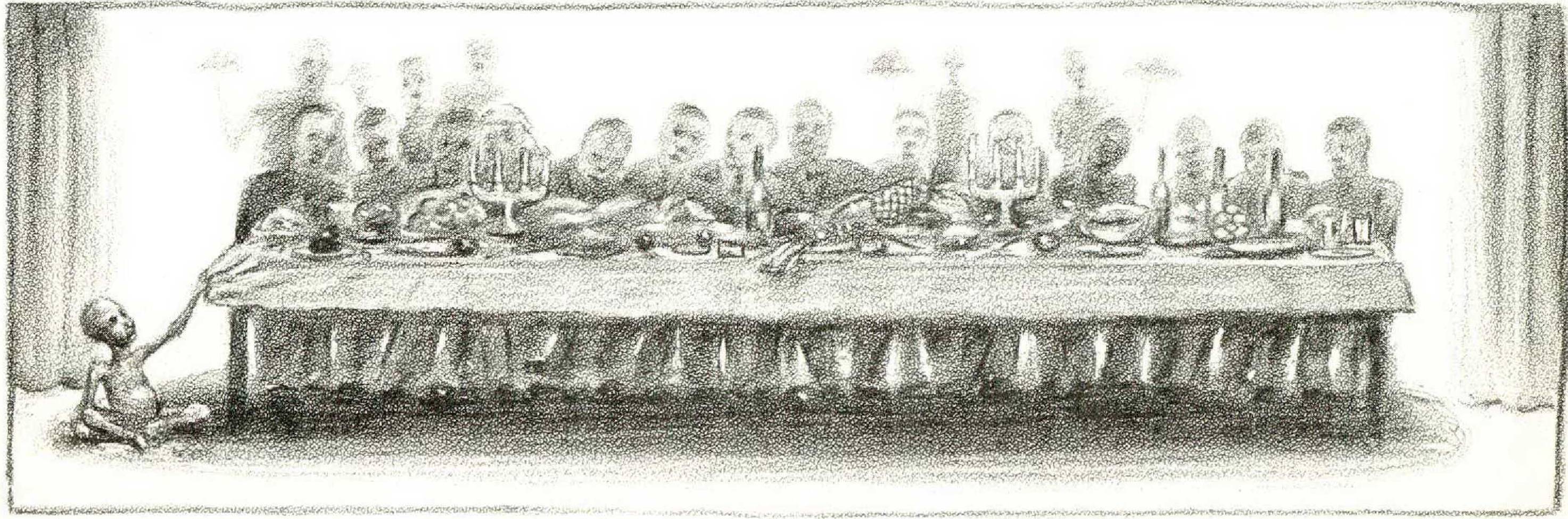
There was a Noah’s Ark quality to this summit, last October, of eight countries from the industrialized “North” and fourteen from the developing “South,” brought together out of a sense that catastrophe is impending unless the world finds a better way to share its resources and its wealth. But in the end, the result reached there may resemble nothing so much as the Kellogg-Briand Pact, the 1928 agreement fashioned by an American secretary of state, Frank Kellogg, and a French foreign minister, Aristide Briand. The Kellogg-Briand Pact renounced war as an instrument of national policy and eventually attracted the signature of nearly every nation in the world. A ban on war proved difficult to enforce. The joint declaration of Cancún eloquently restated the case for a more just international economic order, and said that “hunger must be eradicated”; it simply failed to say how.
The “North-South dialogue” is probably as awkward a diplomatic process as has ever been fashioned. The poor nations of the world are, in effect, throwing themselves at the feet of the rich, trying to find the mix of stridency and reason that will bring results. They threaten and cajole, appeal to charity and fear, yet somehow try to preserve their dignity along the way. The rich countries, meanwhile, faced with domestic economic conditions that do not exactly inspire confidence, find themselves saying: “We understand. We really do. But we’ve got problems too, and you have to try to understand them . . . and be patient.”
This particular installment of the dialogue took place at one of the world’s newest and most luxurious seaside resorts, and there were moments when the mere fact of this assembly of twentytwo governments seemed to eclipse the substance of their discussions. The Mexican sponsors of the summit produced souvenir tote bags, ashtrays, pencils, and Frisbees; they issued a stamp to commemorate the occasion and gave every delegate a first-day cover. The pomp of the official arrival and departure ceremonies came complete with schoolchildren trucked in to wave streamers and cheer for people they had probably never heard of. All of this was just a lot of noise to the Mexican peasants in the town, their faces frozen in bafflement.
ANY CONFERENCE OF this sort is in danger of seeming extravagant or irrelevant. But this international encounter was worth some expense and some risks. For one thing, it featured a subtle change in the tone that prevailed at earlier meetings—away from exhortation, toward nuts and bolts. Talk of duty and obligation was replaced, at least part of the time, by discussion of capacity and willingness to help. And whereas Jimmy Carter, the self-proclaimed friend of the Third World, had sworn never to go near such a gathering, his hard-nosed successor, Ronald Reagan, plunged in with gusto.
(Along with him, of course, Reagan brought an enormous White House press corps. If the spokesmen for the poorer countries thought that meant access to the American media, which rarely discuss issues of development, they were in for a surprise. “We’ll try to feed you as often as possible,” Secretary of State Alexander Haig promised at an early briefing in the makeshift White House press room, situated in the basement of the hotel where most of the American reporters stayed. The Reagan Administration did feed the media, and many American journalists’ accounts of what happened at Cancún came straight from that official source. Some members of the White House press spent an entire week there without meeting a single foreign delegate.)
Understandably, Reagans behavior was viewed by everyone as a major issue. Although the Mexicans took great pains to treat him as just another head of state, he did get the best hotel room in town. In the weeks before the Cancún summit, Reagan had given two tough speeches—one to the annual meeting of the World Bank and the International Monetary fund in Washington, and the other to the World Affairs Council of Philadelphia—that seemed to reject the whole basis of the undertaking. Official development assistance he dismissed as handouts, which would not solve the poorest countries’ problems even if it was more widely available. The best path to prosperity, the President said, was to be found through free trade and private investment. No nation had ever been less developed than the fledgling United States of America, and look how far it had come through economic freedom.
But once on the scene, Reagan and his team impressed their counterparts with their moderation. After only noting the absence of the Soviet Union (which had been invited, but ignored the whole affair on the grounds that international economic disparities are exclusively the fault of the West), they mercifully dropped the subject. There were no great promises of new American aid. Reagan did say he would send U.S. agricultural task forces around the world to help the neediest become self-sufficient—but the cost would be borne by private business rather than by the government. And the United States did accept the hitherto controversial principle of further “global negotiations”—someplace, sometime, somehow—to talk about how to share wealth more evenly.
That was not the concession it might at first have seemed. For if Reagan learned anything at Cancun, it was that the richest country in the world was becoming increasingly isolated from all the rest on these issues. America could not merely sit back, point proudly to its past record, and give lectures on laissez-faire economics, when even the Conservative Government of British Prime Minister Margaret Thatcher was supporting global negotiations. And the United States was asking plenty of favors itself—imploring others to take on a bigger share of the Western defense burden and to join a kind of international anticommunist crusade. Once it paused in its lectures on how-to-succeed-just-like-us and listened to what others were saying, the American delegation found much of the dialogue quite reasonable.
To be sure, there was some ranting and raving, and more than one delegate demanded an international income tax to enforce sharing. But there were also the measured remarks of President Julius Nyerere of Tanzania, a country that inherited little in the way of infrastructure or know-how from the colonial era and whose only recent accomplishment was to drive Idi Amin from power in neighboring Uganda. That venture devastated Tanzania’s already weak economy. Nyerere appeared to have examined Reagan’s pre-conference remarks and designed a persuasive reply:
We are here to talk about poverty and what can be done to bring it to an end for the good of us all, including the richer among us. We are talking about individual poverty— people perpetually suffering from the diseases of undernourishment and therefore unable to do a good day’s work, and people continually threatened by actual starvation. We are also talking about the kind of national poverty which means that nations are too poor to have the capacity to invest and thus to increase their wealth-production in the future.
... it is now recognized that no nation lives, or can live, in isolation. We are all affected by . . . the linkages created by the present systems of international production and exchange.
World trade depends upon the ability of people to buy. A salesman has to be interested in the prosperity of his potential customer. The poverty of the poor is thus a matter of economic concern for the rich. It is also a matter of political concern; not even the poorest will indefinitely accept a further reduction in their standard of living without protests—and political instability in any nation creates an opportunity for external intervention and thus a possible change in the so-called “balance of power.”
And in recent years the poor have been getting poorer . . . Our balance-of-payments deficits are enormous, and getting greater. This is not because we are trying to live as though we were rich. It is because our already low income is constantly being reduced as a result of our participation in international trade . . .
The increasing impoverishment of the poor is not the result of some evil conspiracy by anyone. It results from the system of international trade and exchange which has grown up over the years ... we find ourselves always selling cheap, and always buying dear.
. . . the poor are the first and worst victims of the present system; but we are not the only victims. When we cannot pay for the goods from industrialized countries, their economies also decline. The evidence is there.
. . . the Third World is not asking for charity but making a proposal for dealing with a world problem. We are asking for a chance to earn our own living in a just international system. We are asking for an end to the system which now causes wealth automatically to flow from the poor to the rich. And we are asking for the implementation of the world commitment to attack the poverty which endangers all of us— rich and poor alike.
If the Americans found it hard to accept that straight talk from a committed socialist, they could listen instead to the Nigerians, who understand well the benefits of international trade, if only because they are the second-largest foreign suppliers of oil to the United States. Dr. Ishaya Audu, the Nigerian minister of external affairs, said that yes, he could understand the value of individual initiative and the importance of a middle class—for “if you only have a little and you spread it too thin, then nobody has anything.” But as for this “private-sector voodoo,” Nigeria had tried that route, and it simply did not work. Third World development means, above all, agricultural development, and private business is understandably reluctant to take the substantial risks of investing in agriculture. Nigeria, thinking it had persuaded a major multinational company to do so, ended up instead with only a factory producing a seasoning and other processed foods.
The Brazilians provided another instructive story. Through the application of the principles of free enterprise, they have quickly worked their way into the more prosperous upper tier of the developing world. They have graduated from reliance on international lending institutions and borrowed willingly from the Western banks, to the point that Brazil has an external debt of some $60 billion, which is still growing. But its ability to keep up with the payments is now threatened by uncertainties in the prices of commodities such as coffee, and its economy could come down like a house of cards at any moment.
One reason for Brazil’s debt, of course —and for the exacerbation of other problems of the developing world—is the skyrocketing cost of energy. Oil prices, traumatic enough for Americans, Europeans, and Japanese, have been disastrous for the Third World, and many economies that seemed on the verge of taking off have stalled completely as a result. The issue was discussed at Cancun, but not as comprehensively as some of the Western participants might have liked. The developing countries were quite prepared to restate their proposal that an affiliate of the World Bank be established to deal with energy, but they were not about to utter a primal scream in front of Crown Prince Fahd of Saudi Arabia. A number of Third World countries, including three of the key participants in this conference—Algeria, Venezuela, and Nigeria—are, after all, members of OPEC, and have benefited greatly from oil-price increases. And the very poorest nations are quite frankly afraid to talk to the oil producers the way they do to the Americans and the West Europeans.
Many in the developing world also have a growing, if grudging, admiration for OPEC as a kind of Robin Hood of the international economy, setting an example that they would like to emulate if only they could turn their own resources into something as strategically critical as oil.
Of the fact that OPEC is robbing the rich there can be no doubt; its members’ record of redistribution among the world’s poor, however, is open to question. (Some OPEC countries claim to be giving development assistance equal to 3 or 4 percent of their gross national product—compared with the official United Nations target of .7 percent, the British record of .4 percent, and the American record of about .25 percent—but it seems clear that they could give much more, in absolute terms, if they were so inclined. Instead they stash their profits away at high interest rates in Western banks, which lend the money back out at even higher rates.)
But the record of OPEC was not the only subject on the unofficial taboo list at Cancún. Reagan and other Western leaders liked to preach about the need for each developing country to “put its own house in order.” But as Nyerere bluntly said, “We are not here to talk about the internal affairs of any of us . . .” Among Nyerere’s colleagues at the conference table, however, were people who have hundreds, if not thousands, of political prisoners, who have been using external aid and internal development to enrich themselves and a small privileged class rather than trying to improve the lot of their own downtrodden masses. “Evil propaganda,” declared Dr. Audu, of Nigeria, when asked whether the inequities of the internal distribution of wealth in the developing countries was not a proper topic for discussion. “Corruption is not the exclusive preserve of the Third World,” said President Marcos, of the Philippines. And that was that.
AT THE CLOSE OF the amazingly brief and sadly unfocused conference, the major disagreement was over where to talk next. Some wanted to set up a whole new structure for global negotiations, outside all existing institutions; but to others that sounded like a bureaucratic and administrative nightmare. Most of the developing countries preferred going to the United Nations, where each government’s vote has as much weight as any other’s, so a rhetorical majority easily translates into a practical one. The United States, however, found itself arguing on behalf of the unique competence of existing specialized agencies such as the General Agreement on Tariffs and Trade (GATT), the World Bank, and the International Monetary Fund to handle the specific implementation of good intentions. In the latter two agencies, voting is weighted on the basis of contributions, so it is difficult for the South to gang up on the North; the Bank and the Fund also tend to impose Western-style conditions on some of their loans, and those conditions run up against Third World ideologies. (There is an irony just now in American enthusiasm for the World Bank and the IMF: the United States is behind in its promised contributions to them, especially to the International Development Association, the window at the World Bank that gives fifty-year loans to the poorest countries at virtually no interest. Congress has been feuding over whether to honor the American pledges, and the Reagan Administration, knowing the unpopularity of “foreign aid” among its conservative constituency, has been unwilling to fight for what it claims is right.)
The conference’s eventual compromise, hammered out by the president of Venezuela, was to assert that all the leaders assembled there “confirmed the desirability of supporting at the United Nations, with a sense of urgency, a consensus to launch Global Negotiations on a basis to be mutually agreed and in circumstances offering the prospect of meaningful progress.” in the absence of anything more concrete, that would have to represent the spirit of Cancun for now.
The Indians gave gifts to reporters who attended Prime Minister Indira Gandhi’s news conference at the end of the summit, and on their last night in Cancún some journalists found little trinkets from the Filipinos in their hotel mailboxes. The Japanese took their leftover mineral water back home to Tokyo. A few days later, it was learned that because of a poor maize harvest in Tanzania, famine is imminent.
—Sanford J. Ungar