Where Sprawl Comes to Squeeze: Solving New Problems of Density in Los Angeles

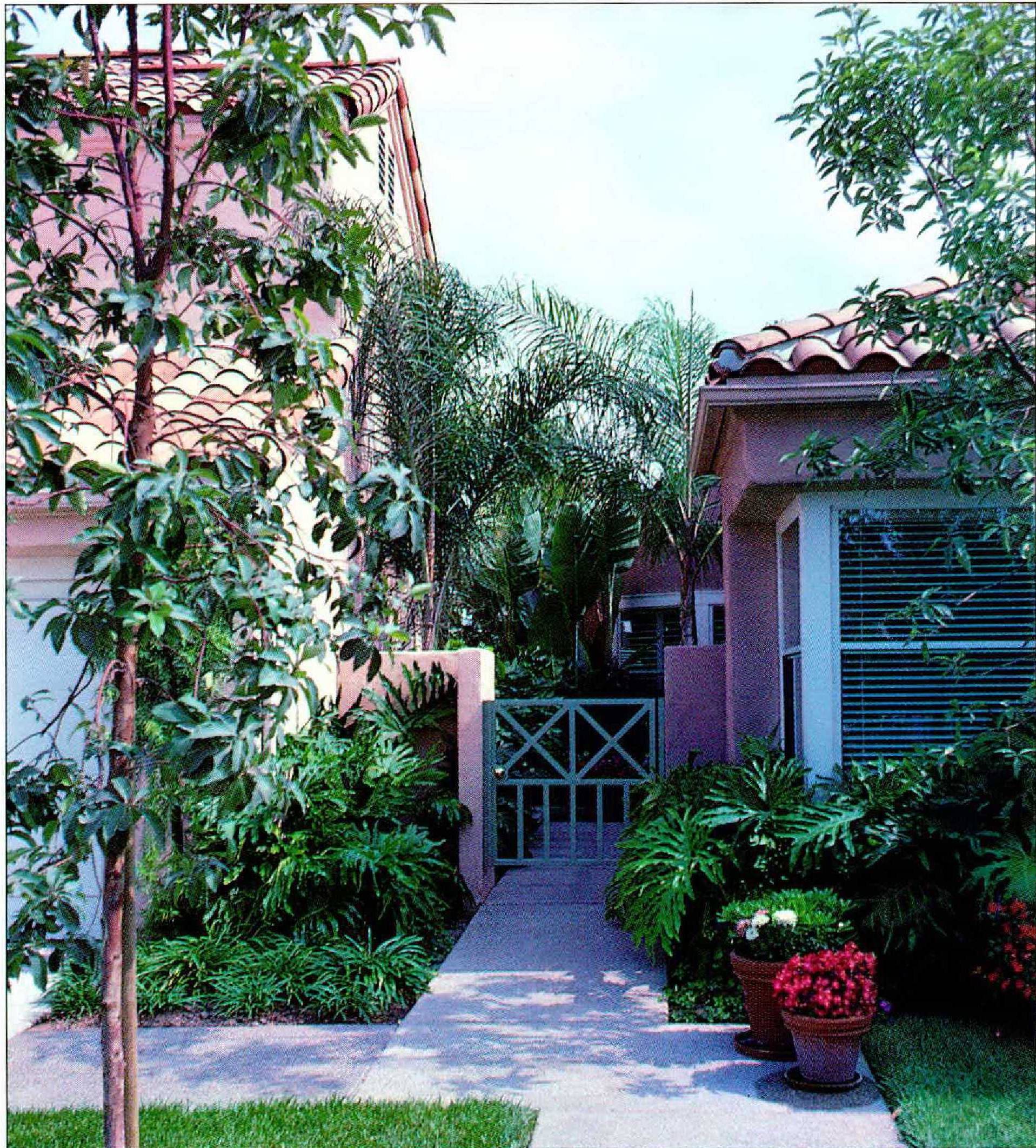
THIS IS WHAT it’s like to visit a tract house of the kind now commonly being built in Southern California: You park your car on the narrow, curving street or on the house’s very short driveway and proceed along an entrance walk toward the front door. If you’re a nonCalifornian, you probably notice how minuscule the front lawn is. You don’t have much opportunity to dwell on its meagerness, though, because almost immediately you find yourself passing through an arched entrance gateway or under a projecting roof and arriving in a much more alluring environment—a courtyard secluded from the street. This courtyard extends fifteen to thirty feet along one side of the house, appropriately terminating with a view of the main door; when nicely landscaped, it counteracts the compressed feeling one gets on the street, and gives the house a certain graciousness. The more skillful firms involved in tract-house design, such as Berkus Group Architects, based in Santa Barbara, and Danielian Associates, in Irvine, almost routinely rely on such side entrance passages to relieve the sense of crowding and to create an appealing transition zone between the public street and the private interior.
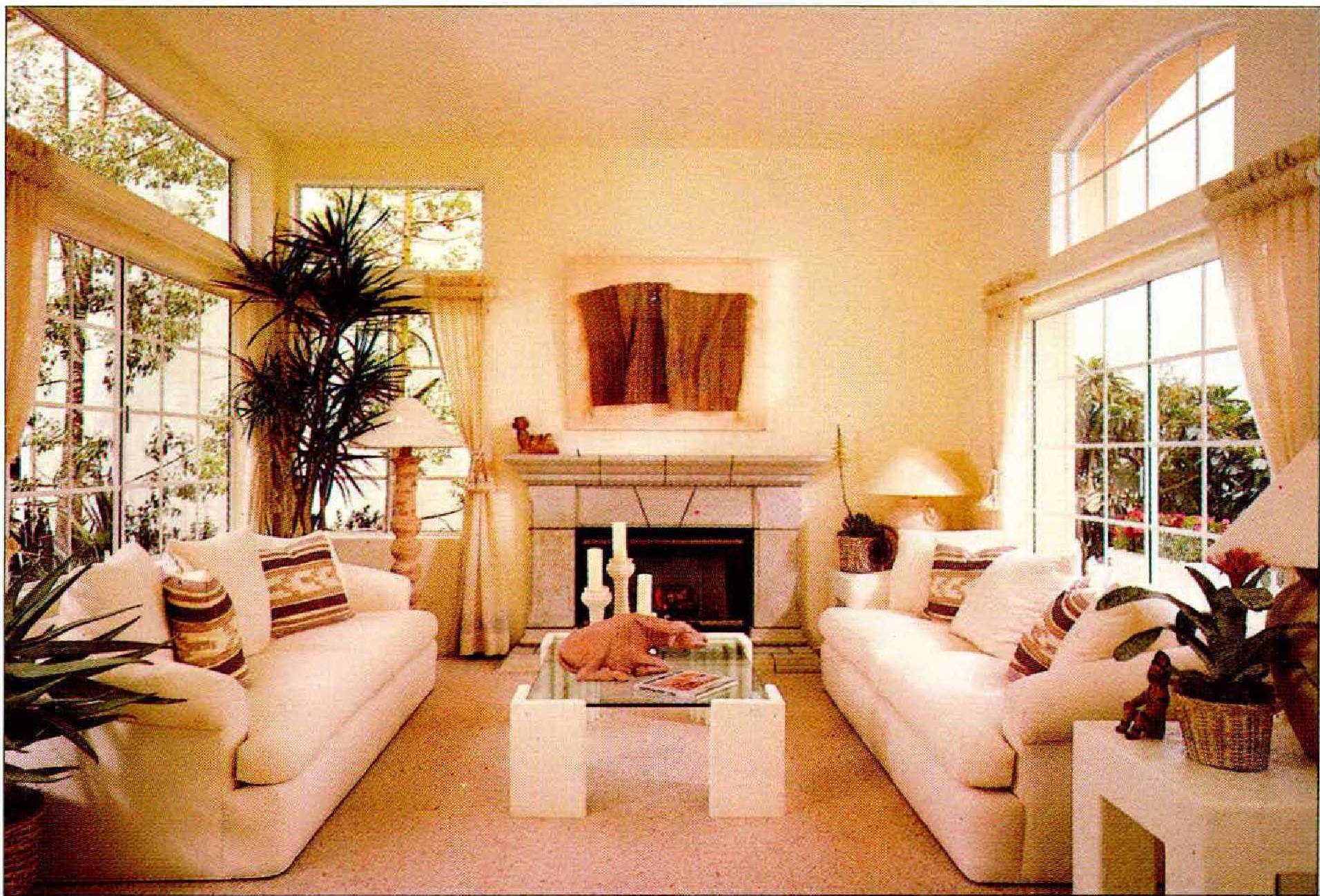
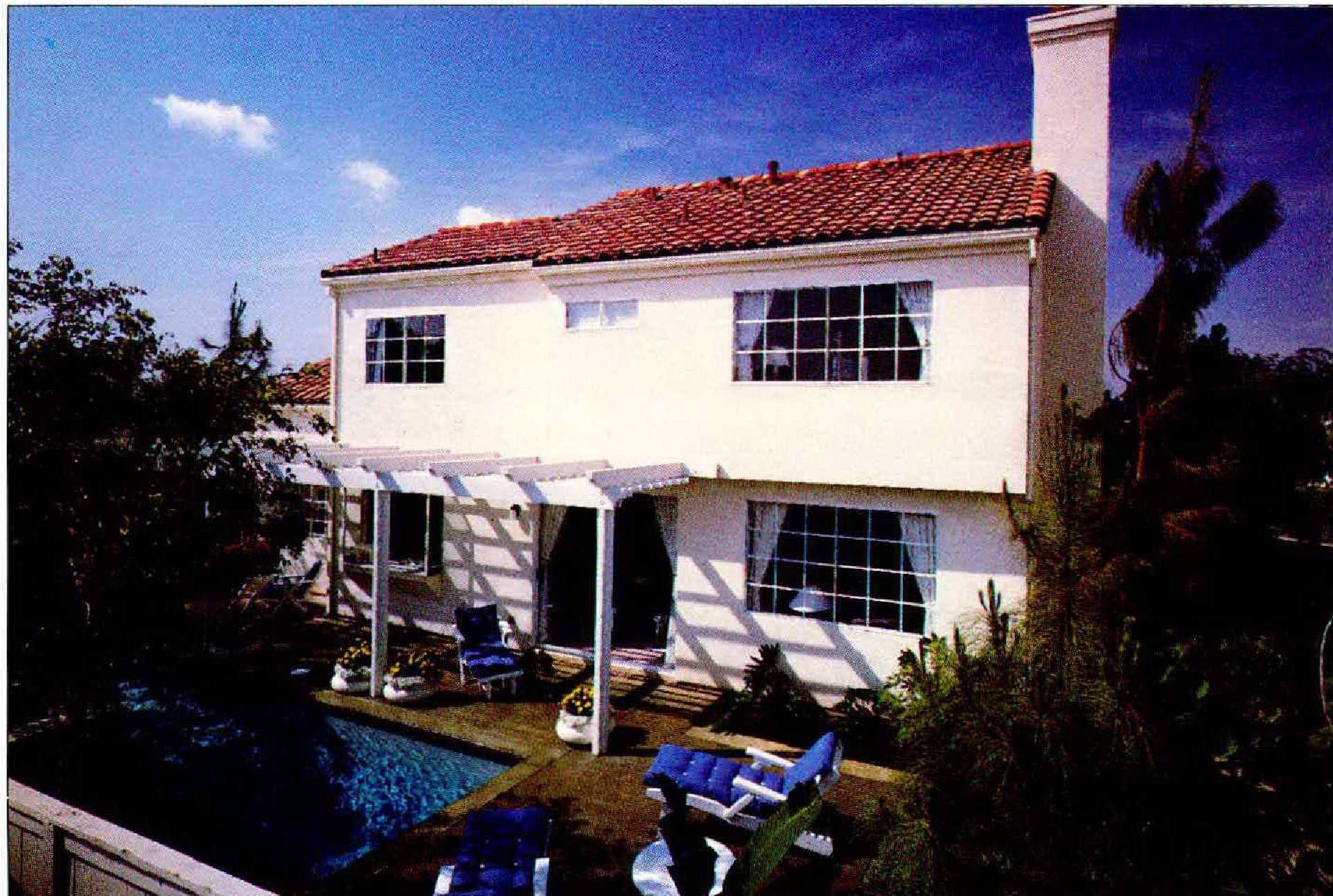
Once you go inside, the space seems to open up in all directions. Often there is a foyer from which you descend a step or two into the living area. The ceiling slopes sharply upward, adding visual drama and intensifying the kinetic pleasure of walking forward into an expanding interior. Glass doors and corner windows are positioned to offer continuous views through the interior and out into the back yard, which in the model homes is nearly always furnished with a fountain, a pool, a pergola, or an elaborate patio. The back yard, with a fiveor six-foot-high privacy wall around its perimeter, is not very deep, but the assumption seems to be that if you buy landscaping as lavish as the model homes’, you’ll hardly notice that there isn’t enough room for a vigorous game of badminton. Typically the front courtyards and back yards are shielded from the neighbors’ windows.
The better architects supply not only plenty of natural light and carefully organized views but also series of smaller glass panels, in sometimes artful compositions, in the walls above glass doors or corner windows, so that in addition to seeing the gorgeous if circumscribed back yard, you take in a vista of limitless sky. What’s marketed is not so much land and shelter as views and style.
To A NON-CALIFORNIAN, the most remarkable aspect of typical tract houses is how far people who want to buy detached houses can drive from the business centers of Los Angeles—to places like Moorpark, about forty miles northwest of downtown Los Angeles— and still end up spending as much as $220,000 for a house on a lot only forty feet wide and about a hundred feet deep. The most successful of Southern California suburban architects have focused their energies on avoiding the feeling of being hemmed in. In fact they are packing the houses onto the land—as many as nine detached houses per acre.
It is possible, of course, to get a less expensive new house on a lot that is much larger, but the cost is an exceedingly long drive through increasingly tangled traffic. The period of the newly planted suburb that was both broadly affordable and easy to get to has pretty much ended.
The Los Angeles Times recently chronicled the commuting life of a homeowner in Palmdale, on the edge of the Mojave Desert at the northern fringe of Los Angeles County, who climbs into his Ford Bronco at 6:15 every weekday morning and drives sixty-five miles—across a summit in the San Gabriel Mountains and then down the freeways of the Santa Clarita Valley and the San Fernando Valley—to get to his job with the gas company in Hollywood, On a good day the trip takes an hour and fifteen minutes one way. When traffic forms into bottlenecks, the journey drags on for two hours or more—an increasingly common length of commute.
The Bronco driver lives in Palmdale because there his family was able to find a new house with three bedrooms and two bathrooms, on its own plot of land, in an area with relatively clean air, for $94,000. (The median price for houses in metropolitan Los Angeles, few of them new, recently rose above $143,000.) In Palmdale, houses on lots sixty-five feet wide and 105 feet deep sell for just under $100,000. The result is that Palmdale, population 33,000, is now the fastest-growing city in California.
Housing at the lower end of the price range is also being built in Diamond Bar, at the far eastern edge of Los Angeles County. And huge tracts of comparatively inexpensive housing are opening up still farther east, in San Bernardino and Riverside counties, a hot and vast area where the smog from Los Angeles accumulates. The farther north or east you go, the better your chances of finding a house at a reasonable price.
Notwithstanding the lush little back yards and entrance courtyards in some of the new subdivisions, the overall impression from street, freeway, and hilltop is of an almost crushed landscape, with tiled roofs marching in every direction. Although Southern California bears the reputation of being the originator and the most extreme example of sprawl, it is caught in an ever more pressing squeeze—not a squeeze of the magnitude of New York City’s but certainly a squeeze by comparison with the local conditions of a couple of decades ago. The continuing growth of population and money, much of it from outside the United States, has raised the density of development. The emerging pattern of a spread-out yet tight-grained metropolitan area is so at odds with images from the past that a new catchphrase needs to be coined. Perhaps two of the key aspects of life in Los Angeles—squeeze and sprawl—should be combined into a single term to represent the new reality: call it “squeeze-all.” Every economic class in greater Los Angeles is having to accommodate itself to more intensively developed land and denser housing.
IN already-built-up older sections of the city, the size of houses is being adapted to the altered market. A longtime observer of Los Angeles growth patterns, Joseph Blackstock, the market-research director for Patrick Media, Southern California’s largest billboard company, and his wife, Doris, drove me around their own San Gabriel Valley suburb, Alhambra, one Sunday. On streets once lined with single-story houses, they pointed out a proliferation of second stories, many of them rising abruptly from behind the center ridge of post-Second World War tract houses.
In the past a family in need of more bedrooms and bathrooms and a bigger kitchen and living area might have moved out to a brand-new subdivision, but now, with the newly developing areas so distant and often so expensive, many people stay put and build substantial additions. Their decision is reinforced by property-tax considerations, llnlike a newly built house, which is taxed in accordance with current realestate values, an older house with a new addition retains some of the benefit of a property-tax assessment made years ago.
In the Westside, the generally affluent Los Angeles communities within several miles of the Pacific, the pressure of the real-estate market is reshaping many neighborhoods and introducing much bulkier development. As land prices swell, so does the volume of living space jammed onto each lot. A few years ago the small oceanfront city of Santa Monica had block after block of lowslung, pleasantly picturesque Spanishstyle houses in a well-maintained area north of the Montana Avenue shopping district. The small houses from the 1920s surged in value during the realestate boom of the late 1970s and by the early 1980s had climbed into the $250,000 range. During the past three years prices have shot up again, and now the old single-story houses are being doubled in size or replaced altogether by two-storv residences that sell for as much as $800,000. The visual character of the neighborhoods is increasingly imperious as new or renovated 3,500and 4,000-square-foothouses with boldly oversize windows and almost swaggeringly large arched entrances elbowtheir way onto 50-by-150-foot lots. Now that the cost of land has risen spectacularly, new owners conclude that what they’re paying for primarily is an attractive site, on which they will build something better suited to current tastes.
Those on the bottom rungs of the economic ladder are responding to the high prices of land and housing by occupying garages that have been converted to living quarters. “When you drive the freeways through the poorer areas, look at the garages in the back yards,” says William C. Baer, an associate professor of urban and regional planning at the University of Southern California. “If you see grates over the windows or a vent or a TV antenna on the roof, it means someone is probably living there.” According to a Los Angeles Times survey, 42,000 garages are inhabited, most of them illegally—many by Mexicans who, because of their poverty and sometimes their status as illegal aliens, are in no position to complain to building officials if their homes lack, as many do, adequate plumbing, electricity, or heat.
Inadequate or not, the illegal garage dwellings are unlikely to be subject to more than scattered crackdowns. The need for affordable housing is too great. Even middle-class people are occupying, I would surmise, a sizable number of illegal housing units—quietly converted and upgraded outbuildings, apartments carved out of old houses, and probably additions built without permits as well. Owners of such unapproved auxiliary units sometimes depend on the rental income to help meet their mortgage payments. Legal or illegal, a great deal of construction intended to create additional housing units is taking place on properties that already contain houses.
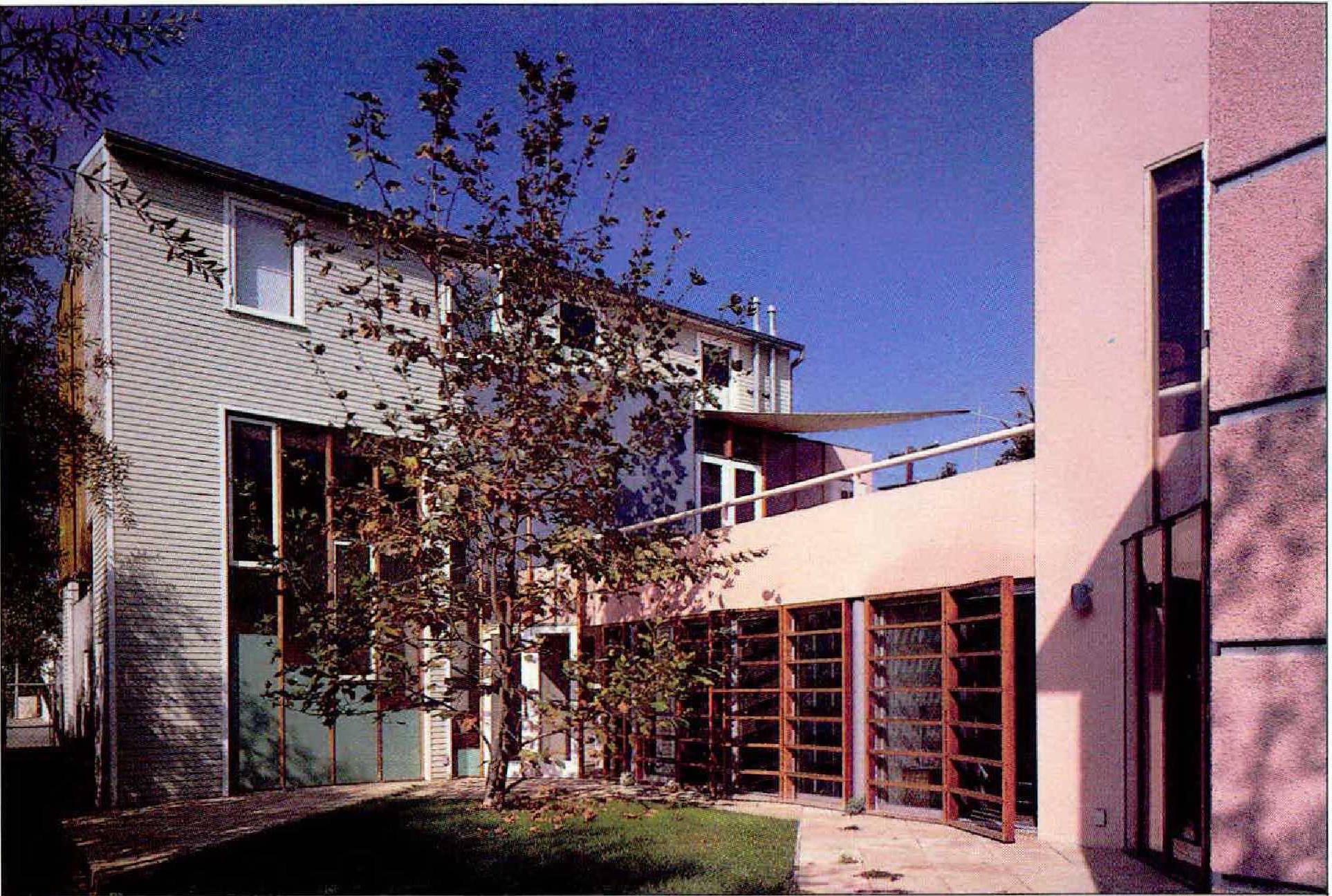
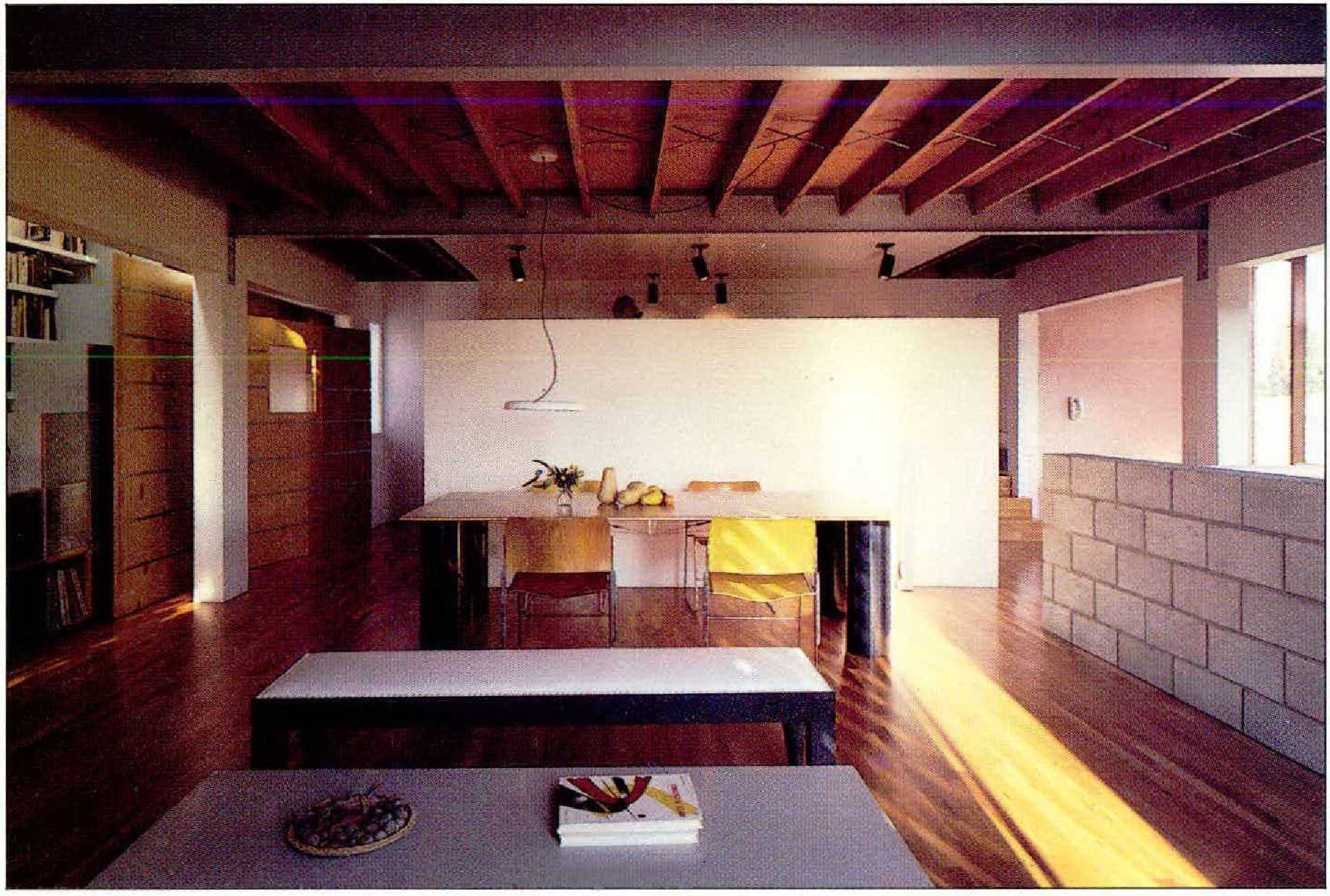
In Santa Monica’s artsy, jumbled Ocean Park neighborhood, where onetime beach shacks on thirty-foot-wide lots sell for $200,000, new buildings rise on any unused portions of the land, and additions pop upward and outward in myriad shapes and styles. For some architectural firms, like Moore Ruble Yudell and Koning Eizenberg, both of Santa Monica, the housing crush has brought opportunities to produce cleverly designed tiny houses and apartments. By building in furniture, by establishing changes of level within small open-plan apartments, and by using partly cut-out partition walls that define various areas without closing off views, designers have produced interesting miniature housing units that work well for oneor two-person households. But the filling in and up of established neighborhoods is coming at the considerable cost of public quarreling over how much additional construction can be tolerated and what character it should have. Los Angeles is no longer a region with the ample room for maneuvering that Reyner Banham admired so strongly when he wrote what is still the best architectural history of the area, Los Angeles: The Architecture of Four Ecologies (1971). Disparate pressure groups are gearing up for what promise to be drawn-out fights over housing questions.
Is THIS STRICTLY a California story? I don’t think so. Real-estate prices have similarly exploded in Boston, western Connecticut, downstate New York, New Jersey, Washington, D.C., and elsewhere. From the summer of 1986 to the summer of 1987 the median house price in the northeastern United States jumped 37 percent, or $38,600, to match the price of housing in Los Angeles. Some of the stories now heard in the Northeast are remarkably like those told in California—tales of people commuting daily from Cape Cod to Boston or from eastern Pennsylvania to Manhattan, because they want a decent house on a normal-size lot. Areas already built up are feeling pressure for additional housing. In Levittown, Long Island, once synonymous with single-family housing at bargain prices, accessory apartments are being carved out of parts of the expanded and now expensive postwar tract dwellings. In blue-collar towns like West Haven, Connecticut, developers are shoehorning tight rows of townhouses onto any leftover pieces of land they can find, to accommodate the bursting demand for housing. In New Haven, where I live, unauthorized apartments in older houses have grown so common that the city zoning director recently warned that there would be “a severe housing shortage” if the rules against illegal conversions were suddenly enforced.
Some of Southern California’s responses to the overwhelming real-estate demand, such as detached houses with minuscule, walled-in back yards and courtyards, will undoubtedly win only limited acceptance in regions accustomed to open suburban landscapes. But on the whole, Los Angeles indicates directions in which more and more of America’s housing will be heading. The squeeze is on. Particularly in this country’s most prosperous metropolitan areas, significant adjustments in the housing market are in the making.