What Poppa Knew
MARIO CUOMO by . Scribners, $19.95.
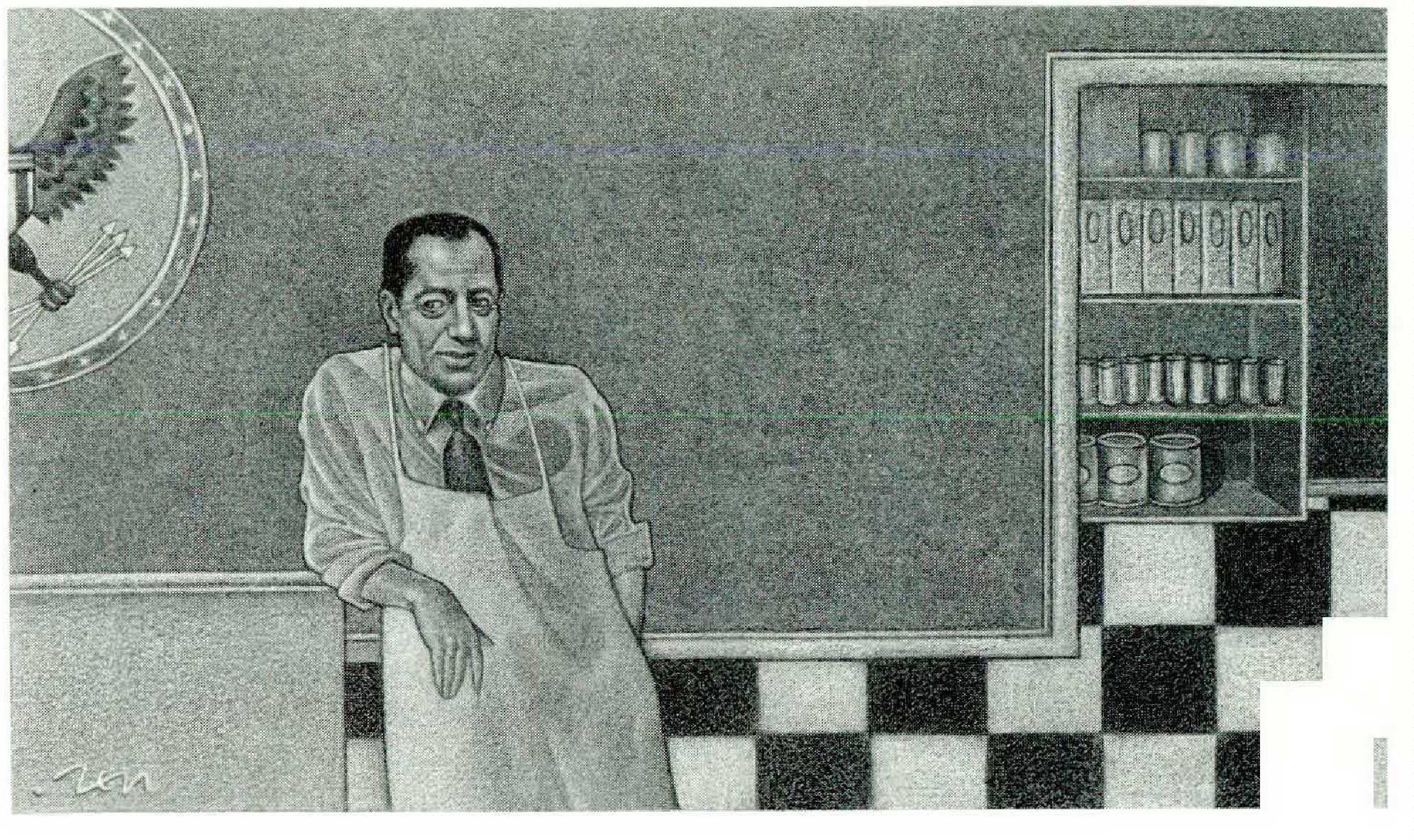
WHEN HE FIRST went to school, he could barely speak English; that was not the language of choice in the apartment above the grocery store in Queens where he was (literally) born and raised. Andrea Cuomo, his father, learned from kind neighbors the names of the products he stocked; Immaculata, his mother, never went to school, either in southern Italy, where she spent her girlhood, or in America, where she arrived, as Andrea’s bride, in 1927. At her citizenship hearing, which she put off for about forty years, the judge asked her how many stars there were in the U.S. flag. She said she didn’t know, but could she ask the judge a question? She could. It was: How many hands of bananas are on a stalk? “When he admitted that he didn’t know,” Robert McElvaine writes in this anecdote-ripe biography, “she proudly said, ‘Well, I do.’ Her citizenship was promptly granted.”
You can’t help sharing her pride: this is the meaning of America, you feel in reading McElvaine’s account of Mario Cuomo’s boyhood. It’s there in the hours Andrea Cuomo put in. Up at 3:00 A.M. to get produce at the market, he opened the store at six to catch the construction workers on the way to work, and kept it open till at least 11:00 P.M. Seven days a week. It’s there in the values Mario learned in that home. “Simple goodness” about sums them up: Obey the law. Be truthful. Fool around with no one but your wife. Study as hard as I work (why else am I working?). Think of others. “He never did anything for himself, period,” Mario says of his father. The meaning of America is there too in the history of the son’s shifting emotions toward his parents: ashamed of their English, he never invited them to activities at school; today the shame has given way to a guilt-tinged awe for what they—indeed, the whole immigrant generation—endured. “I can’t help wondering what Poppa would have said if I had told him I was tired,” the wears’ candidate for governor remonstrates with himself in his diary, knowing full well what Poppa would say. It’s there in the overachieving scholar-athlete—summa cum laude in college and first in his class in law school, the star basketball player, the minor-league baseball player who caught Branch Rickey’s eye and who changed Mario to “Matt” to make himself less exotic to fans of Triple-A ball in Georgia. It’s there in the young lawyer who was given all the impossible cases and won them. It’s there, finally, in the Rocky-esque politician who failed to win four straight elections before, at age forty-six, he was elected New York’s lieutenant governor. With Walt Whitman, Mario Cuomo can truly say, I contain multitudes.
That resonant life story furnishes Cuomo with his overarching political myth, his vision of America as a family in which burdens are shared equitably and all pull together for the common good: Poppa stocking the shelves, Momma behind the cash register, brother Frank cutting the meat, sister Marie arranging the window display, and little Mario studying—yes, and perhaps even then seeing in that Queens store the pattern of a nation’s greatness. Cynics may laugh at this vision. Where’s competition, the impeller of all our progress, in it? Where’s individualism? How do you get rich in an America formed on the template of that family store? But the weight of Western political thought, which from Plato on finds in the well-regulated family a metaphor for the state, is all with Cuomo.
Robert McElvaine, a professor of history at Millsaps College, in Mississippi, is all with Cuomo too; Mario Cuomo is a campaign biography that, at this writing, awaits its campaign. “This is the book that will get Cuomo elected President,”McElvaine’s agent has said. I hope he’s right. Though Cuomo can be “vindictive,” though he has a weakness for forensic sophistry, though his pride in both his mind and his soul are hubristic, though he is touchy with the press and takes criticism personally in a way that could be ruinous in a President, I agree with McElvaine’s conclusion that he is
a man who is more aware of his faults than most of us are of ours, who has great compassion rooted in deeply religious belief, who possesses extraordinary talent and intellect, and whose abilities seem almost perfectly to match what America needs at this point in its history.
Earlier in the book, McElvaine observes that
Cuomo is the first American politician since . . . Robert F. Kennedy who seems capable of bringing together a coalition similar to that of the New Deal—one composed of middle-class whites (including ethnics), blacks, Hispanics, organized labor, and liberal intellectuals. The reason for this potential in Cuomo, ironically, is that he is in fact so different from the Roosevelts and Kennedys, and indeed from most people who call themselves liberals today.
It is not going too far to say that no one like Mario Cuomo has ever before approached the pinnacle of American politics. Like the Roosevelts and the Kennedys, he is a champion of “the people.” Unlike them, he began life as one of the people.
. . . He became a liberal because of his deep religious commitment, his understanding of Teilhard dc Chardin and Pope John XXIII, and his own experience. It is because of this unusual course that Cuomo is in a nearly unique position to bridge the vast gulf that opened in the late 1960s between liberal intellectuals and the “common people” they professed to champion. In the simplest terms, Cuomo can heal that breach because he is both a “common person” and a liberal intellectual.
This is all unexceptionable, and explains Cuomo’s attraction for so many Democrats. But would Mario Cuomo persuade a skeptical reader that Cuomo is “what America needs at this point in its history”? Perhaps, but barely. In the first place, Mario Cuomo reads in places like what it must be: a book produced in a hurry. Last fall McElvaine was in the lists with The End of the Conservative Era: Liberalism After Reagan and here he is with a 400-page biography less than a year later. Second, in his zeal to make the case for Cuomo, he sometimes lays it on fulsomely: “He believes he is on a mission to improve politics and government. If he can do that it just may be that he is holier than most of us,” reads one not atypical effusion.
Third, although Cuomo was evidently generous with his time, McElvaine is not one to put it to the best use by asking the great man challenging questions. Nor is McElvaine the sort of fellow who would wonder aloud how a man who told his fiancee that there would be no contraception jeopardizing their immortal souls and who, during his 1974 campaign for lieutenant governor of New York, “came out against the sale of contraceptives”—how a man with these settled views on birth control could now find himself firmly in the pro-choice camp on the far more morally vexed issue of abortion. Was it just “careful theological reasoning,” as McElvaine says? Or did political calculation play a role, the pro-choice position being a litmus test for Democrats? It was surely a bit of both, but McElvaine is too pious to see it that way.
From an excess of that same piety’ he gives the back of his hand to psycho-history. His book would have been more convincing if he hadn’t. One wants to know—or at least to hear a spectrum of conjecture on—why a man as smart as Cuomo lets the press get under his skin. McElvaine says he’s just sensitive about charges, which first surfaced in 1986, that his son Andrew, a lawyer, was guilty of ethical improprieties in representing firms before various state boards; and McElvaine implies that Cuomo’s “press wars,” as he calls them, are now’ behind him. But if he did not admire Cuomo so extravagantly, he would no more be satisfied with that answer than the skeptical reader will be.
So Mario Cuomo, like its subject, has faults. Still, for any of the roughly 79 million people who saw Cuomo deliver the keynote speech at the 1984 Democratic convention, in San Francisco, and are curious to know what went into the making of his eloquence, McElvaine’s book will be hard to put down. If this volcanic election cycle ends with Cuomo elected President (and the talk of a deadlocked convention’s nominating him refuses to die), Mario Cuomo will rightly be compared to James MacGregor Burns’s 1960 volume John Kennedy: A Political Profile as a biography that set the terms for all subsequent discussion of its subject and that is as fair as anything written in the glow of affection can be. Its sections on Cuomo as a “Catholic" (“Mario is the only Italian male I’ve ever met who was a virgin when he got married,” his friend Fabian Palombino says), as a “Competitor” (he will cough loudly to disturb your pool shot, his brother says), as a “Conciliator” (he first came to public attention by mediating tangled disputes over urban renewal and integration between ethnic Queens neighborhoods and City Hall), as a politician and a governor, make up a rich portrait of a public man who is deeper and more interesting than anyone else either on the scene today or in green memory.
WHAT DOES McElvaine tell us about Cuomo that we cannot learn from his two published diaries or from other sources? The most astonishing revelation, given Cuomo’s philosophy, is that “like his father, Mario Cuomo has talked more about family than he has spent time with his family.” Mario Cuomo was so busy making it as a lawyer that he was reduced to spending “quality time” with his kids. Nor was he only working when he should have been helping his wife, Matilda, raise their five children: sometimes he was sitting in a bar in Brooklyn, “unwinding” with the boys.
For readers aware of Cuomo’s spiritual and intellectual force, another revelation will be his readiness to use physical force: beneath the “feminine” rhetoric about sharing and caring, Cuomo is a tough city guy. The story of how, in his year of minor-league ball, he belted a catcher who passed a peremptory judgment on Italians is well known. But McElvaine has found a pack of new stories. While Cuomo was campaigning for mayor of New York in 1977, to cite one, a man at a meeting in Brooklyn called him a liar. Cuomo grabbed him by the shirtfront with both hands and propelled him through the swinging doors of the hall. In that same campaign he angrily complained to New York Governor Hugh Carey about Carey’s having broken his promise to support him. When Carey, taking none of it, started to get out of his chair, Cuomo shouted, “Sit down, Hughie, or I’ll knock you right on your ass!” Such stories are political gold. The Democrats have a huge problem appealing to white males, far more of whom can identify with (and envy) Cuomo’s physical competence than have ever heard the name Teilhard de Chardin. These fight scenes are Cuomo’s PT-109.
Can he navigate it to the White House? Sitting in Albany while the other Democratic candidates slog through the primaries, he’s going about it in a strange way. He does give McElvaine one clue about why he chose not to run in 1988: he thinks Reagan may be Coolidge, not Hoover. That would cast Bush or Dole as Hoover, a Republican succeeding a Republican, and cast Cuomo himself in the role of FDR, the New York governor who rode into office on the economic disaster left by the Republicans. This 1932 scenario would play out, destiny and economics always permitting, in 1992, when Cuomo would be in his third term as New York’s chief executive. (FDR had only one term.)
The 1992 scenario breaks down, however, when you consider that FDR’s base in 1932 was the South. The South is today the Republicans’ base in presidential politics; Ronald Reagan carried 71 percent of the votes of southern whites in 1984. To move from that generic Democratic problem to Cuomo’s special problem, the South is not thickly populated with descendants of the New Immigration of the early twentieth century. Nor would Cuomo’s Catholicism be a plus there. McElvaine thinks that Cuomo has the gift of generalizing his experience as an outsider—the Italian kid being rejected by the WASP world of the Wall Street law firms—in a way that will speak to the cognate feelings of other outsiders, even southerners. But that remains to be seen. There’s a cautionary note for Cuomo in what happened to the New York governor he most closely resembles: the first presidential candidate thrown up by the New Immigration, Alfred E. Smith. He lost to Hoover in 1928 in no small part because the South could not brook his too-audible ethnic and regional associations.
Against these negatives—both the contingent and the enduring—must be ranged the unrivaled positives of Cuomo’s experience (he’s one of the country’s best governors, according to U.S. News & World Report), his authenticity, or “realness,” his wit and intellect, and his eloquence. The dominant crisis of politics today, the alienation of poor and lower-middle-class Americans from political participation, is largely a crisis of political speech. The issues of the day— the deficit, the foreign-trade imbalance, SDI—are dauntingly technical. They seem to tack all kinship to the moral principles that animated political debate in the sixties. In increasing numbers people don’t vote, because they don’t grasp the relevance of the issues to their lives, pickled as the issues are in the elite jargon of policy entrepreneurs, who are just as happy to have the people shut out, uncomprehending and quiescent. To get more of the public back into the public realm, the issues have first to be translated into what Wordsworth called “the real language of men.” They have to be reclaimed for sense by metaphor. That is Ronald Reagan’s greatest gift, as it is the gift of Mario Cuomo, who admires most in Lincoln what many of us admire most in him: “his language—the magnificent way he communicated profound truths with simple images, simple words.”
Until the gap between Reagan’s confident metaphors and the facts widened to a chasm, you could make a case that Reagan was the right President for an era of self-doubt. Now we are clearly in a new era; yesterday’s malaise has given way to real economic trouble, because of the President’s default of leadership in his second term. Shared sacrifice is now the order of the day. So is an assertion of national unity in the face of foreign economic competition. It has taken the Japanese example to bear out the wisdom of what Mario learned peering over the flour sacks, watching his father and mother build a business on their sweat, forge a family from their sacrifice. Great men see further, to paraphrase Isaac Newton, because they stand on the shoulders of giants. Mario Matthew Cuomo awaits his chance to be a great man, but the giants are already there in place beneath him. □