The Frightful and the Sublime
BY BENJAMIN DEMOTT
MASTER OF THE RETURN by. Harcourt Brace Jovanovich, $21.95.
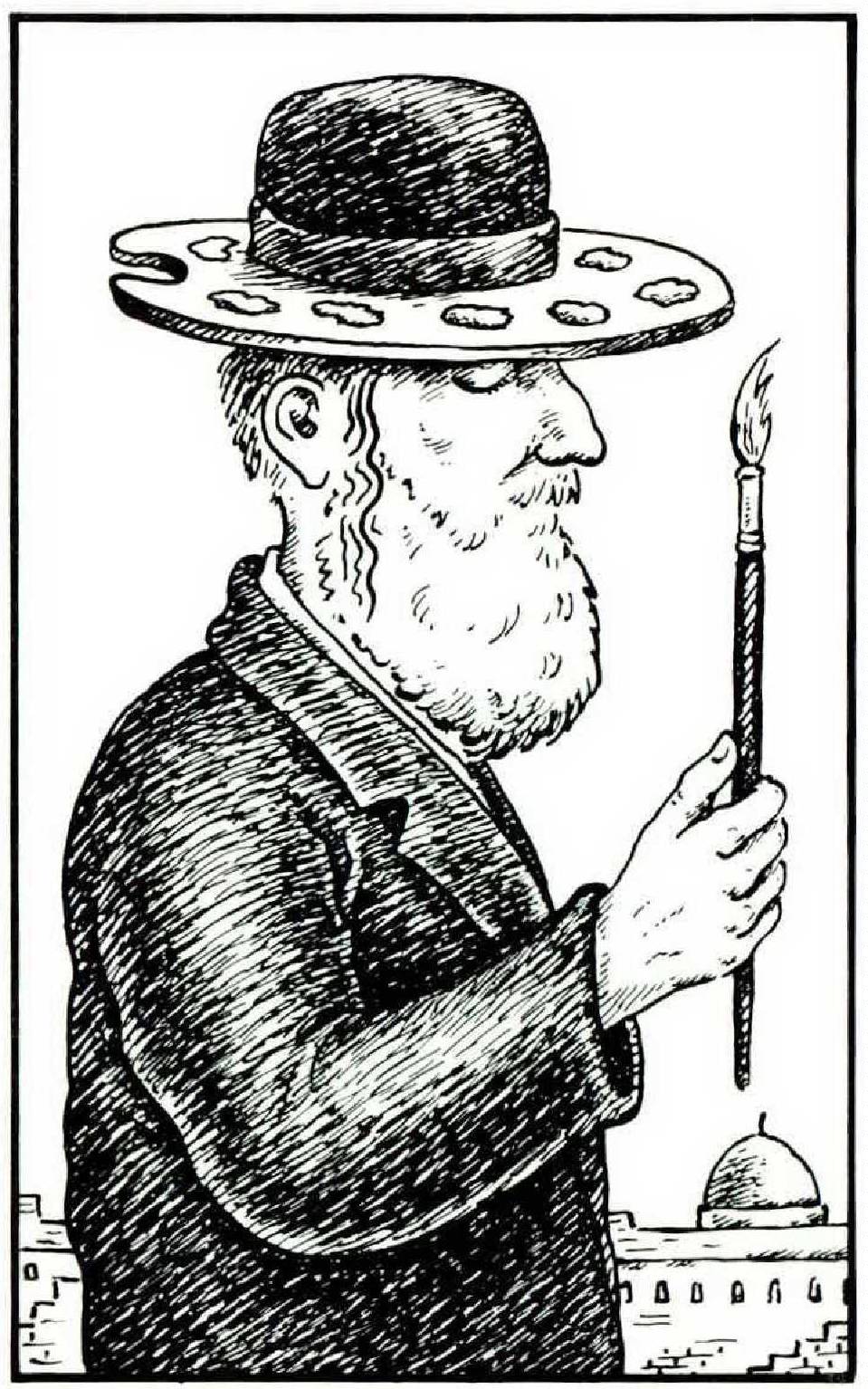
TOVA REICH’S Master of the Return is a novel in the form of an ambush—a wildly funny story that becomes mysteriously touching and ponderable before the end. The focus is a far-out Israeli religious feud involving a sect of penitents— “extreme converts to the Hassidism of Rabbi [Rav] Nahman of Bratslay.” The sect is based at Uman House, in Jerusalem’s Moslem Quarter, financed by an angel known as “old man Katz in [Brooklyn’s] Boro Park,” and includes potheads, math students, rock musicians, a former Southern Baptist, and an “innocent artist” from Morocco who “closes his eyes and praises God with each brushstroke.”
The issue dividing the community concerns pilgrimages. One Umanite faction believes that visiting Rabbi Rav Nahman’s birthplace, near Kiev, is indispensable to spiritual health; the opposition says no. (The two sides agree that the place “cures” nocturnal emissions.) The narrative centers on moments reverberantly symbolic for the faithful—a wedding, a birth, a death and burial, a community-building ascent of Mount Sinai— and the event that brings the dispute to a head is a kidnapping. At the novel’s climax a prodigal returns after narrowdy avoiding slaughter in a ritual sacrifice, and his rescue (by Israeli soldiers) opens a path toward factional détente.
Comic characterization abounds in Master of the Return. The pro-pilgrimage faction is inspired by one Shmuel (né Samuel) Himmelhoch, a former rockband lighting specialist—a man with a gold ring in his nostril, gold chains around his neck, henna-colored chest hair (Shmuel dyes it), and a “solid-gold mantra,” purchased from a guru for $10,000 during an Indian gig. (“The mantra was ‘feh.’”) The anti-pilgrimage chief is Rabbi Reb Lev Lurie, a math demon preoccupied with “referencing and cross-referencing the numerical values of the letters and words in the Torah,” and bent on smuggling an IBM computer through Israeli customs (in pieces in a case of Pampers) to speed his work.
The situations involving these and other major characters move frequently toward farce. An overnight funeral march featuring a platoon of wonunbaiting veshiva boys resembles a Broadway update of Faulkner’s Af I Lay Dying, choreography by Brooks and Reiner. At a noisy wedding party hash pipes are passed while angry Moslems upstairs rain garbage on the celebrants. In the Jerusalem airport three Umanite pilgrims, in broad hats, sidelocks, and beards, traveling to Kiev on stolen Mexican passports (Shmuel Himmelhoch is Manuel Domingo), battle a fourth who’s infuriated because he’s excluded from the trip. “Here comes Pancho Villa!” shouts a checkpoint security officer as the excluded pilgrim bears down on the group.
But, as I said, farcical tones don’t finally dominate this book. Partly this is because the author has a lively imagination of states of possession and perfervid faith; the vividness with which she dramatizes these phenomena burns off, for long stretches, awareness of the zealots’ absurdities. The steadying presence of history in the story also counts for something. (It induces memories of previous, pertinent, dignifying lives and ancient dreams of transcendence that breathe in Jerusalem’s streets and temples.) And so, too, does the recurrence of feelings that, although extreme in their expression, are normative at their core—a mother’s grief for her stolen child, a grandmother’s articulated outrage at the madness she sees as the thief.
More important than any of this, though, is Tova Reich’s fine refusal to simplify the central experiences of the book—experiences that reason and “taste" tend to dismiss as preposterous but that intelligence, aware that religion and decorum are not one, is slower to scorn. In a chapter called “The Dead Will Rise,” the Uman House faithful “[mix] two different types of rejoicings"—the festival ofPurim and a wedding—and the tides of grotesquerie seem at moments engulfing. The marriage celebrated is polygamous, arranged by a rabbi’s wife who is pursuing war against the Arabs by other means. (“Imagine how many more Jews we could produce if every Jewish man married two, or three, or however many wives he could handle.”) The bride is from Macon, Georgia, a Baptist devoted to hashish and foot massage who, when she soars, waxes beamish about her conversion. Song, dance, jokes, pranks, mad visions, and credulousness are everywhere, and at a crisis point the mob is persuaded that one of its leaders—Abba Nissim—has levitated.
Reich fully evokes the saturnalian aspects—the mental and moral chaos of Uman House. About the levitation she remarks drily that although “it is impossible to confirm or deny these reports,” it’s undeniable that “at that moment Nissim rose in the estimation of many. ...” But her manner is astringent, not contemptuous; her cool, unillusioned eye seems incapable of indifference to the intensities of desire—the desperate hunger for some means of escape from habit, prudence, identity, politics, class; some higher, better way. The levitator calls out to his flock, “Let us elevate ourselves. Let us cast off our old shells and expose our inner core of purity. Let us grow and expand in spirit. Let us rise to the pinnacle of Mount Sinai and await the answer!” Voices cry out in answer: “I shall rise! Let us climb . . . ! Let us rise! I shall rise! We shall rise!”
And as eyes close in passionate supplication, in fierce loony longing for ecstasy, old questions and sayings come to mind. (“The frightful is the gate to the sublime"—Saul Bellow, paraphrasing Heidegger.) Is the collective delicacy that assures us the Umanites are gripped by false faith capable of recognizing true faith? The tiny, powerless band of disciples lost in its vision two thousand years ago: was it so utterly different from the Uman House faithful?
These are my questions, not the author’s. But her feeling for the complex, perhaps inexpressible relationships between true vision and the kingdom of grotesque comedy freshens them in the reader’s mind. Tova Reich is a marvelously enigmatic original, and there are effects in her book that are beyond casual summoning, secrets reason can’t reach. I urge you not to miss Master of the Return.