Notes: Hostage
En garde!
FIVE DAYS A WEEK I arise punctually at 6:15 and after a frugal repast set out for a train that comes for me at 7:34 and completes its journey at 8:04, whereupon I walk the five blocks to work. At 12:25 I go to a club for some exercise, returning at 2:00. I leave the office at 5:55 to catch a train home, and, after driving a lonely route that never varies, I walk in the front door a few minutes after 7:00. This is the behavior, I was recently informed, of a man who has forgotten Abu Nidal—of the kind of person terrorists would describe as user-friendly.
“Vary your times and routes of travel”: that advice and a lot more came the other day in a piece of mail from the Defense Information Access Network, of Raneocas, New Jersey, which has published a booklet called How to Avoid, Prepare For, and Survive Being Taken Hostage. The study is drawn from various unclassified State Department publications, and it is truly comprehensive, with sections devoted to such matters as Personal Preparations (“Update your will”), Residential Security (“Be alert to persons disguised as public-utility crews”), Transportation Security (“Be especially alert in underground garages”), and Torture and Pain (“Many people find that they can tolerate much more than they thought they could”).
It is a chilling document in some ways, and not only because I own a Japanese car (“Avoid using vehicles that identify you as an American”). The real source of concern lies in the subtext, in the bland and matter-of-fact dissection of the psychology of dominance and submission. I don’t live in Beirut or pay much attention to security arrangements, but reading this booklet made me realize that hostage-taking incidents are impossible to avoid in daily life.
The occasion may at first seem innocent enough—say, taking a seat next to a stranger at the outset of a long journey. Suddenly the stranger begins to talk. “The moment at which a person is captured, no matter where that capture may occur—in the home, in an automobile, in an airplane, or in the office—is psychologically traumatic. You may be suddenly transformed from a relaxed and complacent frame of mind to a state of absolute terror.” Telephone calls from people who want to sell you something, such as insurance or financial-planning services, are an insidious and increasingly common form of hostage-taking, even in neighborhoods otherw ise considered safe. These calls are sometimes difficult to terminate. “Interrogators will also know what you fear most. They may know, for example, that one of your primary concerns is for the welfare of your family, and they will play upon this fear to induce you to talk.” Day after day thousands of people are held in long lines against their will by a faceless few who operate inside most government offices and at all ticket counters and who probably control the fast-food industry. “Their activities are intended to make you more compliant. . . . They may, for example, . . . keep you in an unsanitary environment, dehumanized by being called by a number.” Many virtual abductions occur in doctors’ offices, where victims are forced to strip and then made to sit in a chilly room, waiting helplessly. “The best reaction ... is to concede that the terrorists have the upper hand, and that resistance would be futile and dangerous. . . . Escape may be possible, but it requires an unlikely combination of events.”
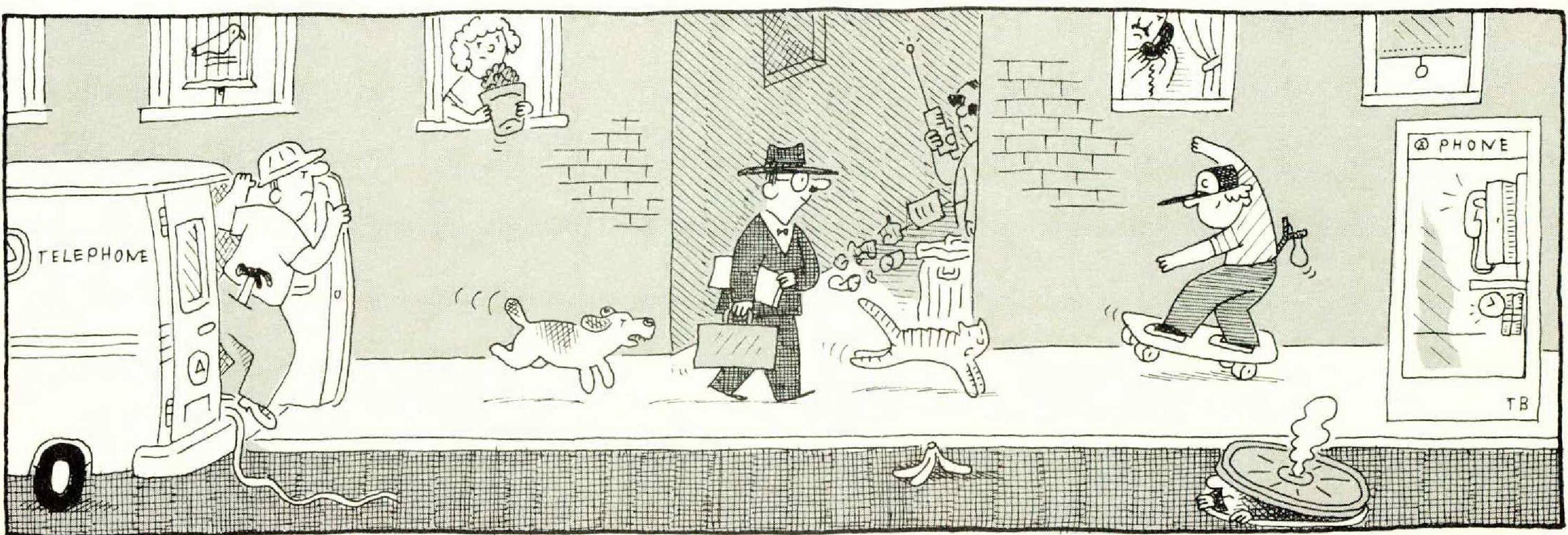
In their own ways and for their own purposes my children take me hostage several times a day, although usually without violence. “While they may make life unpleasant for you, they are unlikely to do anything intentionally that is life-threatening. Dead, you are worth nothing to them.”As a result of these episodes at home I have come, somewhat to my surprise, to appreciate and even depend on the so-called Stockholm syndrome—the little-understood phenomenon whereby “hostages become emotionally involved with their captors” and “occasionally, the hostagetakers reciprocate the positive feelings of the hostages.” It may be that in a world where hostage-taking of one kind or another is a pervasive and licit social gambit, the Stockholm syndrome represents not a form of aberrant behavior but a powerful force for cohesion. Around my house, anyway, the casualties have been light.
-Cullen Murphy