Shanghai Surprise
Visiting China’s largest city is like rolling time back fifty years
BY JAMES FALLOWS
ASIA IS SUPPOSED to be timeless, but its cities don’t look that way. Tokyo burned once in 1923, after the great earthquake, and again in 1945, after the American bombing raids. Seoul was so badly pulverized during the Korean War that its few rebuilt ceremonial gates look only slightly more natural than London Bridge in its adoptive home at Lake Havasu. When Mao Zedong’s Communists came to power, Beijing still had many of its ancient walls, in concentric rings out from the Forbidden City. The palaces of the Forbidden City itself remain, but the city walls have been torn down to make way for oversized ring roads. These can make being in Beijing seem like being on an airport runway, where the horizontal distances are too great and the buildings too far away. From certain angles Kuala Lumpur’s skyscrapers and greenery can make the city look like Los Angeles. From most angles Singapore looks as Los Angeles might if it were shined up and modernized—and Hong Kong shows what Manhattan could be if it were really crowded and built-up.
One big Asian city, though, does seem to have frozen in time. This is Shanghai, self-proclaimed “Paris of the East” in the 1920s and now more romantic, sort of, than Paris itself.
Shanghai rose to importance later than other Chinese cities—150 years ago, rather than at the dawn of history— but has changed less in the past fifty years. In the mid-eighteenth century foreigners poured in and, taking advantage of China’s weakness, won control of chunks of territory—“concessions” — where they lived under their own laws and traded imported opium to the Chinese for silver and silk. The French concession had a Cercle Sportif and streets with names like rue du Moulin; a large ring road encircling a Chinese settlement they named avenue des Deux Republiques. The American concession was full of churches and missionary schools. The British built a racetrack, gardens, and numerous drinking and country clubs; they named their major thoroughfare Bubbling Well Road. Along the sluggish Huangpu River, on the famous Bund (or “river embankment”), the foreigners built hulking, colonnaded trading houses, graceful Art Deco hotels, consulates and apartments that could have been plucked from prewar Paris or Berlin. Shanghai filled up with Jewish refugees from Europe, White Russians who had come overland, Chinese who served, traded with, and connived against the foreign devils. Shanghai became China’s center of commerce, fashion, intrigue, its center of prostitution, drug addiction, sin. “Its apogee from the 1890s to the 1930s coincided with the nadir of Chinese national pride,” Larry Robinson, an official in the U.S. consulate, wrote recently in a surprisingly lively report called Life in the Big City. “The idea of Shanghai is linked historically in the Chinese consciousness with corruption and foreign domination.”
The gaiety abruptly ended, and the money to finance it stopped flowing in, when the Japanese arrived in the late 1930s. From that point on it was as if the physical aspects of the city—buildings, streets, homes—had gone into suspended animation: nothing added and nothing taken away. Shanghai was shelled but not devastated during the war and the subsequent Communist takeover. Although Zhou Enlai operated out of Shanghai and the Communist Party’s first National Congress was held there, in 1921, once in power the Party showed itself to be deeply suspicious of this former capitalist hothed. For three decades the regime treated it the way a George Wallace Administration might have treated Manhattan. Shanghai, still the nation’s industrial heart, home of the well-known Flying Pigeon bicycle, and long the home of the Shanghai car, sent money to Beijing, but money did not come back the other way. Beijing built new roads and Stalinist-style grotesqueries throughout the country. Shanghai crammed numerous families into what had been one French or British family’s home and used the social clubs as barracks for the army or the police. The city lacked the money to build, even the money to destroy.
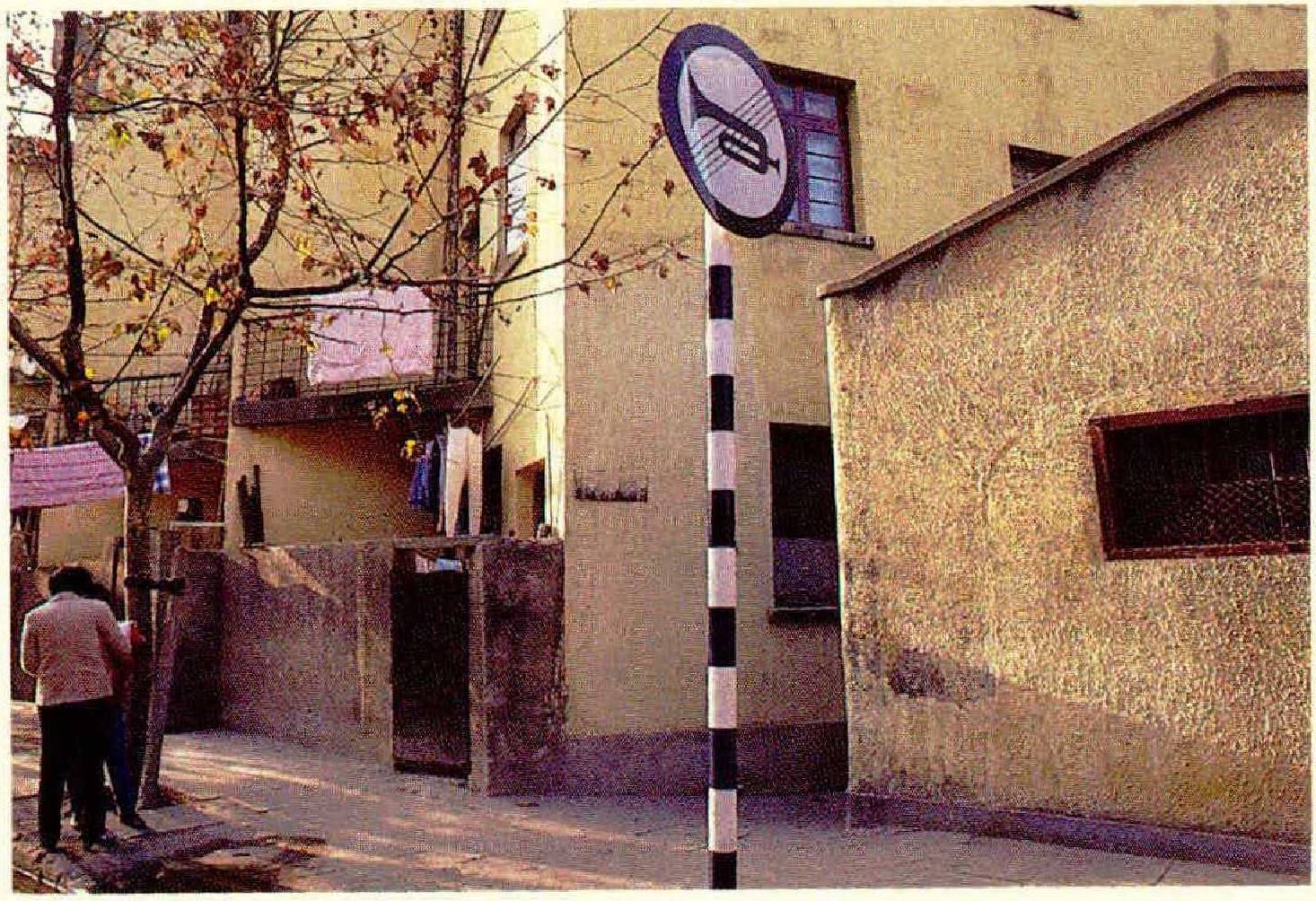
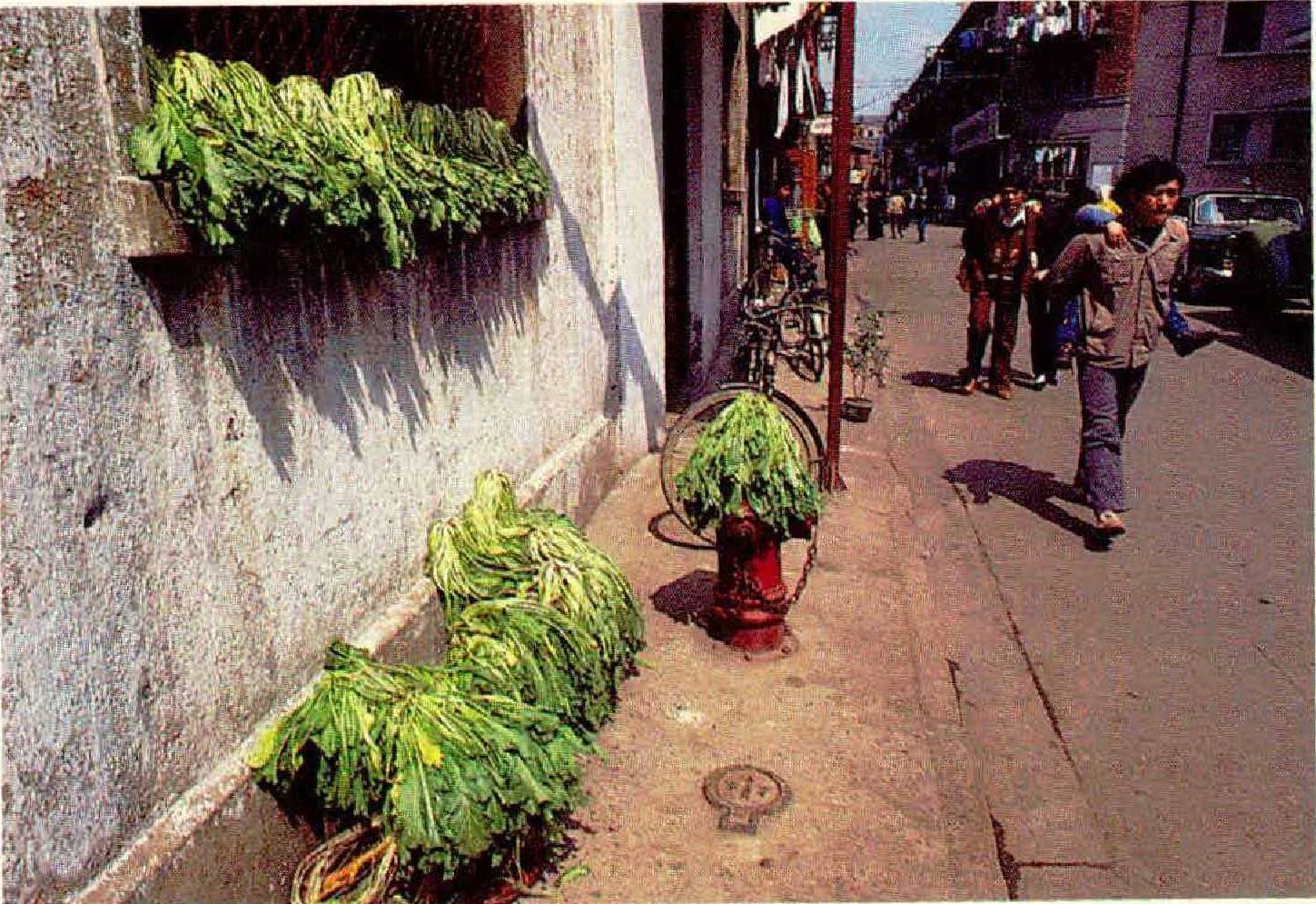
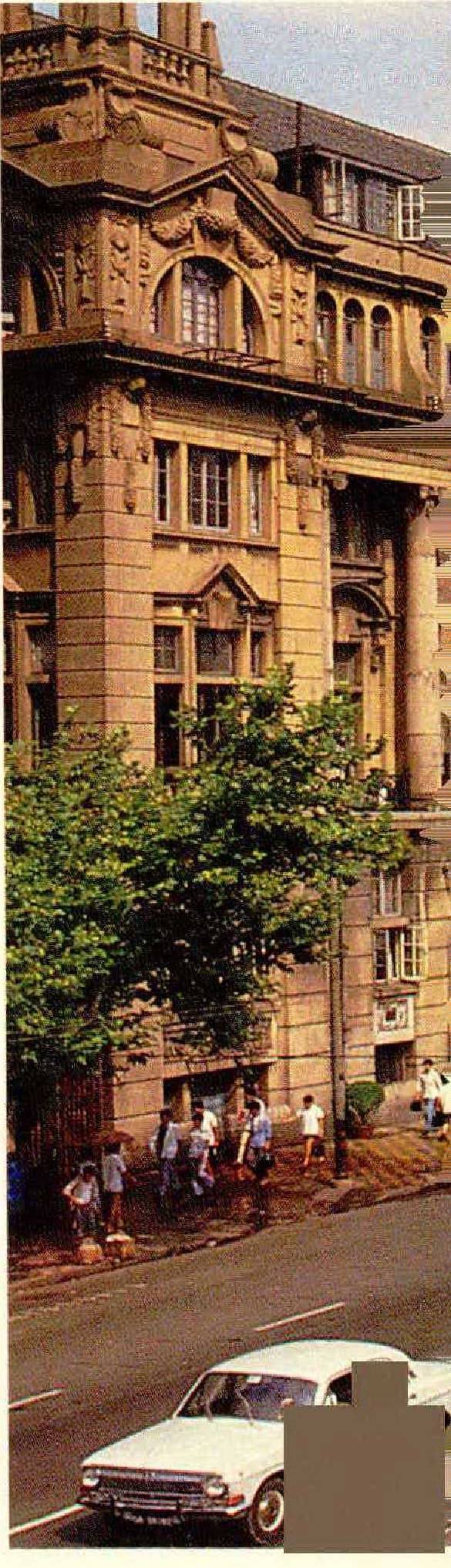
No doubt it is decadent to find the results entrancing. Shanghai’s appeal has little to do with Chinese history or indeed with anything Chinese. But the effect is entrancing, even magical. To visit Shanghai is like being able to walk into the Manhattan or Berlin of fifty years ago.
Some things have changed. The racetrack is now People’s Park, Deux Républiques is People’s Avenue, and one outlandish Stalinist structure, a legacy of the Russian-friendship era, looms above the town—an exhibition center that resembles an outsized New England church, with extra turrets, columns, and Communist stars stuck on everywhere. Two supermodern hotels have been built, and more are on the way. There is a big indoor sports center, a first step toward fulfilling Shanghai’s pre-war dream of hosting the Olympic Games. The opium addicts have disappeared. How were they cured? I asked a Chinese man during a recent visit, hoping for useful wisdom. “Mostly they were shot,” he said. Even the Shanghai car, a cartoonish vehicle with billowing fenders, said to have been modeled on a 1955 Plymouth, has been elbowed aside by modernity. The factory is now turning out its version of the Volkswagen Jetta, in one of China’s joint-venture steps toward “economic reform.” The new cars look infinitely more sporty, but I was told they are unpopular. The Shanghai car, which bore a family resemblance to a Checker cab, had a capacious rear seat. The new VW is sensible and efficient. This is a serious drawback in a country where the people who buy cars are generally Party officials, who plan to sit in the back seat and be chauffeured around.
But the things that haven’t changed are easier to notice, and make a deeper impression on the heart. From the balcony of one Art Deco apartment building scores of others present themselves, and beyond them rows of English semidetached houses with gardens. In the Park Hotel, the essence of chic in the old days, the cavernous dining room is still outfitted with tattered hangings in Jazz Age shades of pink and blue. At the Peace Hotel, where Noel Coward is said to have finished Private Lives when the hotel was called the Cathay, aged Chinese jazz musicians perform in the lobby at night. Along the streets of the old French concession, city residents ride their bicycles beneath the leafy plane trees, brought by the French to befit the concept of Paris of the East. In front of hotels and banks lurk shady characters known as Uighurs. They dress like other Chinese, in cheap, ill-fitting clothes, but they have unsettling round-eyed Western faces; they come from China’s Far West and look less Asian than anyone this side of the Levant. “Change money, mister!” they rasp at each foreigner who passes by. Their eyes dart back and forth, searching for Sydney Greenstreet.
It would be more decadent still to wish that this time-warp version of Shanghai would always remain. What was exotic and “unspoiled” to me, on a five-day visit, is frustrating and “unimproved” to the Chinese who spend their whole lives there. “To the extent they regard Shanghai favorably, they do so for its modernity,” Robinson said, in Life in the Big City.
There is little nostalgia for the colonial era. Given enough money most Shanghainese would gladly tear down the old mansions and put up skyscrapers. What they see here is not a stately city that has aged gracefully but an old grey metropolis on the verge of collapse.
Shanghai, with 12 million people, is China’s largest city and has its worst housing problem: in the central city the average floor space per person is 4.5 square meters, an area about seven feet on each side. Only one household in twenty-five has a telephone (although nearly all have TVs). Much of the sewage goes straight into the river; if you didn’t know by the evidence of your senses, you’d guess from news of last winter’s hepatitis epidemic, in which half a million people fell ill. Because the city is in “south” China, on the southern bank of the north-south dividing line, the Yangtze River, it is defined as having a mild climate and allows no heating whatsoever in schools, offices, stores, and other public buildings, fin fact its climate is similar to Atlanta’s—truly pleasant only in spring and fall. But winter tourists can take heart: hotels are exempted from the heating ban.) “During peak hours, bus loading reaches 12 riders per square meter,” Robinson wrote. “It is impossible to fit 12 pairs of shoes into one square meter, so at any given time some thousands of feet cannot touch the floor.”
It must change, and it will. One young city planner described the city’s touchingly ambitious pre-war vision of preparing for the Olympic Games. First they’d give the city a telephone system, then they’d rebuild all the sewers, then put in a subway ... It could happen, even within my lifetime, and I should go back to see those Olympic Games. But I don’t think I will go back, not ever again. I am glad to have seen it just this way.
IF YOU’D LIKE TO see Shanghai while it’s still in amber, you have one major choice to make: hard or soft. Chinese trains make a (somewhat theoretical) distinction between “hard sleeper” and “soft sleeper” cars. I’ve come to think of this divide as a metaphor for the choice one has about every aspect of tourism in China. The soft road is to dredge up some international meeting you can attend or take a package tour. The hard road is to go on your own.
The hard road is feasible—you can get a visa for independent travel, you can find cheap hotels from town to town—and no doubt virtuous, but it’s hard. For instance, you can’t make a train or airplane reservation except in the city where the trip is to begin. So if you were not on a package tour, the first thing you’d do on arriving in Shanghai would be to rush to the CAAC (government airline) office to see if you could ever get out. The Anglophone traveler’s faith that “Oh, somebody there is sure to speak English” holds true in much of the world, but not in much of China. I don’t speak Chinese and have had enough Asian hard-road traveling to hold me for a while, so I can offer no firsthand tips about where this road leads in Shanghai. If you’re game for such an adventure, look at The Rough Guide toChina (Routledge & Kegan Paul) and Mark Salzman’s charming hard-road memoir Iron and Silk (Random House). You’ll do well to learn some Chinese phrases too.
The soft road has different hazards. It can be very expensive—real living costs in China are at most one twentieth of what they are in Japan, but package tours to each country cost about the same. And of course it is irritating to be herded from monument to monument in a big group. So if you go with a tour, look for one that gives you lots of free time.
On the soft road you may not have a choice about lodging, but if you do you’ll find a richer variety in Shanghai than in most other Chinese cities. There are two extremely fancy marble-andglass all-modern high-rises: the Hua Ting Sheraton and the Jing An Hilton. The prices are similar to what you’d pay at a good hotel in the United States or Europe—which is to say, as much per night as the pick-and-shovel laborers you see outside the window earn in several years. If you reach Shanghai at the end of a journey through China, the clean bathrooms and functioning telephones of these hotels may have irresistible appeal, as those at the Sheraton did for me. The Hilton, still under construction when I visited last year, is more conveniently located, in the heart of the old French concession. Of course, to preserve the concession’s stuck-in-time atmosphere you have to avoid looking at the glistening Hilton tower itself.
Shanghai also has a wonderful assortment of less expensive, more atmospheric, and of course more run-down hotels: the Park (facing People’s Park), the Peace and Shanghai Mansions (both on the Bund), the Jing Jiang and Jing An (in the French concession). These are the very structures that give the city its allure. They’re roughly half as expensive as the modern hotels, with the bill ranging from about $44 to $55 a night.
I ate most meals in the restaurants of these old hotels. I never had a bad or boring one anywhere, but the most sumptuous were served at the Park. What about hepatitis? My wife got it in China, but on an earlier trip and in a different city (Guilin). My children and I, having eaten in all the same places, felt Fine. If you’re worried about the risk, you can take the State Department’s advice and get gamma-globulin shots before you go. The greater risk would be postponing a visit. What’s here now won’t be for long. □