Graphic Details
by Cullen Murphy
THE PENCIL: A History of Design and Circumstance by . Knopf, $25.00.
THERE IS A TYPE of book—often merely a stunt, sometimes a tour de force—in which the author crawls inside a subject of seemingly limited interest, as if on a dare, and then pushes out in all directions until unexpected and fascinating connections are made with the larger world. Perhaps the most famous example of the genre is Henry David Thoreau’s Walden, a book ostensibly about a pond. Page Smith and Charles Daniel gave us another example fifteen years ago in The Chicken Book, which dispenses copious amounts of science and lore, along with valuable lessons in the historian’s craft. More recently we have had Tracy Kidder’s Soul of a Sew Machine, which shines into a variety of corners while focusing chiefly on the inner life of a computer. Now Henry Petroski, an engineer who teaches at Duke University, has produced The Pencil, a serious and charming history of an item most of us take completely for granted. “Even what can appear to be the most common, small, and simple of objects,” he writes, “can reveal itself to be on its own terms as complex and as grand as a space shuttle or a great suspension bridge.” Petroski contends that the pencil may usefully serve as a paradigm of all engineering, and he argues his case with wry humor and an amplitude of anecdotage drawn from many centuries and continents. The Pencil is that great rarity, a book that will appeal to ordinary readers and yet seems destined as well to become a minor classic in academe.
THE WORD pencil is derived from the Latin penicillum, which in Roman times referred to a fine brush used for writing; looking in Webster’s Third New International Dictionary, I saw to my great surprise that “a brush of hair, or bristles" was still the first meaning given for pencil. The pencil we use today resulted from the quest, pursued since ancient times, for a written line that was both dark and dry. The penicillum provided darkness along with temporary wetness, while another Roman instrument, the stylus, which was typically made from lead or lead alloy, provided dryness along with exceeding lightness. From Roman times through the Renaissance people experimented with a variety of unsatisfactory writing technologies; their stones have about them the same sense of marvel and poignancy of stories about flying machines before the Wright brothers.
Then came the discovery, under Seatoller Fell, near Keswick, Cumberland, in the Lake District of northwestern England, of a dry, dark substance called plumbago, now known technically as graphite but commonly called lead. Just when the discovery occurred (supposedly after the uprooting of an ash tree in a gale) remains a matter of speculation, but it certainly happened before the publication, in 1565, of a book on fossils by Konrad Gesner (“the father of zoology” and “the German Pliny”), which for some reason contains an annotated drawing of a piece of graphite inserted in a wooden holder—the first known depiction of a pencil. Cumberland graphite’s excellent properties, including the fact that it could be easily erased, ensured a lively market, and graphite, attached to some sort of holder in various ad hoc and inventive ways, was soon the medium of choice throughout Europe for drawing and casual writing. By the mid-seventeenth century cottage factories in England and Germany—a prototype of the garage workshops in which a fancier type of word processor has come into being—were manufacturing crude versions of a standardized pencil, one in which a long, thin piece of graphite was encased in a piece of wood.
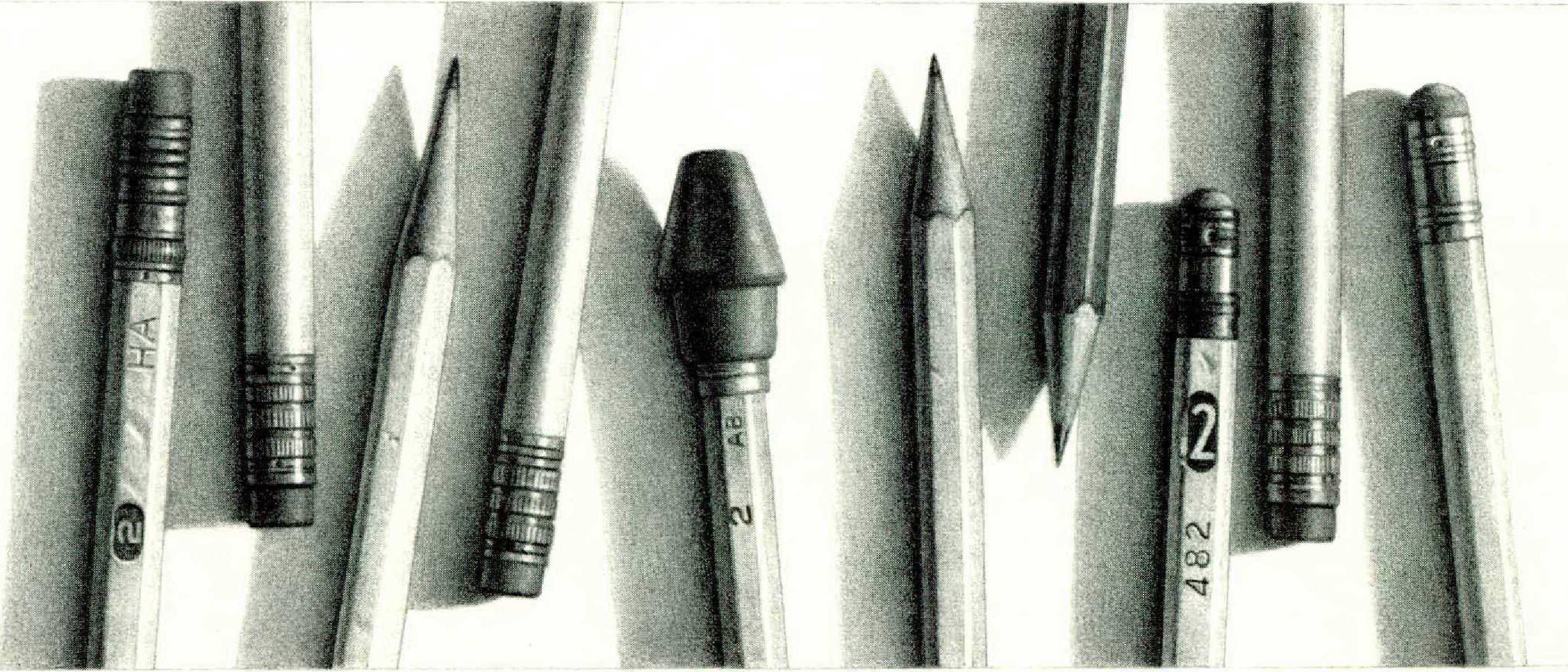
Petroski has a pretty good sense of what his readers want to know and when they want to know it, for at this point in his narrative he stops and asks, “How do they get the lead into the pencil?” I had always thought that a tunnel was somehow dug through the shaft (or “infrastructure,” as Petroski calls it), and the lead was snugly inserted afterward, but making a pencil in this way turns out to be the industry’s version of finding the Holy Grail. In fact every pencil consists of two grooved pieces of wood. The lead, which was originally square or rectangular in cross-section, is glued into the groove on one piece, and the second piece completes the sandwich. This was at first delicate work, the province of joiners and cabinetmakers, who made each pencil individually. Eventually the task was mechanized, with many grooves being cut on long boards and the individual pencils cut out only after the top piece had been glued down over several dozen leads. The prevalence of the hexagonal pencil, now standard, had everything to do with mass production: the shape allowed more pencils to be cut out of a given block of wood than a circular design would have, and it was still fairly comfortable to hold.
PETROSKI EMPHASIZES time and again the fickle role played in engineering by both the abundance and the dearth of raw materials. The modern pencil, for example, was made possible by the discovery of high-quality graphite; once such graphite became widely available, experimentation with alternative fillings virtually stopped. A sudden shortage of graphite was responsible for the next breakthrough. In the 1790s Britain and France went to war, and the French as a result lost access to supplies of graphite from Cumberland. As the availability of pencils in France began rapidly to diminish, hampering education, commerce, and war, the government launched a kind of Manhattan Project to find a new way to produce them. In charge of this effort was a young engineer named Nicolas-Jacques Conté. Conté started experimenting with the many widely available grades of graphite that were not of pencil quality, and was able to remove impurities by grinding the graphite into a fine powder. He then mixed the pure graphite dust with clay and water, and allowed the mixture to harden in molds; the hardened leads were later fired at a high temperature. Conté’s process, which succeeded wonderfully, is the basis for pencil-making today.
Fluctuations in the graphite supply led directly to another innovation in pencil design: the adoption of yellow as the standard pencil color. By the early nineteenth century the graphite mines in Cumberland were pretty nearly exhausted, and while the Conte process enabled manufacturers to make good pencils out of impure graphite, the search was on for a new source of the finer stuff. It was found in 1847 in Siberia, near the Chinese border, and the German company A. W. Faber acquired exclusive rights to it. In its advertising Faber repeatedly reminded customers that it alone had access to the very best graphite, from the Far East. The other pencil companies responded by producing lines of pencils with suggestive names like Mongol and Mikado, and they further implied an Oriental association by painting the pencils yellow. Today three out of four pencils are yellow. (The American-made Mikado was renamed the Mirado after Pearl Harbor.)
One of the great names in the history of pencil-making is that of Henry David Thoreau, whose father was in the pencil business, and who was responsible for the first high-quality pencil manufactured in America. Having no apparent knowledge of Conté’s process (pencil-makers are famously secretive), Thoreau by 1844 had developed a pencil lead made from ground graphite and clay. By varying the amount of day he also produced pencils with a range of hardnesses, and he distinguished among them by assigning the pencils numbers or letters. With this achievement behind him Thoreau abandoned the pencil business and went to live in the woods at Walden Pond; in the celebrated list he drew up of the things one needs on a wilderness excursion— “matches (some also in a small vial in the waistcoat pocket); soap, two pieces” — he neglected to mention the very object that he wrote the list with, and that Ralph Waldo Emerson recalled his never being without.
As NOTED, The Pencil is a book about engineering, and one is never far in these pages from discussions of raw materials, physical laws, economics and marketing, and the processes of discovery and invention. Sensible observations are strewn about matter-of-factly. (“Engineering,” Petroski writes, “can be its own worst publicist, because the more it succeeds in making a product or a service that is reliable and efficient, the more engineering itself becomes virtually invisible and seemingly humdrum.”)
What makes this book especially delightful is the author’s propensity to doodle, as it were — to allow his thoughts to stray into the tangential, and dally. He devotes one excursion to the rotary pencil sharpener, noting that its proper functioning depended on the development of a circular lead that was placed exactly in the middle of the wooden shaft. (Unless it was, the pencil could not be made to come to a true point, or would break during sharpening.) He devotes another to the advent of pencils tipped with erasers, which were condemned by some educators as inappropriate for use in schools. (One publication put the argument this way: “It might almost be laid down as a general law, that the easier errors may be corrected, the more errors will be made.”) Yet another excursion takes us to the Soviet Union in the 1920s, where the young Armand Hammer reaped a handsome profit by manufacturing with Russian labor cheap pencils for export. (When the plant came under Soviet control, in 1930, it was named the Sacco and Vanzetti Pencil Factory.)
One is left in the end with great admiration for those who have played significant roles in the history of pencilmaking. Their achievement, as Petroski notes, is not inconsiderable. They created an object that must be sturdy while in use but whose wood must be easy to carve away, that must be comfortable in the hand and produce a line that pleases the eye; an object that is manufactured by the hundreds of millions, adheres to rigorous technical standards, is available for pennies, and underlies much of our science, literature, and art. “No artifact is perfect,” Petroski writes near the end of his study. But I had the distinct impression that he was tempted to make an exception. □
About the Author

Cullen Murphy is an editor at large at The Atlantic.