Modem Classics: Allan Greenberg's Houses Reflect a Revival of the Classical Tradition

by Philip Langdon
SEVERAL YEARS ago a Connecticut couple decided they wanted a modern house. They invited a prominent modern architect to look at their property, and soon he gave them a sketch—of a dwelling with the second floor twisted atop the first, creating what the couple says were “all these wonderful angles that you didn’t want to live in.” When they reminded the designer that what they really wanted was a simple, clean-lined house—the kind of building that had made his reputation— he replied, “No, this is a new thing I want to do.”
Frustrated, the couple tried another architect, this one a prominent South American.
After he spent a few months in careful contemplation, he presented them with a model. Well, this is a magnificent piece of art, they thought, but it’s an underground house. We don’t want to mow the roof. When they parted from the South American, he gave them a book on Italian architectural history, and it began to alter their outlook. Now they sensed that they wanted a classical home, so they sought out a well-known postmodern architect, thinking that he would give them what they were looking for. But they discovered that he was unwilling to satisfy their aspirations. “We wanted an Italian villa, ” they recall. “He wanted a French one.”
This kind of conflict between ambitious architects and their clients is common. Witold Rybczynski, a Montreal architect and the author of Home and The Most Beautiful House in the World, says that one of the problems with architects is that in order to build a reputation they design houses that suit their need for a strong signature, frequently at the expense of their clients’ wishes. The architect, if he’s aiming for the brass ring of publication in major architectural journals, has to insist on creating buildings that add up to a strong, singleminded portfolio. Yielding to the highly divergent needs of clients runs the risk of muddying the architect’s message.
The Connecticut couple went through about ten architects in all before finding one who pleased them. Ultimately they settled on Allan Greenberg, of New Haven, after reading an article that called him the dean of classical architecture in America. Greenberg is willing, even eager, to give clients what they want within a broad range of classical and traditional styles, The couple now occupy a grand symmetrical house that Greenberg designed with columns, pilasters, sculpture niches, and a domed ballroom with a cupola at its peak—a home based on the Italian classical architecture of Palladio and on buildings as American as Monticello.
“One role of the architect,” Greenberg says, “is to act as the sponge, absorbing everything your client tells you. You throw it back in the form of drawings, to test your understanding of the client’s needs. When people tell you something, it may be based on premises that are unstated. You have to learn what are the unarticulated premises on which their desires are based. It’s very difficult.”
Still, it can be done. The couple with the neoclassical villa has nothing but praise for how well the house fits them. “Allan is a great problem-solver,” one of the owners says. “He asks you what do you want where. He was the only one of the ten who would really listen to Us.”
GREENBERG ARRIVED at his cur-rent status as a leading classical architect by a circuitous route. Born in 1938 in Johannesburg, South Africa, of Russian Jewish ancestry, he was educated in South Africa and London and he worked for architects in Denmark, Sweden, and Finland before coming to the United States in 1964, to earn a master’s degree at Yale University. He taught at Yale, the University of Pennsylvania, and Columbia, and served for several years as a consultant to the Connecticut court system, doing long-range planning for judicial facilities and reviewing other architects’ designs. His work has included academic buildings, offices and meeting rooms for businesses and the State Department, houses, and the beginning of designs for part of a 5,000acre community called West Pleasanton, near San Jose, California.
It was while working for the courts that he came to see architecture primarily from the client’s rather than the designer’s point of view. “What this taught me,”he says, “was that buildings that architects thought were good could be catastrophes for the clients — in terms of their operations and maintenance but also in their meaning.”
Meaning is central to Greenberg. He was trained in both classical and modern architecture, and for a while was influenced by the Philadelphia architect Robert Venturi, whose writings ushered in what has become known as postmodernism. But Greenberg decided that there was something unsatisfying about seizing bits and pieces of historical architecture and reproducing them playfully or mockingly in new buildings. The meaning of the historical elements was missing or obscure or deliberately subverted in the new buildings. Greenberg reveres classical forms and employs them for the most part with earnest conviction.
He sees himself as a populist, even if he drives a BMW and has an air of formality and reserve. “Most Americans love traditional architecture,” he says. “Three million people visit Mount Vernon every year. I see the preservation movement as a grass-roots response to modern architecture, which lacked a sense of continuity with the past.”Greenberg is described by people who have worked for him as a studious, dedicated man who rushes from one appointment to another yet gives unhurried attention to whomever he is dealing with. But he can also be prickly, using his British accent to intimidating effect. He argues that classical and traditional buildings are more readily understood by the public than modern or postmodern buildings. Unlike many architects, he sees nothing wrong with the desire of many people for “Colonial” houses in modern times. On the contrary, he is intent on perpetuating the resonant tradition from which the simplified American Colonial style is descended.
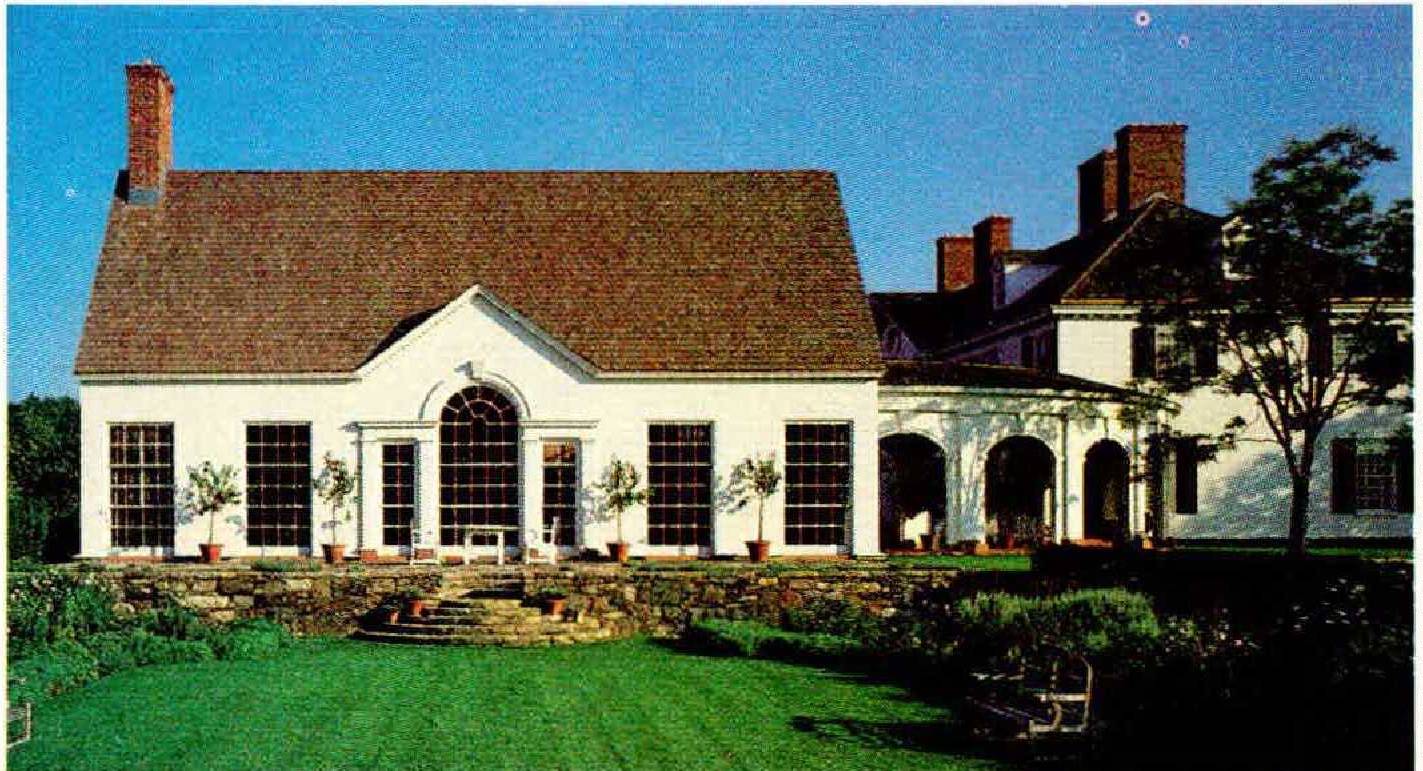
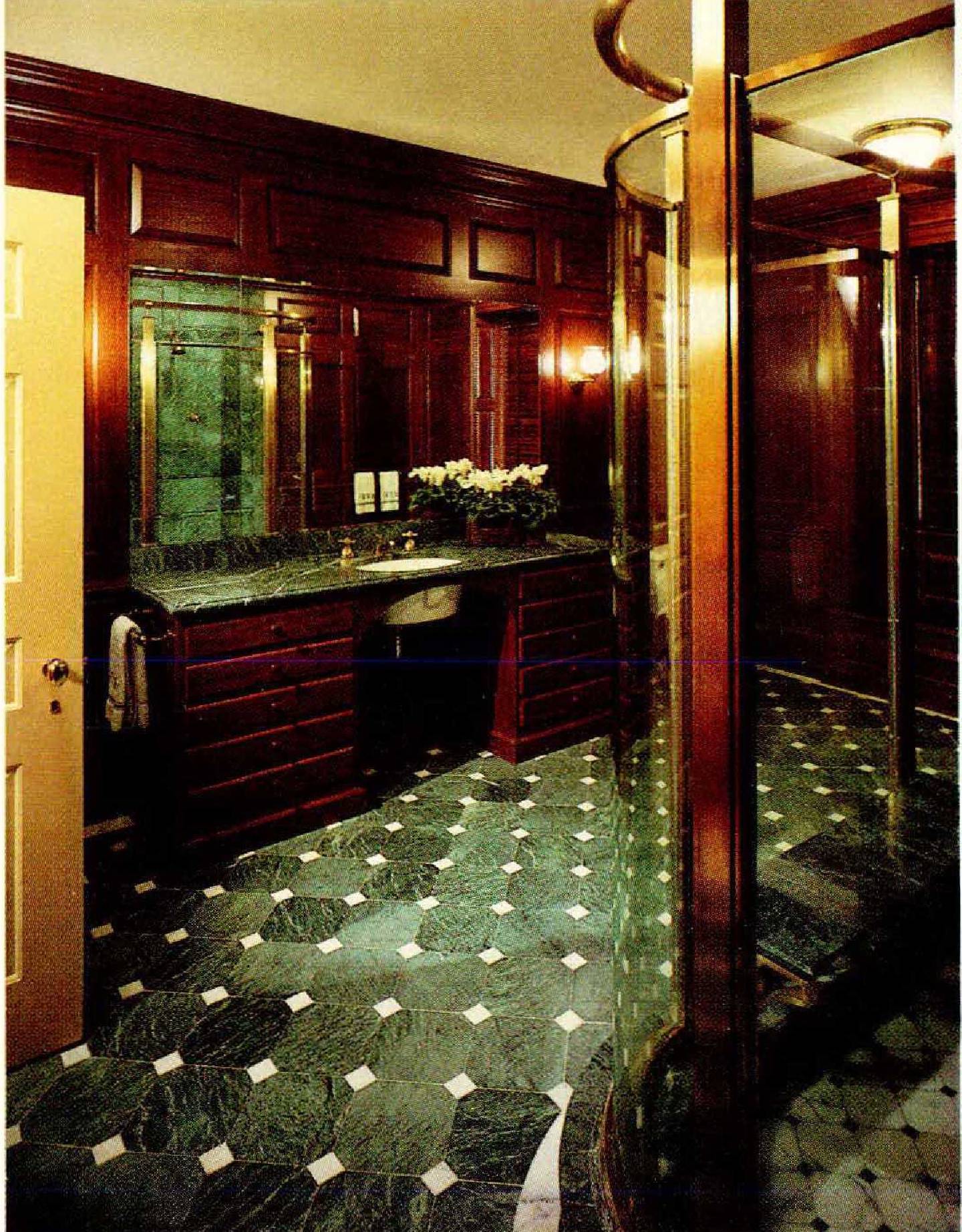
To work effectively in traditional styles, he sometimes travels extensively with clients, looking at buildings that might serve as models. For a Connecticut house much different from the neoclassical villa, he and a client toured Virginia and Connecticut period houses built from the eighteenth century to the turn of the twentieth, and he traveled by himself to others in Massachusetts. Eventually a decision was made that the new house, on a knoll of a rolling several-hundredacre estate, should be loosely based on Washington’s Mount Vernon, but about half again as long.
Visitors drive into the Connecticut estate by way of a winding road that Greenberg says he and the client plotted inch by inch to offer a succession of oblique views of the house rather than a long, direct approach in the French style. “The changing, picturesque views make it softer, less pompous,” he says. Not until the very end of the drive, when visitors enter an elegant motor court, are they confronted by the full power of the architecture—the symmetrical white pedimented house straight ahead and its dependencies (a pool house to one side and a garage and service wing to the other) reaching around on both sides.
Greenberg sees the basic Mount Vernon shape as one of classicism’s archetypally humane gestures, suggestive of an embrace. Classical architecture is full of anthropomorphic features, as George Hersey, an art historian at Yale, makes clear in a recent book. The Lost Meaning of Classical Architecture. People without a classical education may not consciously recognize that many of the architectural features come from the human body, but it’s quite possible that they are subliminally aware that the symmetry of a classical building mirrors the symmetry of the body, that Corinthian capitals connote a human head and hair, that the type of bracket known as a console resembles a human ear, and so on. Rudolf Arnheim, an authority on visual perception in art, pointed out years ago that modern buildings, as broad at the top as at the bottom, are off-putting in that they seem to defy the law of gravity. Classical buildings, on the other hand, typically act in harmony with gravity, appearing smaller and lighter at the top than at the bottom. Greenberg’s houses are often built with a base, such as a portico on the main facade or a walkway along the house’s foundation, that extends outward just as the feet extend out from a human being, offering a sense of stability.
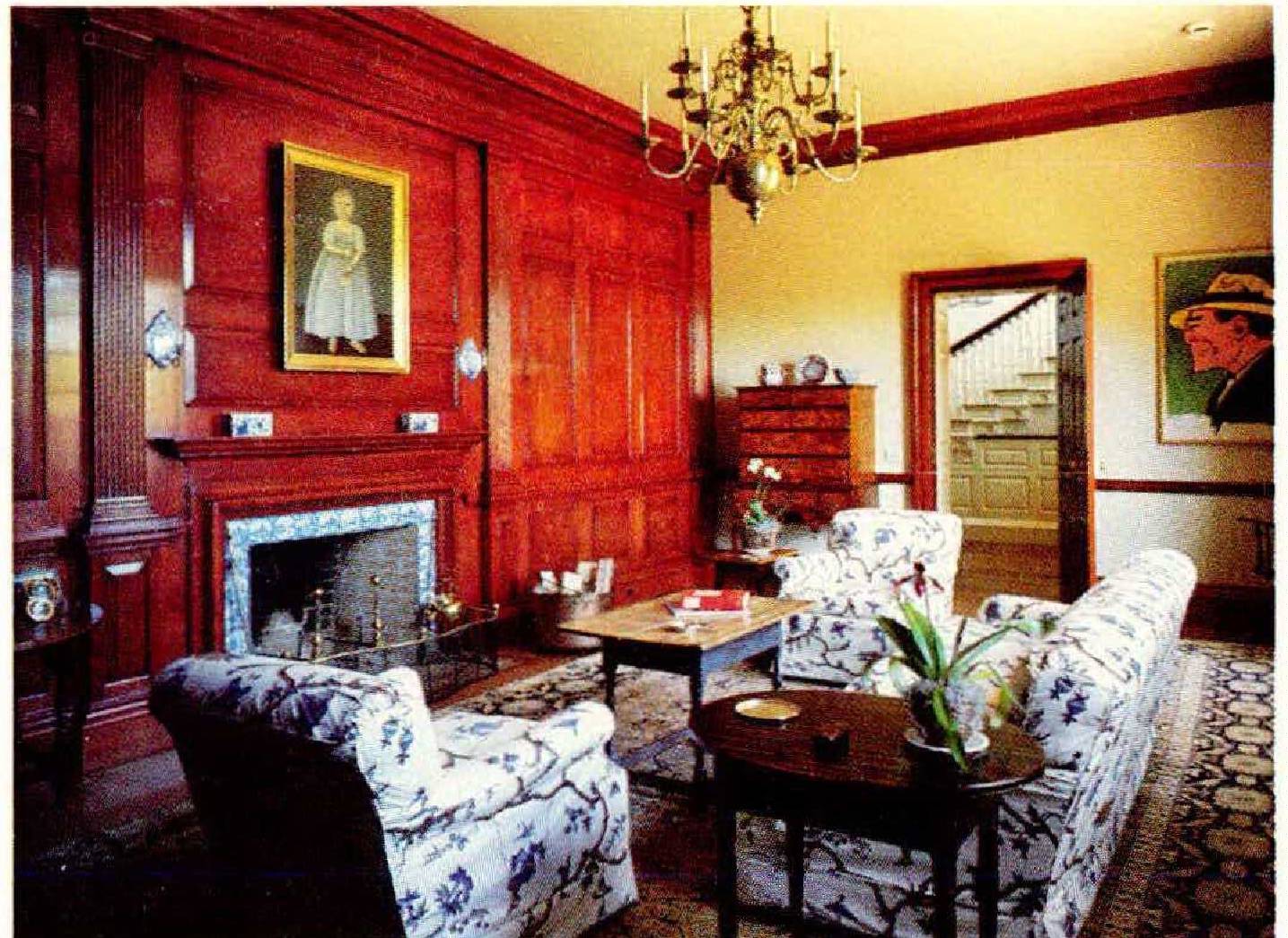
Inside Greenberg’s houses prolific moldings help to establish a comfortable though bold scale. “There should be no room in a house in which you’re overwhelmed,” he says. Chair-rail moldings or wainscoting breaks eleven-foot-high walls into more comfortably human dimensions. Cornice moldings of varying designs soften and embellish the transitions between walls and ceilings.
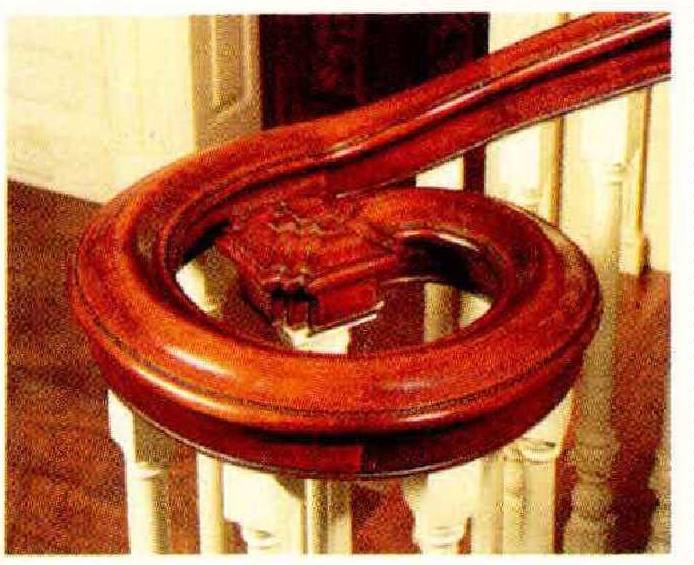
Greenberg has been known to buy a cache of fine wood, such as bird’s-eye maple or tiger maple, and store it until an opportunity comes along to use it in one of his buildings. He revels in subtle details of craftsmanship—for example, having the mahogany handrail of a grand staircase dyed, waxed, and polished rather than stained and sealed, which he says would fill up the pores and not produce as rich a luster.
Most of the ornament is modeled closely on that of buildings of the past, though Greenberg feels free to arrange the elements in fresh ways. A small amount he invents outright. For State Department ceremonial rooms in Washington he designed columns with capitals incorporating the Great Seal of the United States. For rooms in private homes he has designed window trim and decoration to complement objects in the room, from antique fireplace mantels to Art Deco furniture.
At the Mount vernon-like house it’s something of a shock to see that column capitals of a great southwest-facing portico have rotted after just a few years’ exposure, for reasons that are not entirely clear. The problem is uncharacteristic of Greenbergs work, and it seems to grieve him, reinforcing his belief that when architects and their clients aim for high quality, “nothing can be taken for granted.”
In many of Greenberg’s buildings, ornamentation swells to exaggerated dimensions. The keystones he used in refashioning the Fifth Avenue facade of the Bergdorf Goodman store in New York and for window and door surrounds on some of his houses are oversized. Greenberg savors robustness. Sometimes the beefed-up proportions are essential if the house is to hold its own against its furnishings. In the estate house the emphatic ornamentation makes an effective counterpoint to the owner’s intensely colored Andy Warhol prints and other vibrant modern art. Some photographs of the interior suggest that this artwork makes a calculated mockery of the architect’s hallowed classicism. But when you’re in one of the rooms it becomes evident that the vigorous architecture is not outdone by the paintings on the walls. Indeed, Greenberg argues that his success in marrying modern art to classical interiors demonstrates just how adaptable the classical tradition is.
His houses—and some of his other work, such as the Secretary of State’s office, which he designed during George Shultz’s tenure—feature secret compartments and discreet storage panels, useful for keeping television sets and modern electronic gear out of sight. Greenberg’s staff supplied a hundred and fifty pages of detailed drawings to the contractors who worked on the Mount vernon-like house. “We locate every light switch, every wall plug,” he says. “Full knowledge of how all the parts go together makes for a happy builder. A happy builder gives you a better job.”Houses require so much effort that Greenberg tries to have no more than two under way at a time—one in construction, the other on the drawing board.
CLASSICAL ARCHITECTS remain a tiny group, although they are more numerous than they were five or ten years ago. A steady stream of young graduates from around the country, eager to learn classical design, find work in Greenberg’s New Haven office—it will be moved within two years to New York, closer to his commissions— and in his more recently opened office in Washington, D.C. (Greenberg now has about thirty people on his staff.) Most classicists, including Greenberg, don’t want to be seen as the latest architectural trend. Rather, they view themselves as part of a majestic continuum that has enriched Western architecture for more than two thousand years—a continuum disrupted only by twentieth-century modernism, which turned its back on the past. Classicism offers them a connection to the West’s most extraordinary accomplishments. There is, however, a more melancholy truth. As Thomas Fisher observed in Progressive Architecture, the classicism that Greenberg employs so skillfully is the architectural equivalent of Latin, a language with the potential for eloquence but one that has dropped out of currency. Many admire it, but few are fluent in it.
Contemporary architects are especially reluctant to talk about beauty. In ten years of attending public lectures at various architectural schools, rarely have I heard a speaker utter the words “beauty" and “beautiful.” Greenberg, once described as “America’s most avant-garde architect who is also a traditionalist”—a description he relishes— is a man of older, more accommodating ways. “I want to build beautiful buildings,”Greenberg says, “buildings that are sexy and sensuous and that fit the client like a suit.”