Is Coffee Harmful? What Science Says Now About Caffeine and Decaffeination
Is Coffee Harmful?What science says now about caffeine and decaffeination.
by Corby Kummer
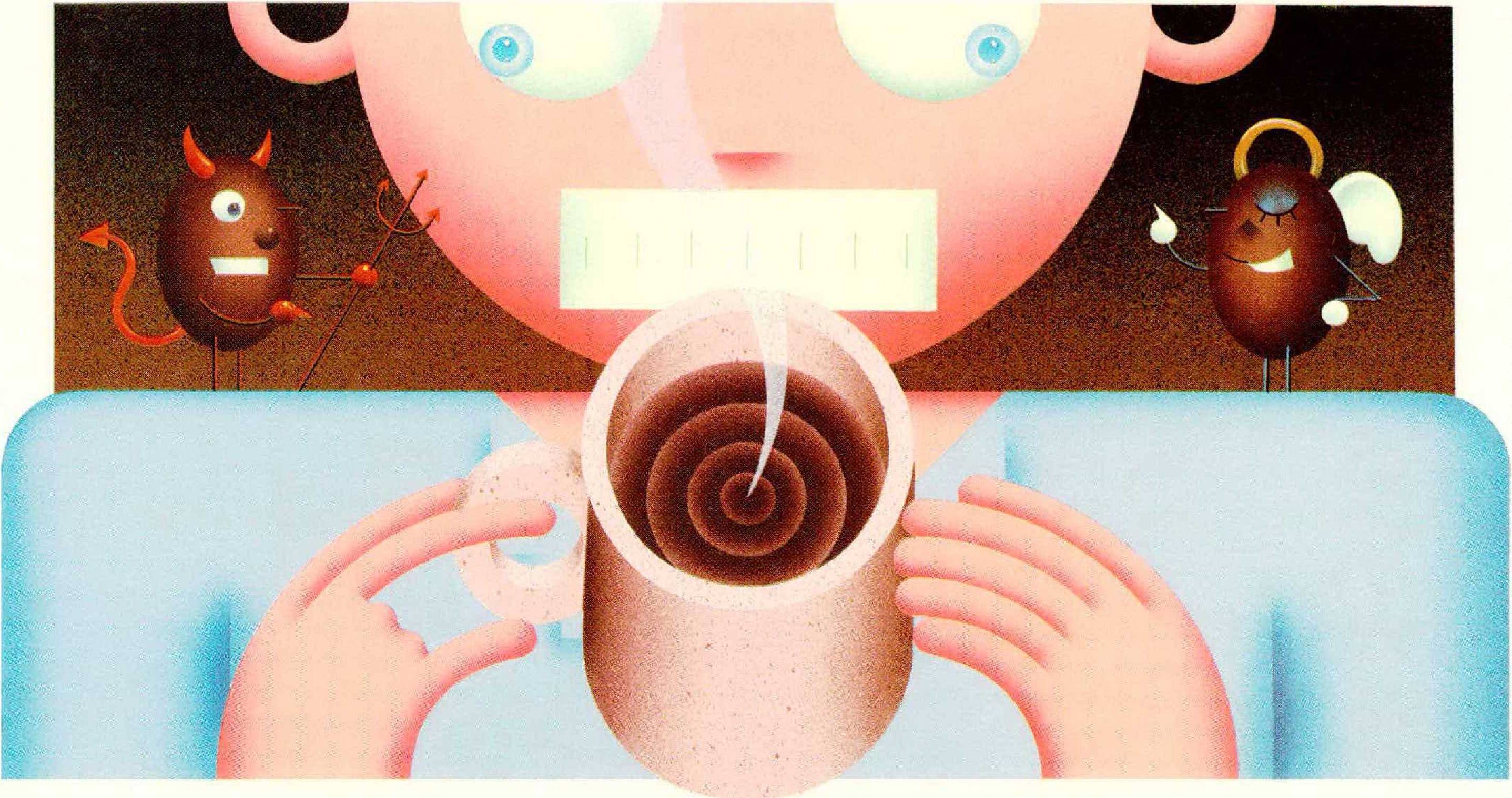
YOU CAN LEARN what fine coffee is and brew it far better than you ever did before. You can really like the taste of the stuff. But the reason most people drink coffee, of course, is the caffeine. Caffeine may do a wonderful job of fortifying you to face the day. You may think you couldn’t live without it. But is it bad for you?
Frank evaluation of its hazards is not easy. There is a vast literature on the effects of caffeine on the body, and for every study reaching one conclusion, seemingly there is another that contradicts it. Although most major health risks have been ruled out, research continues at a steady clip. I’ll summarize here the work done recently.
The first indictment of caffeine in recent years came in 1972, when a Boston group found an association between heavy coffee drinking (more than six cups a day) and elevated risk of heart attack. The association was never confirmed by other studies, however, and the first studies were shown to have been flawed. In 1974 a twelve-year review by the Framingham Heart Study concluded that there was no association between coffee consumption and heart attacks, coronary heart disease, angina pectoris, or sudden death.
Today the possible link between caffeine and heart disease is still controversial, and remains the most widely studied aspect of caffeine; recent studies have separated out other risk factors, chiefly smoking, that misled researchers in the past. They have so far come up pretty much undecided. Because very high doses of caffeine can provoke arrhythmia (irregular heartheat), the danger to people who already suffered from arrhythmia was for a while widely researched, but a study reported last year in the Archives of Internal Medicine concluded that moderate doses of caffeine did not pose a danger even to people with life-threatening arrhythmia. Last fall a widely publicized study suggested that people who drink decaffeinated coffee experience a rise in serum cholesterol, but the medical community has largely dismissed the study as preliminary and inconclusive, and no supporting studies have appeared. A recent study in the Netherlands, reported last winter in the New England Journal of Medicine, found a significant increase in serum cholesterol among drinkers of boiled coffee, still popular there but made very little here; filtered coffee, which is what most Americans drink, had no effect.
A famous health scare associating caffeine with pancreatic cancer turned out to be another case of the missing link: cigarette smoking was the important risk factor, and five years after publication of the study its authors reversed their original findings. Studies associating coffee with bladder, urinary-tract, and kidney cancer have also been inconsistent and inconclusive.
No link to breast cancer has been proved, although whether a link exists between coffee drinking and benign breast disease, or fibrocystic disease, is still controversial. Large and well-controlled studies have virtually ruled out any link between caffeine consumption and the development of fibrocystic disease, but abstaining from caffeine as a way of treating the disease has been less thoroughly studied. Although the studies conducted so far suggest that no significant lessening of fibrocystic disease occurs when women give up caffeine, many women believe that doing so is an effective treatment.
Pregnant women were told in 1980 by the Food and Drug Administration that they should avoid caffeine, on the basis of an FDA experiment in which pregnant rats were force-fed the equivalent of 56 to 87 cups of strong coffee at a time through a stomach tube, and gave birth to offspring with missing toes or parts of toes. A later study giving rats the same exaggerated doses, but orally, in drinking water and at a steadier rate over a day, resulted in none of the birth defects. No later studies on human beings have linked coffee-drinking to any birth defects.
The subject for further study seems to be the connection between heavy consumption—more than six or seven cups a day—and low birth weight or birth defects. The average half-life of caffeine in the body, meaning the time it takes the body to get rid of half the caffeine consumed, is three to six hours. Women in the second and third trimesters of pregnancy clear it half as fast, and caffeine, which passes easily through the placenta, can remain in an unborn child for as long as a hundred hours. (Heavy smokers, in contrast, clear caffeine twice as fast.) Although no dangers to infants have been found when pregnant women or nursing mothers drink moderate amounts of coffee, many doctors recommend on principle that pregnant and nursing women avoid caffeine.
HOW CAFFEINE WORKS is still incompletely understood, and the prevailing theory took shape only in the early seventies. The theory holds that caffeine acts less by starting than by stopping something, the something being the depressant effects of adenosine, one of the chemicals the body makes to control neural activity. Caffeine blocks the adenosine receptor sites in cells. This theory is not perfect, for reasons including that there are different types of adenosine receptors, but it is widely accepted.
Proponents of caffeine emphasize its ability to increase alertness and enhance performance on various tasks. Its effects are most pronounced, however, on performance levels that are low because of fatigue or boredom. Also, caffeine seems to affect people to a degree that varies according to personality type. For example, it appears to help extroverts keep performing tasks requiring vigilance more than it helps introverts, who are evidently able to plow through such tasks unassisted. Despite the generations of writers who have assumed that coffee helps them think more clearly, caffeine seems to increase only intellectual speed, not intellectual power. Subjects in experiments do things like read and complete crossword puzzles faster but not more accurately.
Some studies reveal a curious fact. One recent study found that people who were given doses of caffeine varying from none to high and at the same time allowed to drink their normal amount of coffee each day had no idea how much caffeine they were consuming overall or whether they were consuming any additional caffeine. Even at the highest additional doses people who ordinarily drank small amounts of coffee reported no irritability, nervousness, or tremors. Numerous other studies reinforce the idea that people respond to caffeine more in relation to how much they think they have consumed than to how much they actually have.
This is not to say that the effects of caffeine are imaginary. Many studies confirm what most people know—coffee keeps you awake. It also often decreases total sleep time and increases the number of times you wake in the night, depending on how much you drink and on how sensitive you are. Variation among people is great. Everyone knows someone like the woman I met in Brazil who told me, “If I’m sleepy, I take a coffee. If I wake up at night, I take a coffee to go back to sleep.” Although caffeine does interfere with some phases of sleep, it has in many studies been shown not to decrease rapid-eye-movement sleep, as alcohol and barbiturates do. The sleep disturbance it causes seems to be more severe in older people, which may be one reason why consumption of decaffeinated coffee increases with age.
That caffeine interferes with sleep doesn’t mean that it reliably makes you snap to. It doesn’t sober you up, black or with milk—your motor functions are just as badly impaired by alcohol as they were before you drank two cups ot black coffee, and even if you feel more awake you’re just as dangerous a driver. Similarly, caffeine does not counteract phenobarbital or other barbiturates. But it does help reverse the impairment of cognitive activity caused by diazepam, the chemical that is the basis of Valium and many other tranquilizers.
Caffeine speeds up the metabolism and makes you burn calories faster, although not significantly for purposes of weight loss, as amphetamine does. The body metabolizes caffeine almost completely, and it appears in all tissue fluids about five minutes after ingestion, reaching its highest levels after twenty to thirty minutes. Caffeine is a diuretic and thus dehydrating, so don’t think that drinking coffee will slake your thirst. Coffee, both regular and decaffeinated, has a laxative effect.
And coffee can cause stomach pain and heartburn. The exact roles played by caffeine and other substances in coffee in stimulating the secretion of gastric acids remains in question, because there has been proof that both caffeinated and decaffeinated coffee can affect the gastrointestinal tract. One study found that regular and decaffeinated coffee each had twice as much effect on the gastrointestinal tract as caffeine alone. Although coffee, with or without caffeine, and caffeine itself are not thought to cause ulcers, their role has been little studied, and both are known to make ulcers worse.
A source of confusion for anyone trying to learn how much caffeine he consumes is the conflicting estimates that appear in studies. Most say that a fiveounce cup of coffee contains from 80 to 100 milligrams of caffeine, although in fact the variation can be much greater, depending on the strength of the coffee. The same amount of tea, brewed for five minutes, has from 20 to 50 milligrams of caffeine; a cup of tea usually contains less caffeine than a cup of coffee because less tea is used per cup. A twelve-ounce serving of cola generally contains 38 (for Pepsi) to 45 (for Coke) milligrams of caffeine. Some studies say that for caffeine to have its effects the minimum oral dose is 85 milligrams, but this too depends on individual sensitivity.
THE QUESTION OF addiction is similarly thorny. According to a review of the literature on caffeine and the central nervous system by Kenneth Hirsh, in Methylxanthine Beverages and Foods, recent data show that tolerance to caffeine develops in the central nervous system and in many organ systems. Tolerance has been better studied than its ugly corollary, withdrawal. In sleep studies researchers noticed that heavy coffee drinkers were less disturbed than light or moderate coffee drinkers by drinking coffee before going to sleep and, if they had had no coffee the night before, felt more in need of a cup in the morning. Those little accustomed to caffeine suffer “caffeinism,”or coffee nerves, when they have a high dose. Those accustomed to but deprived of it report, and experiments confirm, irritability, inability to work well, nervousness, restlessness, and lethargy.
Worst, and most common, is the headache that comes with giving up caffeine. The headache can be severe and often lasts for one or two days. The adenosine-receptor theory holds that long-term caffeine consumption creates more adenosine receptor sites, and thus sudden abstention from caffeine means unusual sensitivity to adenosine. This could explain withdrawal headache: overreactivity to adenosine in blood vessels in the scalp and cranium can dilate them, and cause a headache. One very effective way to treat the headache, unsurprisingly, is with caffeine, which constricts the blood vessels in the brain; this effect is why caffeine has long been used to treat migraines. (In contrast, caffeine dilates coronary arteries.) The reason so many over-the-counter headache remedies include caffeine, though, is that it is thought to enhance the effects of the other drugs in them—something that has never been proved. Kenneth Hirsh optimistically thinks that because the body is more sensitive to adenosine after caffeine withdrawal, it will compensate by reducing the number of adenosine receptors to the number that existed before caffeine tolerance developed.
If caffeine is so painful to give up, can caffeine tolerance be compared to addiction to other drugs? Hirsh, like many other scientists, wants to avoid the comparison. “All definitions of addiction . . . eventually boil down to compulsion with and for a drug,”he writes. Caffeine, he concludes, just doesn’t result in addictive behavior. He points to rat and baboon studies in which animals regularly gave themselves doses of morphine, cocaine, and amphetamine but gave themselves caffeine no more often than saline placebos. Some animals in the experiment seemed more eager for caffeine than others, which supports the idea that individual variation is important. Hirsh, it must be noted, worked for General Foods when he wrote his study, but he is not alone in his conclusions.
However fine one draws the distinction, caffeine use does fit several standards of drug addiction, which include compulsion to continue use, tolerance for the drug, and withdrawal. It is silly to invoke the argument, as caffeine apologists often do, that truly addictive drugs impel their users to commit any act, however violent, to obtain them. You don’t have to mug someone in a park at night to get money for a cup of coffee. You can stand on a corner and ask for it.
WHETHER OR NOT caffeine is hazardous or truly addictive, becoming habituated to it and suffering coffee nerves or caffeine withdrawal is no fun, and many people have chosen to drink decaffeinated coffee instead. In 1962, the peak year for American coffee consumption, decaffeinated coffee made up only three percent of coffee sales; today it accounts for more than 20 percent. It’s a shame that most decaffeinated coffee is so terrible, because it doesn’t have to be. Traditionally, the inferior robusta species of bean has been decaffeinated, not only because it is cheaper but also because it yields more caffeine, which can be sold to soft-drink and patent-medicine companies, and because it has more body and so can better withstand decaffeination processes. Arabica beans, which are of higher quality, are now being decaffeinated. But the public buys the vastly inferior water-process decaf, because it suffers from an unwarranted fear of chemical decaffeination.
Decaffeination has been practiced since the turn of the century, mostly using chemicals. Every process starts with steaming the beans, to loosen the bond of caffeine to the coffee bean.
Then, in the “direct” process, a chemical solvent is circulated through the beans. The beans are again steamed to remove any residual solvent, and dried; the solvent is mixed with water and the caffeine extracted. In the water process, after beans are first steamed they soak in water, which removes not only caffeine but all the other solids that flavor a cup of coffee. Caffeine is removed from the solution, which is reduced to a slurry that is returned to soak with the still-wet beans and give them back some of the lost solids.
The problems of water-process decaffeination are obvious. The water strips out most of the body and the flavoring compounds. What goes back is sometimes from the previous batch ot beans, and it won’t all go back anyway. Jacobs Suchard, a large Swiss company, has made improvements in the water process that keep more solids intact in the beans. It has mounted a new campaign to promote the Swiss process, in which caffeine is extracted from the water-solids solution with carbon filters rather than with the chemicals that are sometimes used. Specialty coffee decaffeinated at Jacobs Suchard’s new factory in Vancouver has made strong showings in taste tests. But most water-process decaffeinated coffee is still a shadow of its former self and must be overroasted, to give the false impression that it has body and flavor.
The most efficient chemical solvent, methylene chloride, is what people think they should avoid. Methylene chloride has been banned for use in hair sprays since it was shown in animal studies to be dangerous when inhaled. But mice fed methylene chloride in drinking water at doses equivalent to 4.4 million cups of decaf a day showed none of the toxicological or carcinogenic response that had occurred when mice had inhaled it in much smaller quantities. In 1985 the FDA said that the risk from using methylene chloride in decaffeination is so low “as to be essentially non-existent.”Methylene chloride evaporates at 100° to 120°F. Beans are usually roasted at a temperature of 350° to 425°, coffee brewed at 190° to 212°. The amount of methylene chloride left in brewed coffee, then, must be measured in parts per billion—comparable to what is in the air of many cities. Even Michael Jacobson, the crusading leader of the consumer-advocacy group Center for Science in the Public Interest, says that caffeine is more dangerous than any chemical residues in decaffeinated coffee. Coffee decaffeinated with methylene chloride certainly tastes better.
A new process, using “supercritical” carbon dioxide, shows great promise.
The supercritical fluid, in a state between liquid and gas, is produced under extremely high pressure. It can pass through steamed coffee beans and remove the caffeine without removing other solids, vaporizing when its work is done and leaving not a trace. So far General Foods is the only company using the process, and its production capacity allows it to decaffeinate only its Sanka brand (not its Maxwell House decaf) and Private Collection, a smaller GF venture into specialty coffee. A new processing plant is being built independently in northern California, and when completed (in about two years) it will decaffeinate beans from specialty roasters using supercritical carbon dioxide, which Marc Sims, a consultant in Berkeley, California, who is involved with the plant, prefers to call “natural effervescence.”
“Regular, decaf—it’s all caf,” a woman said dismissively when I recently offered her a choice of coffees after dinner. She was not entirely wrong. Advertisements for coffee that is “97 percent caffeine-free” might as well describe any coffee, since the caffeine content of coffee beans varies from 1.1 to 2.6 percent. It would be better to say “decaffeinated,” since the FDA requires that 97 percent of caffeine he removed from unroasted beans. (It has no requirements for brewed coffee.) Coffee decaffeinated by careful firms like Jacobs Suchard and KVW, near Hamburg, which uses methylene chloride, yields 0.03 percent or less caffeine in unroasted beans. Brewed decaf can thus have one to five milligrams of caffeine per cup, and however little that sounds compared with the supposed minimum 85milligram dose, it can keep some people—me, for instance—going.
You can rate the processes for yourself. The Coffee Connection (800-2845282) will send you Jacobs Suchard water decaf, Starbucks, an excellent roaster in Seattle (800-445-3428), and Thanksgiving (800-648-6491) will send you that or KVW chemical decaf. Any of these beans will prove that you don’t have to give up what you love about coffee if you give up caffeine.
NOT ONLY are people turning away from caffeine, they’re turning away from coffee, and in more significant numbers. Since 1962 per capita coffee consumption has fallen by more than a third, from 3.12 to 1.75 cups a day. At the same time, per capita consumption of soft drinks has nearly tripled. The decline can’t accurately be attributed to fears about caffeine, because two thirds of it occurred before the first health scare about caffeine, in 1972. The culprit is soft drinks, whose manufacturers spend much more on promotion than coffee companies do. Young people drink cola to wake themselves up, and so do many former coffee drinkers. Pepsi recently test-marketed Pepsi A.M., a cola with more than the usual amount of caffeine.
The coffee trade has naturally been alarmed by this trend, but no one quite knows what to do about it. The big fear is that coffee will go the way of tea— now considered (when served hot, at any rate) to be an old person’s drink. Big companies have tried to compete with specialty roasters, as General Foods did when it started its Private Collection line of whole-bean and ground coffee, because the specialtycoffee market has been growing by 15 to 20 percent a year while the mass coffee market has been shrinking.
A recent article in Tea & Coffee Trade Journal suggested various ways to combat the decrease: trying to break the coffee-caffeine association, both conceptual and aural, by using brand names to refer to coffee, as with soft drinks; trying to give coffee a youthful image in advertisements, rather than relying on a logo to sell the product; promoting coffee at colleges; dyeing plain old styrofoam cups so they’ll look zippy, like soda cans. The Coffee Development Group, an organization dedicated to increasing the consumption of coffee by improving its quality, thinks that one answer is in promoting iced coffee and sweetened coffee drinks, to compete directly with soda. In fact, the fastest-growing part of the specialty-coffee market is coffee mixed with bits of nuts and dried fruit and stirred with flavoring extracts, making really awful combinations that roasters disdain but stock—“those yucky flavors that sell,” in the words of Dan Cox, of Green Mountain Coffee, in Vermont, who is the current chairman of the Coffee Development Group.
Yucky they are. Better to drink straight coffee, with or without caffeine, that tastes good.