Word Histories: Etymologies Derived From the Files of the Dictionary of American Regional English
bigot
Gus Savage, a Democratic congressman from Illinois, was harshly criticized for a campaign rally last March at which he attacked an opponent on the grounds that so many of his contributors were Jewish. The House majority whip, William Gray, who had attended Savage’s rally, denounced the remarks as “bigoted.” One etymology for bigot (a person who intolerantly espouses a particular religious creed or opinion) suggests that it comes from an Old french variant of Visigoth, the Medieval Latin plural of which was Bigothi. The Visigoths of France, unlike the Franks, were followers of the doctrines of the fourthcentury heretic Arius. Another etymology centers on a remark by the Anglo-Norman chronicler Wace, who observed that the French called the Normans “bigots and dreg-drinkers.” The history behind this version perhaps begins with a probably fanciful tale in which Charles III, the Frankish king, commanded Rollo, the duke of Normandy, to kiss his foot, and the duke replied, “Ne se, bi got ” (No, by God!). A more likely explanation is that Norman soldiers adopted the English oath “by God!” — in Middle English bi god—which the French then naturally associated with the Normans. How did a derogatory term for a Norman develop religious overtones? One possibility is that bi god, being a meaningless expression to the French, was conflated with beguin (a religious devotee), thereby altering its meaning.
boondoggle
What with the savings-andloan scandal, the high cost of the Stealth bomber, and the hugely expensive cleanup of toxic waste at the nation’s atomic-weapons plants, the word boondoggle (a trivial or wasteful project or activity) is being heard with no little frequency these days. Last fall Senator Dale Bumpers lamented yet another wasteful enterprise, in an essay titled “The Trident Boondoggle.” the reference being to the Trident submarine. Boondoggle has been a staple of American politics for almost 60 years. In the 1930s Republicans applied it to the Roosevelt Administration’s “alphabet” agencies (WPA, FERA, NYA). According to one explanation of the word’s origin, it is jargon from the iron-smelting industry and refers to unprofitable attempts to retrieve good iron from slag. According to another, it is from a Scottish word for a playing marble received as a gift without having been earned. Doggle, or dogle. is indeed English dialect for a common marble, but there is no evidence that it was ever compounded with boon (favor, gift). The most
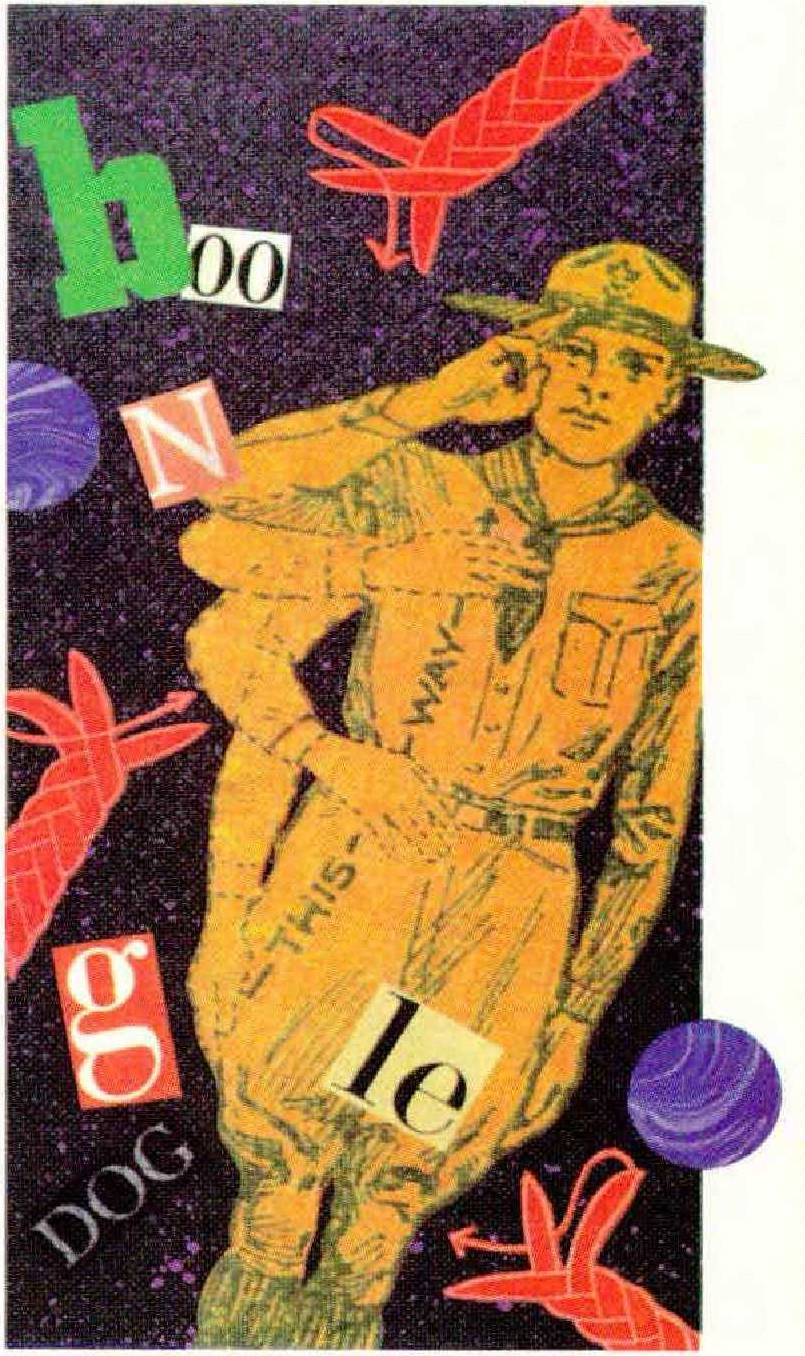
commonly accepted etymology holds that boondoggle was the invention of one Robert H. Link, a New York scoutmaster. He supposedly began using it around 1925 to refer to the plaited leather cords made by Boy Scouts to wear around the neck, from which a knife, keys, or a whistle might hang. Link considered the crafting of such boondoggles to be “makework.”
maverick
Just before the start of the NCAA basketball tournament last spring, Billy Tubbs, the coach of the No. 1—ranking University of Oklahoma team, responded to criticism of his outspokenness and of his team’s “run-and-gun" playing: “We’ve made some mistakes like everybody else. But I don’t agree with the so-called maverick label I have. We play hard. We give no quarter and we ask for none. . . ."Maverick (an individualist, an Unconventional person) originated in Texas. In 1845 Samuel A. Maverick, a lawyer and land speculator, and one of the sign-
ers of the Texas Declaration of Independence, in which Texas seceded from Mexico, accepted 400 head of cattle in payment of a $1,200 debt owed by a neighbor who was unable to raise cash. Maverick placed the cattle under the steward-
ship of a poor family, who performed their duties indifferently, branding few of the calves and letting the cattle wander and breed untended. Neighboring ranchers came to call the loose, unbranded calves “mavericks.”By about
1870 the name had become generic for any stray calf, cow, or steer, especially if it had no brand. To maverick was to steal unbranded yearlings, or any calf that could be separated from its mother ("Numerous cases are reported of cows having their throats cut so that the mavericking of the calf would be more easy“—Glenrock [Wyoming) Graphic, 1889), and a person who “strayed" from conventional behavior or beliefs was branded a maverick. This last sense was quickly exparted to the rest of the English-speaking world (“A very muzzy Maverick smote his sergeant on the nose" — Rudyard Kipling, Life’s Handicap, 1892).