The Real Stuff in Life: Tony Bennett Brings Urgency, Not Nostalgia, to the Standards He Sings
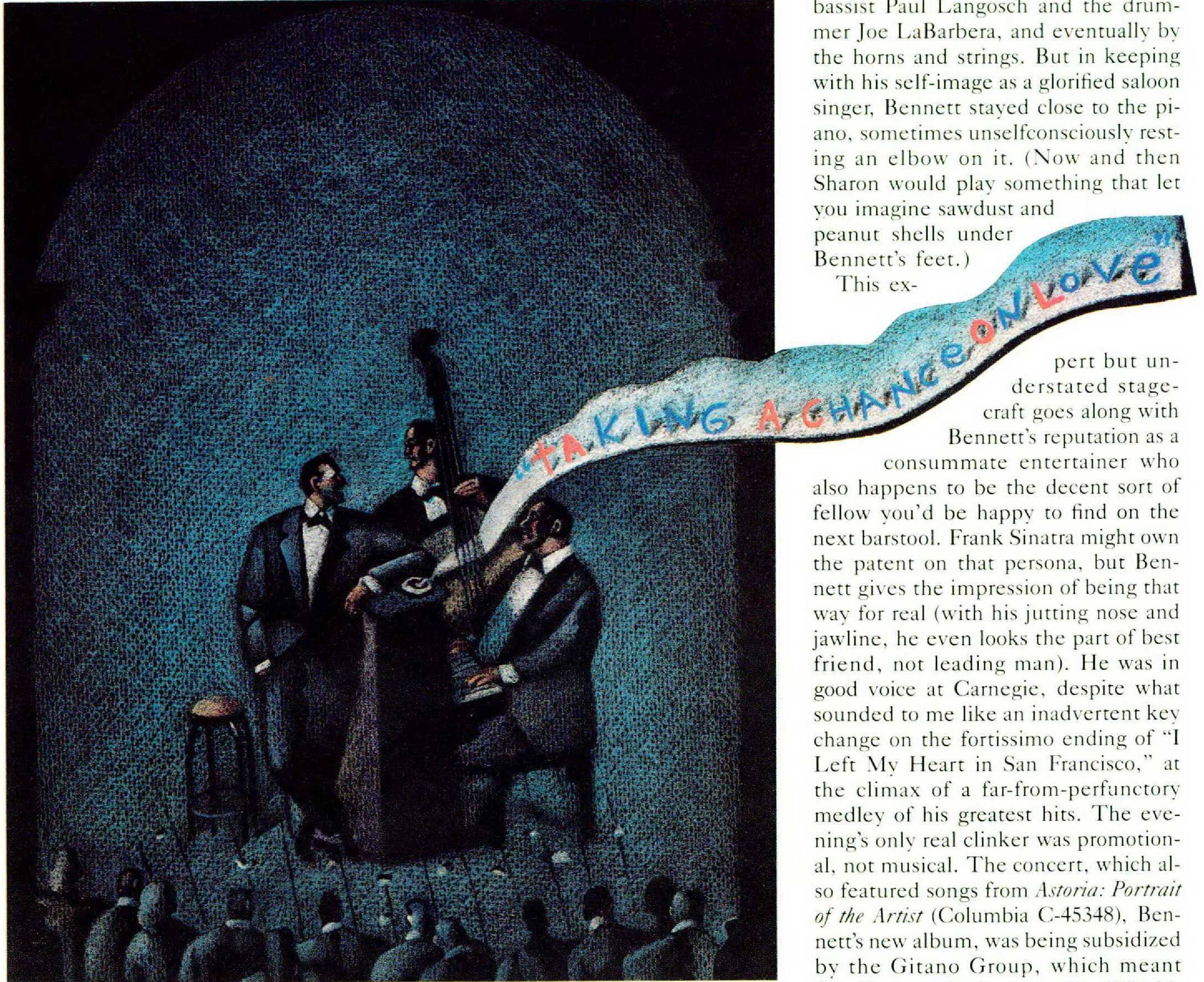
IF IT’S POSSIBLE to seem unpretentious dressed in black tie and surrounded by a chamber symphony on stage at Carnegie Hall, Tony Bennett did it at a performance that I heard last spring. The show began without announcement: Bennett just walked onstage, accompanied by the pianist
Ralph Sharon, his longtime music director, and sang “Taking a Chance on Love.” On the line “I walk around with a horseshoe” he pointed a thumb at his chest and lifted one foot off the ground, as though proud enough to strut. He followed with “My Foolish Heart,” slowly shaking his head “no" on the line “For this time it isn’t fascination,” turning palms down on the offending word for good measure. He and Sharon were then joined by the bassist Paul Langosch and the drummer Joe LaBarbera, and eventually by the horns and strings. But in keeping with his self-image as a glorified saloon singer, Bennett stayed close to the piano. sometimes unselfconsciously resting an elbow on it. (Now and then Sharon would play something that let you imagine sawdust and shells under Bennett’s feet.) A This ex-
pert but understated stagecraft goes along with Bennett’s reputation as a consummate entertainer who also happens to be the decent sort of fellow you’d be happy to find on the next barstool. Frank Sinatra might own the patent on that persona, but Bennett gives the impression of being that way for real (with his jutting nose and jawline, he even looks the part of best friend, not leading man). He was in good voice at Carnegie, despite what sounded to me like an inadvertent key change on the fortissimo ending of “I Left My Heart in San Francisco,”at the climax of a far-from-perfunctory medley of his greatest hits. The evening’s only real clinker was promotional, not musical. The concert, which also featured songs from Astoria: Portrait of the Artist (Columbia C-45348), Bennett’s new album, was being subsidized by the Gitano Group, which meant that Bennett had to sing his 1963 hit “The Good Life” to footage of young marrieds and their children romping outdoors in the sponsor’s sportswear.
I know that corporate underwriting of live music is a necessary evil at this point (chamber symphonies do cost money), but by presenting what amounted to a TV commercial on stage, Gitano was crossing one of the few remaining lines. It was unworthy of Bennett, and I thought he seemed embarrassed by it. “This is my commercial,”he said in introducing “Lost in the Stars”—his third and final encore, after “Fly Me to the Moon" and “How Do You Keep the Music Playing?”—and then explained to the audience that the song was from a 1949 Broadway adaptation of the South African novel Cry, the Beloved Country, and that he found its message of brotherhood still timely.
But Bennett had already given the audience something to think about with “Fly Me to the Moon.” He often does this song as his encore (probably because it allows him to exit after singing the final words, “I love you,” and pointing to the front rows), and he frequently asks that his microphone be turned off when he does it in nightclubs. Still, it was a surprise to hear him make the same request in a hall as large as Carnegie.
“Musicians’shoulders go back when they walk onstage there,” he told me a few days later, during an interview in his business office, a few floors down from his apartment in midtown Manhattan. He meant that he had wanted to prove himself still worthy of Carnegie Hall, at sixty-three, by bouncing his unamplified voice off its walls.
Actually, there were moments during the song when you could barely hear him, but his lung power wasn’t what made the stunt remarkable. Bennett was breaking down pop’s fourth wall (how often these days, even in concert, do we hear a singer’s actual voice, minus echo, reverb, and artificial sibilance?) and thus exposing his style to scrutiny. I was finally able to put my finger on something I had always thought of as curious: his way of stretching the final words of a phrase while riding up on the notes, a melismatic touch that I (perhaps owing to my ethnic background) associate with the Irish, not with an Italian-American singer like Bennett.
“Ah, that’s Crosby,” Bennett said in the interview when I mentioned this. “You see, my uncle was married to an Irish lady, and they both adored Bing.”
Then, indirectly, Bennett pinpointed one of the secrets of his own appeal. “He loved to sing, and you could hear it. That’s something that you can’t buy. Either you have it or you don’t. It had nothing to do with the money he made. He had a natural love for it. Just like a guy in a barroom. You say, ‘Come on, sing us a tune.’ And he sings.”
In a 1965 article for Life magazine in which he found most vocalists wanting in one way or another, Frank Sinatra called Bennett “the best in the business. . . . the singer who gets across what the composer has in
mind and probably a little more.” These words from on high have since acquired the air of prophecy, no matter how dubious they must have sounded at a time when Sinatra himself was still very active.
To GAIN A MEASURE of Bennett’s musical growth over the decades, all you need to do is compare the new version of “The Boulevard of Broken Dreams,” on Astoria, with the 1956 version, which is included on 16 Most Requested Songs (Columbia CK-40215), a CD-only compilation of his hits of the fifties and early sixties. The older version’s Apache dance of an arrangement, for which Bennett can’t be held accountable, isn’t the only problem. There’s also Bennett’s vibrato, which doesn’t know when to stop, and his overzealousness in punching up each note, even at the expense of lyric message and rhythmicflow.
The new version, with spare but effectively atmospheric accompaniment by Sharon, Langosch, and LaBarbera, demonstrates Bennett’s mature willingness to let a song breathe. The lower key, although obviously dictated by the singer’s diminished range, amounts to an advantage. It’s more in keeping with the rueful mood of A1 Dubin’s lyrics, which Bennett manages to make seem almost worthy of Harry Warren’s lovely melody, virtually sighing that silly but delightful line about “gigolo and gigolette.” 16 Most Requested Songs also includes Bennett’s back-to-back No. 1 hits from 1951, the quasi-aria “Because of You” and his pop crossover version of Hank William’s country song “Cold Cold Heart.”
On the albums of standards he made wath jazz musicians in the fifties and sixties you can hear Bennett on his way to becoming the singer he is today. A reissue from this period worth seeking our is Basie!Bennett (Capitol/Roulette Jazz CDP7 93899 2). Although Basie plays piano on only two tracks, his band is present throughout. Sharon did the arrangements, including an especially lovely version of Lerner and Loewe’s “I’ve Grown Accustomed to Her Face,” from My Fair Lady.
But I think that Bennett reached a turning point in 1972, when he was dropped by Columbia Records after twenty-two years on the label, his departure hastened by bis reluctance to do more albums like Tony Sings the Great Hits of Today, from 1970, on which he interpreted pop tunes for which he bad no genuine feeling. At least Bennett was assigned songs by Stevie Wonder, Lennon and McCartney, and Burt Bacharach—unlike his label-mate Mel Torme, who was given “If I Had a Hammer,” “Red Rubber Ball,” and “Secret Agent Man.” When I spoke with Bennett in March, he likened his disgust at being pressured to do “contemporary” material to that of his seamstress mother when she was forced to work on a cheap dress.
Although Bennett was off the hit parade for good, appealing mostly to listeners beyond the usual record-buying age, he continued to fill nightclubs and concert halls. The confidence that he was going to “make a buck no matter what” seems to have enabled him to renew his relationship with jazz, recording an album of voice-and-piano duets with Bill Evans for Fantasy, and two collections of Rodgers and Hart with the guitarist George Barnes and the eornetist Ruby Bra If for his own label, significantly named Improv (for which he also recorded another album with Evans). During his banishment from Columbia, Bennett also began to enjoy success in his second career, as a painter, signing his works Anthony Benedetto (his real name) and reportedly selling them tor as much as $40,000 each.
During the seventies Bennett developed what has since become his most endearing vocal trait: bearing down on the key words of a lyric and sometimes delivering them in what is practically a stage whisper or a shout, like a man thinking out loud while singing conbrio. The effect is too fleeting—and too much Bennett’s own—to be characterized as sprechstimme or parlando. In addition to making a virtue of the slight huskiness that has crept into his voice with age, it gives his performances an autobiographical depth comparable to that which Sinatra achieved in his late prime, in the 1950s. The most striking instance of this is on his recording of “Make Someone Happy” with Evans. “Fame, if you win it, comes and goes in a minute. Where’s the real stuff in life to cling to?” Bennett sings, and you sense that the real stuff to which he’s holding fast includes the song itself and others like it.
AFTER GOING NINE; years without a new release, Bennett re-signed „with Columbia in 1986. His three new albums since then have been produced by his son, Danny, and delivered to the label as finished products. The Art of Excellence (Columbia FG-40344) featured mostly newer, nonrock songs of Bennett’s own choosing; although the emphasis was on such dolorous, overblown ballads as “How Do You Keep the Music Playing?” and “Why Do People Fall in Love,” Bennett sang them beautifully. On Bennett! Berlin, Bennett did with “White Christmas” what might have seemed impossible, putting the song across with gentle barroom yearning in place of the familv-around-thefireplace smugness with which it’s usually sung. Bennett/Berlin captured Bennett at his best, with flawless support from his trio
and cameo appearances by George Benson, Dizzy Gillespie, and Dexter Gordon.
Astoria, with Bennett’s trio, plus an orchestra conducted by the arranger Jorge Calandrelli on all but two ot the fourteen tracks, is what used to be called a concept album: a musical “autobiography" (although Bennett wrote none of the songs) and a celebration of the working-class section of Queens, in which the singer grew up and for w hich the album is named. (Given this, Astoria bears a superficial resemblance to Bennett’s long-out-of-print 1958 album Hometown, My Town, whose unifying extra-musical subject was the fast pace of Manhattan.)
Although a song from the 1930s called “Just a Little Street Where Old Friends Meet” (“and treat you in the same old way”) successfully evokes the front-stoop culture Bennett remembers, Astoria amounts to an uneven collection of vintage and recent songs. The older songs are fine: aside from “The Boulevard of Broken Dreams,” the best performance here might be “Body and Soul,” if only for the pleading edge with which Bennett renders the line (which most singers find nearly unsingable) “My life a wreck you’re making.” Bennett also fares well with “Speak Low,” “The Folks That Live on the Hill,” “A Weaver of Dreams” (interpolating it with “There Will Never Be Another You”), “The Man I Love” (which Bennett sings as “The Girl I Love,” using Ira Gershwin’s alternate lyrics), and the Billie Holidayassociated “It’s Like Reaching for the Moon.”
The problem is that while these older songs are about love, friendship, ambition, heartbreak—the works— Astoria’s newer songs tend to be about little more than the older songs. This is true usually only in terms of mood but quite literally in the case of P. J. Erikson and Buddy Weed’s “Where Did the Magic Go?,” whose lyrics pine for “Francis Albert,” “The King of Swing,”and “Dorsey’s sound,” along with “Spencer playing Katharine’s beau” and “Fred and Ginger dancing slow.” (The lyrics also rhyme “Hemingway” and “Courvoisier,” reducing educated taste in literature, movies, and song to consumerism with class.) Bennett puts the song across with such snap that I find myself humming along despite myself. I suppose that what really bothers me is that songs like this provide ammunition for those who dismiss Bennett and the songs he does best as irrelevant to contemporary life.
“All this music is written and sung in the style that dominated popular music before rock & roll—which also means before the 60s, before feminism, before what we’ve come to accept as the dawn of modern life,” Greg Sandow complained in his review of Astoria in Entertainment Weekly.
Men, in those days, were men; marriage was forever; woman comforted men and cooked their meals. No, Bennett never explicitly sings that here. But every time he does sing about marriage . . . the very sound of his music drags me back to an age when wives were expected to spend their time keeping house. And that. I’m afraid, tells me why the classic American popular song might be going out of style.
To spot the illogic in Sandow’s argument, you don’t need to know that he’s a music critic (arguably the best ever on the subject of classical avant-garde) who now writes with a convert’s zeal about rap and heavy metal, genres whose lyrics hardly tend to be enlightened in their view of women. Sandow is forgetting that music and the emotions it calls into play don’t have to be raw in order to be real. He’s also not giving Bennett—who is twice divorced and a product of the ethnic working class—credit for realizing that life doesn’t always work out the way it did in the great old songs, and for knowing that that might be the best reason to go on singing them.
Some of Bennett’s supporters don’t help him any. “All of this only two years ago, right out there, front and center, on a Bruce Springsteen planet,” Jonathan Schwartz, a writer and radio personality with a past as a progressive-rock disc jockey to recant, wrote in praise of Bennett!Berlin in Wigwag last year. Bennett’s own pronouncements often don’t help either. In summing up the difference between rock and his kind of pop, he said, “One is marketing, rhe other is good music.”
Why should it be necessary to choose between Tony Bennett and Bruce Springsteen? Bennett conveys as much urgency, although it’s of a different sort. Often written about as though he were Sinatra’s exact contemporary, he is eleven years younger, the difference of at least a generation in pop. The lost magic that Bennett mourns on Astoria was already vanishing by the time he began his career: jazz and pop were no longer close kin, Broadway and Hollywood were entering what everybody must have sensed would be their last decade of providing durable new songs, and rock-and-roll was just around the corner. Forty years later Bennett has become the best singer of his kind, but he must sometimes feel like an ambassador from a country that’s fallen off the map.