Notes: Was the Bard Behind It?
Old light on the Lincoln assassination
IF YOU’RE LIKE a lot of Americans, your school days included a class in which you recited orations from Julius Caesar. You may have been taught that the title character in Shakespeare’s tragedy was a forerunner of the King that Britain’s New World colonies felt driven to defy in 1776. And you may have learned that the Patrick Henrys and Nathan Hales who took arms against George III were following in the steps of honorable patriots who had done what they’d had to do during the most soultrying days of republican Rome.
Julius Caesar encourages people to draw such parallels, because shortly after Brutus and his companions have performed their bloody deed, Cassius asks,
Shall this our lofty Scene
be acted over
In States unborn and Accents yet unknown?
These are provocative, prophetic words, and a Shakespearean actor who heard them spoken a century and a quarter ago appears to have taken them as his cue for one of the most dramatic moments in American history.
That moment is the culmination of the new eleven-hour, five-part documentary The Civil War, on PBS—a fitting occasion to ponder “the irrepressible conflict” the way Lincoln sometimes did: as a re-enactment of Shakespearean tragedy.
AS IT HAPPENS, the man who fired the most notorious shot in the struggle bore the name of an eighteenth-century British radical, John Wilkes, who had supported the secessionist rebellion that established a new nation on these shores. There can be little doubt that John Wilkes Booth looked to his contentious predecessor for inspiration during the Confederacy’s effort to sever unwanted political bonds. But Booth responded to even deeper stirrings, with a more classical source. His father, the eminent Junius Brutus Booth, had been given a name that identified him with both the legendary founder of the Roman republic (Lucius Junius Brutus) and the descendant who fought to preserve that republic half a millennium later (Marcus Junius Brutus). The elder Booth in turn had bestowed the same appellation on the oldest of his sons, three of whom were destined to follow him into the theater.
You’ll recall that in Julius Caesar the example of the original Brutus is invoked as a symbolic conscience for Shakespeare’s brooding protagonist. Partly through the persuasions of Cassius, but mostly through Brutus’s sense of his own honor, the spirit of the ancient Brutus urges the inheritor of his virtues to circumvent a would-be king and thereby safeguard the liberties that have defined Roman dignity since the abolition of monarchy some five centuries before.
Like the Marcus Junius Brutus of Shakespeare’s play, John Wilkes Booth was keenly receptive to the promptings of ancestral tradition. He aspired to what “an antique Roman” would do in his place, and it is very likely that he was alluding to both Brutuses when he spat out “Sic Semper Tyrannis” (“Thus Be It Ever to Tyrants”) and slew a President he had frequently scorned as a “King.”
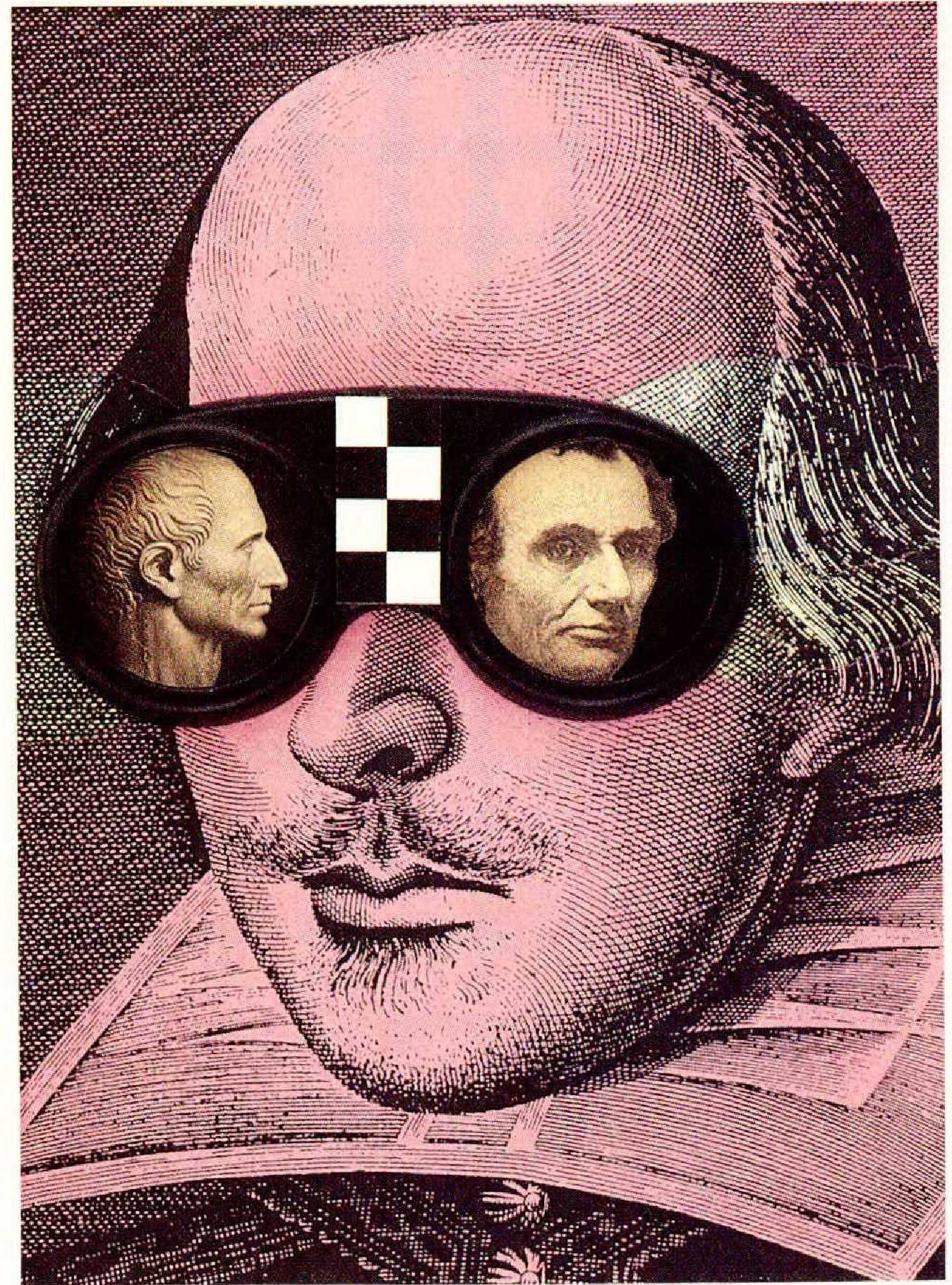
What Booth declaimed was the motto of the State of Virginia. For him it was a rallying cry for the Confederacy. But it also seems to have epitomized a cause he identified with “the noblest Roman of them all” and his venerable forebear.
Five months earlier Booth had spoken the eulogy for Brutus at the end of Shakespeare’s Roman tragedy. The occasion, in November of 1864, was a benefit in which he and his brothers performed Julius Caesar to raise funds for a Central Park statue to commemorate the three-hundredth anniversary of the playwright’s birth. The production took place in New York’s Winter Garden Theatre, and it was attended by an enthusiastic audience of more than 2,000. Junius Brutus Booth the younger portrayed Cassius. Edwin played Brutus. And John Wilkes appeared as Mark Antony.
Subsequent developments would suggest that the youngest of the Booths was in the wrong part for an evening that one observer later described as “too strikingly historic to be soon forgotten.” But it may have occurred to him even then that he was in the right play. And how carefully he must have listened as he heard his oldest brother describe the timelessness of a scene that was soon to be remounted in another lofty setting, not far from the White House.
Other members of the Booth family were strong supporters of the Union. In fact, Edwin Booth had saved Robert Todd Lincoln from a near-fatal accident, when the President’s son slipped between a departing train and a railway platform in Jersey City. His alertness earned Edwin a letter of gratitude from General Ulysses S. Grant and solidified the warm regard of the President, who saw him perform several times and who counted himself among the actor’s most ardent admirers.
But, of course, it was Edwin’s brother whose destiny most tellingly converged with Lincoln’s. In the view of the younger Booth, the President was determined to destroy the Constitution, set aside the rights reserved to the states, crush civil liberties, and restore monarchy. Persuaded that the Confederacy was the only means of upholding the values of the Founding Fathers, John Wilkes Booth devoted much of late 1864 and early 1865 to a series of plots to abduct Lincoln and use his capture to nullify the Union’s war aims. Every scheme ended in frustration. So by the time Lee surrendered to the Army of the Potomac, in the second week of April, it was clear that only the most desperate of measures offered any hope of salvaging the Southern cause.
Shortly before he went into the theater for what would turn out to be his final performance, John Wilkes Booth stopped for a drink in a nearby tavern. According to one account, an acquaintance laughingly remarked that the young Booth “would never be as great as his father.”With “an inscrutable smile” Booth assured his critic that “when I leave the stage, I will be the most talked-about man in America.”
And so he was. As he fled across the boards of Ford’s Theatre to the horse that awaited him in the alley, he must have been convinced that he had identified himself forever with the role that Shakespeare had scripted for antiquity’s most notable assassin.
WHAT HE MAY not have realized was that he had cast himself even more indelibly in the role of antiquity’s most infamous villain. The night that Booth had selected for his deed was April 14, Good Friday, and the symbolism of the date contributed immeasurably to the rapidity with which his victim came to be enshrined as a martyr. The President’s redemptive qualities were emphasized in one sermon after another. Inevitably, the name of his killer became associated not with “the noblest Roman” but with Judas, the betrayer of Jesus, who had been placed by Dante, in the Inferno, alongside Brutus and Cassius in the lowest circle of hell.
Ironically, Dante was not the only poet to imply a connection between Brutus and Judas. Shakespeare had hinted at the same analogy through several echoes of the Gospels in Julius Caesar. In a key departure from his primary source in Plutarch, for example, the playwright had had Brutus describe the conspirators as “Sacrificers but not Butchers.” Shakespeare had had Caesar invite his “Friends” to “taste some Wine” with him before they all set out for the Capitol. Shakespeare had arranged to have the bloodletting occur at “the ninth hour.” And after Brutus’s decision to let Mark Antony speak at Caesar’s funeral, Shakespeare had had Cassius admonish him, “You know not what you do!”
Like the Brutus of Shakespeare’s play, John Wilkes Booth assumed that his act would be gratefully applauded; and like his role model, he was astonished by the hostility it elicited among a public whose sympathy for the fallen leader he had grievously underestimated. Near the end he wrote in his diary, “After being hunted like a dog . . . , with every man’s hand against me, I am here in deep despair. And why? For doing what Brutus was honored for. What made Tell a hero.”
As he lay dying after being shot in a Virginia barn some sixty miles south of Washington, John Wilkes Booth’s last request was one that spoke volumes about the idealism that had motivated him: “Tell Mother I died for my country.”
FITTINGLY, BOOTH’S victim was as devout a Shakespearean as the actor who played Brutus to his Caesar. Abraham Lincoln was an intensive reader, and during his time in the White House he turned with increasing frequency to two books: the Bible and the works of Shakespeare. He saw parallels between the American Civil War and the Wars of the Roses as depicted in Shakespeare’s English-history plays, and he was deeply affected by the title character’s call for “sad Stories of the Death of Kings” in Richard II. He understood the fatalism of the Prince of Denmark, and he once confided that “I have found all my life, as Hamlet says, ‘There is a Divinity that shapes our ends, Rough-hew them how we will.’”
On Palm Sunday, April 9, the same day that Grant and Lee were meeting at Appomattox, Lincoln engaged several of his companions in a lengthy discussion of Duncan’s assassination in Macbeth. A day or two hence Lincoln told his wife about a dream in which he saw a President shrouded on a catafalque in the East Room of the White House. Like Calpurnia in Julius Caesar, Mrs. Lincoln was terrified by what sounded like a portent, and her husband regretted sharing his nightmare with her. But “like Banquo’s ghost,” he said, “it will not down.” At the end of the week, on a misty Friday evening, and in a way that recalled both Hamlet and Julius Caesar, Lincoln disregarded his premonitions and proceeded with plans to attend a performance of Our American Cousin. He thereby played his own role in a New World restaging of what generations had regarded as an archetypal tragedy.
Not long before his last excursion to the theater, as he was reflecting on memorials such as the Shakespeare monument to be erected in Central Park, Lincoln asked what “bronze or marble” could possibly do to enhance “such a man as Shakespeare.” In due course much the same would be said about the President himself. After the attending physician pronounced Lincoln dead on the morning of April 15, Edwin M. Stanton, the Secretary of War, declared, “Now he belongs to the Ages.”Later eulogizers echoed Ben Jonson’s words about Shakespeare: “He was not of an Age, but for all Time.” And, with unintended irony, one writer lauded the Great Emancipator by citing the same tribute that John Wilkes Booth had delivered over the corpse of Brutus a few months before the assassination of Lincoln:
So mix’d in him that Nature might stand up
And say to all the World, “This was a Man!”
—John F. Andrews