Notes: Healing the Ghettos

A vision of the possible in race relations
THINKING ABOUT the history of American race relations can easily give rise to bitterness and fatalism, but it is encouraging to remember how often in the past situations that appeared to be impervious to change finally did change, and for the better. The framers of the Constitution, idealists though they were, couldn’t imagine an end to slavery, but in the long run slavery was ended. In this century legal segregation looked impossible to eliminate until well after the end of the Second World War. That black America could become substantially middleclass, non-southern, and non-agrarian would have seemed inconceivable until a bare two generations ago.
Today the racial problem that is regarded as insuperable is the condition of the black slums in big cities. At the level of conversation, if not of political oratory, there seems to be a conviction that we don’t know what could possibly help the ghettos; that even if we did know, it couldn’t be done, for lack of political support; and that some unbridgeable gap between blacks and whites makes the amelioration of any problem related to race unlikely. These sentiments are neither cleareyed nor realistic. They belong on the long list of dolorous racial attitudes that turn out to be resistance to change wearing the garb of pessimism.
American society in the wider sense is not a presence in the ghettos except on television. Policemen don’t walk the beat, most schools don’t teach, fathers don’t live at home, crime goes unpunished, the ward and precinct bosses who once offered a link to the political system are disappearing, and the old-fashioned settlement-house and social-agency training functions have withered away. Outside the ghettos, especially in the black middle class, sentiment has begun to run strongly in favor of re-establishing the social linkages between poor blacks and the rest of black society, but right now there is no mechanism to bring that about. It is tempting to believe that the ghettos would pull themselves up by their bootstraps if only we could remove from the scene “irresponsible black leaders” who blame everything on white people, but the truth is that given how poor and dispirited slums are, it is unlikely that their residents would suddenly mobilize around some new figure who preached moderation and bourgeois values. Any planned undertaking will have to be of enormous scope if it is to affect the ghettos significantly. For both practical and moral reasons, the institution by far best suited to the task is the federal government.
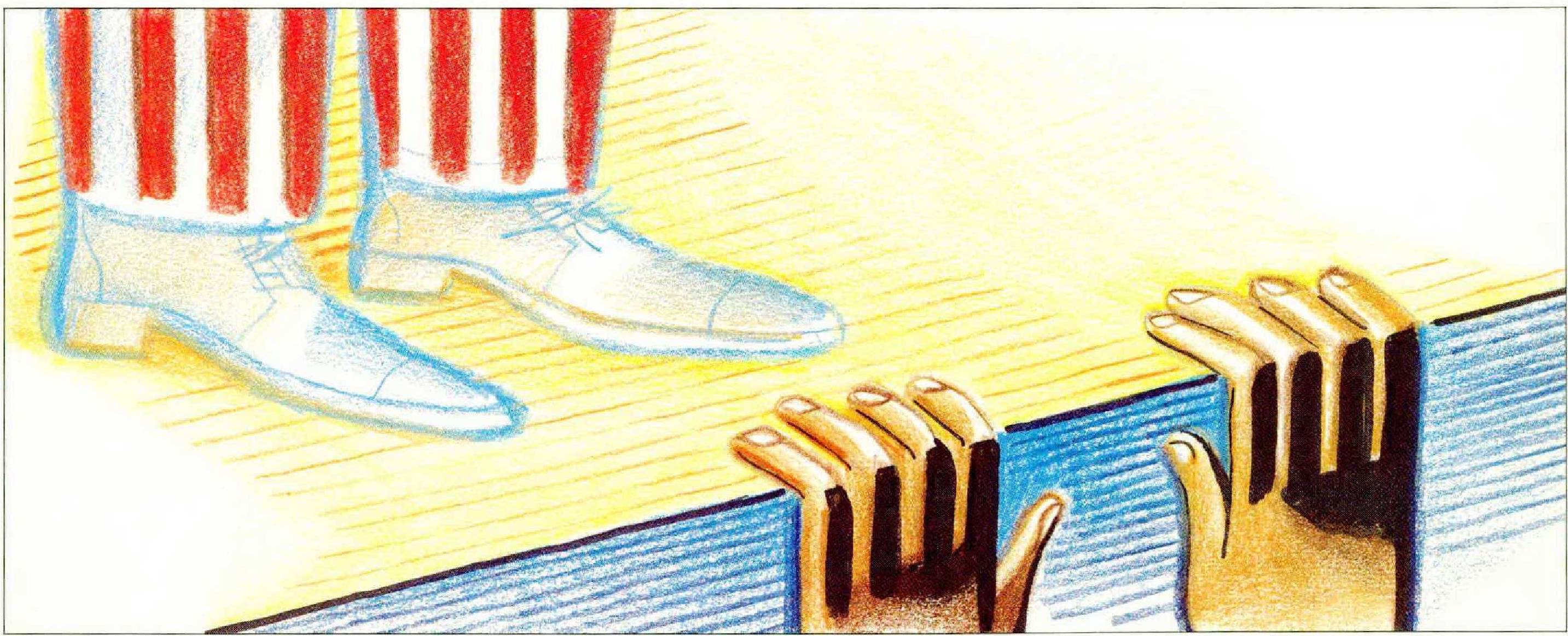
THE PROSPECT OF federal involvement in community affairs tends to elicit two fears. The traditional white southern one is that Washington will impose its will (usually liberal, and usually race-conscious) on the finely wrought social organization of faraway communities; the second, the newer, black one, is that whites will try to colonize and subjugate black communities.
Neither of these prospects need be severely worrisome. Most of the government offices already in ghetto neighborhoods operate under local auspices and would continue to. A revival of the War on Poverty’s “maximum feasible participation” clause, which was enacted in 1964 as a way to bypass local government in search of “authentic leaders” to receive federal funds, is the remotest of all political possibilities, especially since so many local officials now are black. The federal function would be to provide more money and to direct what should be done with it. Past experience tells us that although this wouldn’t be wildly popular, it would not amount to Washington’s forcibly taking over local institutions. As for the issue of white imperialism, the threat would not seem nearly so serious now as it did in the time of the War on Poverty, because today most of the government employees who work in the ghettos (like the politicians who represent the ghettos) are black, and the social-welfare bureaucrats staffing any new social programs in the ghettos would also be mostly black. The programs would help to bring the two parts of black America together, and would incidentally strengthen the economic base of the black middle class, which is government employment.
Another block to new federal programs is the now pervasive skepticism about the ability of the federal government to take on any task without botching it. The shortcomings of the government’s response in the first place to the problems of the ghettos are largely to blame for the wider loss of faith in government domestic policy. With respect to the ghettos, however, the idea that the government can’t accomplish anything is a smokescreen obscuring the useful and encouraging results of a quarter century’s worth of research on anti-poverty programs— research of a kind that didn’t exist when the War on Poverty began. We now know that the easiest problem to solve is simple material need: the foodstamp program plainly reduces hunger, for example. In the ghettos material need is only part of the problem, and the successes are less dramatic. Still, many programs that come under the banner of “intervention,” in which the government becomes a guiding presence in the lives of the ghetto poor, do demonstrably work.
Programs offering education, counseling, and birth-control devices in high-school-based clinics can reduce teenage-pregnancy rates. Programs that send nurses and social workers to the homes of expectant mothers to provide prenatal care or food reduce infant-mortality rates. Head Start produces higher graduation and employment rates and lower rates of arrest and teenage pregnancy among its former participants. James Comer, of the Yale University Child Study Center, has impressively raised the achievement scores of ghetto elementary school students through a system of unusually intense involvement by the school in the lives of students and their parents. Various job-training programs, including the Job Corps, increase their former participants’ longterm likelihood of being employed.
All these programs are relatively expensive per participant, and their payoff is not immediate and tangible, but in the long run they save the government money that would have gone to welfare and incarceration. Planning them and carrying them out creates a setting where many thousands of blacks and whites can work together to bring something new and worthy into being; this is a public dialogue about race far better than one consisting mainly of squabbling over the distribution of resources and arguing about whose fault it is that things are so bad.
IT IS NOT at all difficult to sketch out the framework of such a wholesale government effort—an effort so comprehensive that it would substantially affect everyone who lives in the ghettos. The rather casual official attitude toward street crime, for example, which has existed for as long as there have been ghettos, could finally change; policemen could be put back on the streets, and criminals quickly punished. Welfare could become a temporary program leading to a job. Housing projects could begin screening tenants again and kicking out bad ones. We could try to ensure that every ghetto child is born healthy, learns to read and write in grade school, graduates from high school, gets trained for the job market as it now exists, has a private or government-created job waiting at the end of the process, and puts off parenthood until he or she can manage a family. Obviously the precise structuring and the management of all the programs would require painstaking, detailed work, but the overall concept is simple and direct: the government should be trying to break the hold of those aspects of the ghetto culture that work against upward mobility, by constantly and powerfully encouraging ghetto residents to consider themselves part of the social structure of the country as a whole.
In the current political climate this may all sound nearly fantastic, but it is fully in accord with the thinking of most of the leading experts in the field. (Only the government’s guaranteeing everyone a job is not now a matter of consensus.) Besides not being a daring conceptual leap into the unknown, as it was in the mid-1960s, a major expansion of the government’s social programs (again excepting guaranteed jobs) would not be that expensive. Most estimates put the cost in the range of $10 billion to $25 billion a year, which even at the high end is only about a thirtieth of the federal budget. Whether that is exorbitant depends on what it accomplishes and how the effort is understood. If it makes a significant improvement in what we all know is the principal problem in American domestic life—a problem that poisons not just race relations but also our attitudes toward education, law enforcement, and city life itself—it will be a bargain.
Racial progress has almost never been a populist or popular cause, except of course among African-Americans. The alliance that in the past has produced reform is between black leaders and white liberals, and they have been able, in the best cases at least, to bring a recalcitrant public around to their views. That the next important step in American race relations now appears politically dangerous is entirely typical, and it need not prevent progress from being made. The real impediment in the short run is not a lack of political support, which in racial matters always comes after the fact if it comes at all, but a weakness of spirit.
FOR MOST OF our history the issue of race has been linked to the issue of nationhood. During periods of fragmentation—periods when a multiplicity of local, ethnic, and economic interests have held sway—racial problems have been put on the shelf. It is when there has been a strong sense of national community that the problems have been addressed. The Civil War was one such time, at least in the Union states, and the long stretch between the New Deal and the Vietnam War was another; these periods brought us emancipation and civil rights. It has always been the federal government, not local governments or private businesses, that has led the way on race relations (though often the government has had to be prodded into action by a political movement); the personal involvement of the President himself has usually been necessary. Like national defense and foreign policy, the management of racial issues seems to require a capability for national action. If the idea that the federal government could now improve race relations seems strange, this is only a symptom of a much broader problem: we are insufficiently unified as a society to be able successfully to undertake ambitious, organized national projects of any kind. If we can heal the ghettos, which are the part of the country most hurt by our current fragmentation, it will be a sign that we are on the way to a restoration of our communitarian spirit.
It is essential that any attempt to address racial issues win public support quickly, even though it doesn’t have public support to begin with. Otherwise it will suffer the fate of Reconstruction and the War on Poverty—a short life followed by a period of reaction. The most straightforward way to win acceptance for new federal programs would be to show that they work, not in the sense of eliminating the underclass overnight but in the sense of being honest, well run, committed to mainstream values, and devoid of the punitive, ram-it-downtheir-throats quality that the shortestlived reforms have had. The forces of practicality could be brought around to support government programs if it became clear that a better work force and calmer cities would be the result. State and local governments would feel a pull to create social programs of their own once they saw that ghetto conditions were susceptible to improvement. But among the reasons why the federal government would need to be central to the first wave of new programs is that it can maintain quality and ensure consistency of purpose. A radically decentralized approach, like the old communityaction program, would be bound to produce at least some disasters.
Since rhe failure of the War on Poverty, the call to action to help the ghettos has always been couched as something else; as a new family policy, or children’s policy, or drug policy, or civil-rights policy. Those aspects of ghetto life that can be characterized as self-destructive behavior rather than as victimization of the innocent—drug use, out-of-wedlock childbearing, dropping out of school—are quite often played down for fear that Americans will leap to the conclusion that the black ghetto poor are undeserving and should be written off.
The result of all this well-intentioned fuzzing of the true nature of the tragedy in the ghettos is the loss of moral urgency, and all causes need moral urgency if they are to be fulfilled. Race relations is the one area in American domestic life about which the whole country agrees that something is terribly wrong, and in which the vocabulary of crisis and national responsibility is not overstatement. The United States has an undeniable strain of racial prejudice in its character, but it also has a racial conscience that periodically comes to the fore. What brings it out is the demonstration that intolerable conditions in black America are clearly linked to the country’s history of departing from its democratic ideals when it comes to blacks.
The ghettos bear the accumulated weight of all the bad in our country’s racial history, and they are now among the worst places in the world to live. To be born into a ghetto is to be consigned to a fate that no American should have to suffer. The more clearly we can be made to see that, and to understand the causes of the situation, the less likely it is that we will let matters stand.
—Nicholas Lemamnn