Caves, Crusades, and Cassoulet: The Other South of France: Languedoc and French Catalonia
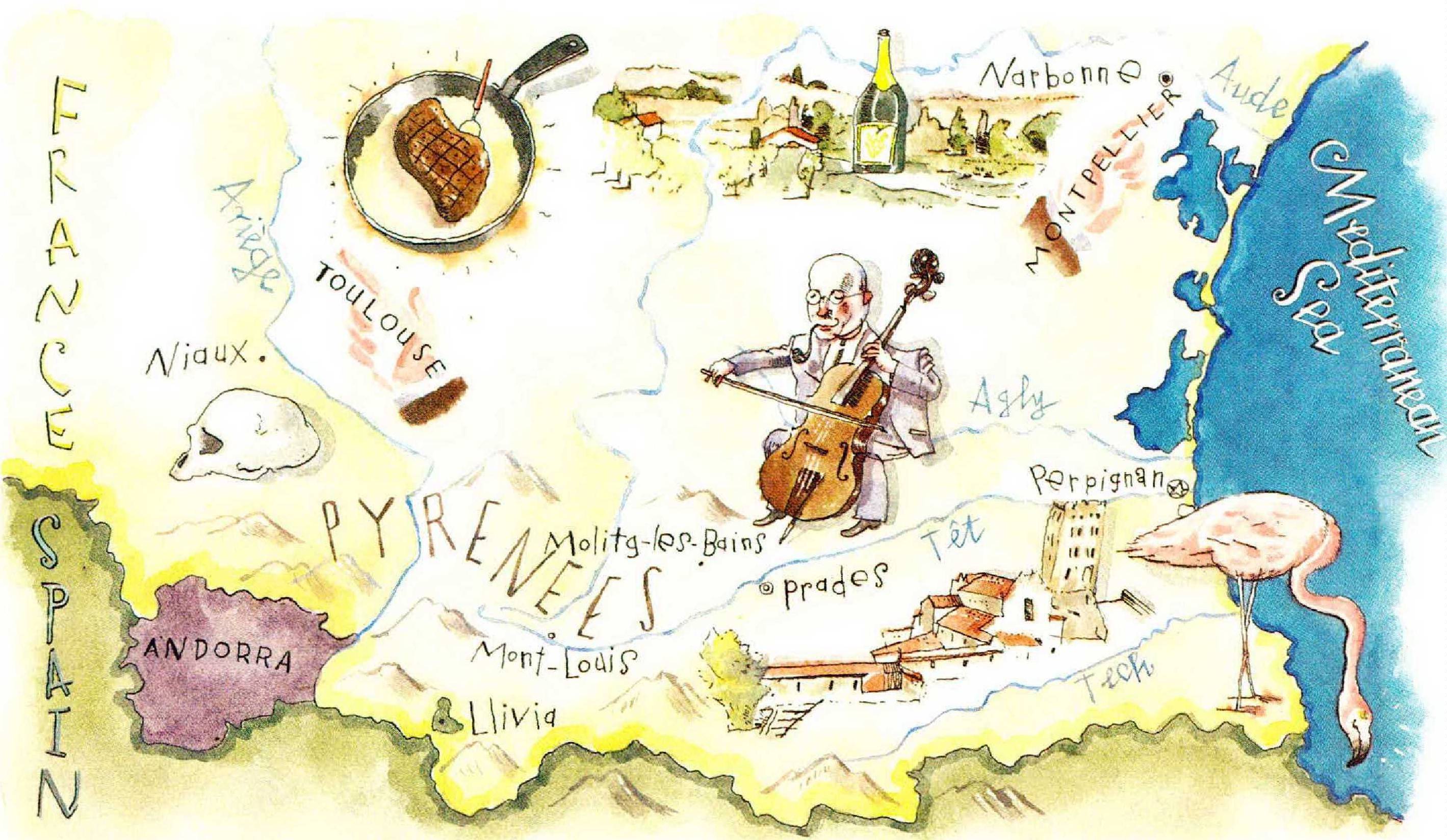
DESPITE THE LONG, nostalgic history of Americans in Paris, there are whole regions of France that Yankees never think to visit and that even Parisians seldom talk about. One of these is among the oldest regions in all Europe, in terms of human habitation; nonetheless, the French haven’t yet settled on one name for it. The region I shall vaguely refer to as Languedoc is bounded by the Mediterranean on the east, the Pyrenees on the south, the tiny Catalan principality of Andorra to the west, and the Lot River on the north. This land of cave paintings, Romanesque abbeys, fortified cities, ruined castles, unbelievable landscape, a complex and bloody history, and a rich menu of table delicacies has an excess of neither population nor tourism. To travel here is like traveling to another country altogether, not France and not Spain.
Much the same region, 35,000 years ago, harbored Cro-Magnon man, whose remains were discovered among the mountains of succulent limestone, underground rivers, and steep valleys honeycombed with the caves (Altamira, Aurignac, Lascaux, Niaux, and so on) that gave our ancestors shelter and places for ritual and celebration. Languedoc emerged from the ancient and prosperous Roman province anchored by the thriving Mediterranean harbor of Narbonne (Latin: Narbo). The area became one of those historical shuttlecocks, like the Low Countries, batted between larger, cruder political entities (Toulouse, Aragon, France, the papacy) and oppressed by the overlordship of its neighbors. In the Middle Ages it developed the tongue—“langue d’oc“—that linguists have come to call Occitan, and it rejoiced in a white-limestone landscape that swarmed with sheep until the herbage was chewed off the hilltops. Undermined by improvident agronomy and inattentive government, bled white by wars of religion, depopulated by genocide, ravaged by the greed of outsiders, it became what it is today: peaceful, productive, underpopulated.
Languedoc was also the land of the Cathars (the “Pure”), sheltering for a long, passionate swath of the Middle Ages an exotic form of Manichean religion. This strange creed of the common people used the demotic Occitan liturgically instead of Latin and eschewed the structures and authority of the Church in favor of specially chosen male and female priestlike leaders. It would take all the secular powers of the papacy and the kingdom of France to extirpate what they called the Albigensian heresy. Innocent III preached a Crusade beginning in 1208, and under the leadership of the notorious Simon de Montfort thousands of inhabitants of Béziers, Carcassonne, Albi, and Minerve—Cathars and Christians alike—were slaughtered or imprisoned. This land grab by the French took several decades: the last Cathar military stronghold surrendered in 1255, and even then shoots of Albigensianism kept sprouting, so the Church devised the Inquisition, first practiced here, to subdue them, which took another hundred years. (In the meantime Catalonia, in the south, suffered under the dynasties of Barcelona, Aragon, and Majorca, not to rejoin France until 1493.) It is not surprising, then, that the erstwhile country of the Cathars greeted the coming of the Reformation, in the sixteenth century, with a flowering of Protestantism and celebrated the French Revolution, in 1789, with an impassioned destruction of ecclesiastical buildings and art.
Most of Languedoc is peppered with villages dominated by fortified churches, soaring Romanesque abbeys tucked away for safety in exotic locations, and wild, craggy castles where the doomed Cathars held out to the end. It revels in such potations as the anise-flavored pastis and heady red wine, and food as savory as the wild herbs—rosemary, thyme, lavender, bay—that flourish in its meadows: langoustes, bourrides, and brandade de morue along the shore, and belly-filling casseroles based on rabbit and boar and duck and goose, peaches and melons and apricots, truffles and chestnuts and walnuts, in the uplands.
Languedoc, especially its southern sections, and Catalonia flourish today as wine country. The grapes for more than half of all the drinkable wine of France are grown here, and those for a lot of the undrinkable as well. Even the best of the wine is not expensive, which cannot be said for many French pleasures these days.
I DROVE A car in a thousand-kilometer are from Montpellier to Brive westward along the Pyrenees and then north with my wife and two other friends, one of whom is an art historian with a passion for Romanesque churches. We were deposited at Montpellier by the très grande vitesse express that had departed Paris at ten in the morning and left us at the gates of Languedoc at three in rhe afternoon, with plenty of time to reach Narbonne by car and rest up before dinner at a three-star restaurant. (Narbonne, by the way, fell apart as a prosperous city when the papacy, in one of its self-destructive gestures at self-purification, made the great mistake of expelling the Jews from the city in 1306. Within fifty years the harbor had silted up and the great university had closed down. Narbonne now lies high, dry, and beautiful.)
Southerly from Narbonne along the sea unsightly vacation communities stretch for 100 kilometers, all the way to the Spanish border. Still, to the north Sète (the birthplace of Paul Valéry and the site of his most famous poem, “Le Cimitière marin”) and to the south the Catalan fishing village of Collioure (a favorite haunt of Matisse and other Fauvist painters before the First World War) are worth an attempt if the season is right; and the coastal étangs, or lagoons, offer plenty of birds for those watchers who have life lists to enlarge. Our route from Narbonne took us toward the sea to the Cistercian abbey at Fontfroide, hidden at the throat of a valley that water had carved out of limestone, its surrounding hills swathed with the gray brush locally called garrigue, studded with cypresses and pines, and tiered with Italian gardens. The abbey boasts a lovely cloister, to which long staircases conducted the monks down from their dormitories to business in the chapter room or services in the abbey church or farm work in the fields. Only a mile or two away lie the ruins of an Albigensian castle, confronting its ancient enemy from a hilltop.
We drove on by the shore of one of the étangs that saltily protect the coast, gulls and egrets flapping through the stiff breezes that blew foam in from the sea, until we veered from the coast at Perpignan and ascended westward and southward into the foothills of the Pyrenees toward Catalan Prades, where for seventeen years Pablo Casals, outraged by the Franco regime in Spain, exiled himself from fascism and played Bach and Mozart, almost within earshot of the Spanish border, with that Catalan intensity that made him the most famous cellist of our century.
Our destination was Molitg-lesBains (that unsightly Catalan word is pronounced moleech), a mountain village with several hotels built around thermal baths. Ours, the Château de Riell, stood high, displaying distant views in every direction, swimming pools on the roof and in the garden, lovely terraces, cypresses as soft and slender as plumes, and somewhat feverish overdecoration (for example, tiger skin on the walls of the barroom, ranges of copper washstands in the bathrooms). The polylingual clientele lounged by the pools, all reading the same American meganovels in varied translations. The food was good but expensive, and the maître d’hôtel presented it condescendingly, stimulating us to try other meals in other restaurants. Still, it’s worth mentioning a carpaccio of raw salmon with a fan of sliced vegetables, a baby rabbit stuffed with herbs, and a whole melon scooped out and filled with the fruits of the season: melon, peaches, apples, pears, and nectarines. The château gave us a base of operations for exploring the ecclesiastical architecture of the Canigou Massif, beginning with St. Michel-de-Cuxa, the half-destroyed abbey where an annual Casals festival is now held—and which, many years ago, provided building materials for The Cloisters, in New York City. This huge Benedictine abbey, like so many churches in the region, was for ages a stopping place for pilgrims on their way to the shrine of Santiago de Compostela, in western Spain. Cuxa was wrecked—and, no doubt, its lands confiscated—by fervent anticlericals during the French Revolution, and parts of its masonry have only lately been rescued from blasphemous misuses in Prades and even farther away (The Cloisters remain unthreatened). As we filed through the ambulatory, a pianist left over from the festival sat playing Brahms intermezzi in the transept.
We spent afternoons walking along valley trails near a perfect little hill town called Mosset, through irrigated orchards and along a plashy stream or, more adventurously, upward on a steep road along a mountain ridge through wild meadows scented with herbs, patrolled by goshawks, the crushed rock of the Pyrenees crackling underfoot and blackberries festooning every bush. Later we drove a few miles to a walled medieval town, Villefranchede-Conflent. Here for the first time we encountered French vacationers in droves, but we also found wonderful rich Catalan wines to sample in the Caves des Templiers, charming items to buy in many tiny shops, and a good meal in an outdoor restaurant inside the town walls.
This had been a scouting expedition for another Romanesque excursion: the ascent to a monastery above Vernet-les-Bains, a resort town favored by Rudyard Kipling and Hilaire Belloc, among other mountain-loving literary worthies of a century ago. Belloc, who once apostrophized of “the fleas that tease in the High Pyrenees / And the wine that tasted of the tar,” also walked over the mountains and the plains to achieve a book called The Path to Rome. Above Vernet lies one of the most beautiful of all Romanesque sites, St. Martin-du-Canigou, which in Belloc’s day still lay in ruins but which has been recently restored. I climbed up the winding mountain road a mile or two in the cool early air. When the jeep brought the rest of my party up the switchback road—a ride that left them quivering—we were conducted (in total and merciful silence) through the monastery. Built between the ninth and eleventh centuries, perched on a crag, and now used mostly for retreats, it looks up and over the mountains of the Massif du Canigou. We ended our tour through cloisters and crypts in the tiny church, where a mass was just beginning. We reluctantly left the plainsong behind, strolling down the mountain while the noontime shift of pilgrims strode manfully and sweating upward toward St. Martin.
IT TOOK SEVEN fatiguing hours of driving to reach Toulouse from Vernet, stitching our way up the French-Spanish border along the ridge of the Pyrenees on slow and winding truck-jammed roads, ascending toward the crest at Mont-Louis, a Vauban fortress that also boasts of recent pioneering ventures in solar power collecting. We made our way through beautiful upland pastures teeming with beige cattle, and then, after penetrating a vestigial Spanish enclave named Llivia, which was left over from the 1659 Treaty of the Pyrenees, settling the border between France and Spain, turned northward into France. Here the mountains were grim and barren, and at last we made our way swiftly down the slope of the Pyrenees toward Niaux, where we had planned (but not far enough in advance, it seems: reservations are required) to see some of the prehistoric wall paintings in the caves.
We sped toward Toulouse, past Disneyland-like Foix, along the valley of the Ariège as it joins the Garonne, and we gratefully welcomed rest in the extremely comfortable Grand Hôtel de I’Opéra, in the center of Toulouse. The hotel’s widely celebrated restaurant (one of whose great specialties is tiny ravioli stuffed with raw foie gras) was closed, but in the grill it was perfectly possible to obtain such regional specialties as first-class cassoulet toulousain, that amazingly flavorful bean stew with goose preserved in its own fat, and magret de canard, which my companions took for steak, only to be instructed by a droll waiter that the ducks of Toulouse were so robust, having lived out their lives on a diet of cassoulet, that their breasts were thick as sirloins, and as lean and delicious. It was duck gone to heaven.
Toulouse protected the Cathars during their persecution—at least for a while. Yet after the rebels had been put down, Toulouse became one of the centers where the Church drew itself up to display its triumphant orthodoxy. Saint Sernin, to whom Toulouse’s most striking basilica is dedicated, was martyred by a bull who dragged him, to whatever purpose, through the main street of town. His memorial is vast and beautiful, a Romanesque masterpiece built in the eleventh and twelfth centuries, with a pointed octagonal Gothic tower constructed over a crypt full of austere and tender sculpture. The strange, two-naved thirteenthcentury Gothic convent of Les Jacobins was specifically founded to counteract the Cathars. Its brilliantly painted vaulting and central row of columns is unlike the interior of any other church I have ever seen. The Augustins Museum has as huge a collection of Romanesque capitals, collected from ruined churches, as one could tolerate, beautifully lit but mystifyingly mounted on great rusty iron stands that resemble stacked bayonets.
The churches are studded around the old city, the former capital of all that lay between the Garonne and the Rhône as far south as the Pyrenees regions of Catalonia and Aragon. Today Toulouse is a place of red bricks and Roman roof tiles, at whose center lies a vast square. Along one side stands Le Capitole, built of brick during the most restrained and classic mood of the eighteenth century and the largest Baroque monument north of the Pyrenees. The cafés and brasseries overlooking the great square share an Italian mood that evokes Piazza Navona, in Rome, or San Marco, in Venice. Greater Toulouse, a metropolis of half a million, contains the oldest university in France after that of Paris— and forms the center of the French aeronautical industry. It displays the gaiety of any city where the population is younger than average, alive, vivid, exciting. Our room opened onto a pedestrian street, the rue des Changes, where we heard the murmurs of walkers and children by day and the roistering of revelers by night—just what one wants in a well-regulated city instead of the fuming of buses and the grinding of traffic.
On our last evening in Toulouse we sought out a highly recommended restaurant, Darroze, where we encountered the best meal we had in Languedoc, featuring tartare of tuna, grilled salmon, a pigeon casserole with green cabbage, and poached pears with raspberry coulis, accompanied by first-class wines from Gaillac (white) and Cahors (red). After our last night in the hotel, with its bright-blue velvet sofas and its cerise-colored barroom, we made our way out of the city through what turned out to be a weekly Sunday market, jammed into the streets around St. Sernin. The crowds forced us to drive our car on the sidewalk. As we reached the corner that would set us free from the stalls selling apricots and old clothing, figs and tablecloths, I made a very careful right turn to avoid a baby stroller at my left front wheel—which produced a noisy scrape on my car’s right side against the railing around a wellfilled café. The tiny collision was cheered by tables full of men sipping a wake-up Armagnac: “Vous avez gagné!” Yes, I guess we had won: we had left our mark on the country with no name. □