Notes: Dear Me
The end of a beginning?

Do YOU HAVE an office job? If you do, does a lot of mail land on your desk every day? If it does, is a large portion of that mail from people you don’t know? If it is, do a lot of those people, instead of addressing you in the salutation as “Dear Mr. Surname" or “Dear Ms. Surname,” address you as “Dear Forename Surname” — “Dear John Smith"?
Quite a few of them do, I’ll bet. Where I work, which happens to be at this magazine, one letter out of every four that arrive addressed to a specific person and that come from someone unknown to that person begins with a Forename-Surname salutation. Let’s be clear on this point: The “Dear John Smith” at issue is not the tactical “Dear John Smith” — the one that serves, after a cordial and sufficiently extensive correspondence, as a hint that the gulf between courtesy title and first name is ready to be spanned, the one whose function is similar to that of an arm moving with studied carelessness to the back of the car seat occupied by a date. The “Dear John Smith” here is the one penned by a complete stranger, the one leveraged on the assumption that intimacy is but a small, inevitable step away. I have been asking friends in lines of work other than my own if they encounter this formulation with any frequency, and they have each replied, in essence, Yes, now that you mention it.
I bring the matter up not simply because it represents yet another small incursion of the outside world into the battered preserve of the self—yet another indication of how many of the gentle and perhaps even wise social conventions developed during the past million years or so have in the course of a generation been breached or dismantled—but also because it begs for understanding. Why has it become so common to begin letters in this way? One possibility is that epistolary etiquette has been infected by the technology that enables billions of computerized letters to be sent out with the space after “Dear” simply filled in with the addressee’s name as it appears on whatever mailing list is being used. Another possibility is that many Americans reach adulthood without ever having learned the basic rules of conducting a correspondence. The program director of secretarial science at a college in Boston was strongly of this opinion. She fairly threw up her hands when I described the phenomenon I was looking into. “So many people just don’t know how to write a proper business letter,” she said. A third possibility is that having to use “Mr.” or “Ms.”seems impossible quaint to people who have come of age since roughly 1965 (although one would think that the atavistic “Dear” might also seem a little ridiculous). Most of today’s social tendencies, according to this view, are urging us toward greater familiarity and informality, even at the risk of seeming insincere, self-conscious, or odd. The consequences are on display everywhere; one medical technician was quoted recently in The New York Times as saying to a patient on a gurney, “Hello, my name is Tim, and I’ll be taking your CAT-scan.”
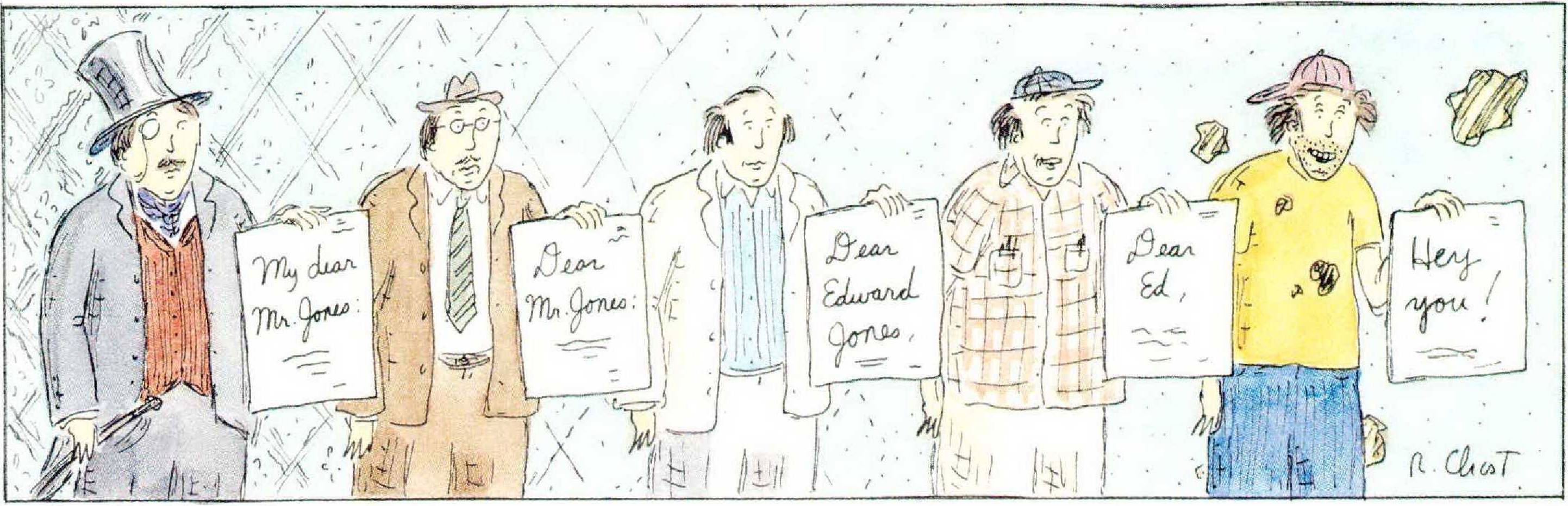
I HAVE NO DOUBT that these larger forces contribute to a climate in which a salutation like “Dear John Smith” can flourish, but I also suspect that something else is at work—indeed, has been the primary catalyst. There is only one situation in which any published manual of style that I’ve consulted either proposes or is willing to countenance the use of a ForenameSurname salutation: as the authors of the Katharine Gibbs Handbook of Business English (1982) explain, “If it is not possible to determine the gender of the addressee, omit a courtesy title in the inside address and in the salutation.” The Katharine Gibbs manual goes on to give the example “Dear Meredith Riker. ” The New American Handbook of Letter Writing (1988) likewise endorses this practice, giving the examples “Dear M. J. Shell” and “Dear Leslie Gowan.” Certainly most of us have at some time been confronted in writing by an ambiguous Courtney, Lindsay, Robin, or Shawn and had to guess at the person’s sex—and guessed wrong. “Dear Lindsay Wagner” or “Dear Robin Leach” offers a safe and sensible way out.
Are unisex names now so common that the stylistic device invented to cope with them is making inroads beyond its sanctioned domain? Several recent conversations with experts in the field of onomastics—the study of names—give reason to believe so. Leonard Ashley, a professor of English at Brooklyn College and the author of the book What’s in a Name?, says that people born during the past few decades are far more likely to have unisex names than people of earlier generations, and that the trend is accelerating. This development can be traced, he says, not to any major change in the names that boys are given but to a quiet revolution in the naming of girls. Two things have been going on. First, female babies have been given once unambiguously male names in such large numbers that droves of these names—for example, Tracy, Stacey, Jody—are now considered unisex. (For that reason they are somewhat less likely in the future to be given to male babies.) Second, female babies are increasingly being given as forenames the kind of surnames, often family names, that males have been getting all along—Montague, Fairleigh, Brennan—and that have no inherent gender content (and may have no relation to the baby’s own family). Professor Ashley says he hears repeatedly from parents that they have given daughters genderless names so that as the girls grow up, they can “better compete with men,” at least insofar as the competition is waged with résumés, applications, and other written documents and communications. Many parents also believe that women who do not have exclusively feminine names will be deemed by others to be more competent than women who do. (These same rationales have been encountered among parents of daughters by another specialist in onomastics, Ralph Slovenko, a professor of law and psychiatry at Wayne State University.) The ascendance of unisex names is being reinforced by their predominance among the names for female characters in soap operas and elsewhere on television. According to Professor Ashley, now, more than ever, the names of characters in movies and television programs influence name selection of every kind.
As IT BECOMES more and more difficult to tell the sexes apart on paper, I fear that trying to hold the line on “Dear Mr.” and “Dear Ms.” will become untenable. One can imagine, of course, a variety of initiatives that could help preserve gender distinctions and thus the use of courtesy titles in salutations. In some cultures male and female names, no matter how similar in essence or provenance, are differently inflected: Aleksandr and Aleksandra in Russian, for instance. Perhaps we could adopt something along those lines. Or perhaps some sort of typographical convention might be devised to distinguish female and male versions of the same name: !Marion and ?Marion, say. The problem with both proposals is that the erasure of distinctions, and not their preservation, is precisely what many people want. There is ample precedent for government intervention in the matter of names—a footnote in a scholarly paper by Ralph Slovenko some years ago cites several of them, including the measures adopted in Argentina in the 1880s to help ensure the assimilation of large numbers of Europeans—but nothing of the sort is conceivable in the United States. Neither, I expect, is the hale British manner of salutation (“My dear Holmes”), which dispenses with gender and title altogether yet achieves a blustery dignity nonetheless.
I will not be surprised, then, if within the next few decades we emerge into a world in which business communications either are curt memos or begin with the Forename-Surname salutation, a world where “Mr.” and “Ms.” survive mostly in speech (though not in every social class), and maybe for a while on envelopes (as when a couple shares a last name). It may be that in the end “Ms.” will slightly outlast “Mr.” as a courtesy title, if only because mizzes tend to outlast misters, but it will surely begin to atrophy as soon as its opposite number is gone.
I feel a momentary sense of loss whenever, in collections of letters, I meet up with a Johnsonian “Sir” or a Dickensian “yr. obdt. svt.” It is painful to watch as other serviceable conventions of long standing prepare to join them. It is painful, too, to realize that, far from being part of any solution, I am part of the problem.
—Cullen Murphy