Doorstops for Dinner
Don’t hold winter squash’s size and decorative qualities against it
by Corby Rummer
FROM LATE SUMMER through Thanksgiving, I live at the farmers’ market. This is only a slight exaggeration. My office is fortunately situated very near a twice-weekly farmers’ market, and I regularly buy more than I can carry comfortably. I’ve almost never bought winter squash, though, and not just because it’s heavy. I’m scared of it. It’s too pretty, for one thing. The artful streaking of gold on green makes me think more of a marbleized papier-mâché ornament for a fall centerpiece than of something to eat. Not only too decorative to be plausibly edible, winter squash looks impenetrable. Is a knife really sufficient to break into one? Or do you need a hammer, as for a coconut? And will it ever cook through?
Summer squash, in contrast, is manageable. We all know to look for small zucchini, and crookneck squash with bright skins. They’re easy to slice. Because zucchini are the plague of gardeners (and their neighbors), inventive and desperate cooks have come up with many ways to prepare them. No dish like ratarouille comes to mind for winter squash, though. Few repertoires extend beyond baked halves of acorn squash filled with butter and brown sugar or maple syrup.
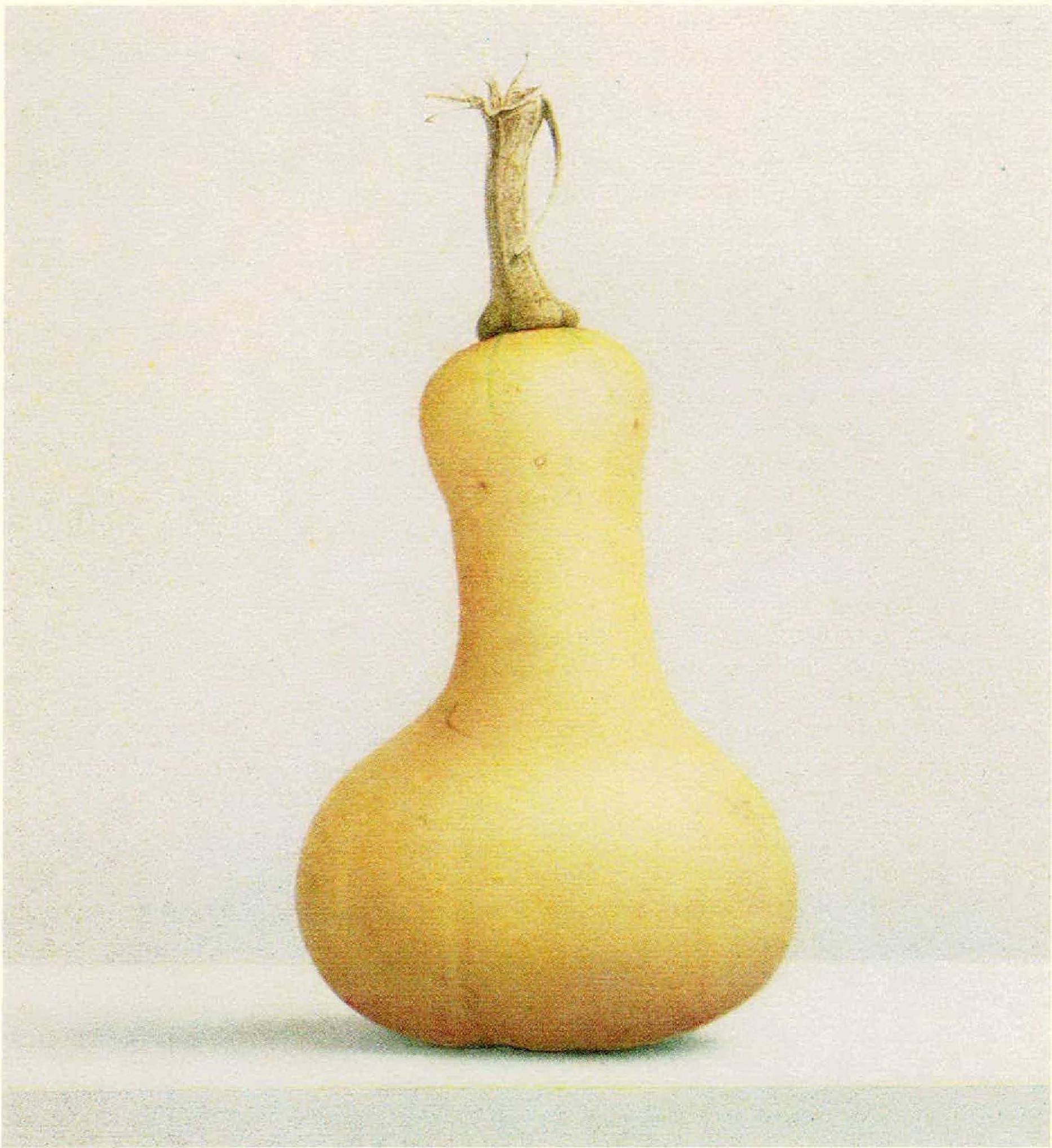
If I’m ever bold enough to buy a winter squash, it’s usually a butternut, which along with the acorn is among the most popular kinds of winter squash in the Northeast. It looks built for business: the shape is smooth and regular, and the skin thin enough to trim off without resorting to carpentry, although peeling one can be time-consuming. Usually, though, it languishes underneath a counter until, looking for a seldom-used utensil, I happen upon it months later. It seems fine, surprisingly intact. But I wonder if it could be edible after so long, and I’m put off by the size—do I really need that much squash? Soon enough the farmers’ market starts again.
I recently decided to overcome my fear born of ignorance, and I tackled winter squash of all kinds, cooking my way through three large crates of them. I found them much more pliable than I had supposed. They’re so simple to cook that I was ashamed of my years of hesitation. In learning more about them, I adjusted to the idea that winter squash don’t follow the rules that apply to most vegetables. Smaller ones aren’t necessarily better tasting. They can be any size and still be richly flavored, if they have not received too much water as they ripen, which tends to weaken their flavor. And they really do keep for months. Winter squash was to early New Englanders what cabbage is to much of the world—the only fresh vegetable in winter. Its thick skin protects the flesh from air, and as long as it has no soft or shiny patches, it should be sound. Its flavor suffers with refrigeration; keep squash in a cellar or a cool part of the kitchen.
Even though winter squash behaves like a root vegetable—many varieties taste like sweet potatoes and yams; squash is very good mashed or purecd. especially in combination with roots like potatoes, turnips, and celery root; and it thickens soups and sauces—it is in fact a fruit, and less dense than tubers in both calories and nutrients. There are 50 to 60 calories in a half cup of mashed squash, the serving size most recipes assume. Although squash is lower in protein and minerals than potatoes, it is a significant source of vitamin A, which helps to retain night vision and also to build skin, bones, and teeth. Unlike vitamin C, vitamin A is not destroyed by heat. The amount of vitamin A in some squash even increases after the picking and while the squash sits in the cellar. Winter squash is also high in fiber—it is comparable to apples, an often-recommended source of fiber—and in complex carbohydrates, so it is filling while being low in calories, and a good source of energy.
I made several happy discoveries in my experiments. The most significant for me is that it is just as good cooked in a microwave oven as in a conventional oven. I don’t like potatoes cooked in a microwave oven, and I assumed that squash, too, would have a better flavor when cooked in a conventional oven. I didn’t realize how different a squash is from a potato. I tried eleven kinds of winter squash in both kinds of ovens, both covered, with a shallow layer of water in the bottom of the pan, and uncovered, without water. I found that for certain kinds of squash the important variable was water. The texture and flavor differed little between the two ovens, and in some cases were better in the microwave.
If you cook squash uncovered in a conventional oven, the skin glistens as if oiled, which it doesn’t in a microwave; but unless you plan to serve the squash in its skin and appearance counts, a conventional oven just wastes time. A pound of squash, covered or uncovered, usually takes ten minutes in a microwave oven; the same amount takes at least a half hour in a conventional oven, and usually forty-five minutes to an hour. (You do have to allow more time for more squash in a microwave oven, whereas any amount will take the same time in a conventional oven, but you can decrease the time by cutting the squash into small chunks.) Steaming also usually takes more time than it’s worth. Boiling is quick but seems to weaken the flavor and waterlog the squash. One other cooking method is so good and so unexpected that I’ll save it for last.
I DIVIDE SQUASH into two categories: the ones that can be easily peeled before cooking and the ones that can’t. (The rind is edible, but it’s tough, and eating too much of it can cause a stomach ache.) In the first category are butternut, hubbard, and banana. All three have bright orange flesh and a compact, firm texture, and they are interchangeable. Butternut is cudgel-shaped; hubbard has a knobby orange skin and a shape like a basketball (frequently a size, too) with a snub-nose top; banana looks like a torpedo, and is named for its shape, not its taste.
I received my squash samples from Frieda’s Finest, a California produce marketer that has increased American awareness of new and better varieties of many fruits and vegetables. You can tell a Frieda’s product by the bright purple label, which includes cooking instructions for unfamiliar foods. I asked the Frieda’s people to be sure to send me banana squash, because cookbooks by West Coast writers specify it, and it is almost unknown on the East Coast. When I opened the box from Frieda’s, I thought they had sent me a 1950s lamp base. It was iridescent yellow and salmon, and huge, but Californians told me that it was a small specimen. I see why banana squash is sold almost exclusively in chunks. So is hubbard squash, which was once as common as butternut and whose flavor I prefer, mostly because there’s more of it. These chunks are often conveniently peeled, but once any of the flesh has been exposed, squash must be stored refrigerated, and lasts only a few days.
Of the varieties I tried that were unfamiliar to me, I’ll seek out three in the future: buttercup, sweet dumpling, and golden nugget. These all fall into the second category—you need to cook them with the skin on and then scoop out the flesh or lift off the peel. You have to tackle the skin to open any squash, whether or not you intend to peel it, and you never know whether you’ll meet with resistance or not. It’s best to pierce the skin with the tip of a heavy knife, and then cut around the equator. Scoop out the seeds with a sturdy spoon, and put the pieces flesh side down on the cooking dish.
Squash seeds, especially small ones, are excellent snacks: Spread out the pulp and seeds on a baking sheet lined with aluminum foil, salt or spice them if you like, and toast them in a 325° oven for fifteen minutes or so, until they start to brown. The seeds will easily break away from the pulp after they are toasted.
I was particularly leery of buttercup, because it is shaped like the most decorative and improbable winter squash—Turk’s turban, a flattened globe crowned by three humps, usually in brilliant oranges, reds, and yellows—to which it is in fact a close relative. (I tried cooking a Turk’s turban, and it was bland and watery, confirming all my suspicions about too-pretty vegetables. It belongs in an autumn cornucopia.) Buttercup is not so spectacularly colored—the skin is usually a drab green. Its cooked flesh is the same ocher color as acorn’s, and the flavor struck me as more acorn than acorn’s: spicy and rich, with a pleasantly smooth texture. The texture can be watery if cooked with liquid, so cook it dry and uncovered.
Sweet dumpling, too, is similar to acorn in the color and flavor of its flesh, but sweeter and spicier. And like acorn it is small enough to divide easily into serving portions (buttercups are usually over a pound) and it can be stuffed. Because the cavity is irregularly shaped, it should be divided top to bottom rather than across the middle. I didn’t find much difference in cooking it dry or with water. Buttercup, acorn, and sweet dumpling are all moist and flavorful enough to need no seasoning when served as a vegetable. Buttercup seems the overall best for flavor and texture, and I’m told that it’s increasingly available. Several new books flag kabocha, a group of Japanese cultivars of winter squash, as being among the sweetest and most flavorful. Many varieties of winter squash once common in the United States have fallen out of use, and today the innovators are the Japanese, who, like many other Asians, have long prized winter squash. I found kabocha comparable to buttercup—the same size or bigger, with a sweet but less spicy flavor.
Golden nugget looks like a thinskinned pumpkin, reliably spherical but not as deeply ridged. Its flesh remains a vivid orange when cooked, and the dry and floury texture (cook it covered, in a shallow layer of water) makes it suitable for mashing or replacing the potato in potato gnocchi. Golden nugget looks and tastes the way pumpkin, which is usually grouped with winter squash, should. (All winter squash and pumpkins are gourds and are in the same family as cucumbers and melons; pumpkin is more closely related to summer squash than summer squash is to winter squash.) I can’t warm up to pumpkin. The behemoths that make jack-o’-lanterns any child can be proud of are good mostly just for that (the seeds are good toasted, though). After years of trying “sugar pumpkins,” which are much smaller than jack-o’-lanterns, and now after tasting the new Jack-BeLittle mini-pumpkin, I’ll still take a squash over a pumpkin in any recipe calling for pumpkin.
Pumpkins other than mini-pumpkins have exceptionally thick rinds, and are so difficult to cut up that they can spoil anyone on winter squash of any kind. And their flavor payoff is small. For years I peeled, baked, and pureed sugar pumpkins for Thanksgiving pumpkin pies, until I realized not only that no one could tell the difference but also that canned pumpkin puree often had more taste. In any case, I was routinely bested by my stepmother’s famous squash pie. Squash does make a better pie, and better soup and stew, too. Cooks who adapt French or Italian recipes calling for pumpkin nearly always use butternut or some such winter squash instead. The most defensible culinary use I can think of for a pumpkin is as an arresting tureen.
IT’S MORE interesting to play off the sweetness of squash than to add to it, as brown sugar and maple syrup do. Something peppery is a good start, whether it be a dash of cumin on baked squash halves or the hot chili peppers the Thais and Burmese use in wintersquash dishes. Sundays at Moosewood Restaurant, by the Moosewood Collective, gives examples of both approaches: a very easy Autumn Gold Squash Soup, with sweet spices and tomato, apple, and orange juices; and a Burmese-inspired winter-squash dish with garlic, ginger root, hot green chili, shrimp paste, and cilantro. Italians also make dishes that are both sweet and hot. A famous pasta filling in the Italian regions of Lombardy and Emilia is pumpkin mixed with crushed amaretti cookies and mostarda, a sweet-and-hot pickled mixture of fruits which has a strong flavor of mustard seed. Paula Wolfert, the author of The Cooking of South-West France, found in that region many pumpkin soups and gratins, some with sweet red peppers or cheese. (Winter squash other than pumpkins barely exist in Italy and France, and even pumpkins are seldom used elsewhere in these regions.) Balsamic vinegar is made in the same region of Italy where pumpkin is popular, and although Italians seldom serve them together, the combination is very good: try cooking squash halves or chunks with a teaspoon or so of balsamic vinegar, and olive oil if you like, instead of maple syrup.
The Italians and the French both make a thick soup in which chunks of peeled pumpkin are boiled with garlic and herbs. Vinicio Paoli, of the Ristorante Toscano, in Boston, gave me this recipe: for two pounds of winter squash, use three or four branches of rosemary or thyme and two cloves of garlic, smashed and peeled. Boil with just a half cup of water about a half hour, until the squash softens. Fish out the garlic and herb stalks, put the squash through a food mill or blend it in a food processor, and season with salt and pepper. The resulting puree is too thick to be considered a normal soup; serve it over croutons or toasted bread for a homey supper (the original meaning of soup and supper is “a thick broth served over bread”).
The best soup I made both exploited the sweetness of squash and added something that contrasted with it. Slightly Smoky Squash Soup (a name I like), from Leslie Land’s The Modern Country Cook, adds smoke by having the cook spread six cups of cooked mashed squash on a baking sheet and then run it under a broiler. The squash chars a bit, and the heat causes much of the moisture to evaporate. To make the soup, saute two and a half cups of chopped onions in butter or oil over low heat for fifteen minutes. Add two cloves of garlic minced fine, if you like, and the grated zest of a large lime, and cook for three or four minutes more. Add the broiled squash, a cup of peeled, seeded tomatoes—if you don’t have fresh, open a can—and five cups of beef broth. Land flavors the soup with a tablespoon of soy sauce and two tablespoons of dark sesame oil: you can garnish the soup with dollops of sour cream or plain yogurt. The color of the soup is the brick red of chili, the flavor deep and rich. You’d think the soup had kidney beans in it (they would go very well, in fact), or even ground meat.
The dish that wins converts is in Verdura, a new book by Viana La Place, who with Evan Kleiman wrote the justly popular Cucina Fresca and Pasta Fresra. In several of her recipes La Place pan-fries peeled and sliced squash so that it tastes like sweet home fries. I wondered why the combination of crisp, caramelized outside and sweet, soft inside was familiar until I remembered how eagerly I eat the squash and sweet-potato slices whenever I order tempura. This method produces the same texture with much less fat (and trouble).
Since you have to peel the squash, choose butternut, banana, or hubbard. Cut the squash into slices a quarterinch thick and an inch or two high and wide. You should have at least two cups. Heat a tablespoon of oil in a heavy-bottomed frying pan. If you like, sauté several cloves of garlic in the oil just until they begin to color, and then take them out. When the oil is hot, add enough pieces of squash to not quite cover the pan in one layer; you’ll probably have to fry two batches. Keep turning the pieces over medium-high heat until they color. Add more oil as needed. After about fifteen minutes the pieces will blacken and blister, and be soft when pierced with the tip of a knife. Drain them on paper towels. You can serve these as they are, with salt.
This method already makes squash taste like a new vegetable, but La Place takes it further, giving a recipe she remembers watching her grandmother make. The dish is becoming a household staple for the people I’ve served it to, all of whom asked for the recipe. After pan-frying and draining the squash slices, toss them with chopped mint leaves (a quarter cup of mint for two cups of raw squash pieces; if you can’t find fresh mint, you can use two teaspoons of dried mint leaves; feel free to substitute fresh thyme, rosemary, or sage). Stir together a quarter cup each of redwine vinegar and sugar and pour the liquid into the still-hot frying pan. Raise the heat so that the vinegar sizzles and evaporates, leaving a thin syrup. Pour the syrup over the squash, season with salt and pepper, and leave to sit for a few hours before serving at room temperature, as an appetizer or a salad course. You might want to double the recipe.