A Jonquil for Mary Penn
She had rarely been sick, and never since she married. And now, also uncharacteristically she began to feel sorry for herself

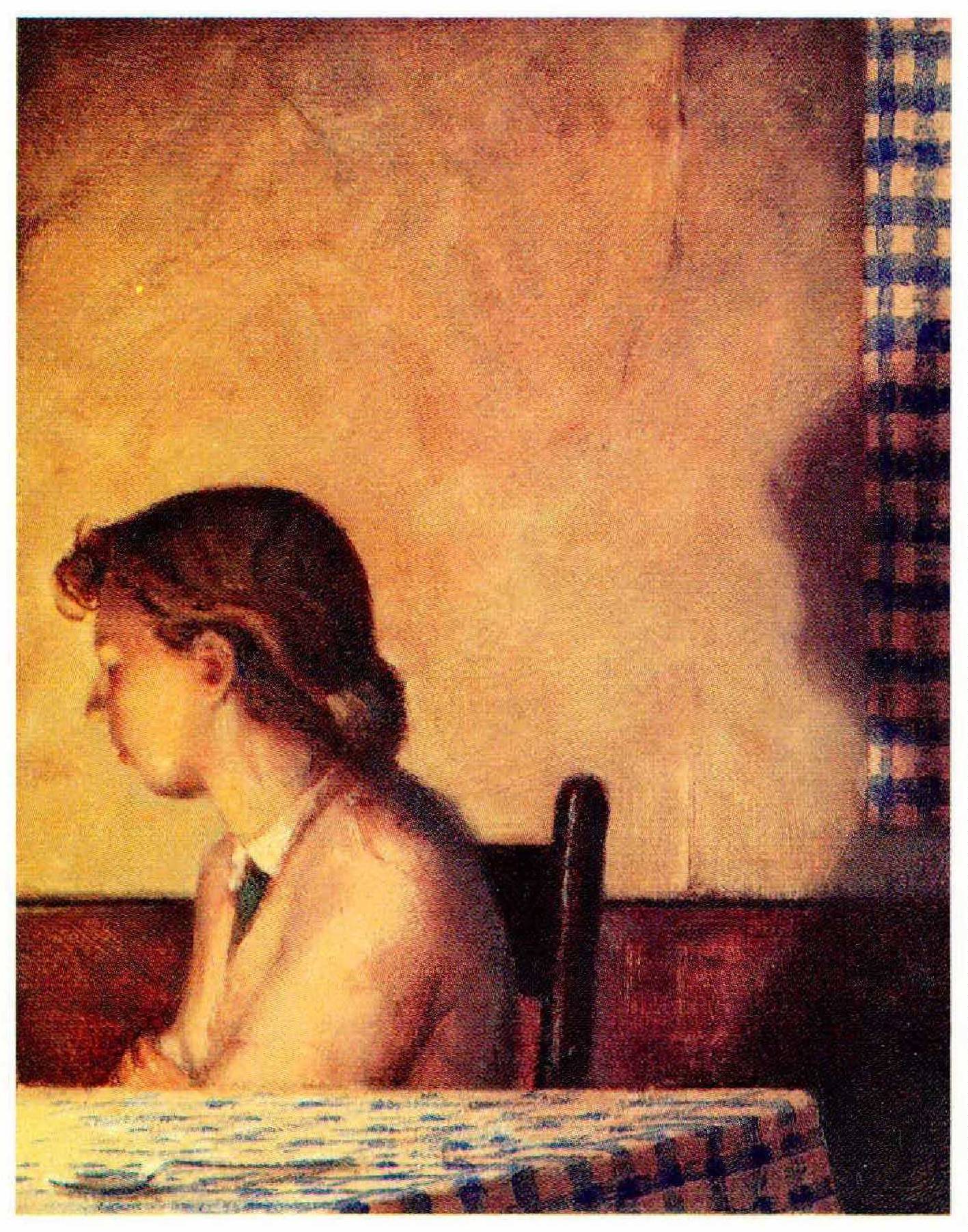
MARY PENN WAS sick, though she said nothing about it when she heard Elton get up and light the lamp and renew the fires. He dressed and went out with the lantern to milk and feed and harness the team. It was early March, and she could hear the wind blowing, rattling things. She threw the covers off and sat up on the side of the bed, feeling as she did how easy it would be to let her head lean down again, onto her knees. But she got up, put on her dress and sweater, and went to the kitchen.
Nor did she mention her sickness when Elton came back in bringing the milk, with the smell of the barn cold in his clothes.
“How’re you this morning?” he asked her, giving her a pat as she strained the milk.
And she said, not looking at him, for she did not want him to know how she felt, “Just fine.”
He ate hungrily the eggs, sausage, and biscuits that she set in front of him, twice emptying the glass that he replenished from a large pitcher of milk. She loved to watch him eat—there was something curiously delicate in the way he used his large hands—but this morning she busied herself about the kitchen, not looking at him, for she knew he was watching her. She had not even set a plate for herself.
“You’re not hungry?” he asked.
“Not very. I’ll eat something after a while.”
He put sugar and cream in his coffee, stirred rapidly with the spoon. And now he lingered a little. He did not indulge himself often, but this was one of his moments of leisure. He gave himself to his pleasures as concentratedly as to his work. He was never partial about anything; he never felt two ways at the same time. It was, she thought, a kind of childishness in him. When he was happy, he was entirely happy, and he could be as entirely sad or angry. His glooms were the darkest she had ever seen. He worked as a hungry dog ate, and yet he could play at croquet or cards with the self-forgetful exuberance of a little boy. It was for his concentratedness, she supposed, if such a thing could be supposed about, that she loved him. That and her yen just to look at him, for it was wonderful to her the way he was himself in his slightest look or gesture. She did not understand him in everything he did, and yet she recognized him in everything he did. She had not been prepared—she was hardly prepared yet—for the assent she had given to him.
ILLUSTRATIONS BY
Though he might loiter a moment over his coffee, the day, she knew, had already possessed him; its momentum was on him. When he rose from bed in the morning, he stepped into the day’s work, impelled into it by the tension, never apart from him, between what he wanted to do and what he could do. The little hillside place that they had rented from his mother afforded him no proper scope for his ability and desire. They always needed money, but, day by day, they were getting by. Though this was yet another spring of the Depression, they were not going to be in want. She knew his need to surround her with a margin of pleasure and ease. This was his need, not hers, but when he was not working at home, he would be working, or looking for work, for pay.
This morning, delaying his own plowing, he was going to help Walter Cotman plow his corn ground. She could feel the knowledge of what he had to do tightening in him like a spring. She thought of him and Walter plowing, starting in the early light, and the two teams leaning into the collars all day, while the men walked in the opening furrows and the steady wind shivered the dry grass and shook the dead weeds and rattled the treetops in the woods.
He stood and pushed in his chair. She came to be hugged as she knew he wanted her to.
“It’s mean out,” he said. “Stay in today, Take care of yourself.”
“You, too,” she said. “Have you got on plenty of clothes?”
“When I get ‘em all on, I will.” He was already wearing an extra shirt, and a pair of overalls over his corduroys. Now he put on a sweater, his work jacket, his cap and gloves. He started out the door and then turned back. “Don’t worry about the chores. I’ll be back in time to do everything.”
“All right,” she said.
He shut the door. And now the kitchen was a cell of still lamplight under the long wind that passed without inflection over the ridgetops.
She cleared the table. She washed the few dishes he had dirtied and put them away. The kitchen contained the table and four chairs and the small dish cabinet that they had bought, and the large iron cooking stove that looked more permanent than the house. The stove, along with the bed and a few’ other sticks of furniture, had been there when they came.
She heard Elton go by with the team, heading out the lane. The daylight would be coming now, though the windowpanes still reflected the lamplight. She took the broom from its corner by the back door and swept and tidied up the room. They had been able to do nothing to improve the house, which had never been a good one and had seen hard use. The wallpaper, and probably the plaster behind, had cracked in places. The finish had worn off the linoleum carpets near the doorways and around the stoves. But she kept the house clean. She had made curtains. The curtains in the kitchen were of the same bluc-and-white checkered gingham as the tablecloth. The nightstands were orange crates for which she had made skirts of the same cloth. Though the house was poor and hard to keep, she had made it neat and homey. It was her first house, and usually it made her happy. But not now.
She was sick. At first it was a consolation to her to have the whole day to herself to be sick in. But by the time she got the kitchen straightened up, even that small happiness had left her. She had a fever, she guessed, for every motion she made seemed to carry her uneasily beyond the vertical. She had a floaty feeling that made her unreal to herself. And finally, when she put the broom away, she let herself sag down into one of the chairs at the table. She ached. She was overpoweringly tired.
She had rarely been sick, and never since she married. And now she did something else that was unlike her: she began to feel sorry for herself. She remembered that she and Elton had quarreled the night before—about what, she could not remember; perhaps it was not rememberable; perhaps she did not know. She did remember the heavy, mostly silent force of his anger. It had been only another of those tumultuous darknesses that came over him as suddenly, and sometimes as unaccountably, as a July storm. She was miserable, she told herself. She was sick and alone. And perhaps the sorrow that she felt for herself was not altogether unjustified.
SHE AND ELTON HAD MARRIED A YEAR AND A HALF earlier, when she was seventeen and he eighteen. She had never seen anybody like him. He had a wild way of rejoicing, like a healthy child, singing songs, joking, driving his old car as if he were drunk and the road not wide enough. He could make her weak with laughing at him. And yet he was already a man as few men were. He had been making his own living since he was fourteen, when he had quit school. His father had been dead by then for five years. He hated his stepfather. When a neighbor had offered him cropland, room, and wages, he took charge of himself, and though he was still a boy, he became a man. He wanted, he said, to have to say thank you to nobody. Or to nobody but her. He would be glad, he said with a large grin, to say thank you to her. And he could do things. It was wonderful what he could accomplish with those enormous hands of his. She could have put her hand into his and walked right off the edge of the world. Which, in a way, is what she did.
She had grown up in a substantial house on a good upland farm. Her family was not wealthy but it was an old Kentucky family, proud of itself, always conscious of its position and of its responsibility to be itself. She had known from childhood that she would be sent to college. Almost from childhood she had understood that she was destined to marry a solid professional man, a doctor perhaps, or (and this her mother particularly favored) perhaps a minister.
And so when she married Elton, she did it without telling her family. She already knew their judgment of Elton: “He’s nothing.” She and Elton simply drove down to Hargrave one late October night, awakened a preacher, and got married, hoping that their marriage would be accepted as an accomplished fact. They were wrong. It was not acceptable, and it was never going to be. She no longer belonged in that house, her parents told her. She no longer belonged to that family. To them it would be as if she had never lived.
She was seventeen, she had attended a small denominational college for less than two months, and now her life as it had been was ended. The day would come when she would know herself to be a woman of faith. Now she merely loved and trusted. Nobody was living then on Elton’s mother’s little farm on Cotman Ridge, not far from the town of Port William, where Elton had lived for a while when he was a child. They rented the place and moved in, having just enough money to pay for the new dish cabinet and the table and four chairs. Elton, as it happened, already owned a milk cow in addition to his team and a few tools.
It was a different world, a new world to her, that she came into then—a world of poverty and community. They were in a neighborhood of six households, counting their own, all within half a mile of one another. Besides themselves there were Braymer and Josie Hardy and their children; Tom Hardy and his wife, also named Josie; Walter and Thelma Cotman and their daughter, Irene; Jonah and Daisy Hample and their children; and Uncle Isham and Aunt Frances Quail, who were Thelma Cotman and Daisy Hample’s parents. The two Josies, to save confusion, were called Josie Braymer and Josie Tom. Josie Tom was Walter Cotman’s sister. In the world that Mary Penn had given up, a place of far larger and richer farms, work was sometimes exchanged, but the families were conscious of themselves in a way that set them apart from one another. Here, in this new world, neighbors were always working together. “Many hands make light work,” Uncle Isham Quail loved to say, though his own old hands were no longer able to work much.
Some work only the men did together, like haying and harvesting the corn. Some work only the women did together: sewing or quilting or wallpapering or housecleaning; and whenever the men worked together, the women would be together cooking. Some work the men and women did together: harvesting tobacco, or killing hogs, or any job that needed many hands. The community was an old one. The families had worked together a long time. They all knew what each was good at. When they worked together, not much needed to be explained. When they went down to the little weatherboarded church at Goforth on Sunday morning, they were glad to see one another, and had lots to say, though they had seen each other almost daily during the week.
This neighborhood opened to Mary and Elton, took them in with a warmth that answered her parents’ rejection. The men, without asking or being asked, included Elton in whatever they were doing. They told him when and where they needed him. They came to him when he needed them. He was an apt and able hand, and they were glad to have his help. He learned from them all, but liked best to work with Walter Cotman, who was a fine farmer. He and Walter were, up to a point, two of a kind; they were both impatient with disorder—“I can’t stand a damned mess,” Walter said, and he made none—and both loved the employment of their minds in their work. They were unlike in that Walter was satisfied within the boundaries of his little farm, and Elton could not have been. Nonetheless, Elton loved his growing understanding of Walter’s character and ways. Though he was a quiet man and gave neither instruction nor advice, Walter was Elton’s teacher, and Elton was consciously his student.
Once, when they had killed hogs and Elton and Mary had stayed at home to finish rendering their lard, the boiling fat had foamed up and begun to run over the sides of the kettle. Mary ran to the house and called Walter on the party line.
“Tell him to throw the fire to it,” Walter said, “Tell him to dip out some lard and throw it on the fire.”
Elton did so, unbelieving, but the fire flared, grew hotter, the foaming lard subsided in the kettle, and Elton’s face relaxed from anxiety and self-accusation into a grin. “Well,” he said, quoting one of Walter’s sayings in Walter’s voice, “it’s all in knowing how.”
Mary, who had more to learn than Elton, became a daughter to every woman in the community. She came knowing little, barely enough to begin, and they taught her much. Thelma, Daisy, and the two Josies taught her their ways of cooking, cleaning, and sewing; they taught her to can, pickle, and preserve; they taught her to do the women’s jobs in the hog-killing. They took her on their expeditions to one another’s houses to cook harvest meals or to houseclean or to gather corn from the fields and can it. One day they all walked down to Goforth, in the Katie’s Branch Valley, to do some wallpapering for Josie Tom’s mother. They had a good time papering two rooms, and Josie Tom’s mother fixed them a dinner of fried chicken, creamed new potatoes and peas, hot biscuits, and cherry cobbler.
In cold weather they sat all afternoon in one another’s houses, quilting or sewing or embroidering. Josie Tom was the best at needlework. Everything she made was a wonder. From spring to fall, for a Christmas present for someone, she always embroidered a long cloth that began with the earliest flowers of spring and ended with the last flowers of fall. She drew the flowers on the cloth with a pencil, and worked them in with her needle and colored threads. She included the flowers of the woods and fields, the dooryards and gardens. She loved to point to the penciled outlines and name the flowers as if calling them up in their beauty into her imagination. “Look a there,” she would say. “I even put in a jimsonweed.” “And a bull thistle,” said Tom Hardy, who had his doubts about weeds and thistles, but was proud of her for leaving nothing out.
Josie Tom was a plump, pretty, happy woman, childless, but the mother of any child in reach. Mary Penn loved her the best, perhaps, but she loved them all. They were only in their late thirties or early forties, but to Mary they seemed to belong to the ageless, eternal generation of mothers, unimaginably older and more experienced than herself. She called them Miss Josie, Miss Daisy, and Miss Thelma. They warmed and sheltered her. Sometimes she wanted to toss herself at them like a little girl to be hugged.
They were capable, unasking, generous, humorous women, and sometimes, among themselves, they were raucous and free, unlike the other women she had known. On their way home from picking blackberries one afternoon, they had to get through a new barbed-wire fence. Josie Tom held two wires apart while the other four gathered their skirts, leaned down, and straddled through. Josie Tom handed their filled buckets over. And then Josie Braymer held the wires apart, and Josie Tom, stooping through, hung the back of her dress on the top wire.
“I knew it!” she said, and she began to laugh.
They all laughed, and nobody laughed more than Josie Tom, who was standing spraddled and stooped, helpless to move without tearing her dress.
“Josie Braymer,” she said, “are you going to just stand there or are you going to unhook me from this shitten fence?”
And there on the ridgetop in the low sunlight they danced the dance of women laughing, bending and straightening, raising and lowering their hands, swaying and stepping with their heads back.
DAYLIGHT WAS FULL IN THE WINDOWS NOW. Mary made herself get up and extinguish the lamp on the table. The lamps all needed to be cleaned and trimmed and refilled, and she had planned to do that today. The whole house needed to be dusted and swept. And she had mending to do. She tied a scarf around her head, put on her coat, and went out.
Only day before yesterday it had been spring—warm, sunny, and still. Elton said the wildflowers were starting up in the leafless woods, and she found a yellow crocus in the yard. And then this dry and bitter wind had come, driving down from the north as if it were as long and wide as time, the sky as gray as if the sun had never shone. The wind went through her coat, pressed her fluttering skirt tight against her legs, tore at her scarf. It chilled her to the bone. She went first to the privy in a back corner of the yard, and then on to the henhouse, where she shelled corn for the hens and gave them fresh water.
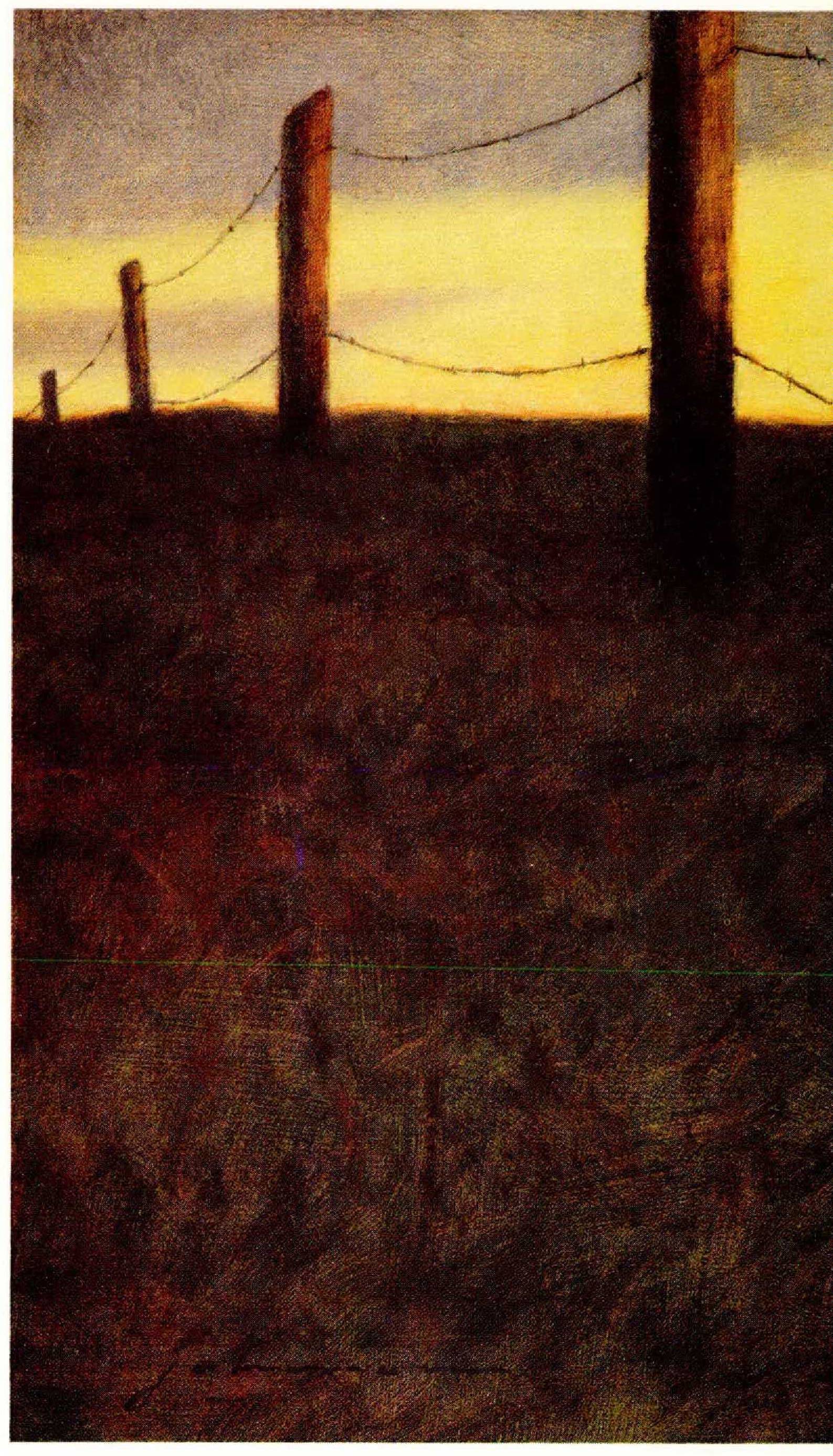
On her way back to the house she stood a moment, looking off in the direction in which she knew Elton and Walter Cotman were plowing. By now they would have accepted even this day as it was; by now they might have shed their jackets. Later they would go in and wash and sit down in Thelma’s warm kitchen for their dinner, hungry, glad to be at rest for a little while before going back again to work through the long afternoon. Though they were not far away, though she could see them in her mind’s eye, their day and hers seemed estranged, divided by great distance and long time. She was cold, and the wind’s insistence wearied her; the wind was like a living creature, rearing and pressing against her so that she might have cried out to it in exasperation, “What do you want?”
When she got back into the house, she was shivering, her teeth chattering. She unbuttoned her coat without taking it off, and sat down close to the stove. They heated only two rooms, the kitchen and the front room where they slept. The stove in the front room might be warmer, she thought, and she could sit in the rocking chair; but having sat down she did not get up. She had much that she needed to be doing, she told herself. She ought at least to get up and make the bed. And she wanted to tend to the lamps; it always pleased her to have them clean. But she did not get up. The stove’s heat drove the cold out of her clothes, and gradually her shivering stopped.
They had had a hard time of it their first winter. They had no fuel, no food laid up for the winter. Elton had raised a crop, but no garden. He borrowed against the crop to buy a meat hog. He cut and hauled in firewood. He worked for wages to buy groceries, but the times were hard and he could not always find work. Sometimes their meals consisted of biscuits and a gravy made of lard and flour.
And yet they were often happy. Often the world afforded them something to laugh about. Elton stayed alert for anything that was funny, and brought the stories home. He told her how the tickle-ass grass got into Uncle Isham’s pants, and how Daisy Hample clucked to her nearsighted husband and children like a hen with half-grown chicks, and how Jonah Hample, missing the steps, walked off the edge of Braymer Hardy’s front porch, fell into a rosebush, and said, “Now, I didn’t go to do that!” Elton was a natural mimic, and he could make the funny things happen again in the dark as they lay in bed at night; sometimes they would laugh until their eyes were wet with tears. When they got snowed in that winter, they would drive the old car down the hill until it stalled in the drifts, and drag it out with the team, and ram it into the drifts again, laughing until the horses looked at them in wonder.
When the next year came, they began at the beginning, and though the times had not improved, they improved themselves. They bought a few hens and a rooster from Josie Braymer. They bought a second cow. They put in a garden. They bought two shoats to raise for meat. Mary learned to preserve the food they would need for winter. When the cows freshened, she learned to milk. She took a small bucket of cream and a few eggs to Port William every Saturday night, and used the money she made to buy groceries and to pay on their debts.
Slowly she learned to imagine where she was. The ridge named for Walter Cotman’s family was a long one, curving out toward the river between the two creek valleys of Willow Run and Katie’s Branch. As it came near to the river valley it got narrower, its sides steeper and more deeply incised by hollows. When Elton and Mary Penn were making their beginning there, the uplands were divided into many farms, few of which contained as much as a hundred acres. The hollows, the steeper hillsides, the bluffs along the sides of the two creek valleys, were covered with thicket or woods. From where the hawks saw it, the ridge would have seemed a long, irregular promontory reaching out into a sea of trees. And it bore on its back crisscrossings of other trees along the stone or rail or wire fences, trees in thickets and groves, trees in the house yards. And on rises of ground, or tucked into folds, were the gray, paintless buildings of the farmsteads, connected to one another by lanes and paths. Now she thought of herself as belonging there, not just because of her marriage to Elton but also because of the economy that the two of them had made around themselves and with their neighbors. She had learned to think of herself as living and working at the center of a wonderful provisioning: the kitchen and garden, hogpen and smokehouse, hen house and cellar, of her own household; the little commerce of giving and taking that spoked out along the paths connecting her household to the others; Port William on its ridgetop in one direction, Goforth in its valley in the other; and all this at the heart of the weather and the world.
On a bright, still day in the late fall, after all the leaves were down, she had stood on the highest point and had seen the six smokes of the six houses rising straight up into the wide down-falling light. She knew which smoke came from which house. It was like watching the rising up of prayers, or some less acknowledged communication between Earth and Heaven. She could not say to herself how it made her feel.
She loved her jars of vegetables and preserves on the cellar shelves, and the potato bin beneath, the cured hams and shoulders and bacons hanging in the smokehouse, the two hens already brooding their clutches of marked eggs, the egg basket and the cream bucket slowly filling, week after week. But today these things seemed both dear and far away, as if remembered from another world or another life. Her sickness made things seem all awry and arbitrary. Nothing had to be the way it was. As easily as she could imagine the house in its completeness, she could imagine it empty, windowless, the tin roof blowing away, the chimneys crumbling, the cellar caved in, weeds in the yard. She could imagine Elton and herself gone, and the rest of them—Hardy, Hample, Cotman, and Quail—gone too.
ELTON COULD SPEND AN HOUR TELLING HER— and himself—how Walter Cotman went about his work. Elton was a man fascinated with farming, and she could see him picking his way into it with his understanding. He wanted to know the best ways of doing things. He wanted to see how a way of doing came out of a way of thinking and a way of living. He was interested in the ways people talked and wore their clothes.
The Hamples were another of his studies. Jonah Hample and his young ones were almost useless as farmers, because, Elton maintained, they could not see all the way to the ground. They did not own a car, because they could not see well enough to drive—“They need to drive something with eyes,” Elton said—and yet they were all born mechanics. They could fix anything. While Daisy Hample stood on the porch clucking about the weeds in their crops, Jonah and his boys, and sometimes his girls, too, would be busy with some machine that somebody had brought them to fix. The Hample children went about the neighborhood in a drove, pushing a fairly usable old bicycle that they loved but could not ride.
Elton watched Braymer, too. Unlike his brother and Walter Cotman, Braymer liked to know what was going on in the world. Like the rest of them, Braymer had no cash to spare, but he liked to think about what he would do with money if he had it. He liked knowing where something could be bought for a good price. He liked to hear what somebody had done to make a little money, and then to think about it and tell the others about it while they worked. “Braymer would be a trader if he had a chance,” Elton told Mary. “He’d like to try a little of this and a little of that, and see how he did with it. Walter and Tom like what they’ve got.”
“And you don’t like what you’ve got,” Mary said.
He grinned big at her, as he always did when she read his mind. “I like some of it,” he said.
At the end of the summer, when she and Elton were beginning their first tobacco harvest in the neighborhood, Tom Hardy said to Elton, “Now, Josie Braymer can outcut us all, Elton. If she gets ahead of you, just don’t pay it any mind.”
“Tom,” Elton said, “I’m going to leave here now and go to the other end of this row. If Josie Braymer gets there before I do, I’m going home.”
When he got to the end of the row, Josie Braymer was not there, and neither were any of the men. It was not that he did not want to be bested by a woman; he did not want to be bested by anybody. One thing Mary would never have to do was wonder which way he was. She knew he would rather die than be beaten. It was maybe not the best way to be, she thought, but it was the way he was, and she loved him. It was both a trouble and a comfort to her to know that he would always require the most of himself. It stirred her.
She could feel ambition constantly pressing in him. He could do more than he had done—he knew he could— and he was always looking for the way. He was like an axman at work in a tangled thicket, cutting and cutting at the little brush and the vines and the low limbs, trying to make room for a full swing. For this year he had rented corn ground from Josie Tom’s mother, down by Goforth, two miles away. When he went down with his team to work, he would have to take his dinner. It would mean more work for them both, but he was desperate for room to exert himself. In two years, after the death of Josie Tom’s mother, Mary and Elton would go to that farm to live. In another two years they would move to the Jack Beechum place, a good, well-husbanded farm that would give them their chance. They foresaw none of that now. They were poor as the times, and they saw more obstacles than openings. And yet she believed without doubt that Elton was on his way.
It was not his ambition—his constant, tireless, often exhilarated preoccupation with work—that troubled her. She could stay with him in that. She had learned that she could do, and do well and gladly enough, whatever she would have to do. She had no fear. What troubled her were the dark and mostly silent angers that often settled on him and estranged him from everything. At those times, she knew, he doubted himself, and he suffered and raged in his doubt. He may have been born with this doubt in him, she sometimes imagined; it was as though his soul were like a little moon that would be dark at times and bright at others. But she knew also that her parents’ rejection of him had cost him dearly. Even as he defied them to matter to him, they held a power over him that he could not shake off. In his inability to forgive them, he consented to their power over him, and their rejection stood by him and measured him day by day. Her parents’ pride was social, belonging, even in its extremity, to their kind and time. But Elton’s pride was creaturely, howbeit that of an extraordinary creature; it was a creature’s naked claim on the right to respect itself, a claim that no creature’s life could of itself invariably support. At times he seemed to her a man in the light in daily struggle with a man in the dark, and sometimes the man in the dark had the upper hand.
Elton never felt that any mistake was affordable; he and Mary were living within margins that were too narrow. He required perfection of himself. When he failed, he was like the sun in a cloud, alone and burning, furious in his doubt, furious at her because of her trust in him in spite of his doubt. How could she dare to love him, a man who did not love himself? And then, sometimes accountably, sometimes not, the cloud would move away, and he would light up everything around him. His own force and intelligence would be clear within him then; he would be skillful and joyful, passionate in his love of order, funny and tender.
At his best, Elton was a man in love—with her, but not just with her. He was in love, too, with the world, with their place in the world, with even that scanty farm, with his own life, with farming. At those times she lived in his love as in a spacious house.
Walter Cotman always spoke of Mary as Elton’s “better half.” In spite of his sulks and silences, she would not go so far as “better.” That she was his half she had no doubt at all. He needed her. At times she knew with a joyous ache that she completed him, just as she knew with the same joy that she needed him and he completed her. How beautiful a thing it was, she thought, to be a half, to be completed by such another half! When had there ever been such a yearning of halves toward each other, such a longing, even in quarrels, to be whole? And sometimes they would be whole. Their wholeness came upon them like a rush of light, around them and within them, so that she felt they must be shining in the dark.
But now that wholeness was not imaginable; she felt herself a part without counterpart, a mere fragment of something unknown, dark and broken off. The fire had burned low in the stove. Though she still wore her coat, she was chilled again and shaking. For a long time, perhaps, she had been thinking of nothing, and now misery alerted her again to the room. The wind panted and sucked at the house’s corners. She could hear its billows and shocks, as if somebody off in the distance were shaking a great rug. It was like something that somebody was doing. She felt not a draft but the whole atmosphere of the room moving coldly against her. She went into the other room, but the fire there also needed building up. She could not bring herself to do it. She was shaking, she ached, she could think only of lying down. Standing near the stove, she undressed, put on her nightgown again, and went to bed.
She lay chattering and shivering while the bedclothes warmed around her. She sensed that the time might come when sickness would be a great blessing, for she truly did not care if she died. She thought of Elton, who could not even look at her, out of the day’s wind that had caught him up, and see that she was sick. If she had not been so miserable, she would have cried. But then her thoughts began to slip away, like dishes sliding along a table pitched as steeply as a roof. She went to sleep.
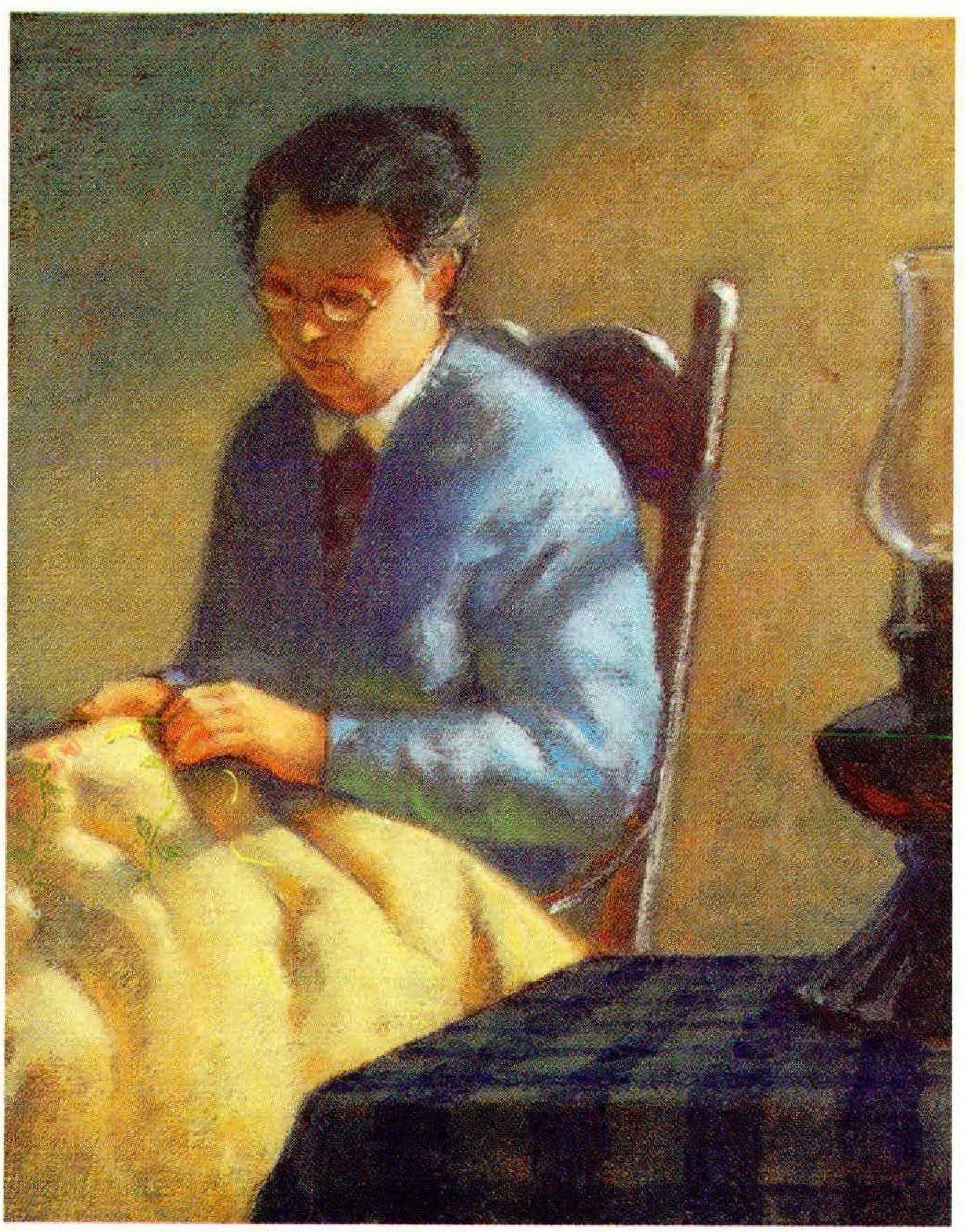
WHEN SHE WOKE, the room was warm. A tea kettle on the heating stove was muttering and steaming. Though the wind was still blowing hard, the room was full of sunlight. The lamp on the narrow mantelshelf behind the stove was filled and clean, its chimney gleaming, and so was the one on the stand by the bed. josie Tom was sitting in the rocker by the window, sunlight flowing in on the unfinished long embroidery she had draped over her lap. She was bowed over her work, filling in with her needle and a length of yellow thread the bright corolla of a jonquil—or “Easter lily,” as she would have called it. She was humming the tune of an old hymn, something she often did while she was working, apparently without awareness that she was doing it. Her voice was resonant, low, and quiet, barely audible, as if it were coming out of the air and Josie Tom also were merely listening to it. The yellow flower was nearly complete.
And so Mary knew all the story of her day. Elton, going by Josie Tom’s in the half light, had stopped and called.
She could hear his voice, raised to carry through the wind: “Mrs. Hardy, Mary’s sick, and I have to go over to Walter’s to plow.”
So he had known. He had thought of her. He had told Josie Tom.
Feeling herself looked at, Josie Tom raised her head and smiled. “Well, are you awake? Are you all right?”
“Oh, I’m wonderful,” Mary said. And she slept again.