Joe Mitchell's Secret
by Hoy Blount Jr.
UP IN THE OLD HOTEL and Other Stories by . Pantheon Books, $25.00.
IF I COULD play around with time, I would make myself alive and literate on that week in 1940 when I could flip suspensefully through the latest New Yorker (whose table of contents in those days was minimal), come upon a piece titled “Lady Olga,”savor its first sentence (“Jane Barnell occasionally considers herself an outcast and feels that there is something vaguely shameful about the way she makes a living”), scan its first paragraph, jump ahead a number of pages to the byline, and exclaim:
“Oh, glory. Joseph Mitchell has profiled a bearded lady.”
I did have the pleasure, in 1964, of devouring fresh out of that magazine Mitchell’s series of articles about Joe Gould, a bizarre Greenwich Village character whose literary pretensions and hand-tomouth subsistence Mitchell had first chronicled, more briefly, in 1942. Gould had continued to pester Mitchell over the years, in person or as a kind of specter (Gould sometimes referred to himself as Professor Sea Gull, and did eerie sea gull imitations that no one who heard them ever forgot), until Gould’s death in a mental hospital. The closing revelation of this series was something Mitchell alone had been in a position to discover: that the fabled trove of notebooks in which Gould claimed to have recorded years and years of many people’s talk, his life’s work, his “Oral History of Our Time,” had never in fact existed.
Except for his Gould articles collected in a book, Joe Gould’s Secret (1965), Mitchell has published nothing since. He hasn’t even allowed his four fong-outof-print collections to be reissued. For twenty-eight years his fans have been hearing that he continues to come to work at The New Yorker, and wondering what he’s up to. We still don’t know, but now we do have Up in the Old Hotel, a welcome one-volume edition of Mitchell’s collected works: the collections {McSorley’s Wonderful Saloon, Old Mr Flood, The Bottom of the Harbor, and Joe Gould’s Secret), seven pieces not included in those books, and a brisk introduction in which Mitchell, now in his eighties, confides little more than that he has always been inclined toward “graveyard humor.”
“No matter how fat and sassy you may be,” proclaims a street preacher in a 1943 piece titled “A Spism and a Spasm,” “you’re living every second on the lip of the grave.” The people Mitchell honored tended to derive enormous energy from that precariousness, to sing at great length from that lip. Up in the Old Hotel’s title piece concerns the boarded-up remnants of a long-abandoned hotel above Sloppy Louie’s (now lamentably refurbished) restaurant. Mitchell and Louie venture up there and find—well, I won’t spoil the details for you. I hey shudder and go back down. As it happened, that piece came out in 1952, the year Joe Gould was institutionalized for good.
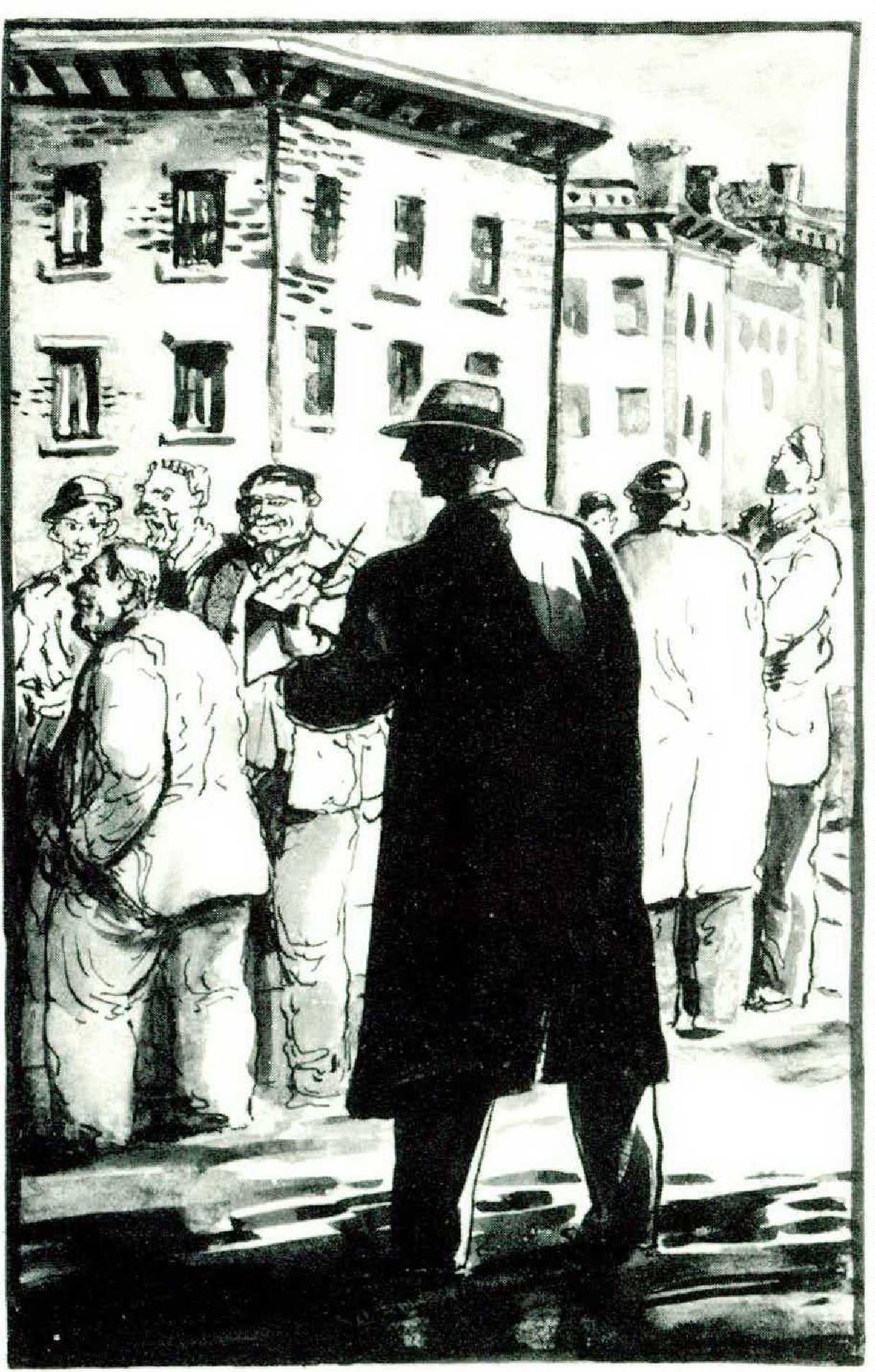
J. D. Salinger, the other living New Yorker writer who stopped publishing in the mid-sixties, has remained in print and—thanks to his reclusiveness —has appeared sporadically in the news. A. J. Liebling, Mitchell’s friend and fellow celebrant of drink, food, and raffishness, stopped writing in 1963, because that is when he died; but Liebling is still a familiar author and a journalistic legend. Mitchell has become dismayingly obscure, except to those of us who are old enough and interested enough in a certain line of writing (he has been credited as a pioneer of the so-called New Journalism, but that suggests an inappropriate trendiness) to regard him as a master.
“PEOPLE DON’T laugh at clowns anymore but they want to see A them around,” a circus official told Mitchell in 1940. If necessary, as a worst-case scenario, I was prepared to salute Mitchell on that basis when I began to read this volume, after not having actually looked at his stuff in some time. But his richly specific, levelly related sketches of mostly New York but sometimes outlying folk and ways—Mohawk high-steel workers, Gypsy swindlers, waterfront rat exterminators—are still funny, fluid, authoritative, tangy, and affecting. Five or six of this book’s thirty-seven pieces are not marvelous (to use a word that I have never used before and that Mitchell would probably not be caught dead using). The rest are. I can’t do them justice by quoting from them, because their best passages are built up to at length, but here is a description of Looba, the wife of Johnny Nikanov, whom Mitchell identified in 1942 as one of “at least one dozen gypsy kings” in New York:
Looba is tall, gaunt, sad-eyed, and austere; in profile she looks exactly like the old Indian on Indian-head nickels. She goes to sleep at sundown and seldom gets up before 10 A.M., but she is constantly yawning, stretching, and grunting. Looba smokes a pipe. She is extremely irritable. Johnny says that she rarely refers to him by name; instead, using Romany, she calls him a ratbite, a sick toad, a blue-bellied eel, a blackyolked egg, a goat, a bat, a policeman, a gajo [a non-Gypsy], and various other loathsome things. He doesn’t mind. “A gypsy woman that don’t scream half the time, something is wrong with her,” he says. “Screaming is their hobby.”
A vigilant female or Gypsy reader today might find that portrait invidiously objectifying. A reader who is abreast of current food-chain consciousness might shudder at “All You Can Hold for Five Bucks,” Mitchell’s 1939 study of old-style New York testimonial steak dinners, in which utensil-disdaining, greasy-to-their-ears gourmands merrily put away many, many animals’ worth of steak and chops and kidneys while sloshing down gallons of beer. A reader who is up-to-date on dependency might have problems with all the drinking in these pieces. Many of Mitchell’s favorite characters are zestfully bibulous, or else so eloquent in their demonizing of rum as to seem inversely intoxicated by it. Then there is the testimony of Mr. Flood, Mitchell’s composite Fulton Fish Market character, who at his ninety-fifth birthday party reflects as follows:
“I was lying in bed the other night... and I got to thinking about death and sin and hell and God, the way you do, and a question occurred to me. I wonder what man committed the worst sin in the entire history of the human race. The man that invented whiskey, he’s the one. When you stop and think of the mess and the monkey business and the fractured skulls and the commotion and the calamity and the stomach distress and the wife beating and the poor little children without any shoes and the howling and the hell raising he’s been responsible for down through the centuries—why, good God A’mighty! Whoever he was, they’ve probably got him put away in a special brimstone pit, the deepest, red-hottest pit in hell, the one the preachers tell about, the one without any bottom.” He took a long drink. “And then again,” he continued, “just as likely, he might’ve gone to heaven.”
One of Mitchell’s great gifts is for mixing humor with references to genuine misery while avoiding that great source of decay in comedy: facetiousness. A writer today could not present a Mr. Flood without shoring him up as regards substance-abuse awareness; but I would bet money that Mitchell’s termagants, gluttons, and topers will outlast—if not indeed overwhelm the scruples of—any particular stripe of contemporarily fish-eyed reader.
SO WHAT HAS kept Mitchell silent since he put quits to the matter of Joe Gould in 1964? To see why Mitchell may not be inspired to write about contemporary New York, all you have to do is compare the old Fulton Fish Market, whose organic redolences Mitchell ventilated so well, with the deathly touristic South Street Seaport that incorporates what is left of it today. But there are other reasons why Mitchell’s style of reporting is no longer, o tempera, o mores, state-of-the-art.
A couple of years ago I was asked to write the introduction to a reissue of one of Liebling’s books. I took the occasion to ask Mitchell how his and Liebling’s heyday differed from today.
“Back then,” Mitchell said, “if you developed a character, the papers would mention him, but he was, you might say, your character. Nowadays fourteen different television programs would take him away from you, promise to pay him something—he’d wind up with about twelve dollars out of it. They just wear out and use up a character. Also, if you try to interview a character today you find that half the things they say they heard on television. Most of the quotes you hear today are pretty thin.”
Also, Mitchell noted, “the disposition to sue wasn’t as rampant then as it is now.”
The quotations Mitchell delivered were so long and rich as to take leave of naturalism. They stretch credibility rewardingly and so far as I know unimpeachably (in his introduction Mitchell says which of his pieces are fictional and which not), but probably not in a way that reporters today, who tend to use tape recorders defensively, can get away with. As we have seen in the case of Janet Malcolm versus Jeffrey Masson, the outraged psychiatrist she had profiled in The New Yorker, the question of fashioning text from transcript has become profoundly vexed.
There is another reason why characters aren’t what they used to be: an honest writer today cannot avoid registering personality differently. Odd ducks today tend to fall under various sociological or psychological headings. They belong to marginalized groups for whom something should be, and probably isn’t being, done. That bearded ladies are now preventable is a development no decent person can regret. I submit that the case of Joe Gould carried Mitchell reluctantly toward such thinking.
Twenty-four of the pieces in this book were published from 1938 to 1942, the year Joe Gould entered Mitchell’s life. Only thirteen—many of them, to be sure, among his best—appeared thereafter. Not content to be a one-piece character, Gould appropriated Mitchell’s office as his mailing address, came painfully close to letting down his mask with him, and made Mitchell feel guilt and disgust. Mitchell’s tone in Joe Gould’s Secret is marred by uncharacteristic self-consciousness and exasperation.
Everyone who got to know the smelly, shamelessly freeloading Gould eventually dismissed him as impossible. Mitchell put up with a lot more from him than anyone else did. I don’t think it is being fanciful to suppose that Gould wore Mitchell out. For one thing, Gould when drinking could talk even Mitchell under the table. More unsettling, Gould turned out to be a bad character for Mitchell’s purposes. Pathetic. Dysfunctional.
Mitchell’s style embraces austerely comic, independently cranky types. It renders downright inspirational their transcendence of hard times, of conventional people’s scorn, and of their own intimations of mortality. In the 1942 profile Gould comes through as such a type. But in the end, unlike any other of Mitchell’s leading characters, he dies as most people do today: disintegrated and in the hands of -ologists. Mitchell— who identified uncondescendingly with a hardheaded bearded lady, an unshakable religious haranguer, a rather unappealing but redoubtable child prodigy, and any number of fishwives, doomsayers, and cranks—couldn’t seem to forgive the mortal weakness of his fellow conflicted writer. Professor Sea Gull, the messiest and most rounded person in this book, may have deconstructed Mitchell’s sense of character.
If that is so, Mitchell’s decades of reticence are a tribute to his integrity. And his oral history does exist, in Up in the Old Hotel, a book that should continue to inspire reporters who hope abidingly, as I do, to celebrate great talk of all kinds and to register such resounding mementos of historical orality as the one Mitchell espied on a hotel wall in 1944, a yellowed photograph of
Buffalo Bill and some Indians in fringed buckskins eating lobsters at a family table in the dining room. Around the margin, in a crabbed hand, someone has written, “Col. Buffalo Bill and 1 doz. red Indians just off the Boston boat, stayed three days, big eaters, lobster every meal, up all night, took the place.”