Notes: No More Laissez-Faire
It’s time to confront a pernicious form of protectionism
WHEN IT COMES to the circulation of words around the globe, I consider myself sympathetic to the forces of free trade. If members of a language community other than my own come up with a way of saying something better or more concisely than it has ever been said before—come up with the mot juste—then it is to the benefit of all of us that the new word or phrase acquire broader currency. A few years ago a collection of serviceable coinages was published under the title They Have a Word for It. it included, for example, the New Guinean word mokita, which refers to “truth everybody knows but nobody speaks,” and the German word Treppenwitz, meaning a “clever remark that comes to mind when it is too late to utter it.” Words like these are valuable commodities, and there is no reason to confine them to one small patch of geography.
In good free-market fashion, people pick up words from foreign languages when it’s useful or necessary to do so— as, for example, when new products or concepts arrive with foreign names attached to them. Needless to say, some languages appear on the scene and contribute almost nothing. The Visigoths swept through Spain in the fifth century A.D. and ruled the peninsula for well over two centuries; not a single word of the Visigothic tongue survives in Spanish. In contrast, languages such as Latin and English have sent useful words by the thousands to foreign shores.
No one regulates all this activity. No one needs to: a natural dynamism is at work. And though it can be held at bay by the outright censorship of publishing and broadcasting, the trade in words is otherwise not greatly susceptible to manipulation or control. Millions of dollars’ worth of advertising by Volkswagen was unequal to the task of making Fahrvergnügen a word that Americans felt they really needed. By the same token, samizdat, sushi, and Blitzkrieg caught on fast, and it is hard to imagine that they could ever be dislodged by substitutes. The system of free trade in words has been in place since the dawn of time, and people almost everywhere—even in Japan—rightly see it as a robust manifestation of human creativity.
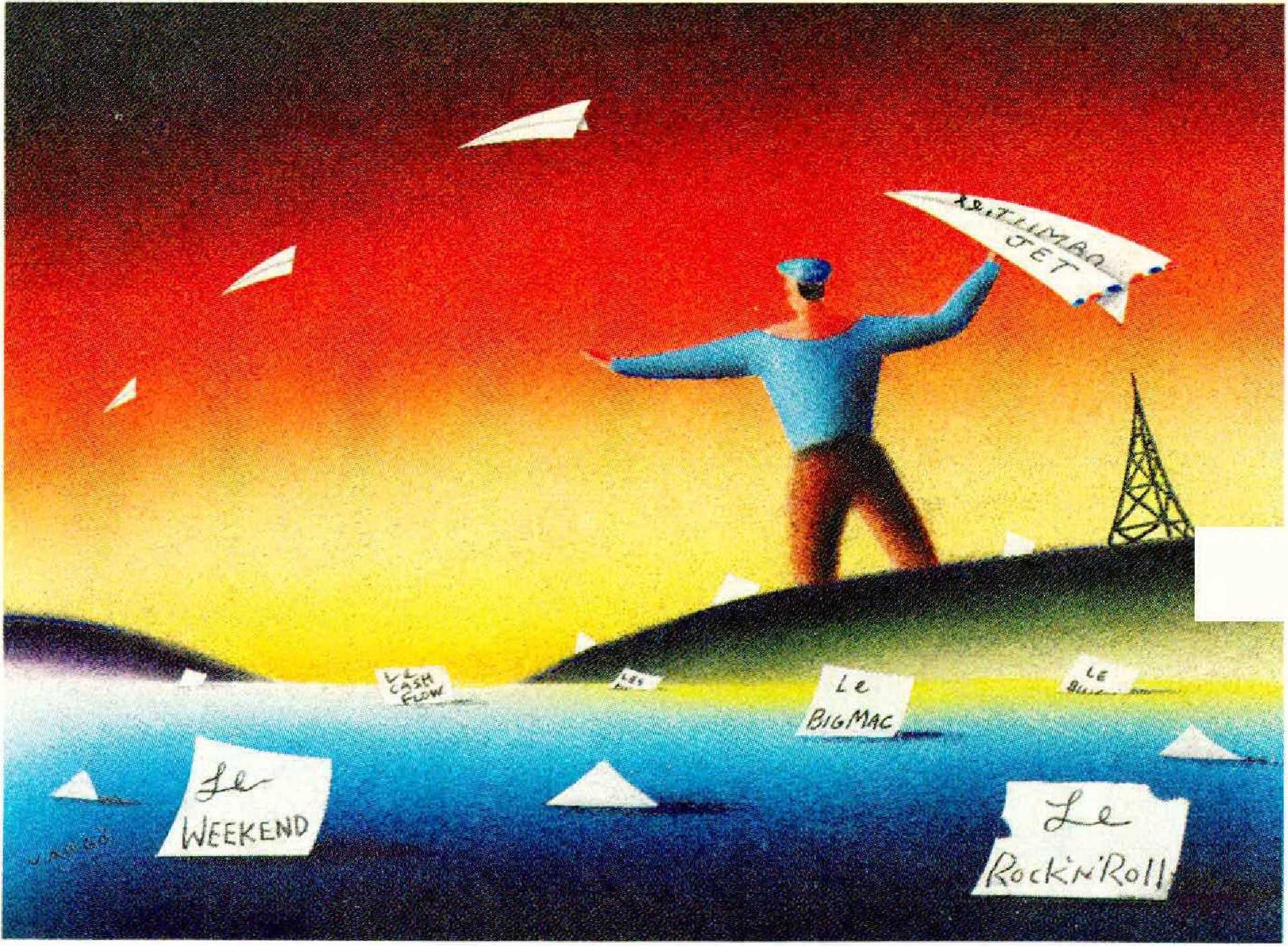
AND THEN there are the French. Although they have been the happy beneficiaries of a freetrade regime on the part of other nations—especially during the eighteenth and nineteenth centuries, when their language was the language of diplomacy, and had penetrated jungle, prairie, and steppe—the French have always returned the favor by attempting to seal the linguistic border. Their first great enemy was Latin. Next came Italian and German. Then, a few centuries ago, the French began to worry about contamination (their term) by English.
The influx of English words into French was being denounced as early as 1757, by Fougeret de Monbron in his book Préservatif contre l’anglomanie. In our own time the threat posed by English was memorably described by Réné Étiemble in his book Parlez-vous franglais?, and ever since its publication, in 1964, complaints about the contamination of French by such words as le week-end, le cash flow, and le sandwich have been a staple of public commentary in France. As one element of France’s bid for linguistic autarky, a commission has been established to come up with French equivalents for intrusive foreign words (for instance, le gros-porteur instead of le jumbo jet). Despite such official measures, from time to time the level of concern assumes crisis proportions, and the world looks on as the French noisily undergo ritual purification.
The French are in a purifying mood right now, owing in part to nervousness about the consequences for their language of a somewhat more united Europe. Characteristically, they have indulged their protectionist impulses. Last summer a joint session of the French Parliament was convened at the Palace of Versailles in order to add the following sentence to France’s constitution: “The language of the republic is French.” The sentence may seem innocuous, but it effectively reduces the status of English words that have wide currency in France to that of guest workers there. Shortly after this constitutional amendment was ratified, a group of 300 French intellectuals issued a declaration that denounced the aural and visual presence of English in France. “We cannot accept this process of collective self-destruction,” they wrote. The intellectuals criticized the growing number of “angloglots” in France and called for a stepped-up government campaign against “linguistic debasement.”
It is perhaps going a little too far to say that the quickest way to make me change an opinion is to tell me that 300 French intellectuals share it, but it does seem in this case that the French might benefit from a modest sense of perspective. Consider what English-speakers have had to put up with at the hands of French-speakers. Until the year 1066 English was an essentially Germanic tongue with roughly 50,000 or 60,000 words. Then came the Battle of Hastings, and in its aftermath William of Normandy and his French-speaking retainers came to power in Britain. During the first 300 years after Hastings, the Kings of England were all speakers of French. So great was the cultural domination of French that relatively few documents from 1066 until the thirteenth century exist in English. When written English at last reappeared, in the form of Middle English, it had doubled in size since pre-Norman days, and almost all the new words were loanwords from French. Besides the many tens of thousands of French words that have been incorporated into English in anglicized form, countless French words and phrases have been incorporated without change, and are even deemed by some to have a certain cachet. The historical infusion of French into English is of far greater magnitude (and came about with far greater loss of life) than anything that happened in the other direction.
And yet despite all that, we speakers of English generally profess to be quite satisfied with our mongrel tongue. When reminded of what the Normans wrought, our reaction is likely to be “C’est la vie.”
THE TIME HAS come, I think, for the English-speaking world, and the United States in particular, to communicate to the French our desire for a more open frame of mind on their part. The way to do this is, in effect, to answer tariff barriers with tariff barriers.
To begin with. I would urge restaurants across the country to take a step that happens in any case to be long overdue: put an end to the practice of writing menus in French, which is the gastronomical equivalent of the Latin mass. This change should not apply merely to expensive French restaurants. Even lowly diners can be found with a “soup du jour” on the menu, and I hope that the owners will opt for the vernacular.
Translating our menus is probably not enough to produce a change of heart in a Regis Debray or a Eugene Ionesco, so I would next ask English-speakers to begin weeding French words and phrases from their vocabulary. At a minimum, I would suggest eliminating the following ten terms, all of which keep an exceedingly high profile: avantgarde., savoir-faire, tour deforce, de rigueur, fait accompli, déjà vu, lèse majesté, raison d’être, belles lettres, and laissez-faire. In addition, there are a number of French phrases—je ne sais quoi, comme ci comme ça, quelque chose, quel dommage—with which people of a certain type seed their conversation, and these, too, should be abandoned. For good measure I would add to the list of proscriptions certain widely quoted French epigrams: the irresponsible Après moi, le déluge; the totalitarian L’état c’est moi; the fatalistic Plus ça change, plus c’est la même chose.
If this ban on imports had no effect, I would then feel compelled to take the fight to the French homeland. To begin with, I would ask English-speaking visitors to the cathedral town of Rheims to stop trying to pronounce the town’s name correctly—that is, trying to make it sound like something between a clearing of the throat and a sinus attack. As we all know, the French have a special organ in their noses that makes such pronunciations effortless, but very few English-speakers are so equipped. Speakers of English should therefore do what comes naturally, and in a loud voice always refer to Rheims as “Reems.” Similarly, on visits to the Louvre (“Loov”), and especially when guards are standing close by, Englishspeaking visitors should not try to pronounce the name of the artist Ingres the way the French do—as if a couple of fingers had been stuck down their throats—but instead employ a straightforward “Ingress.” With nine million English-speaking tourists visiting France every year, it shouldn’t take more than a few summers before the French get the message.
Yet they may not, and it is for this remote eventuality that we must reserve a final weapon. I am reluctant to use it; France and the United States are historic allies. But if protectionist attitudes persist, we should press ahead with a selective trade embargo. Specifically, English-speaking countries should ban the export to France of any product the word for which the French deem offensive. The embargo might take effect in stages, with, say, an initial ban on the export of les blue-jeans, les Big Macs, and recordings of le rock and roll. In the absence of a prompt change of attitude on the part of the French, the embargo could rapidly be expanded.
Needless to say, I hope it does not come to this. I look forward to the day, perhaps not too far distant, when a French-speaker, confronted by linguistic contamination in a French magazine or newspaper, can turn to a friend and say, with a shrug of Gallic indifference: “That’s life.”
—Cullen Murphy