House to House
AT LAST COUNT
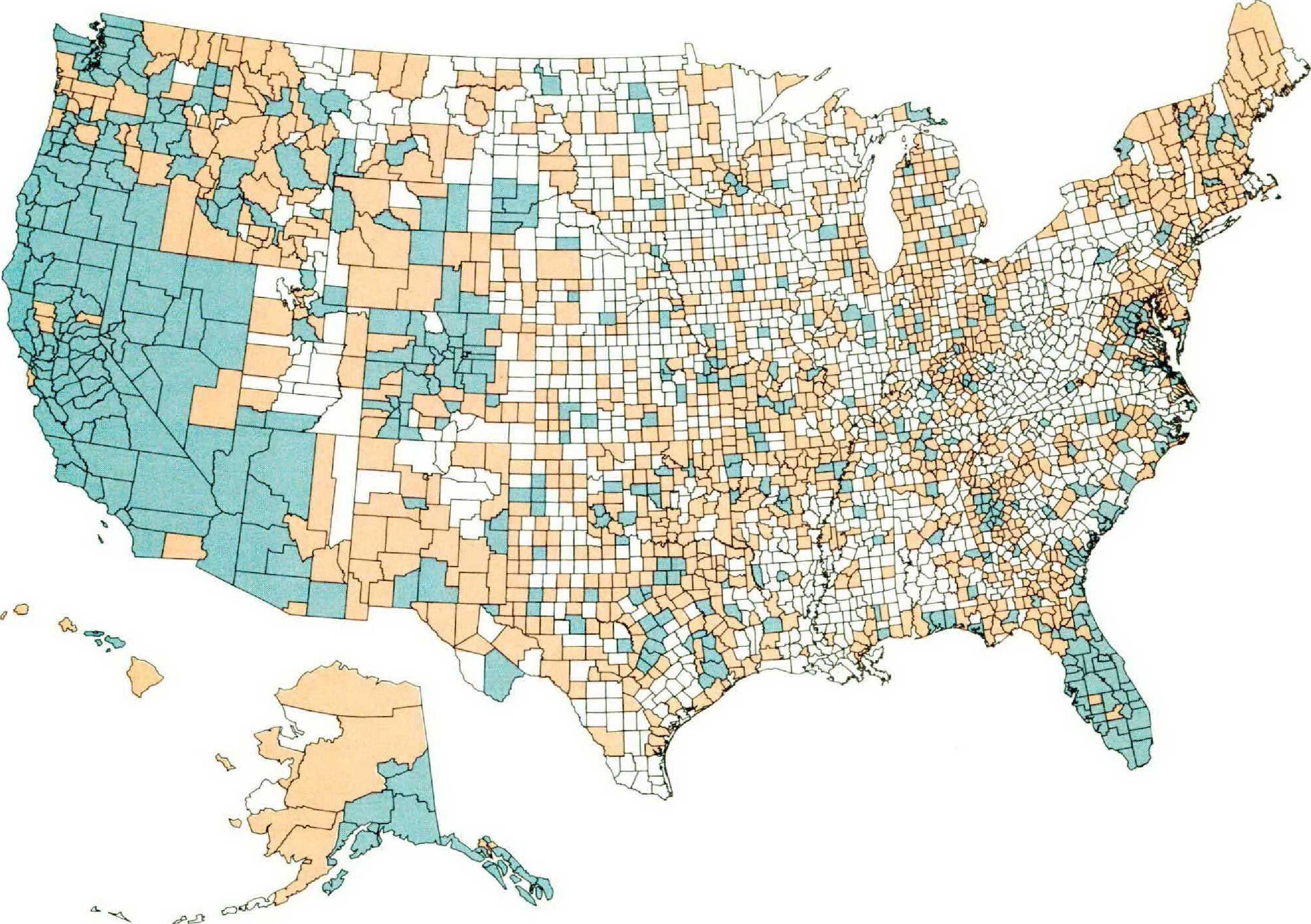
Percentage of people five years old or older who moved to a different house, 1985-1990:

0 to 39.9 percent

40 to 49.9 percent

50 percent or more
Source: U. S. Bureau of the Census
“IN THE UNITED STATES,”Alexis de Tocqueville observed in 1835, “a man builds a house in which to spend his old age, and he sells it before the roof is on.” The average American occupies twelve or thirteen residences in the course of a lifetime, roughly twice as many as the average person in Britain or France does, and four times as many as the typical Irish person.
Why are Americans so mobile? One reason is the U.S. divorce rate, which is among the highest in the world. Economic opportunity is also more dispersed geographically in the United States than it is in many countries, where the locus of economic, political, and cultural life may be a single big city. Tocqueville speculated that the absence of rigid class distinctions in America, which gave the average man greater opportunity than he would have had in Europe, also produced in him “anxiety, fear, and regret,” and led him “perpetually to change his plans and his abode.”
As the map above shows, mobility rates are not uniform nationwide. In the period 1985—1990 people in the western states and in Florida were considerably more mobile than their countrymen elsewhere. This is owing in part to the relatively high divorce rate in the West and Florida and in part to the booming economy in much of the Sunbelt in the late 1980s, which lured many people from other areas. An influx of long-distance migrants eventually leads to an increase in short-distance moving: long-distance migrants tend to move yet again—locally, this time—when they become more familiar with their new place of residence.
During the past three decades there have been two major streams of long-distance migration: one from the northeast quadrant of the United States to Florida, and the second from the northeast quadrant to California. Two other significant streams have run from the Southwest, principally Texas, to California, and from California to Washington and Oregon. —Rodger Doyle