Notes: The People's Business

Government writ small
EVERY YEAR at about this time I find myself making a trip down to the John Fitzgerald Kennedy Federal Building, in Boston, to obtain the form for an automatic extension of the deadline for filing an income-tax return—a form that the administrators of the Internal Revenue Service don’t see fit to include (and I can hardly blame them) in the standard packet that arrives at residences every January. I am always surprised at how much I end up enjoying this trip, despite the inconvenience it involves and the financial hemorrhage it sometimes portends.
The truth is, there is a certain grandeur in these federal buildings, which have by now arisen in the downtowns of every large and medium-sized and subcompact city in the land. The grandeur is almost never architectural. It derives from the fact that here, in one building, are offices and officials representing virtually every distinct function of the government of the United States—a homuncular version of the entire federal bureaucracy. I once took the elevator to the top of the Kennedy Building and then made my way down, floor by floor, walking the hallways just to read the signs. FEDERAL BUREAU OF INVESTIGATION. ARMYz LIAISON OFFICE. GOVERNMENT PRINTING OFFICE. BLINDED VETERANS ASSOCIATION. GENERAL SERVICES ADMINISTRATION. PUBLIC HEALTH SERVICE. OFFICE FOR CIVIL RIGHTS. On any given day families of various hues and from various points of origin can be seen fidgeting as they wait in line outside the Immigration and Naturalization Service. In other corridors military officers crisply stride by. Agency seals enliven walls and doors.
The Public Buildings Act of 1959 supplied the legislative underpinning for the federal office buildings we have today. Lyndon Johnson’s push for urban renewal and the federal government’s growing domestic activism in other areas provided further impetus. Federal offices that had once been scattered throughout a city were now consolidated in a large federal complex whose erection was frequently intended to anchor the redevelopment of a decaying downtown. There were about sixty of these new federal office buildings in 1965. There are now several hundred.
However maddening the federal government may sometimes be, the ubiquity of federal buildings brings a certain reassurance. When I arrive these days in an unfamiliar city and happen upon one of these outposts, I experience, momentarily, the odd sense of being . . . well, a Roman citizen during the second century A.D., shortly after Hadrian’s building spree. As different as one city may have been from another, the public core of major population centers bore the unmistakable imprint of Roman ride: the temples of Jupiter, Juno, and Minerva, the imposing basilica, the public latrines. One would have felt somehow grounded whether wandering about in Trier or Cyrene or Leptis Magna; would have felt, as Gibbon noted, that imperial authority was being exercised “with the same facility on the banks of the Thames, or of the Nile, as on those of the Tiber.”Wander about inside the federal office building in Raleigh or St. Louis or Tucson and a similar sensation may catch up with you.
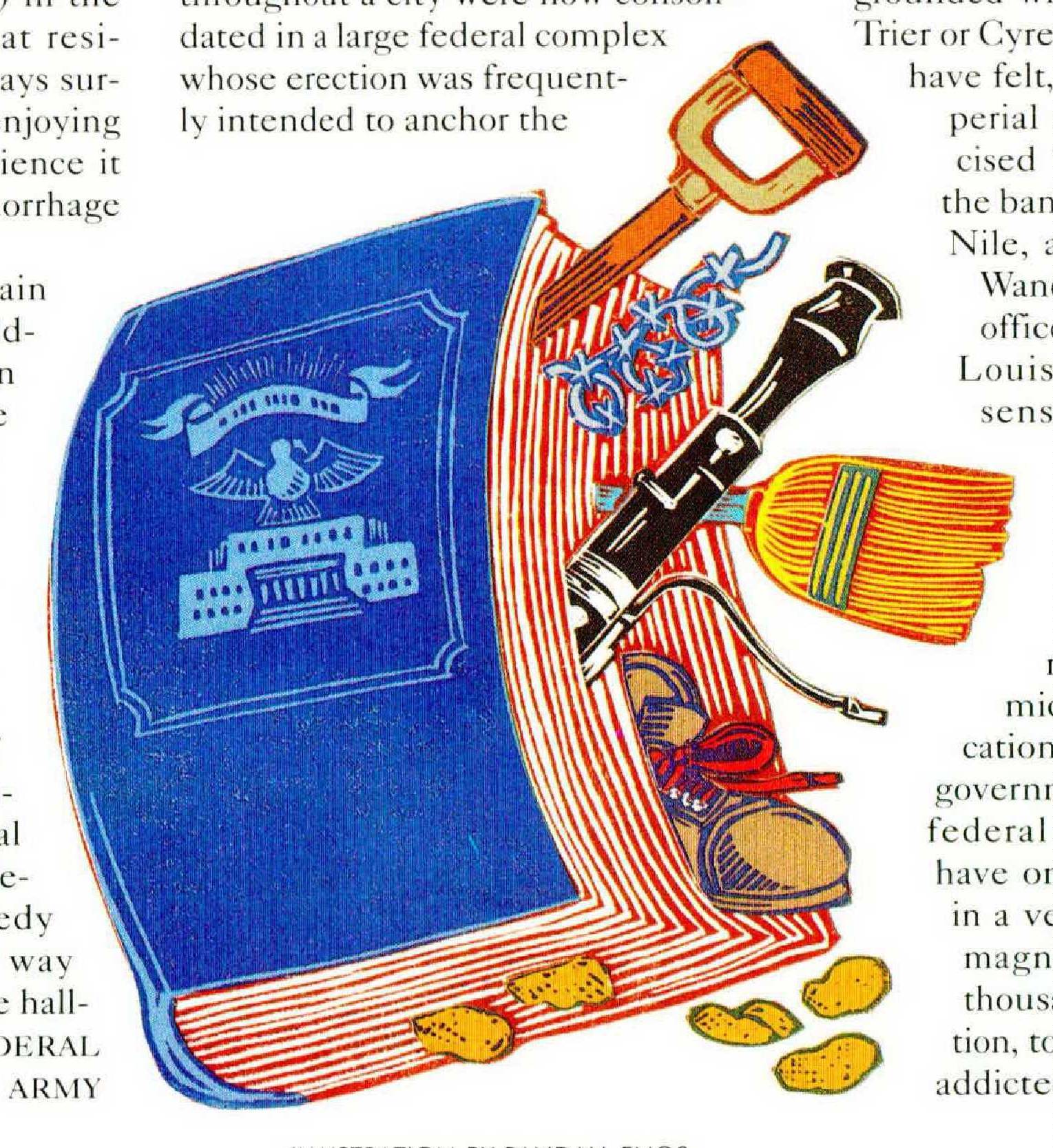
IF THE WORLD inside the federal office building seems to represent the government in microcosm, an obscure publication that one can order at any government bookstore (the major federal office buildings usually have one) shows the government in a very different way: with the magnification turned up a few thousand percent. The publication, to which I have grown mildly addicted, is called Commerce Busi-ness Daily, and it owes its existence to the fact that whenever the federal government needs to procure goods or services valued at $25,000 or more—which it does continually—it must publicly solicit bids. Commerce Business Daily is the public record of all this activity (and also of many smaller transactions). In tiny type on cheap newsprint it announces bids that are being accepted and contracts that have been awarded—bids and contracts for the lease of helicopters by the Interior Department in Anchorage and of washers and dryers by the Air Force in Plattsburgh; for the purchase of graph paper by the National Institutes of Health, of new bassoons by the Air Force Band, of steel-toed shoes for rhe Job Corps; for tree clearing and snow removal and garbage collection; for software maintenance and offset printing; for demolition; for everything. A friend of mine once came across a solicitation for “red tape.” A typical entry reads like this:
Bureau of Prisons, Federal Correctional Institution, Marianna, FL 32446
Installation of Razor Wire. . . . Provide labor and equipment necessary to attach 610 rolls of non-reinforced and 30 rolls of reinforced wire to the fences and grounds along the perimeter. . . .
As one might expect, many of the U.S. government’s needs involve the military. “Potato Chips and Corn Chips": a dozen lines give precise specifications for the 132,000 packages of the former and 55,000 of the latter needed by Fort Campbell, Kentucky. “Shell Eggs”: the Defense Personnel Support Center, in Philadelphia, is looking to buy 394,360 dozen of them. “Various Football Equipment”: a supplier is sought by West Point. “Set, Reset and Realign Headstones at Arlington National Cemetery.” “Drydock & Repair, USCGC Wyaconda.” “Loose Mine Restraint System.” “Insignia, Embroidered.” “TV Surveillance and Monitoring System.” “Guided Missiles.”
Reading Commerce Business Daily even for a few weeks (each issue contains 500 to 1,000 notices) gives one an appreciation for how vast and all-permeating an enterprise is the federal government—helps one see it from the point of view, one might say of someone appointed to be the janitor of the whole thing. And small signs here and there give hints of wider national problems. The Bureau of Land Management one day makes known its need for people to conduct a population survey of the desert tortoise, a threatened species.
The U.S. Customs Service puts out the word that it is looking for a company to provide “Laboratory Urinalysis Drug Testing Services.” The U.S. Justice Department asks to hear from organizations with experience in computer-games technology, because “the department wishes to use role-playing/simulation gaming techniques” to train employees in the “rules and regulations on ethics in the federal government.” From time to time there is also cause for modest celebration—for example, the recent cancellation of an order for this item; “Pouch, Human Remains.”
Mostly, however. Commerce Business Daily pulls one in not by means of what is exceptional but through the sheer scope and volume of what is normal— the mundane immensity of the people’s business.
NOT LONG after I became a reader of Commerce Business Daily, I began to entertain the possibility of a sister publication, similar in format but devoted exclusively to the management and provisioning of my own household. I am still of two minds about this.
On the one hand, Murphy Household Daily could lend a sense of grandeur (“Drydock & Repair, Ford Taurus Wagon”) to activities that otherwise might be deemed little more than chores. The publication would also act to reduce impulse buying. The occasional planting of items like “TV Surveillance and Monitoring System” and “Installation of Razor Wire” would also be an ideal way to send subtle social cues to the younger members of the family. So there would be clear advantages.
On the other hand, a record of every item bought and every service used by a typical family during the course of a year could turn out to be, on balance, an oppressive document, its validation of unimaginably vast and varied accomplishments undermined by the knowledge that, most probably, the exact same things will have to be done again and again—like filing tax returns. Know - ing what you’re getting into has its uses in government. Not knowing what you’re getting into has its uses in life.
—Cullen Murphy