No-Phone Homes
AT LAST COUNT
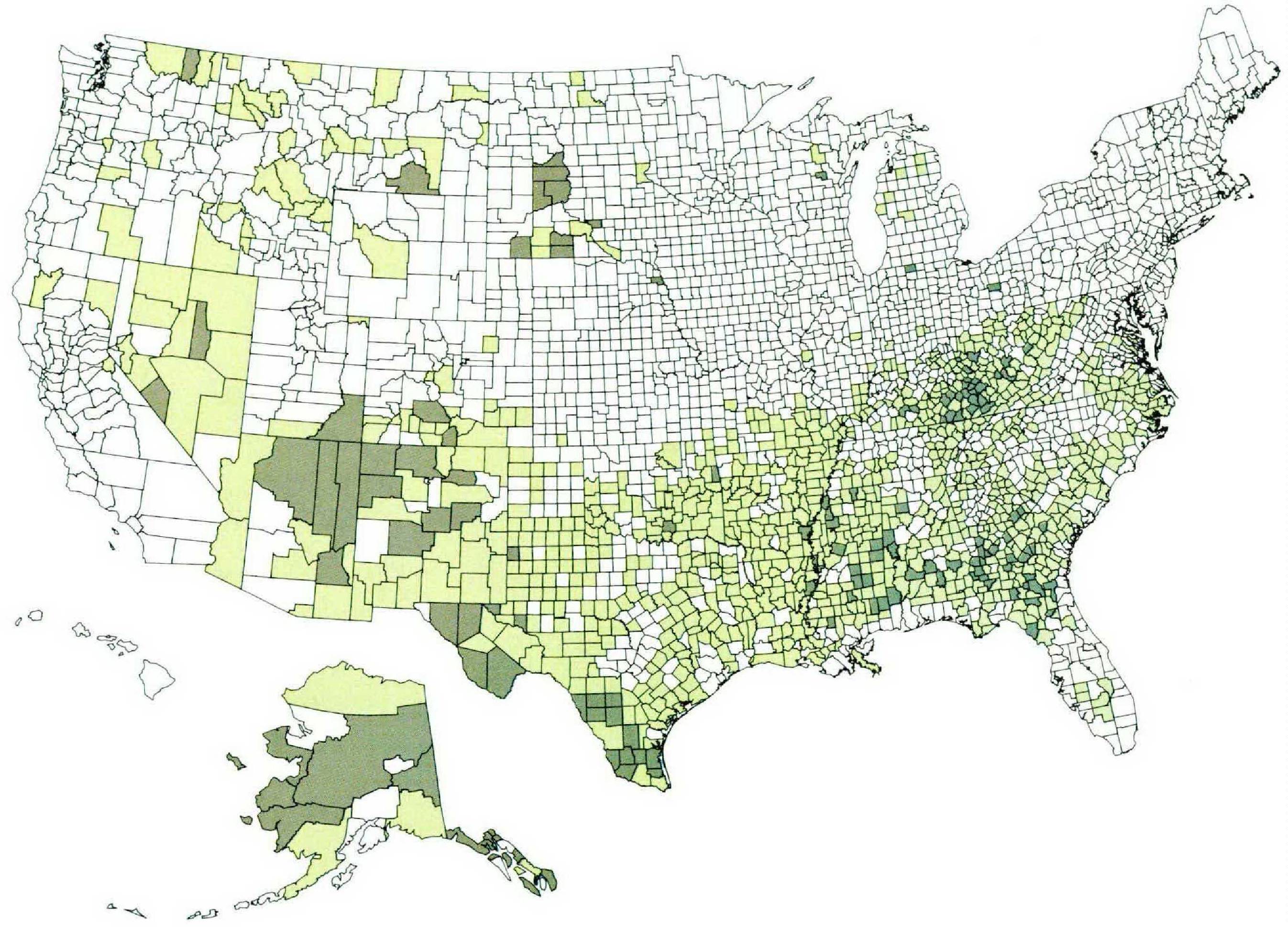


Source: 1990 U. S. Census
IN machines THIS ERA there of cellular are surprisingly telephones, large modems, gaps in and the nafax tion’s telecommunications network. According to the 1990 U.S. Census, almost five million of the country’s 92 million housing units lack basic telephone service. Overall, only five percent of white households lack a phone, whereas 15 percent of black and Hispanic and 20 percent of Native American households lack one.
In most housing units without telephones, a telephone is an unaffordable luxury; two thirds of the families below the poverty line do not have a home phone. A majority of the homes without telephones are in urban areas. Among the nation’s hundred most populous counties, Bronx County, New York, contains the highest proportion of families without phone service (12.5 percent) and of families below the poverty line (26 percent).
While poor urban counties have the most phoneless homes in terms of absolute numbers, the percentage of phoneless homes is higher in rural areas. In some rural areas service is simply unavailable. For about 200,000 remotely situated houses, many of them in the Rocky Mountain states, stringing up wires would be either physically impossible or prohibitively expensive for the regional phone companies.
But as in urban areas, a far more significant cause of phone gaps in rural America is povertv. Even when poor families can afford basic service, they often cannot get a phone owing to bad credit ratings. Rural phone service is scarcest in Appalachia, which is home to many poor whites, and in areas with large minority populations, such as counties in the Southeast where African-Americans predominate, areas of the Southwest where Mexican-Americans are most concentrated, and Native American enclaves in Alaska, the Southwest, and the West Central states. In rural Apache County, Arizona, which has a large Navajo population, 60 percent of housing units have no phone.
—Rodger Doyle