Washington: Housebreaker
Newt Gingrich, who has been accused of trying to destroy the House of Representatives in the name of saving it, is now poised to take on Bill Clinton
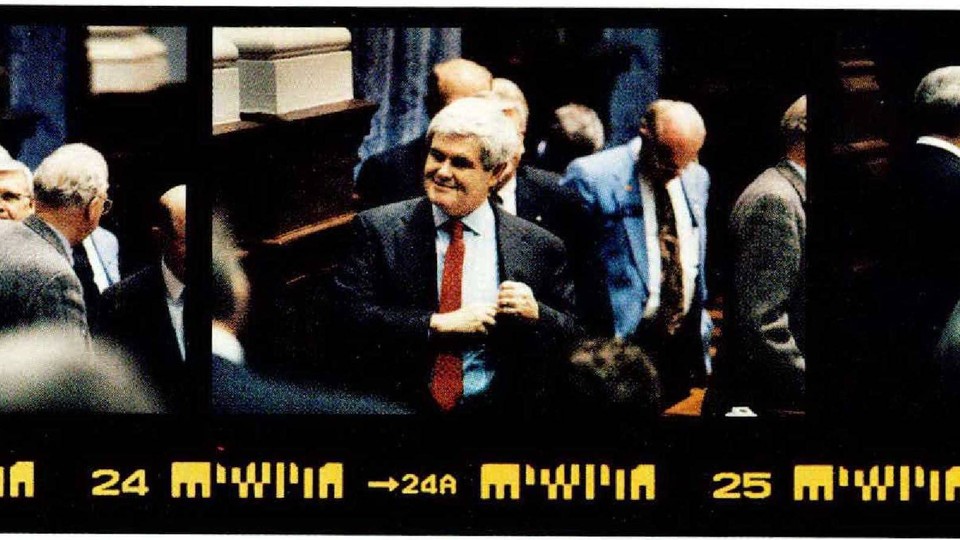
ASK WHETHER the Democratic Congressional Campaign Committee has a file on Newt Gingrich and an aide there responds, “Do you have a truck?" Gingrich, the second-ranking Republican in the House of Representatives, has more enemies than friends in Washington, and not only among Democrats. He tried to make the House bank scandal an issue that would unseat Democratic incumbents; it did, but it also boomeranged spectacularly on such leading House Republicans as Mickey Edwards, of Oklahoma, and Vin Weber, of Minnesota. Edwards (386 overdrafts) lost an election, and Weber (125 overdrafts) retired rather than face an ugly campaign dominated by the bank issue. Discovering that the fallout from exploding grenades can’t always be controlled, Gingrich (twenty-two overdrafts) himself narrowly escaped defeat in a primary challenge last year. In his crusade to save the House by destroying its reputation, he has been hissed by the Democrats and investigated by the House ethics committee. But he relishes the publicity: “Newt Gingrich, R-Television,” he’s been called. Having compared the Democrats’ platform to Woody Allen in one intemperate campaign speech, Gingrich shows no sign of restraining himself in the Clinton era. Indeed, freed of having to carry water occasionally for a President of his party, the fifty-year-old Gingrich is coming into his own as a leader of the opposition. He helped make Clinton’s first week in the White House miserable, leading attacks on the new President’s ill-fated nomination of Zoë Baird to be Attorney General and his plan to drop the ban on homosexuals in the military. “This is just what Newt Gingrich and the Republicans do best,” Stuart Rothenberg, a political analyst, says. “They can be adversarial with no concern about the President. If you thought they were partisan and political over the last four, eight, twelve years, just wait. Now they’ll be able to let it all hang out.”
For a member of the minority, Gingrich has had a remarkable impact on the House. If not for him, Jim Wright might still be speaker and the House bank might still be floating checks. Gingrich has molded the House Republicans into a more combative group, and his penchant for personal attack has made the House a less collegial body. Despite a slender legislative record and relative inattention to constituent issues, he has become the most visible and most frequently quoted member of Congress. He has risen from backbencher to minority whip, the No. 2 Republican leadership post in the House, and is positioned to succeed Representative Robert Michel as Republican leader. Revered by a band of conservative activists, Gingrich is reviled by most Democrats.
To his detractors, Gingrich is a fasttalking, power-hungry hypocrite who has cheapened political dialogue and plunged the House into partisan warfare, a man whose personal life mocks his professed concern for family values. To his admirers. Gingrich remains the daring Moses who will yet lead his party to its first House majority since 1954. In a city where prudence is prized, he is a politician unafraid of taking risks in behalf of his cause, which he defines as nothing less than preventing the decline and fall of American civilization.
Gingrich has become a prototype for the new entrepreneurial politicians, the independent contractors who use sophisticated campaign techniques to bypass tedious years on school boards and zoning panels. “Gingrich engages in retail politics with his constituents only to the extent that it’s necessary to get reelected,”says Marc H. Rosenberg, a former congressional aide who helped tutor Gingrich in the ways of Washington. “He’s not there to do the ribbon cutting and baby kissing you might expect from someone who came up on the constituent-service side, like the town councilman or local mayor. Instead, you’ve got a history professor who took a keen interest in politics because he thought that was the way for him to have an impact on the course of history.”
As a historic figure, Gingrich has already created an archive for his personal papers at West Georgia College. After his first term, reportedly, he began to insist that his public remarks be taped; staffers who slighted posterity would see their pay docked. Unlike politicians who feign modesty, Gingrich wears his aspirations on his sleeve and is given to grandiose pronouncements. “I have an enormous personal ambition,” he once declared. “I want to shift the entire planet. And I’m doing it.”
SOON AFTER Gingrich was elected in 1978, he told an aide he had two goals: to make an impact on national politics and to become speaker of the House. Early in the Bush Administration it did not seem farfetched that Republicans might finally win a House majority in 1992, paving the way for Gingrich to achieve his second goal. Redistricting after the 1990 census—which shifted nineteen House seats from slowgrowth states, mainly in the Northeast and Midwest, to fast-growth states, mainly in the conservative-leaning South and West—offered the Republicans a rare opportunity in last year’s elections. Gingrich had begun planning for the 1992 elections soon after Bush became President. In the summer of 1989 he spent eighteen days at a cabin in the Colorado Rockies with no electricity and no telephone. Like-minded strategists came to the retreat in groups of four, for three days at a time, to discuss where the country ought to be headed and how conservative leaders could get it there. “Everything we’ve done this year came in large part from those eighteen days,”Gingrich said last September.
What he did was to try to persuade Americans that Congress was so inept and corrupt that only Republicans could save it. Enlisting a group of freshman protégés, Gingrich created an uproar over a routine audit report about overdrafts at the House bank, endorsed the term-limitation movement as a way to promote turnover, and backed a measure allowing veteran law makers to keep their accumulated campaign war chests—but only if they retired in 1992.
In order to fill all the open seats that he expected would result, Gingrich used his political-action committee, GOPAC, to recruit and train a cadre of Republican congressional candidates. The candidates listened to tapes of his speeches in their cars and watched him on videocassette recorders in their homes. They learned his military-planning model of vision, strategies, projects, and tactics. They studied his lists of words, tested in focus groups, to use about Republicans (words like “initiative,” “liberty,” “reform,”“pristine,” and “prosperity”) and words to use about Democrats (“cynical,” “destructive,”“devour,” “disgrace,”“shallow,” “shame,” “taxes”).
As the election approached, Gingrich traveled the country on behalf of Republican candidates and sponsored press conferences to promote Republican legislative proposals. GOPAC attempted to line up wealthy business executives and professionals to bankroll Republican campaigns. If everything went right, Republicans would take over the House and show their gratitude by electing Newton Leroy Gingrich speaker, third in line to the presidency.
As it turned out, voters did become fed up with gridlock in Washington, but they decided to change parties in the White House, not in Congress. Squandering their once-in-a-generation opportunity, the Republicans picked up a paltry ten seats in the House last November, leaving the Democrats with a 258-to-176 majority. Gingrich himself has had two political near-death experiences, winning both his 1990 general election and his 1992 primary by less than a thousand votes.
GINGRICH’S DAYS often begin with a 6:00 A.M. walk from Capitol Hill to the Lincoln Memorial or the Washington Monument. When we met recently for an eight o’clock breakfast, Gingrich had already taken his morning stroll in the midst of a snowstorm. His cheeks were still ruddy as he entered the dining room downstairs from his second-floor Capitol office; picture Jimmy Connors ten years after he retires from tennis—gone gray and paunchy, but still young-faced, brash, and pugnacious. Like an eager gameshow contestant, Gingrich answers questions before you’ve finished asking them.
How do House Republicans plan to deal with Bill Clinton?
“Our goal should be cooperation without compromise,” Gingrich told me. “Our role in the minority is to offer new ideas, to offer intelligent criticism of their dumb ideas, and to cooperate when we have common ground.” Gingrich is savvy enough to recognize that voters are tired of inaction in Washington and the Republicans mustn’t allow the Democrats to paint them as obstructionists. If Clinton aligns himself with Democratic moderates, he says, “my guess is we’ll cooperate with him 50 or 60 percent of the time,” but if he swings to the left, “then we will oppose him and the country will simply walk off and he’ll be a one-term President.”
Gingrich used to pound liberals for being naive about the Soviet threat. Now that the prospect of nuclear war has diminished, he is almost sanguine about a Democratic presidency. “If the Soviet empire still existed, I’d be terrified. The fact is, we can afford a fairly ignorant presidency now. It’ll just be a mess. [Clinton] is entering a world which is tactically more dangerous but strategically safer. Twenty or thirty little messes can be very debilitating. You can bleed to death from lots of little cuts.”
Defining the Republican Party’s mission amid the wreckage of the Bush presidency isn’t easy, given the factions within the party and even within its conservative wing. One of the nastiest spats, in fact, is between Gingrich and George Will, the conservative columnist. In his latest book, Restoration, Will singles out Gingrich as “a case study of the primacy of careerism in the life of the modern congressman.”Gingrich used to make convincing arguments for term limitation and now he is one himself, Will writes, citing Gingrich’s House bank overdrafts, including a check for $9,463 to the Internal Revenue Service, and his use of a government-provided Lincoln Town Car and driver, the aptly named George Awkward . (Gingrich abruptly stopped using this leadership perquisite when it became an issue in last year’s primary fight.) By promoting himself as a power broker who can deliver for Cobb County, Georgia, Gingrich has become just another “well-wired, pork-producing, inside-the-Beltway operator,” Will maintains.
Gingrich, who responds to criticism with massive retaliation, says that Will understands neither the role of a representative nor Gingrich’s own career. Gingrich points out that he sided with George Bush against the machinists’ union in the Eastern Airlines strike, which almost cost him the 1990 election, because of the large number of Eastern employees in his district. That same year he alienated many Republicans by opposing a bipartisan deficit-reduction plan that included higher taxes. He supports the free-trade agreement with Mexico, despite opposition from textile interests back home. “I have risked my seat a lot more often than Will has risked his column,” he declares.
“Will doesn’t like me,” Gingrich says. “He doesn’t like me because I’m against tax increases. He doesn’t like me because I’m a populist and he’s a Tory. He doesn’t like me because I have different ideas than his, which is even more dangerous than having no ideas.”
Gingrich’s ideas are an unusual blend of “megatrends” and traditional values, of conservatism on most domestic and foreign-policy issues tempered by moderation on civil rights and women’s and environmental issues. In the World According to Newt there are four keys to the 1990s: applying the concept of quality, as defined by the business guru W. Edwards Deming and others, to the delivery of government services; encouraging “entrepreneurial free enterprise” with an emphasis on small business; taking advantage of technological advances; and recognizing that America’s culture and core values are both universal and unique. Lately Gingrich has added a fifth key—strength, courage, and persistence—because “if you don’t have strength and courage and persistence, the rest just remains theory.”
Gingrich’s five pieces don’t seem to fit together easily, and it’s not apparent how the nation is supposed to get where he wants it to go. Gingrich has explained that he does not advocate “a sudden overnight wholesale replacement of our current welfare-state structure,” because no single group would be able to plan and execute the necessary changes. Instead, he has said, every level of government should begin reforms, and “the creativity of millions of Americans in thousands of locations will ensure the success of an opportunity society and the demise of the welfare state.”
When Gingrich talks about replacing the welfare state, he doesn’t mean doing away with popular programs like Social Security and Medicare. His targets are easier than that—bureaucrats, big-city machine politicians, corrupt labor bosses, and trial lawyers, for example. In fact, stripped of the futuristic rhetoric, Gingrich’s specific priorities look a lot like traditional conservative remedies with new marketing slogans: more police officers, prosecutors, and prisons to deal with crime; more discipline and homework in schools; tort reform to cut down on frivolous lawsuits; less red tape on business; health-care reform that makes private coverage available to all; mandatory work programs for able welfare recipients; enterprise zones in inner cities; tougher negotiations with trading partners; and a strong foreign policy even in the postSoviet era.
Gingrich is often criticized for being heavy on ideas and light on legislative achievements: of the thirty-one measures he has sponsored in the past decade, one cleared the House. Asked about this, Gingrich is momentarily thrown off balance, but he bounces back with a good sound bite: “If you define legislative success as things George Mitchell and Teddy Kennedy and Dick Gephardt will approve, then there will be very few moments for conservatives.” He goes on to note that he pushed the Reagan Administration toward supporting the federal holiday on Martin Luther King Jr.’s birthday and sanctions against South Africa, types of things that don’t show up on legislative scorecards. He also co-sponsored the new Clean Air Act, worked to repeal a tax-code section opposed by small business, and drafted health, crime, and economic-growth bills that the Democrats ignored.
For someone who came to Congress as an outsider fighting the establishment, Gingrich certainly likes being an inside player. During Republican organizational meetings after the elections, his candidate for the No. 3 leadership spot in the House, Dick Armey, of Texas, defeated Jerry Lewis, of California, in the race for Republican conference chairman. Lew is was considered one of Gingrich’s main rivals to succeed Michel as minority leader, and Gingrich can’t resist noting that Armey “won by four votes; there are four Georgians.”
(Continued on page 37)
(Continued from page 28)
A Georgian by chance, Gingrich was born north of the Mason-Dixon line, in Harrisburg, Pennsylvania. As the stepson of a domineering career Army officer, he landed in Georgia in his high school years, when he became precociously interested in Republican party politics. He went to college at Emory and rounded off his education with a masters and a Ph.D. in history from Tulane. He then taught for some years at West Georgia College, in Carrollton, from where he launched unsuccessful campaigns for Congress in 1974 and 1976. Told that he had better win his third race, in 1978, because he wouldn’t be granted tenure, Gingrich, who had been a Rockefeller Republican, veered right, charging that his Democratic opponent, a woman, would have to break up her family to move to Washington. The gambit worked, though Gingrich’s own marriage—at nineteen he had married a teacher seven years his senior, and they had two children—was soon to end in circumstances that his enemies have used against him ever since.
IN HIS EARLY YEARS in the House, Gingrich became known for drafting a plan for governing Americans in space colonies, giving him a reputation as something of a right-wing Jerry Brown. He enthusiastically embraced the supply-side economic theory espoused by Jack Kemp and others, a politically painless program that contributed both to the 1980s boom and to a $3 trillion increase in the national debt.
Gingrich was also learning about the power of the media and how to harness it to his own advantage. Since the beginning of his career he had courted relationships with newspaper editors, first in Carrollton and then in Atlanta. In his unsuccessful congressional campaigns he had noticed that he got far more attention in the Georgia media by attacking his opponent on matters of ethics than he did by issuing policy papers. The Washington media were no different. National reporters didn’t care how much legislation you sponsored; they wanted conflict, a good story. In his freshman year Gingrich made a minor splash by calling for the expulsion of Representative Charles Diggs, a Democrat from Michigan who had been convicted of embezzling office funds. Denouncing colleagues and the opposition in unusually harsh and personal terms was a surefire way to get attention, Gingrich discovered.
People who dismissed Gingrich as a cartoonish bomb thrower underestimated him. His outrageous, exaggerated charges were part of a larger plan. “I’ve done very few things that were hip shots in my career,” he once told a group of reporters. “The style of being aggressive enough and different enough when you guys cover me is conscious.” Gingrich became an expert at media manipulation. Last year, according to an analysis by The Washington Monthly, Gingrich appeared in or was mentioned in 151 stories on ABC, CNN, and The MacNeilLehrer NewsHour—twelve more than the Senate minority leader, Robert Dole; fifty-six more than the Senate majority leader, George Mitchell; and 130 more than the House majority whip, David Bonior.
During Ronald Reagan’s first term Gingrich and a group of restive Republicans who called themselves the Conservative Opportunity Society set out to use the media in a quest for attention and, ultimately, power. The vehicle for their guerrilla warfare against the Democrats was C-SPAN, the cable-satellite public-affairs network. In after-hours speeches delivered to a vacant House chamber but also to thousands of C-SPAN households, Gingrich and company decried the Democrats as soft on communism. Eventually Tip O’Neill, then speaker of the House, was provoked into ordering the cameras to pan the empty chambers and denouncing Gingrich personally. O’Neill’s denunciation of a fellow member was deemed to have violated House rules on personal insults, making O’Neill the first speaker since 1797 to be rebuked for his language and catapulting Gingrich into the limelight.
Gingrich’s next move was to take on O’Neill’s successor, Jim Wright, of Texas, who was threatening to wield and consolidate Democratic power to an extent that O’Neill never had. Gingrich was refining a theory of a House corrupted by decades of Democratic rule. Early in Wright’s speakership Gingrich decided to charge Wright, repeatedly and publicly, with unethical conduct, in an effort to force a formal investigation. Common Cause picked up on Gingrich’s call for an ethics investigation, which ultimately led to Wright’s resignation.
The toppling of Wright made Gingrich a hero among his long-suffering Republican colleagues, who were anxious for more confrontation and less cooperation with the Democrats. In an almost tribal ritual they rewarded him with the whip’s position in March of 1989, after Dick Cheney resigned to become Secretary of Defense.
The Democrats counterattacked almost immediately. For a student of history, Gingrich appeared remarkably unprepared for the effort they mounted to destroy him. “I was shocked that he was shocked,” said his former colleague Vin Weber, who was one of Gingrich’s close allies. “He had charged into the enemy camp and killed the king’s pig. And he wondered why the king’s soldiers were gathering with their swords drawn.”
Ironically, the Wright investigation had focused on a questionable book deal, and Gingrich himself was involved in two unusual book partnerships. Democrats charged that both arrangements were ways for Gingrich to receive financial help from wealthy benefactors without having to report it. But the ethics committee, in March of 1990, cleared Gingrich of any wrongdoing in the publishing partnerships, although it did admonish him for not disclosing that he had co-signed a mortgage on a house his daughter had bought from the wife of a political supporter.
The ethics investigation didn’t end Democrats’ efforts to get rid of the selfdescribed Republican revolutionary. The Democratic campaign committee’s dossier on Gingrich charges him with using various perks available to incumbents to entrench himself, even while criticizing the practice. In 1991 he spent more than anyone else in the Georgia delegation on office expenses, payroll, and franked mail combined. To get re-elected in 1992 he spent $1.96 million, the fifth highest amount spent by a candidate for the House, and took $654,000 from PACs, the tenth highest amount taken by a House candidate. Ralph Nader, who has taken a personal interest in removing Gingrich from Congress, calls him an indentured servant of corporate interests. “He has no more principles left to compromise,”Nader says. “He’s purely a foghorn opportunist.” Gingrich, however, sees no contradiction in taking advantage of practices he denounces. Until the rules are changed, he says, he’s not going to disarm himself unilaterally.
Democrats also assert that Gingrich’s political-action committee, GOPAC, is little more than a way for fat cats to support Republican consultants and finance Gingrich’s travels in behalf of his various personal and political agendas. Housed on the fourth floor of a nondescript office building a few blocks from the Capitol, GOPAC has taken on Gingrich’s character—an emphasis on ideas, training, and activism, and performance that falls short of promises. GOPAC announced that it would round up $17 million for Republican congressional candidates in 1992; it ended up directing about one tenth that amount. Gingrich remarks that money alone won’t enable Republicans to capture the House of Representatives. What the party’s candidates really need, he says, is “positive ideas for governing.” GOPAC’s tapes, booklets, and training sessions do appear to be useful to inexperienced candidates, many of whom have written to GOPAC to express their appreciation. Sometimes, though, the line between useful instruction and the glorification of Newt Gingrich gets a little blurry.
HAVING SURVIVED the worst the Democrats have been able to throw at him, Gingrich continues fighting his fight while many of his Republican soulmates have gone on to other, less discouraging endeavors. He’s in a safely Republican district north of Atlanta, but he remains vulnerable to a primary challenge, especially because in Georgia, Democrats can cross over and vote against him in a Republican primary. “His problem here is he doesn’t have a local agenda,” says Bill Shipp, the publisher of a newsletter on Georgia politics. “The perception is that all his interests are inside the Beltway.” Gingrich is working to change that perception. In the last four months of 1992 he sent out more than a dozen press releases announcing federal grants or contracts in his district. During his current term he can be expected to exert considerable effort to extract federal aid to help the Atlanta area prepare for the 1996 Summer Olympics.
In Washington, Gingrich must do the delicate tightrope walk of the outsider who’s now an insider, the revolutionary who wants to be a ruler. He remains fixated on creating a Republican majority in the House and becoming speaker. People who don’t understand that ambition thought he might challenge the vulnerable Democrat Wyche Fowler in last year’s Senate race in Georgia, but Gingrich declined, explaining, “I’m a creature of the House. I can do so much more for Georgia and for the values that we stand for by being in this [whip) job than I could do by being a freshman senator.”
Unless the Clinton Administration turns into a complete debacle for the Democrats, Gingrich is likely to become minority leader before he becomes speaker. Even to become minority leader he will have to soothe hard feelings in the party over his role in the check scandal, which strained his friendships with Weber, Edwards, and others who had large numbers of overdrafts. Some Republicans seem to be growing tired of Gingrich’s policy of rigid confrontation and opposition. The day before the 103rd Congress convened, Representative Steve Gunderson, of Wisconsin, resigned as chief deputy whip under Gingrich, saying that his party’s leaders didn’t represent mainstream Republicans and weren’t in step with his style of political cooperation. Representative Fred Upton, of Michigan, quit as deputy whip the following week, citing similar reasons.
To be elected Republican leader Gingrich must hold his conservative base together and attract moderates— for example, Representative Bill Goodling, of Pennsylvania. When Gingrich was elected whip, Goodling wrote him a long letter suggesting the changes Gingrich would have to make to become an effective leader. Goodling, despite being burned in the House bank affair, says that Gingrich is becoming more of a consensus builder, one who recognizes that proposing alternatives and making a difference are more important than ideological purity.
“He has grown dramatically, and I have told him so,” Goodling says. “His concerns now for what other people think have really begun to come to the forefront. That’s very, very important if you are going to be an effective leader. And I didn’t know if he could make that change.”
Despite a shaky beginning and various policy disputes, Gingrich and the man he hopes to succeed, Bob Michel, have settled into a sort of good-cop, bad-cop routine. On the opening day of the new Congress this year Michel promised that mutual respect and personal good will would be at the heart of House deliberations. Within hours Gingrich was hurling invective at the Democrats. “I don’t like Michel every morning; he doesn’t like me every morning,” Gingrich says. “But I respect Bob Michel a lot. And I think he’s grown to respect me a lot.” Asked if he’ll challenge Michel for minority leader in 1994 if Michel, who turned seventy in March, does not retire, Gingrich says the question is not relevant at the moment. “I want to be the next leader of the House Republican Party. In the interim I want to be effective as the number-two leader in the House Republican Party. And I’m not willing to disrupt the second for the former. I think Michel and I make a pretty good team. I’m having fun. I’m doing everything I want to do.”
Well, almost everything.
—William Sternberg