Pipa's Story
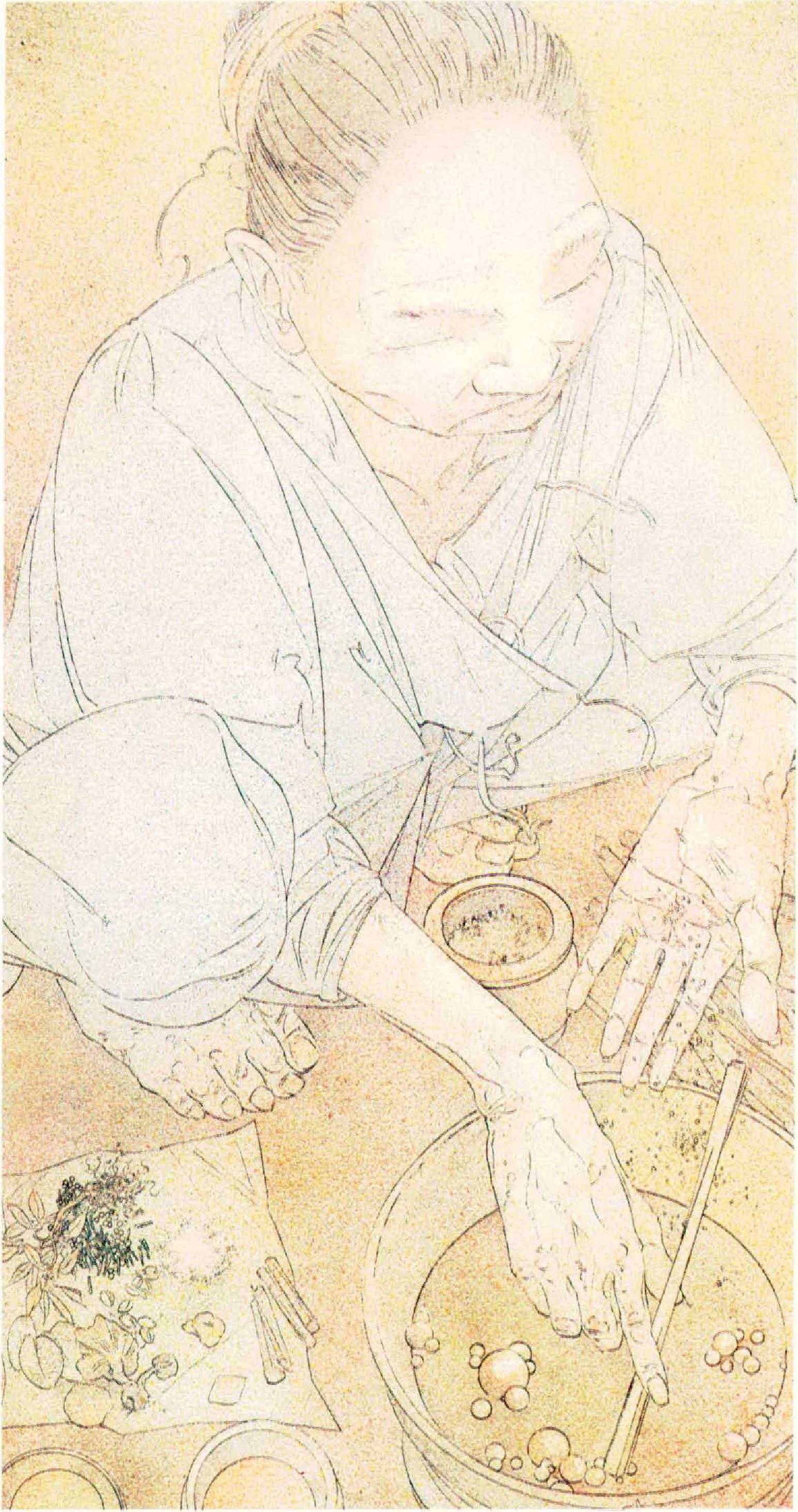
MY MOTHER WORKED IN CHARMS. SHE COULD brew a drink to brighten eyes or warm the womb. She knew of a douche that would likely bring a male child, and a potion to chase away unborn children. Except in emergencies, she gathered her own herbs and animal parts. I was not allowed to help.
The villagers said she had learned her craft from a Miao tribeswoman. A group of Miao—strangers from the west—had stayed in our village for a few months shortly after my father’s death. My mother had mixed potions to forget, wandering in the woods to learn where mushrooms grew. My earliest memories are of watching the smoke from her kettle: white smoke, blue, gray, and black smoke.
When I was a child, she seemed all-powerful, and although time passed and I grew tall, she continued to loom over me until I thought I would disappear if I could not get away from her shadow. When I was nineteen, I decided to leave the village. For four days I watched my mother stir a mixture over the stove kettle. On the fourth evening I gathered the courage to tell her.
“I will go to Shanghai and work for a family there,” I said to her back. “I’ll send you an envelope filled with money at New Year.”
My mother added a bowl of ice that hissed and crackled against whatever was in the pot. Then she turned to look into me. I forced myself to look back into her black eyes.
“Sit down,” she told me, gesuiring to the wooden chair by the window.
I sat and watched her strain the cooling potion into a wooden bowl. Then she unbraided my hair and combed it, dipping the comb into the potion. It was a warm evening in early spring. The half-moon gave us light.
“What is the potion?” I said.
“It is a mixture to make you ready for departure.”
I lost a breath. My mother tugged and pulled at me, braiding my hair into a fourstranded plait.
“There are herbs here that will protect you against bodily harm from illness, loss of energy, and unclear thinking. There are also herbs that will fix your memory, your past. You will never forget me here, no matter how far away you go.”
She wrapped the end of my braid around and around with red thread. “You want to leave,” she said. “You have my permission if you make one promise to me.”
“I promise,” I said. Anything if she would let me go.
She looked out the window to make sure that no one was standing by. “Come here,” she said. I followed her to a corner of the room, where it was dark.
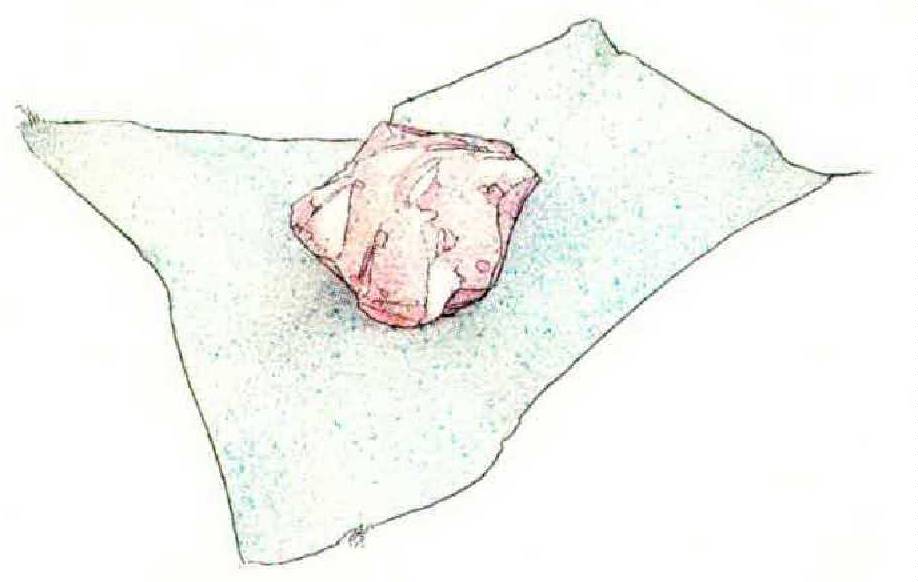
Three steps from the corner my mother knelt down and began digging into the dirt with a spoon. She unearthed a small box, muddy but with dull tin showing in patches. We walked to the window, where we could see. My mother opened the box, took something out, and handed it to me. It was a lump, smaller than the palm of my hand, wrapped in rough cotton.
She promised her mother she would find the center of her master’s house and hide there a piece of pinkish stone. This, her mother said, would bring to an end an old, old story
“Open it,” she said.
I unfolded the cloth.
Inside glowed a pinkish stone, a craggy piece of our mountain.
“Lao Fu will take you to Shanghai,” my mother said. “Find work with a family named Wen.
They have a large household and probably many servants. You’re still rough, straight from the country, and they may not want to hire you, but I’m sure you can persuade them. Don’t tell them that you’re from this village, and don’t tell them my name.”
“Why not?” I said.
“That doesn’t concern you. If you don’t like working for the Wens, you may leave and go wherever you like, but before you leave, you must do one thing for me.”
“What is it?”
“Find the heart of the house,” she said. “It’s a huge, modern place, I’m sure. Wen will have become involved with Western business, and he will have a large Western house. You’ll have to spend some time searching. Let the house seep around you; listen for its rhythm. Before three months are up, find the center and hide this stone there.”
“What are you talking about?” I said rudely. “I never learned anything about houses. You never told me. How would I know?”
My mother didn’t scold me but squatted on the floor and looked into the beam of pale moonlight.
“ Fell me,” she said, “where the heart of our own house is.”
I thought for a minute. Then I pointed to the middle of the floor.
“No,” she said. “The physical center is not what I mean.”
I sighed. Our house— a hut, really—was quite small, and as far as I could tell had no other center. We had a table, our beds, some rickety chairs. The corner shelf held storybooks, Dream of the Red Chamber and Outlaws of the Marsh, that my mother had been teaching me to read for years. Our house had no male presence, because my father had died before I was born. My mother earned our living. I thought about my mother, her long gray braid hanging down her back, hunched before the stove kettle full of glowing coals.
“The fire,” I said. “The stove is the heart of our house.”
My mother nodded. “Good,” she said.
At her praise I felt cold and heavy. “What is this about?”
She shook her head. “It’s better if you don’t know,”she said. “It began before you were born. Your deed will be the end of it.” She stood up and walked to the window again. “It’s something that happened long ago.”
I LEFT WITH THE STONE SEWN INTO MY POCKET. I rode in a cart with Lao Fu, my mother’s old friend, who was bringing ginseng to sell around the city. The precious roots grew wild on the mountains.
I watched Lao Fu’s thick, arthritic hands on the reins, carelessly guiding his spotted horse. Now and then he flicked a tattered whip. In those days the trip to Shanghai took weeks. Lao Fu didn’t usually make such long trips. He was taking me as a favor to my mother, who often rubbed an ointment into his knuckles. We didn’t speak for hours, by which time the most familiar mountains had grown pale blue in the distance and we were surrounded by shapes I had seen before only from far away. Then Lao Fu turned an eye to me.
“You’re a nenggan girl, Pipa,” he said in his rusty, wheezing voice. “A capable, dutiful girl. Traveling hundreds of miles in order to hcip your mother.”
He smiled kindly, exposing four brown teeth. I glared at the stains on his gray beard and wished that someone else were driving me, someone I had never met. Even in this remote region the lines of the surrounding hills seemed to shape my mother’s face. The stone in my pocket, my secret, weighed so heavily I could hardly sit upright. I wanted to rip it out of my smock and fling it into the next river. She would never know.
But when we reached Shanghai, I felt so terrified by my first view of the great port that I held on to the stone like a talisman. I sat close to Lao Fu, dreading our approach to the Wen house, where he would leave me. The city seemed to whirl past. The wide streets were cluttered with travelers—in carts like ours, but also in rickshaws and automobiles. I had never seen either before, nor had I seen the kind of people, foreigners, who rode in them.
In those days foreigners were everywhere: stiff soldiers in uniforms from England and America, businessmen from Russia, hurrying in and out of large, square, Western buildings. I sat paralyzed, blocking my ears against the roaring, honking automobiles. I turned away from the riekshawmen, their faces drawn, their feet slap-slapping against the pavement. We stopped at an intersection. I saw a man with yellow eyes lurch toward our cart. Lao Fu twitched his whip in that direction. “Opium,” he said. “Don’t look.”
On another corner I spotted a powerfully built Chinese man dressed in Western clothes, his short, glossy hair oiled back from Ins forehead. He was talking to three foreigners, standing as straight as any of them. For a moment he seemed to stare at our cart, at Lao Fu adjusting a strap on the harness. Then he looked away.
As we went on, the shops and businesses gave way to houses: tall briek boxes set back from the road, with no round doorways or Chinese gardens. Shining black automobiles veered around us. One of them nearly struck the horse. I turned to Lao Fu in alarm, but he merely shook his head and guided our cart closer to the side of the road.
“Lao Fu, where are we?”
“Close.”
After one more street he turned to our right. The horse clip-clopped around a long bend, and suddenly we were twenty yards from an entrance to an immense house built of brick and wood. I spotted a woman watching ns from a window. Lao Fu stopped the cart.
“Here you are, Pipa. That door is the servants’ entrance.” I stared at my lap. “Xialai. Get down. I’ll take your bundle.”
I climbed from the cart, my legs stiff, my left hand clutching the stone in my pocket. Lao Fu came around the back of the cart holding my blue cotton bundle.
“Go in,” he said. I wrinkled my mouth to hold back tears. “You will be all right,” he said. “I’ll be in the surrounding towns for a few months. I’ll come visit you.”
We faced each other and bobbed our beads. Lao Fu climbed back onto his cart and picked up the reins in his gnarled hands. He nodded again before turning aw’ay.
I stood watching his cart go back around the bend. I realized that I had said good-bye to the last of the village, and to my mother. After years of avoiding her sight I had gone to a place where she could not see me. Suddenly I was filled with an emotion so terrible that I turned and vomited at the side of the road.
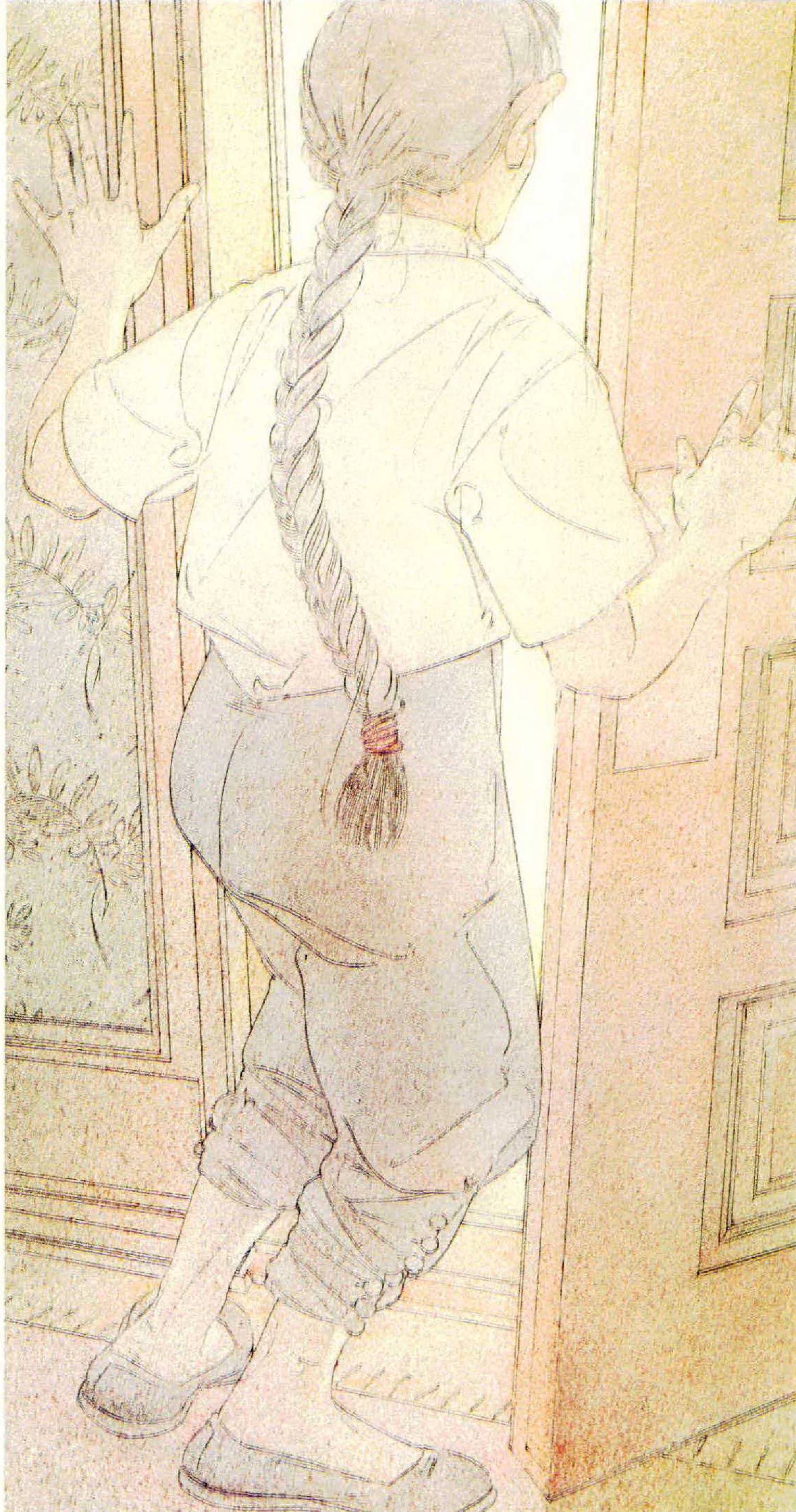
A VERY PRETTY GIRL STOOD AT THE SERVANTS’ door, waiting. She wore black pants and a clean white blouse. From the way her hair was done, I guessed that she had been the one looking out the window.
“Are you all right?” she asked in a low, pleasant voice. Close up, I stood a head taller than she.
“Yes,” I said. I clutched my bundle. “I want to work here.”
Her eyes darted over my rough cotton clothes. “Come in,” she said. “Clean up inside. You should bathe, and change. Then I’ll introduce you to the housekeeper.”
I walked inside the great house and smelled the warm, rich odor of food and spices. We stood in a square room lined with wood. A door to my right opened into a hallway. I could see at the end a room where a number of people were chopping vegetables.
“Come here quickly,” whispered the girl, darting toward another doorway. She led me to a very white, shining room with a long white basin on four feet. I had never seen a bathtub before, and I stopped to stare. The girl, who said her name was Meisi, turned two silver fixtures at one end of the tub, and out of them poured steaming water. She held a huge towel in front of me so that I wouldn’t be embarrassed while she stayed in the room.
I took off my dirty traveling clothes and stepped into the tub. The warm water rushed around my body, erasing the village dirt. I unbraided my hair, and my mother’s spells were washed away in a swirl of steam. I felt myself changing, like a tadpole, and I looked at my hands and limbs as if they were new.
Behind her towel Meisi chattered away.
“Of course they’ll hire you; the family just moved into this new residence, and they need servants. They hired me only three months ago. I’ll have you fixed up so that no one will think twice.”
“Why did you come to work here?" I said.
“I’m from Beijing. My mother died giving birth to me, and my father was in the kuomintang army. He died last year in the fighting. I am an orphan. I had to find work, This is a good place. The master is rich and good-looking. Supervision is not very strict.”
After a minute I said, “Fighting? What fighting?”
“You really are from far away! There’s been terrible fighting, not in Shanghai, but maybe soon!" Her voice dropped, and I had to lean close to the towel in order to hear.
“I don’t know anything about these events,”I said. “Our village is so remote, even the Japanese ignored it.”
When I was finished, she found a pair of black trousers and a white shirt that were both a little too small for me. “We’ll get some others after you’ve started,”she said. “I’ll steal them from the closet.”
“Thank you for helping me, I said.
Meisi smiled. “This is nothing.”she answered. “There is plenty here; why not share it? And besides, you look like a nice person.”She picked up my old blue cotton smock. “Do you want this saved?”
I thought of the stone sewn into the pocket. “No, I said.
THE WENS LIVED ON ONE OF THE MOST STYLISH new streets in Shanghai. For weeks I marveled at their house; I had never even dreamed of anything like it. The rooms were broad and tall, with glossy, patterned wooden floors built by English carpenters and covered with flowered Persian carpets. English curtains draped down by long windows, blood-red velvet curtains with gold-colored tasseled cords. Everything in that house was new, from the mysterious electric lights to the great wooden tubs in the kitchen, filled with live clams in salt water in case one of the family should have a craving for them.
The housekeeper, Lu Taitai, was an immense older woman whose face lay as still as a mud bog. When she was very angry, she would slowly lift one fat finger into the air. I lived in terror of her. I was the newest of thirty servants, so unskilled that at first I worked in the servants’ quarters, which, as Meisi pointed out, had to be kept clean along with the rest of the house. Meisi’s swift hands and pretty face had earned her a job on the third floor, where the family lived. I imagined that the upstairs must be a magical place.
“Can you show me the upper floors?" I asked her once, as we ate dinner at one end of the long servants’ table.
She looked right and left before answering. “We have to watch out for Fu Taitai,” she said. “And it’s harder to get away with things upstairs. The women have sharp eyes. If I have a chance. I’ll take you.”
“What women?" I said. “ I he servant women?”
Meisi put down her chopsticks. “Pipa.”she said, “the master has four wives.” She smiled. “Stop blushing, and keep eating.”
I looked at the table. We ate what the Wens left. The night before, they had feasted on duck done ten ways, and there was a pile of crackling duck skins, which I had discovered I particularly liked. There were also jelled duck eggs, pigeon eggs in sauce, shrimps with chicken and peas, chicken and scallops with ginger, scallops in sauce, salted prawns, spicy prawns, late oysters, early asparagus, several other vegetable dishes, and a great fish that lay on its side, barely touched. I thought that if a man was wealthy enough to serve four dishes for each member of the family, then perhaps four wives was to be expected
A FEW WEEKS LATER LU TAITAI WAS SUDDENLY called away to her home province. “Good,”Meisi said. By flirting with the second housekeeper, she arranged for me to bring tea to the master upstairs in his library, during a meeting with some of his Western associates.
“If ir weren’t for you, I would be lost,” I said when I thanked her. “I’ve been here for a month and I’ve never seen him.”
“Well,”she said, “he’s very good-looking. I can see why the women fall for him: rich, handsome, and powerful! Of course, he seldom looks at people like you and me
—we can only watch. But if that’s what you want, my dear friend Pipa, you shall have it.”And she made me practice several times with the bamboo tea tray.
On the day of the meeting we waited to hear the men’s heavy shoes start up the staircase. “Go up now,” Meisi said. She fixed some of the coarse hair that constantly escaped from my pinned-up braids. The cook’s assistant stared with grim disapproval while I balanced the tray.
For the first time I climbed the polished staircase.
The second floor was quiet. The carpet melted under my feet. Meisi had instructed me: “Turn left at the top, go down two doors, and you’ve reached the library.” The heavy, unfamiliar tray hindered my progress; delicate teacups slid on their bits of lace. I reached the library door, braced the tray as securely as possible against my hip, and knocked
“Come in,”said a resonant male voice.
I looked at the big china knob. How could I possibly turn it? I moved to brace my feet and felt the smooth wooden tray slide against my blouse.
Suddenly the door opened and a man stood over me, holding a book in one hand. For a moment I forgot my manners and stared at him. I had seen him before: the arrogant man whom I had noticed while riding with Lao Fu on my first day in Shanghai. Now he stood and looked at my face, my blouse, my hands holding the tray. I felt as it a piece of burning ash had been put down my back. I gasped; the tray tilted in my hands. The house with its soft rugs fought against me, making me lose my balance, Hot tea spilled on the master’s arm and over the book he carried.
“Duibuqi,” I gasped, hastily putting down the ruined tray. I grabbed an embroidered linen napkin and reached to dry his arm.
“I’m fine,” he said. “Dry this.” He handed me the book, and even in my horror it occurred to me that this man must have strength not to so much as flinch at the boiling water. I waited for him to scold me, or even strike me, but he did not move.
“Duibuqi” I repeated, and indeed at that moment I did not think I could ever look him in the face again. I wiped the pages. “Xianggang Falu,” I read aloud. Why was he studying I long Kong laws?
“You can read,” he said.
“My mother taught me,” I blurted out.
“Then you’ll still be of some use to us,” he said. “It’s obvious you’re not a good maid. Come in.”
I tiptoed into the room. Opposite me stood three crowded bookshelves. The foreigners sat at the end, before the fireplace.
“You’re tall,” Wen said. “You can read, Find the books I want and bring them over. Find me the volume about transportation on the Yangtze and the Orand Canal,”
I turned toward the shelves, my hands sweating. Wen went back to the fireplace.
“If you want factual proof, I’ll give it to you,” I heard him say to the foreigners. “But I guarantee, they’ll wait. They’ve won too many battles too quickly. They need to regroup. It will be months before they reach Shanghai, maybe a year. You needn’t worry.”
Someone coughed. “Oh, certainly, certainly.” This man spoke Chinese with difficulty. “It’s just that we have received some—reports from farther north. Of course,” he continued, searching for the words, “we re not worried about them. The Kuomintang troops have regrouped themselves to defend our side of the Yangtze . . . We are just—making sure that we understand the situation.”
“Those who flee are fools,” Wen said. “I tell you, it’s not time to leave yet. They would never touch a foreigner. Remember, the longer you stay, the more you’ll make.”
“And you as well,” one of the men said.
“You can believe me.” Wen’s voice grew hard. “I know what Mao will do. I’m one of them. I was born a peasant, you know.”
In the bottom right corner of the shelf I spotted a blue volume on waterways, which I pulled and brought to Wen. I watched for a minute as he studied the book, the firelight flickering on his face, and I could sense his force, his intelligence and cunning.
“Ha!” he said, pointing to a paragraph of characters. “You see, I was correct.” He showed the book to one of the Western gentlemen, who squinted, nervously stroking his blond beard.
“What does it say, Stanton?” one of them asked.
“Ah, yes! Mr. Wen is correct,” Stanton said. I wondered if he could read characters well enough to know what he was talking about.
“Now,” Wen said, “about those collections. I’ll have the first half to you by Monday next week.” He turned to me. “You can go now,” he said. “I’ll call you the next time there is a meeting.”
As I left the library, I saw the tea tray sitting in the hallway. I bent down to pick it up.
“What are you doing?” said a musical, imperious voice.
I straightened. I had not heard her walk across the carpet. She was tiny, beautiful, with large eyes and a curved lower lip like an orange slice. She wore a qipao of shimmering sea-green silk.
“I came with the tea,” I tried to explain. “I was helping in the library.”
“Helping,” she said. Her eyes flickered up and down my body.
“Getting books.”
Her lower lip swelled with dissatisfaction. She walked past me to the library door. “Are they still inside?”
I nodded.
She lifted her chin. “Hmph!” she said. “Get back downstairs.”
I picked up the tray and hurried away, cold tea splashing on the carpet.
Downstairs Meisi waited for me.
“I was worried!” she cried. But when I explained what had happened, she smiled and patted my arm. “Now you’ve earned your job in the house. No more rag-pushing for you!” Her eyes sparkled.
YOUR MOTHER WILL WANT TO KNOW HOW you are doing,” Lao Fu said.
I didn’t answer. Lao Fu guided his horse past two arguing street peddlers. He had returned to the city and come by to take me on a ride. I felt ashamed that the others would see me with him, with his patched clothes and shabby cart. But it was a beautiful day in May. The fresh warm air reminded me how seldom I had a chance to go outside, now that I was working at the Wen house.
“Before we left, she asked me to check on you,” Lao Fu said, “and to ask you if you kept your promise.”
“Why is everything so crowded?” I said, changing the subject. Even on the quieter streets we could not drive in a straight line.
“In the past few months more and more people north of us have fled the Red Army, seeking safety.”
“Where is the army now?”
“Since the end of the year it has been waiting north of the Yangtze River.”
I remembered the conversation in the library. “What will happen when it moves south again?”
Lao Fu looked at me, and I saw his cloudy cataracts. “Things will change.”
“How will they change?”
“Ah,” he said. “Who knows? These days I demand silver in payment. The Kuomintang is crumbling. Why won’t you answer your mother’s question?”
“I don’t have time to think about her anymore,” I said.
Lao Fu ignored me. “Look over there,” he said. “A decent noodle house, and not too busy. Let’s have lunch.”
After we had taken care of the cart and horse, we stood for a minute outside the noodle shop, watching the people on the street. A thin man carrying a large wicker basket shuffled close to us. “Zhuan qian, zhuan qian” he repeated under his breath. Lao Fu nodded and handed him a piece of silver. The man opened his basket and counted out sixteen bundles of paper money. They nodded at each other, and we entered the dark, noisy noodle shop.
“You see?” Lao Fu said as we sat down at a corner table. “By the time we leave, that coin will be worth sixteen and a half bundles of paper money.”
I felt as if he were saying this to make a point against me. Stubbornly I folded my hands in my lap.
“What will happen when the Communist army reaches this city?” Lao Fu lit his long, large pipe. “They’ll go after people like your master, rich people who flourished under the Kuomintang by working with foreign capitalists. There’s a word for your master, Pipa. He’s an ermaozi, a comprador.”
“He’s a peasant,” I said. “He’s a former peasant who used his wits to make a fortune for himself, to move away from his village.”
“Ha,” Lao Fu said. He fitted the pipe between his four stubby teeth. “You’re a young girl, Pipa. You’re young, and the world is a strange place.”
I scowled and took a sip of the tea that a greasy-haired, smudge-faced woman had Hung on the table.
“What difference do his origins make to you?” I said. “You’re here with a message from my mother. You don’t know Master Wen or anything about him.”
“But I do know him,” Lao Fu said. “I used to know him well.”
I stared at my wavering saucer of tea.
“When he was a young man in the village, we used to call him Xiao Niou, Little Bull. He was once a friend of your father’s.”
There was a terrible pounding in my ears. Lao Fu’s rusty voice sounded like a shout. I waited for him to stop, but he continued. “Some people forget their histories, but they don’t realize that others remember,” he said. “Not everyone forgets the wrongs they’ve suffered.”
He raised the saucer to his mouth. His loud slurp brought me back to my senses.
“What do you mean?” I forced out the words.
“Ah. Well, this is an old story. Something that happened before you were born. It is, shall I say, a village secret.”
“There aren’t any secrets in the village.”
“Well, it’s possible. There were only four of us who knew. One died, one has forgotten, and two of us have chosen not to tell. That is, until now.”
At that moment the woman brought us two broad, steaming bowls of noodle soup. Lao Fu nodded. “Good. Eat.”
I took a spoonful of soup, waiting. The food and even the serving utensils were so much coarser than what I had grown used to.
Lao Fu began. “Your father and mother were the two village orphans. No one arranged their marriage. When they wed, it was a love match.”
He took a mouthful of noodles and went on. My father, he said, was gentle and kind. He had spent years learning to read in his spare time; he sat and daydreamed over his tea. My mother was clever, forceful. She never rested. And she had an astounding talent that everyone in the village knew about. If an object was lost, my mother could almost always find it. On the mountains she understood the natural order and discovered more ginseng roots than anyone else. It was she who suggested that she and my father supplement their income by collecting ginseng roots. Xiao Niou and Lao Fu agreed to help them.
“ There was one problem,” Lao Fu said. “Perhaps because she was so sure of herself, your mother underestimated Xiao Niou. He was a ruthless, ambitious boy who wanted to be the best at everything. And the more he saw of your mother, the more he wanted her as well. He desired her. He wanted to stop her constant thinking and doing; he wanted her to think and do only for him.
“Your mother was not beautiful, but she had so much vitality that she was impossible to ignore. She knew that Xiao Niou wanted her, but she thought she could control him. This goaded Xiao Niou until he couldn’t bear it.”
One cloudy fall day the four of them had gone to gather ginseng. For part of the day they worked together. All morning Xiao Niou watched my mother out of the corner of his eye. After lunch my mother suggested that they split up and search on different parts of the mountain. And Xiao Niou suggested that he and my father go off together.
That afternoon the fog grew so thick that my mother and Lao Fu, working close together, could hardly see each other. It was very quiet. The path became almost impossible to find; trees and stones looked like people and animals. If not for my mother, Lao Fu said, they might not have found the pathway down the mountain, back to the village.
When they reached the village, my mother waited for Xiao Niou and my father to return. She built a fire, cooked dinner. But the other two did not come back. She began to worry. Finally, after the gray fog had turned dark, Xiao Niou stopped by our hut.
“Where’s Dangbei?” he asked.
“What do you mean?” my mother said. “I thought he was with you.”
“He left early,” Xiao Niou told her. “He decided to go back to the village.”
All that night my mother waited, but my father did not come home.
The next day my mother went out on the mountain, in the fog, searching for him. She looked and looked, but she could not find him. Finally some men from the village had to force her to stay inside—she was pregnant, after all. Then winter set in.
“All winter your mother mourned,” Lao Fu said. “She would speak only to me and Xiao Niou. Xiao Niou asked her to marry him, but she refused to discuss anything until your father’s body was discovered. That spring, right before you were born, the villagers found him at the bottom of a ravine, lying on a bed of pinkish quartz. After the birth your mother insisted on going up on the mountain and to the spot where they had found his body.”
“Now here is the secret,” Lao Fu said. “Your mother told only me. After seeing the site where your father’s body was discovered, she felt certain that he had not gotten there on his own. If the two of them had gone to dig ginseng in the place Xiao Niou had described, your father would not have died where his body was found.”
“How did she know?” I said. “On foggy days in our mountains, a person could wander anywhere.”
“I asked her. ‘I know Dangbei,’ she said, ‘He would never have gotten lost there,’ she said. And I believed her. She knew the mountains. I felt foolish and angry. So much had been going on right under my nose, and I had not understood.”
He looked at me. I ignored him, studying my soup. “I was younger in those days, and I hated being wrong about things,” he said.
“That summer Xiao Niou again asked her to marry him. She accused him of killing Dangbei, and Xiao Niou left the village. He disappeared for years, and when we heard about him next, he had taken the name of Wen.”
After this my mother had begun to brood before the stove, to speak to Miao travelers and learn their arts. She was unable to forget what had been lost.
“Now,” Lao Fu said, when the story was finished and our bowls were empty, “when I return to the village, your mother will ask me if you have kept your promise to her.”
I looked at him. He leaned toward me; a noodle hung from his beard. I felt my eyes grow hot with confusion and anger. I felt as if my inner world had been turned inside out. He had cast her shadow over me again, and I could not forgive him.
“Leave me alone!” I said. “You tell my mother that I will not keep my promise to her. None of this has anything to do with me. I’m far away, and she can’t reach me. She can’t make me do what I don’t want to do. Besides, it’s impossible now.”
Lao Fu’s wrinkled lids lowered. He nodded. “You do what you must do. I’ll be in the city another week—”
“Don’t visit me anymore,” I said.
BACK AT THE Wens’ house the servants were getting ready for an important business dinner. I looked for Meisi. I wanted to talk to her, but the second housekeeper gave me a pile of rags and some scented oil, and set me to work on the yards of rich wood paneling in the sitting room and dining room.
As I wiped and polished, certain thoughts traced themselves over and over in my mind. The scented oil filled my nostrils, reminding me of my mother’s potions. I remembered her sorting out bundles of herbs on the wooden table in our hut, her frown deepening in the firelight. She had loved my father, whom I had never met. For years I had secretly believed that the purpose of her herbs, her potions, and her utterances was not to help others but to keep me near her. But now it seemed that even my flight from her fit into some incomprehensible design. I began to see that Lao Fu was right. I was young; the world was a mystery.
I finished the woodwork and walked into the hall. And for the first time I noticed something odd about the Wens’ house. I saw the great house, with its women and servants, as testimony to the unquenchable desire of its master, desire that destroyed all obstacles and then discarded them. The house seemed raw and unexplained, as it it were hiding its origin. The rooms were big and empty: too clean, too new, too cold. I looked down the hall at the dozen servants cleaning and sweeping as if there were more than dirt to get rid of.
As I entered the dining room, one of the rags dropped out of my hands and fell to the wooden floor with a small thud. I knelt down to pick it up, but then I stopped, crouching, and stared at the rough blue cotton fabric.
Snatching the rag, I sprang up and ran toward the staircase. I had to find Meisi, my friend, and tell her what had happened. I needed to hear what she would say. I had to see her. I pounded up the stairs, past the second floor, and up to the family quarters.
The upstairs was lit by the fading light from a few windows. I had never been up so high before, but I remembered the stories from the servants’ table: the four wives each in a suite of rooms, and at one end the master’s room, near a separate staircase to the outside door, so that he could get away. The doors were closed. Sweet scents of soap and perfume filled the air. They must all be getting ready for dinner. I would never find Meisi.
I heard a doorknob turn, and then another door open and shut. I saw two doors at the north end, and one was ajar. I hurried toward it and ran straight into Meisi coming out. When I saw her face, I forgot to think for a moment. “What’s wrong?” I cried.
Meisi buried her face in her hands. “Oh!” she sobbed. “It’s terrible—I have to get away from here! I can’t work here anymore.”
“What happened?” I said. She clutched herself around the waist and ran down the hall. I followed her down the two flights of stairs, rushing past a few surprised-looking servants. “Meisi,”I begged, “let me help you!”