Word Court
by Barbara Wallraff
I work for an attorney and proofread his documents. I always cross out phrases in which he uses where, an adverb, to modify a noun—for example, “a case where" or “a situation where.” He always ignores my notes and leaves the script as is. I say it should be “a case in which,” and so forth. What do you say?

Carol Ibilteicher
Johnstown, Pa.
The court finds for you. You cannot, however, object to your boss’s constructions on strictly grammatical
grounds. Where isn’t only an adverb; it can also be a subordinating conjunction, one of whose jobs it is to attach certain other parts of a sentence to a noun.
What you can say, though, is that it is considered a stylistic flaw to use where where the meaning has little or nothing to do with places or space: The restaurant where we met for dinner—fine. A case where I was at a loss—no, not really.
Various language experts use words like “immature style” and “amateurish” when they describe this flaw. Needless to say, don’t tell your boss that. That one is right is unpleasant enough for others when one is tactful about it.
F or severed years now I have noticed increasing reference to people as inanimate objects, as in “Are you the one that borrowed my dictionary?" Is this more than a passing trend? What do you make of it?
Jeff Sloan
Pueblo, Colo.
I’m as touchy as anyone,
I like to think, when it comes to issues of dehumanization. For example,
I wince when I hear someone say to a supermarket cashier who seems idle, “Are you open?” What’s wrong with “May I check out here?” or “Is your register open?”
I hope you will trust me, therefore, when I tell you that the word that has a long history of referring to people as well as things. This usage may in some contexts sound a bit crude, but it is not ungrammatical, and it can sometimes offer a writer a graceful way out, as in “Did she say it was a man or a book that she curled up with last night?”
My son’s English teacher gives him writing samples that use like as a conjunction. Have I missed something? Is it now acceptable to use like in place of as ? Or do we no longer follow rules of grammar like we used to?
Cal hie l ow miller
Chandler, Ariz.
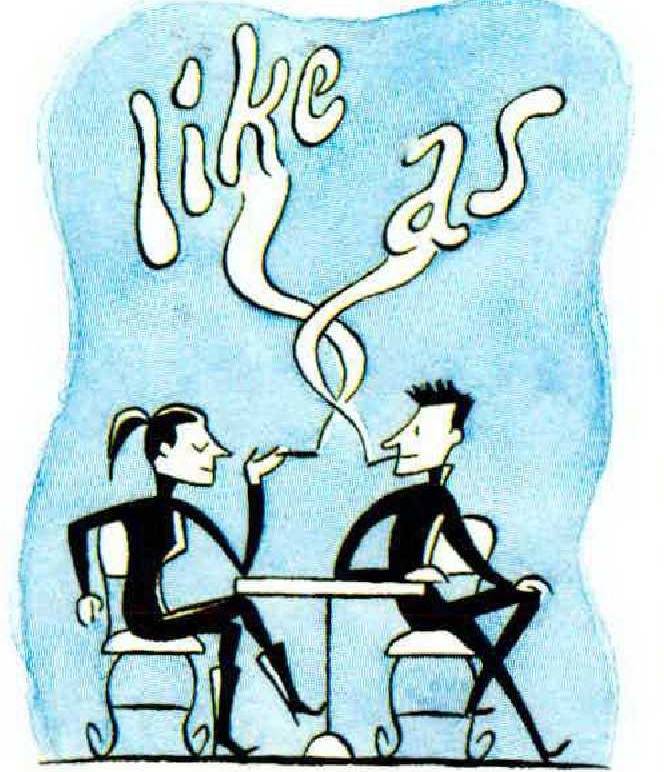
People who remember the flap over a cigarette that “tastes good like a cigarette should,” some forty years ago, can consider themselves up to date—at least with respect to the grammar of the slogan. The rule about like never did quite ban using it as a conjunction but only forbade using it to introduce a clause— that is, a group of words containing a verb, such as “a cigarette should.”
(It may be used as a conjunction if one leaves unexpressed the verb that would come after it: “The Surgeon General responded like a firehorse to a bell.”)
This rule still holds in standard English, but informal English almost requires one to break it—a distinction those sly ad copywriters surely kept

in mind. Alternatives that are acceptable at both levels of language do exist: As if sometimes works ("It sounded almost as if they were telling the truth”). And where as
if won’t do, the way usually will (“It comes in a pack with a warning label, the way a cigarette should”).
I have been waging a one-man battle for months at work. I contend that the possessive form of a singular noun is created by adding an apostrophe and s, even if the noun a lreach ends in s. For example, the possessive of Charles is Charles’s.
My co-workers all believe that you add only the apostrophe to any word ending in s, so they insist the proper form is Charles’.
Who is right?
Tom Corell
Porter Ranch,
Calif.
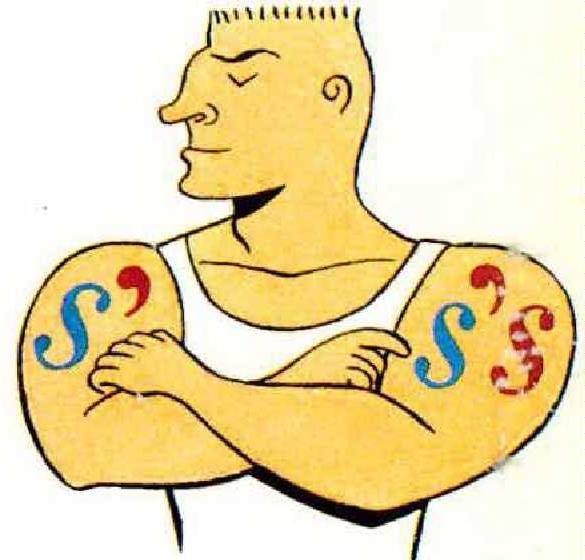
Your rule is certainly the usual one, though language authorities recommend some exceptions to it. Constructions in which it would be difficult to pronounce an additional sibilant (an s, sh, x, z, or zh sound) are a common kind of exception. Most authorities would add only an apostrophe to a proper name that ends in two sibilants. such as Jesus or Texas. By a similar rationale, for conscience’ sake and for goodness’ sake are also preferred.
But the exceptions are line points. Be grateful that your co-workers don’t think the possessive of Charles is Charle’s.