Word Court
by Barbara Wallraff
A friendship of more than fifty years hinges on your expertise. One of us claims that something is different from something else. The other claims that something is different than something else. We have found sources that support both views.Please solve this dilemma so that we can find something else, equally ridiculous, to argue about.
Ethel C. HayesDennisport, Mass.
Janet E. LeaSouth Yarmouth, Mass.
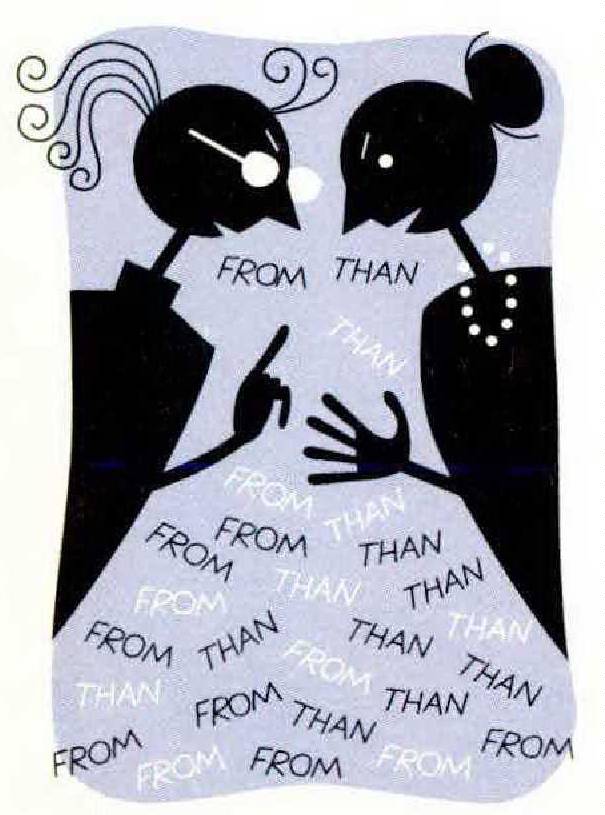
Sticklers tend to insist that than is to be used with comparatives (“smarter than I,” “more careful than she”). Nonetheless, they allow the exceptions of else and other (“what else than that?,” “what other than this?”). Tradition, which at least in language is not to be taken lightly (what else is there to teach us how to speak and write?), is the only reason why different than should be different from other than —that is, why different than should be frowned on.
All the same, it is frowned on by many. Sometimes observing the proprieties brings about a tortuous result, however, and then reputable writers have been known to overlook them. Consider “The word has a meaning different from that which I thought it had.” Some people will have no objection to that sentence; others will want to avoid the issue altogether with something like “The word doesn’t mean what I thought"; and still others will cut straight to “The word has a different meaning than I thought.”
We gave my father-in-law a set of napkins, and said they might be appropriate if he was throwing a small dinner party. He said, “I only throw small parties anymore. ” Putting aside the trump-all grammar rule that says that your father-in-law is always right, I wonder if anymore is correct when used in a positive statement.
Bob WardLouisville, Colo.
The Dictionary of American Regional English convincingly demonstrates that anymore has been used in colloquial affirmative contexts at least since the 1930s. It isn’t standard English, but the usage can now be found all over the country (most rarely in New England), in casual speech and writing by people of all educational levels.
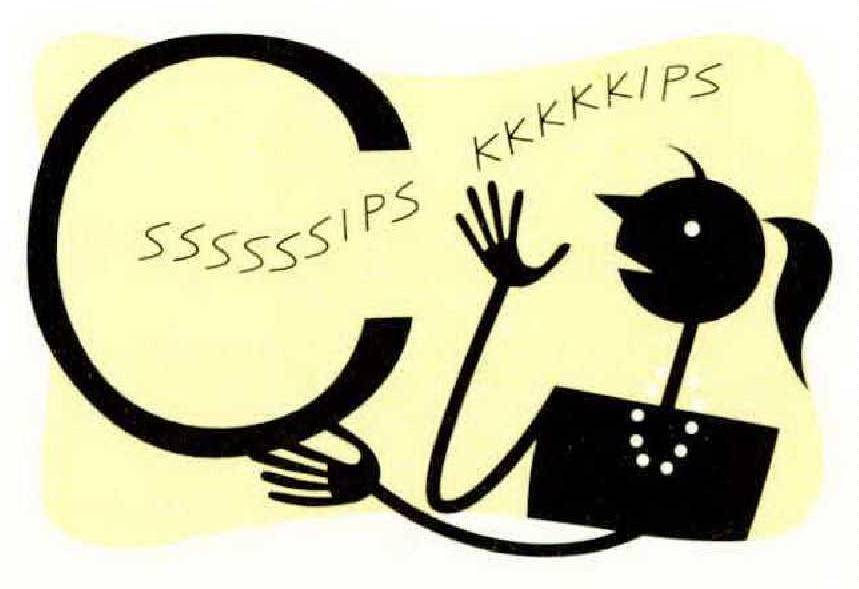
I am on a statewide committee working on the development of a computer system. The committee is titled Statewide Computer Users Group, known as SCUG, and pronounced “skug,”presumably (I thought) because the word computer has a hard c or k sound. The new system is called the Court Information Processing System, or CIPS, which from its inception was pronounced “sips” by the techies. I want to pronounce it “kips,” because it seems logical that the sound of the letters in the acronym would follow the sound of the original words. But then, we always think that logic is on our side, don’t we?
Carole FrostAnchorage, Alaska
Perhaps logic is, but that’s not quite the point. You may find history instructive: during the Second World War the Navy designated a “Commander in Chief of the U.S. Fleet” in the Pacific, but soon discovered that everyone was pronouncing “Cincus,” the pertinent acronym, “sink us”—and so they changed the name. Today CERN (for the Conseil Européen Pour la Recherche Nucléaire) is not pronounced “kern,” nor UNICEF (for the United Nations International Children’s Emergency Fund) “unichef.” Acronyms, once coined, go off and lead lives separate from those of the words that gave rise to them. They are almost invariably pronounced as they would be if they were wholly independent words.
“Gravitas” is a word that pundits such as William Safire and William F. Buckley Jr. love to use. It’s good to drive the reader to a dictionary from time to time—but shouldn’t the word used be in the dictionary? What does the dlanged word mean?
Marco GilliamSan Antonio, Texas
A direct borrowing from Latin, gravitas means “gravity” in the sense of solemnity or seriousness. By now it has begun to appear in a few English-language dictionaries, notably the Oxford English and the Shorter Oxford. You’re quite right that it is unkind of authors to use unfamiliar words that leave their readers guessing. But isn’t it nice to know that it’s not only people with rings in their bellybuttons and skateboards under their toes who are giving us words for the dictionary makers to include in their next editions?