February 1950
In This Issue
Explore the February 1950 print edition below. Or to discover more writing from the pages of The Atlantic, browse the full archive.
Articles
Going Down Fast!
The Swiss look at American skiiers
The Atlantic Report on the World Today: The Middle East
Truman's Third Term
On July 18, 1948, GERALD W. JOHNSONof Baltimore published in a New York daily the prediction that Truman could win, provided he would run his own campaign and make it aggressive. Now he points out the reasons why Truman will win again unless the Republicans wake up to realities. Mr. Johnson was a leading editorial writer of the Baltimore Sunpapers from 1926 to 1943 and is well known for his biographies of Andrew Jackson, Woodrow Wilson, and F.D.R., and for his succinct, factual study of the new South, The Wasted Land.
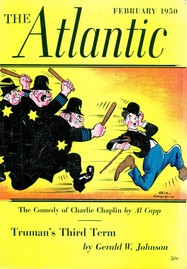
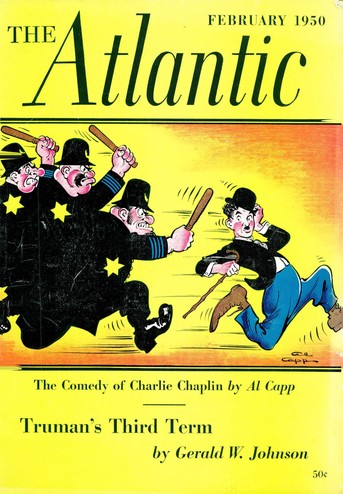
The Comedy of Charlie Chaplin
No comic artist enjoys a more ardent following than AL CAPP has gained with his “Li’l Abner" and the other residents of that mythical area known as Dogpatch. Occasionally Capp erupts into a prose as branny as his visual technique, and his last book, The Life and Times of the Shmoo, sold into astronomical figures. Since 1934, when his drawings were first syndicated. Comedy has been his medium; with his skill and laughter, he has built up a cheering section of more than forty million, and in 1948 earned the annual Award of the Society of Cartoonists. This is the first of a series of articles by Mr. Capp which the Atlantic will publish in 1950.
Our Worst Blunders in the War: Japan and the Russians
A Baltimorean who graduated from the United States Naval Academy and who subsequently saw service aboard our destroyers and battleships, HANSON W. BALDWIN has been the military editor of the New York Times since 1942, in which year his articles earned him the Pulitzer Prize. In this and his article in the January Atlantic he has added up the most costly mistakes which we made in the Second World War; they all stem from our misjudgment of the Russians and the Japanese.
Turn Off That Faucet!
A two-fisted fighter for Conservation, ARTHUR H. CARHARTjoined the regular staff of the U.S. Forest Service in 1919, where he rose to the responsibility of planning the human use of wild lands in six states, a total of 23 million acres. On this job he covered most of the Rockies between Montana and New Mexico on foot, on horseback, and by car — a survey which turned him into a vigilante. He has fought the cattlemen and the lumber interests for the preservation of our public lands; now in this article he faces every American — country man and city dweller — with the hard facts of our water famine.
The Atlantic Report on the World Today: Washington
Our Baby Was Blind
A graduate of Wellesley now in her thirty-eighth year, MRS. X is the wife of a successful lowyer who occupied an important post in the Pentagon during the war years. Their second daughter, Constance, was born in Washington, and then began the sensitive, stubborn struggle to reach the child through the barrier of her deficiency. The following article raises the question, Can a child who from birth is cut off from normal development be fitted into the close community of a family? A third child, Charlotte, was born eighteen months ago and is, as Mrs. X writes, “the happiest of substitutes for the sister who had to leave.”This is the second winner of an Atlantic I Personally Award.
Winter Song
Educating Women in a Man's World
We Americans, says LYNN WHITE, JR., have the world’s most consistent equalitarian society. But have we rethought our education in terms of our breach with the aristocratic tradition? His answer is a flat “No” — and in the article which follows, he points up three of the most glaring shortcomings in our college education. This paper has been drawn from his forthcoming book, Educating Our Daughters, which Harper will publish early this year. Educated at Stanford and at Harvard, Dr. White has been President of Mills College since 1943.
The Convert
MARY LAVIN does her writing today looking out on one of the loveliest carves of the River Boyne with the famous Hill of Tara rising above the distant trees. A protégée of Lord Dunsany, she turned to the Atlantic with her first short stories, which when published in 1942 in book form, under the title Tales from Bective Bridge, were awarded the James Tait Black Memorial Prize. Her first novel. The House in Clewe Street, was serialized in our columns, and ice are happy to announce that her second. Mary O’Grady, has just been published.
Rebuilding German Steel
A member of the editorial staff of the Boston Globe for the past ten years, OTTO ZAUSMER served as head of the Intelligence Department of the Office of War Information in London. After the war, he covered the Nuremberg Trials and the Trial of Pétain for his paper, and made firsthand reports on the reconstruction going on in Czechoslovakia, Austria, Hungary, and Germany. Recently he again checked developments in Germany, and here is the account of what he found.
The Salamander
The Atlantic Serial: Sergei Diaghilev
NICOLAS NABOKOV,who was born in St. Petersburg in 1903, is the talented son of a family which was known for its liberalism under the last of the Tsars. His study of music, begun at an early age, was resumed at the Berlin Conservatory after the Revolution, and his first ballet-oratorio, Ode, was produced by Diaghilev’s Ballet Russe in Paris and London in 1928. As an impressionable boy, he had heard the singing of Chaliapin and the playing of Rachmaninov and young Heifetz, and had seen the dancing of Pavlova and Karsavina. Now, in his creative years, he was to work under the stimulus of Diaghilev and in growing friendship with Stravinsky, Prokofiev, and Koussevitzky. This is the second of a three-part portrait of the man in whose workshop his music came to life.
The Blanshard Book
Few books in recent years have aroused more public controversy than American Freedom and Catholic Power by PAUL BLANSHARD.The Atlantic presents a criticism of Mr. Blanshard’s thesis by T. ROBERT INGRAM, together with Mr. Blanshard’s rejoinder. Mr. Ingram, a former newspaperman and naval officer who served in the assaults on Palau and Okinawa, is now studying for the ministry at the Episcopal Theological School in Cambridge. Mr. Blanshard, who has also studied theology, has had a varied career as journalist, lawyer, and public official. For a time he was an associate editor of the Nation.
Paul Blanshard Replies
The Peripatetic Reviewer
Reader's Choice
Potpourri
Three brief book reviews
This Month
The Atlantic Report on the World Today: Britain
Memory or Dream?
Few Americans have combined such lively experience in the field of cookery and such ability to describe it as M. F. K. FISHER.She is now living in California.
Breakfast À La Carton
WEARE HOLBROOK has written many light articles for news syndicates and magazines. A former Iowan, he now lives in Hartsdale, New York.
Latin Marriage
RAY JOSEPHS spends the greater part of each year in Latin America and is a frequent contributor to Accent on Living.
Sleek, Chic ... Eek!
ELINOR GOULDING SMITH is a New Yorker whose work has appeared many times in these pages.
Adam and Eve
Long Run
JOHN W. VANDERCOOK is widely known as an author, world traveler, and radio commentator. He is now living in New York.