August 1957
In This Issue
Explore the August 1957 print edition below. Or to discover more writing from the pages of The Atlantic, browse the full archive.
Articles
Moscow
"The Soviet leaders and the nation remain preoccupied with two aspects of Stalin's extraordinary career: 1) what is Stalin's role in Soviet history, and 2.) what are the limits of the continuing process of de-Stalinization?"
The Atlantic Report on the World Today: Washington
Fall-Out Fever
The American people have grown increasingly apprehensive about the dangers of radioactivity and the fall-out of the H-bomb. The official protest of Japan, the petition organized by Nobel Prize winner Linus Pauling and signed by 2000 American scientists, the hearings recently conducted in Washington, are all indications of our need for a more in formative policy in Washington. DR. ERNEST C. POLLARD, a long-standing nuclear physicist who stresses that need in this article, is chairman of the biophysics department at Yale University.
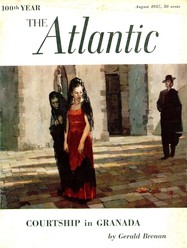
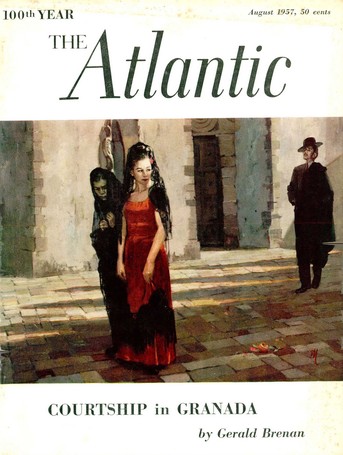
Courtship in Granada
GERALD BRENYA is an Englishman who settled in the south of Spain shortly after the First World War. He took with him a great many books and a little money, and for a considerable period he lived in the primitive mountain village of Yegen. from which vantage point he wrote his first two hooks, The Face of Spain and The Literature of the Spanish People from Roman Times to the Present Day. From Mr. Brenan’s new hook, South from Granada, which is to be published by Farrar, Straus & Cudahy in the autumn, we have selected this intimate picture of an ancient mode of Spanish life.
The Wonder Horse
GEORGE BYRAM lives on a small ranch in Colorado, which he operates on the side, paying for what I lose on the ranch out of what I earn in television and writing, wailing for the day when I’ll write tlie big one and can go back to the vast, mean, windy, murderous, tvonderful country of north-centred II yarning.”The idea for this present story, he says, “came about quickly one evening when I was studying genetics in regard to my men horsebreeding program (crossing Arabians on Quarter Horses). Like any horse-breeder, I began dreaming what kind of mutation I would like to have happen”
Jordan
A Day in Early Winter
At no time in our past has the Atlantic received as many poems as are now submitted to us. they are elidence of an interest in poetry which never slackens and which often burns most brightly in the undergraduate years. As an incentive for writers yet unestablished, we have set aside each year a number of pages to be devoted to the work of young poets in our February and in gust issues.
Song
Dream of the Pastoral Poet
Weekend
Penelope
In Search of Sight
Meningitis robbed VED MEHTA of his sight at the age of three. His father was a Western-trained doctor marked for high place in the Indian Civil Service: but though Ved learned English with his brothers and sisters at home, the educational system of India makes no provision for higher education for the blind. The boy studied Braille, and at the age of fourteen he began typing his letters of appeal to American institutions. After more than thirty rejections he was finally admitted to the Arkansas School for the Blind, and here he began his alteration in a new world. His experiences in India and in America are set forth in his book. Face to Face, to be published this month by Atlantic Little, Blown, from which this is the second of two excerpts.
What's Wrong With the American Woman?
There has been a spate of recent speculation about the allegedly unhappy state of the American woman. The author of the present article believes that the numerous psychological and sociological theories advanced to explain her plight are pure moonshine, and that the basic trouble is dietary. DON CORTESis a much-traveled freelunce writer who has spent years observing American womanhood in action both in this country and abroad.
The Tomahawk
Born in Indiana, WILLIAM BRANDON lived in Yucatán, New Mexico, trance, and England before settling down in California, where he devotes his time to writing. “I like to write,” he says. “It isn’t work in any sense whatsoever except that it gains my income. It’s a pleasure, delight, and recreationHis book, The Men and the Mountain, written in the form of a long historical essay about the Fremont expedition, teas published in 1955.
Old Jubal
Foreign Trade Is a Two-Way Street
HERBERT V. PROCHNOW, general vice president of I The First National Bank of Chicago, is one of the top-ranking financiers who were called to Washington by President Eisenhower. There, as Deputy Under Secretary of State for Economic Affairs (1955 and 1956), he had the responsibility of dealing with our foreign trade policy and with those pressure groups, now no longer confined to the North, who fear free trade and plead for protection.
The Landlocked Sailor
A native Canadian, FARLEY MOWAT lived in Saskatchewan before the war and in 1935 accompanied an uncle to Churchill on the south edge of the Barrenlands. From that time on he was strangely attracted to the arctic expanses. After his service in the Canadian Army during World War II he teamed up with a young native of the Barrenlands and together they explored about 1200 miles of that territory. From this experience came his book People of the Deer. Mr. Mowat is now married and living near Toronto, where he and his wife raise Huskies for fun and vegetables for insurance against the vicissitudes of a wandering writer’s life. The following account of his life in Saskatchewan is part of a non book. The Dog Who Wouldn’t Be, published by Atlantic Little, Brown.
Mushrooms, Food of the Gods
poet, rincelist, and scholar who resales in Majorca and makes his intellectual home in antiquity, ROBERT GRAVES became an addict of mushrooms at an early ape. Hat it was not until his maturity, alien his rending, and research far his novel. I, Clamlins, resulted in his friendship with R. Gordon H asson, the New York investment banker, and his wife. Dr. Valentina Wasson. that he fully understood where the mushroom trail has led in times past.
The Peripatetic Reviewer
Reader's Choice
Accent on Living
Cotton Picker
No Comparison
The Big Top
Two Weeks in August
Record Reviews
Venetian Hotel