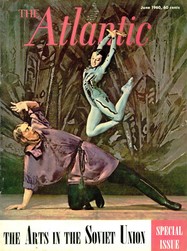
June 1960
In This Issue
Explore the June 1960 print edition below. Or to discover more writing from the pages of The Atlantic, browse the full archive.
Articles
Report on South Africa
During a time of apartheid and brewing unrest, the outlook for South Africa is extremely grim
Monastery at Zagorsk
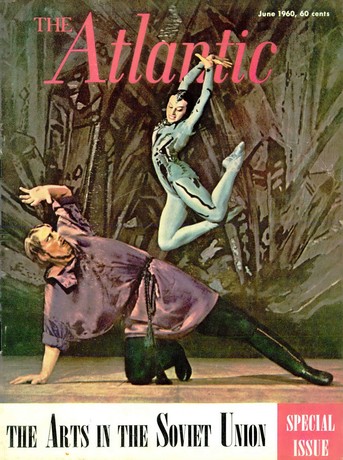
Talent and the Ballet
Russia’s foremost critic of the dance, YURI SLONIMSKY here describes the search for young ballerinas which is being conducted throughout the sixteen Soviet republics, and the education and training of the new talent in ballet schools, whose scope has been noticeably enlarged since the end of World War II.
The Battle of the Tractors
SERGEI ANTONOV, who was born in Leningrad in 1915, is well known for his deft and amusing satire. He was trained as a road-building engineer and is at home with tractors and bulldozers. He served at the front throughout the war and did not publish his first volume of stories until 1947. The narrative which follows is taken from his popular and mischievous novel of a cooperative farm, IT HAPPENED IN PENKOVO.
To My Critics
The Difficulty of Producing Comedy
In this paper NIKOLAI AKIMOV, director of the Leningrad Comedy Theater, explores the sensitive question of how far one may go in the writing of satire. He makes a plea for creative latitude for the comedy writer comparable to what the serious dramatist enjoys.
Two
A lyric poet who was born in 1915 and studied at the Literary Institute of the Soviet Writers’ Union, Margarita Aliger was awarded a Stalin Prize for her long poem, ZOYA. She is one of the most audacious women now writing in the U.S.S.R.
The Art of Restoration
LEV PETROV is the Director of the Institute for the Restoration of Historic Monuments in Moscow and the man most familiar with the artistic and dedicated work which has gone into the rebuilding of the cathedrals and historic shrines and the restoration or uncovering of the ancient icons.
Soviet Epic Singers
Born in 1897 into a nomad family of Kazaks, MUKHTAR AUEZOV is the author of more than twenty plays, many short stories, and a four-volume novel about the famous Kazak hero Abai. He is an authority on the folklore of Asiatic Russia and has been instrumental in transcribing on paper those epics of Homeric length which the famous singers have handed down over the centuries.
Television in the u.s.s.r
WILLIAM S. HALSTEAD was supervisory engineer and consultant to the Nippon Television Network Corporation, Tokyo, in establishing the first commercial television service in the Far East. He also is the author of a proposed North Atlantic Relay Communications Plan which is now under consideration in North America and in Europe. President of Unitel, Inc., a global television enterprise, he was invited in 1959 to Moscow to present a paper at the International Electronics Conference, and while there observed the development of television in the Soviet Union.
Eighth Editor of the Atlantic 1872-1960
How My Love Was Sawed in Half
Playwright, novelist, and short-story writer, ROBERT FONTAINE is perhaps best remembered for his Broadway success, THE HAPPY TIME. Fontaine jans will enjoy his most recent book, THAT’S A GOOD QUESTION,a humorous guide to the writing trade recently published by The Writer.
The Magician
JACKSON BURGESS has worked as a newspaperman and as a teacher in North Carolina and in Illinois, where he was editor of theCHICAGO REVIEWin 1952. For the past two years he has been a lecturer in the English department of the University of California. This is his first appearance in a magazine.
Horse and Hammer
The Special Case
CHATM RAPHAEL, who has published under the pseudonym Jocelyn Davey, is a former Oxford don,currently a British government official, who draws upon his experience for his fiction. His first novel, A CAPITOL OFFENSE, was a spoof detective story set in the British Embassy in Washington, and his defective, Ambrose Usher, appears in his other novels. He has also written a number of short stories.
South Africa
The Love Letter
Accent on Living
The Ultimate Fi
J. G. MITCHELL is a librarian in the British Columbia Provincial Library of Victoria. This is his first appearance in the pages of the ATLANTIC.
Public Addresses: Memorial Day
The Neurotic's Notebook
Luxury Symbols
WILLIAM K. ZINSSERis the former film critic of the New York HERALD TRIBUNE. This is his first appearance in the ATLANTIC.
The Seventy-Nine-Cent Spread
Nepal
They Shall Have Music
The Peripatetic Reviewer
Books the Editors Like
Reader's Choice
London
Soviet Writers and American Readers
Uncle Ivan's Tale
The most celebrated of Russian novelists. MIKHAIL SHOLOKHOV made his reputation with his powerful classic AND QUIET FLOWS THE DON. The first volume of his second big novel, VIRGIN SOIL UPTURNED, dealing with collectivization among the Cossacks ,appeared in 1932. The concluding volume, from which this present episode is taken, has only recently been completed. His books are published in America by Alfred A. Knopf.
The Atlantic Report on the World Today: Washington
Dawn
A poet whose translations of Shakespeare are the best in Russian and whose novel, DOCTOR ZHIVAGO,is still a subject of controversy, Boris Pasternak is in the front rank of contemporary Soviet writers.
At the Beginning of Life: My Meeting With Gorky
A poet who enjoys particular success in his books for children, SAMUIL MARSHAK was discovered by Gorky. He learned English in London in 1911 and there began his brilliant translations of Blake, Wordsworth, and Burns, as well as the English ballads and nursery rhymes. We have selected this chapter from his reminiscences now being serialized in NOVY MIR.
Literature in the Age of the Sputniks
A Russian press correspondent in the Paris of 1912, who was an early friend and collector of Picasso’s and came to know Hemingway well at the time of the Spanish Civil War, ILYA EHRENBURG is today a novelist noted for his satire and for his discerning criticism of Western and Soviet literature. His novels, THE STORM and THE THAW, were both published in this country, and the latter was the subject of considerable controversy in 1955.
Brooklyn Bridge
VLADIMIR MAYAKOVSKY, who was born in 1893 and died in 1930, was one of the most exciting poets during the last years of the czars and the first decade of the Soviet Union. This poem, written during his three months’ visit to the United States in 1925, is taken fromTHE BEDBUG AND SELECTED POETRY by Vladimir Mayakovsky, edited by and with an introduction by Patricia Blake.
A Walk Along the Neva: The Siege of Leningrad
One of the leading women poets, whose war poems, collected in her LENINGRAD NOTEBOOK (1942), are among her finest contributions, OLGA BERGOLTS has used the autobiographical vein to give this poignant account of the Siege of Leningrad.
Three Poems
Stepan Shchipachev, who was born in 1899, is a wellknown Soviet lyric poet, winner of his country’s highest literary prize. He headed the delegation of Soviet writers in their visit to the United States last March.
The Easter Outing
Leonid Leonov’s novel THE THIEF, which appeared in 1927, is a panoramic story of the Moscow underworld in the early twenties. The central figure is Mitya Vekshin,a former aristocrat, then a Bolshevik, and finally, cut of his disillusionment with the Revolution, the leader of a gang of thieves. Opposed to him is Nikolai Zavarikhin,a shrewd, inexperienced peasant who has come to Moscow to make his fortune, legally or otherwise, and who falls in love with Mitya’s sister, Tanya. Tanya, a high-wire artist in the circus whose stage name is Hela, lives with her trainer, Pagel.
Death and the Hero
ALEXANDER TVARDOVSKY, born in 1910, is known throughout Russia for his three long poems, THE LAND MURAVEI, which established his reputation; VASILY TYORKIN, a memorial to the Russian soldier in World War II; and SPACE ON SPACE. He is today the editor of the leading Soviet literary periodical, NOVY MIR.