October 1964
In This Issue
Explore the October 1964 print edition below. Or to discover more writing from the pages of The Atlantic, browse the full archive.
Articles
The 1964 Election
“In the election this fall, which will go far to determine the conduct of the United States in the next twenty-five years, we stand for the election of President Lyndon B. Johnson.”
A Writer in Search of Himself
An Irish writer, SEAN O’FAOLAIN, unlike his predecessors who trooped off to London, has defied censorship and done his work at home. He is the author of more than a score of books, and his versatility will be appreciated by those who turn to his novels, A NEST OF SIMPLE FOLK, COME BACK TO ERIN, AN AUTUMN IN ITALY, and his finest collection of short stories, I REMEMBER, I REMEMBER. This is the second installment drawn from his reminiscences, VIVE MOI!, just published by Atlantic—Little, Brown.
Cyprus
Escape Hatch: Pay-Tv
Burning Questions
Why Don't You Try the Piano Instead?
Femelle De l'Homme
After Tahiti, What?
Steinberg's Programming
The Peripatetic Reviewer
Reader's Choice
Spain
London
The Price We Paid for War
Diplomat and historian , GEORGE F. KENNAN entered our Foreign Service in 1926 following his graduation from Princeton. He served as a Russian-speaking aide to Ambassador Bullitt from 1933 to 1935; was in Prague at the time of the Czechoslovakia subjugation, in Berlin until Pearl Harbor; and was our ambassador to Moscow from 1952 to 1953 and to Yugoslavia from 1961 to 1963.
Conviction Means Loss of License
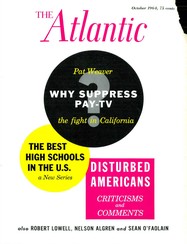
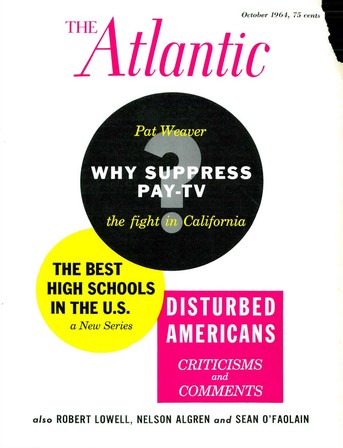
Why Suppress Pay-Tv? The Fight in California
Radio and television executive, a creator of the pungent phrase, and a man of unquestionable enthusiasms, SYLVESTER L. (“PAT”) WEAVER, Jr., is president of Subscription Television. Inc. In his home country of California he is making a fight for an innovation in television which, if he succeeds, will make available programs that commercial television could not, or would not, provide. STV began broadcasting in Los Angeles on July 17 and in San Francisco in mid-August. It already has over 30,000 subscribers.
The Atlantic Report on the World Today: Washington
Poems
Requiem
The Buoy
“I was graduated from Wesleyan in 1956 in English,” writes II. L. MOUNTZOURES, “even though I spent three and a half years living out a myth as a premedical student.” In 1961 he spent six months in Greece, the scene of the following story. Mr. Mountzoures lives in New London, Connecticut, where he is at work on a novel.
What Makes a School Good
At a time when our schools and colleges are crowded as never before, we think it may be stimulating to look into the performance of outstanding American high schools. Here we turn the spotlight on Newton, Massachusetts, and thereafter we shall publish articles about the East High School in Denver, the William Allen High School of Allentown, Pennsylvania, the nongraded high school in Melbourne, Florida, and the Dunbar School in Chicago. To introduce the series we call upon DR. EUGENE YOUNGERT, who served for sixteen years as superintendent of the Oak Park and River Forest High School in Illinois before joining the research team of James Bryant Conant.
The Schools in Newton: Experiment in Flexibility
The superintendent of the Newton public schools, CHARLES E. BROWN, now approaching his fortieth birthday, was educated at Springfield College and took his master’s degree and doctorate in education at Harvard. From 1954 to 1957 he taught mathematics, science, and social sciences at the Day Junior High School in Newton; he then moved up to be an administrative assistant, and since 1960 has been superintendent of all the city schools.
Nelson Algren at Fifty-Five
H. E. F. DONOHUE is an editor and short story writer whose first novel, HIGHER ANIMALS,will soon be published. Two years ago, Mr. Donohue began a series of interviews with NELSON ALGREN,author of the prize novel THE MAN WITH THE GOLDEN ARM.From their many discussions has emerged CONVERSATIONS WITH NELSON ALGREN,to be published this month by Hill and Wang. This is good talk from one of America’s ablest writers.
The Wishing Box
SYLVIA PLATH, who died last year, grew up in Wellesley, Massachusetts, and graduated from Smith College in 1955, where she studied under Alfred Kazin. She won a fellowship to Cambridge, and there she met and married the poet Ted Hughes. This story was written during her Cambridge years and originally appeared in GRANTA.
What Prudent Stewardship?
Disturbed Americans: Criticisms and Comments
In July, 1961, the ATLANTICpublished a Special Supplement, Psychiatry in American Life, (now available in book form) in which the majority of the contributors were psychoanalytically oriented. In July of this year we returned to the subject of mental illness with the deliberate intent of discussing other forms of treatment, and of inquiring into the present care and needs of the community. Those analysts who have angrily resisted the criticism we brought to bear should remember that our approach has not been one-sided and that medical procedure, now as at the time of the famous Flexner Report, must be open to the public inspection both by the professional and the layman. Our issue on Disturbed Americans has been more widely read than any other this year, and the responses to it, only a fraction of which we can publish, manifest the deep concern of a conscientious public. — The Editor
The Adams Papers
The Adams family of Massachusetts has produced more Presidents and more books than any other family in American history. In the essay that follows, THOMAS BOYLSTON ADAMS, an alumnus of Harvard and president of the Massachusetts Historical Society, takes a familial look at the volumes of the Adams Papers which have thus far been published by Harvard University Press. Two more volumes will appear this fall.
Caesar