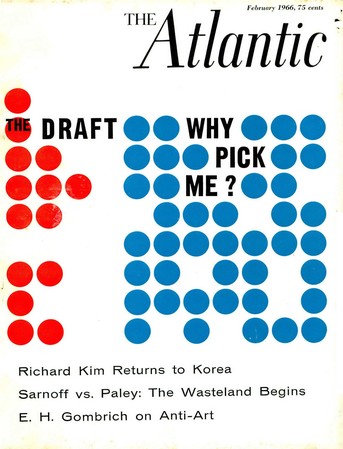
February 1966
In This Issue
Explore the February 1966 print edition below. Or to discover more writing from the pages of The Atlantic, browse the full archive.
Articles
Trondheim
When this appears, Phoebe-Lou Adams, the literary editor of the ATLANTIC,will be experiencing at firsthand what the winter in Finland feels like. This is the sixth of her articles on Scandinavia, and we hope there will be more.
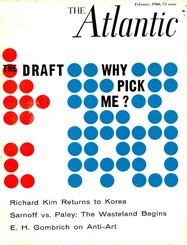
O My Korea!
A native of North Korea, Mr. Kim teas at Seoul University in 1950, when the Korean War broke out. As a volunteer in the army of South Korea, he served first with the Koreans and then with the American forces. Later he came to the United States and attended Middlebury College and the University of Iowa, where he wrote most of THE MARTYRED.He holds master’s degrees from Johns Hopkins, Iowa, and Harvard, and is now teaching at the University of Massachusetts. Last spring he received a Guggenheim award for work on a new novel.
Gambling
I Remember Mama Nature
MARGARET BENNETTis the pseudonym for two young librarians from Sherman Oaks, California.
Please Hire the Handicapped
RICHARD BOETH, a former reporter for TIME and TV critic and a book reviewer for NEWSWEEK, is now a free-lance writer liviny in New London, New Hampshire.
Ballade Des Professeurs Du Temps Fadis: (Or, as Long as You're Up, Get Me a Grant!)
The Neurotic's Notebook
The Vale of Kashmir Won't Be Undersold
Berg, Bernstein, Britten, Bacli, and the Beatles
The Peripatetic Reviewer
Reader's Choice
Potpourri
London
Israel
Ethiopia
How the Wasteland Began: The Early Days of Radio
One of the original pioneers of broadcasting, Carl Dreher brings back the enthusiasm and the exasperation of the days when wireless began and young David Sarnoff and William Paley set up their rival shops. Mr. Dreher spent a good many years as a radio engineer and was director of recording at RKO Studios when he turned to writing. He is now science editor of THE NATION.
"Taking a McNamara Fellowship"
Here two young men speak their minds. Each is twenty-one, each a leader on his university campus; both hold strong but highly divergent views on the inequities of the draft and the realities behind it. The first is Donald Graham, a senior at Harvard and former president of the CRIMSON.The second is Jeffrey Goodman, an honor student in sociology at the University of Michigan, and an active participant in the anti-Vietnam and anti-draft demonstrations of the Students for a Democratic Society. For varying reasons, many will disagree with their views, but they accurately reflect the thinking of vocal elements among young Americans.
Washington
How to Be Patriotic and Live With Yourself
Who Should Serve?
In this thoughtful article , Keith Johnson , a reporter for TIME magazine’s Washington bureau, sizes up the draft and analyzes possible improvements or alternatives to it. On page 69, a chart assesses the various programs open to young men who prefer to volunteer for military service. Mr. Johnson, a former New York HERALD TRIBUNE reporter,served as a second lieutenant in the U.S. Army Reserve.
Animals Running Free Two Weeks in the Serengeti
Novelist and short-story writer, Martha Gellhorn was in residence for nearly two years in East Africa, in the course of which this appealing article was written.
The Unbanning of the Books
As the courts free more and more books from the contraband shelf, there is not much left in literature that can consistently be banned, says Harvard professor and critic Harry Levin. Here he assesses what the new candor in literature could mean to the critic and to the reader.
5:00 p.m
The Tour
A short-story writer who made her initial appearance in these pages, May Dikeman won the Atlantic “First” prize in 1961. Her two subsequent stories, “ The Sound of Young Laughter" and “The Woman Across the Street,” were selected for the Martha Foley collection.
Tregardock
The Achievements of the Negro Colleges
Art and Anti-Art
A Viennese who found sanctuary in England before the Second World War, E. H. Gombrich established his international reputation as director of the Warburg Institute of the University of London. His article is based on a slightly longer chapter which he has just prepared for the eleventh revised edition of his book THE STORY OF ART, published by the Phaidon Press.