The Correspondents’ Dinner Was a Security Success*
*But it’s time to rethink security at an event that is clearly so vulnerable.
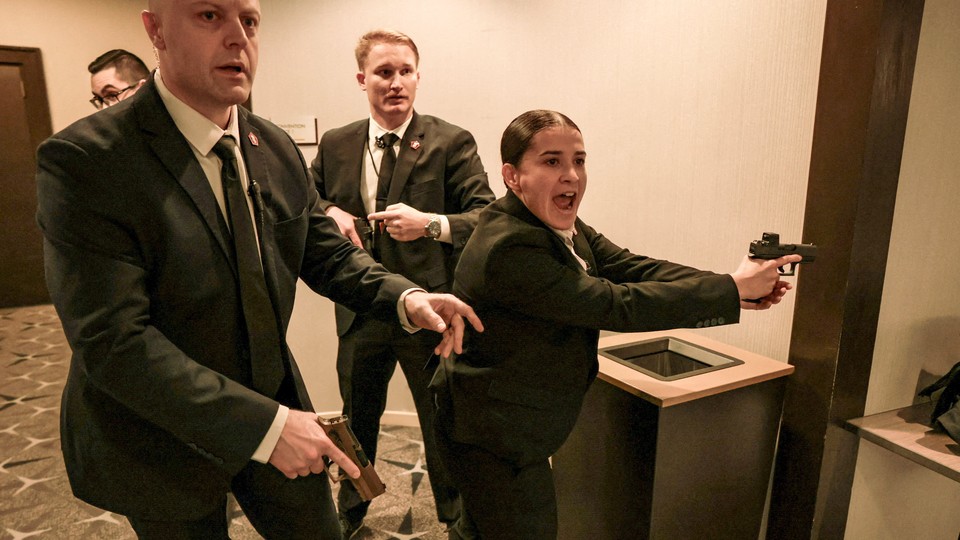

Here’s what happened: On Saturday evening, a man carrying a shotgun, a handgun, and knives got close to the ballroom of the Washington Hilton, where more than 2,000 guests, including the president of the United States, were enjoying the appetizer course at the annual White House Correspondents’ Association Dinner. “I am no longer willing to permit a pedophile, rapist, and traitor to coat my hands with his crimes,” the would-be shooter purportedly wrote in a letter that was apparently written in the lead-up to his attack. He said his targets were Trump-administration officials, “prioritized from highest-ranking to lowest.”
Terrifying, for sure. But here’s what happened next: The assailant was intercepted by armed agents from the Secret Service before he came anywhere close to his intended victims. He was tackled, restrained, and arrested after sprinting past a security checkpoint, through which guests passed earlier in the evening. Shots were fired. The assailant, later identified as Cole Tomas Allen of Torrance, California, hit a Secret Service agent, whose bulletproof vest and cellphone protected him. The agent is recovering. The suspect is in custody. No one died. And the president, his Cabinet, and all other dinner guests left the ballroom safely.
There is much we still don’t know. But it appears that the security at the Correspondents’ Dinner worked as designed. The Secret Service is there to guard the president and senior officials, not the other guests—although they surely could and did do that.
Two U.S. officials who were not involved in planning for the dinner credited the agents for never letting the gunman reach the ballroom. Even if he had made it, the entrances were in the back and sides of the room—a long way from the dais where the president and vice president were sitting. At the first sound of trouble, both men were rushed out as agents in heavy armor swarmed the stage. The only injuries were likely sustained by guests and banquet staff tumbling over one another to hide under tables.
“The law-enforcement response to the assailant’s breach was exceptional. He ran through the security perimeter and was immediately stopped,” one former Homeland Security Department official, who requested anonymity to discuss the response while knowledge of the situation remains fluid, told me. “The question is: Was that security perimeter appropriately defined?”
In other words, the operation went well, given the setup. Yet the fact that a well-armed man could cause so much chaos and distress can hardly be considered a complete security success. And the difference between success in the breach and failure in the planning may come down to the very nature and location of the event itself.
If you’ve never attended this black-tie mosh pit that passes for a civilized evening, this next part may surprise you. To get into the Washington Hilton, guests need to present an invitation, but that can involve just flashing a folded, cream-colored piece of card at an overworked security guard on the sidewalk at the edge of the property.
From there, partiers mingle in the lobby, pose for photographs on a red carpet, and search out any celebrities who have been persuaded to show up. At the busy lobby bar, those attending the function are easily distinguishable by their tuxedos and ball gowns from hotel guests in their Saturday-night duds. One floor down, many dinner guests attend cocktail parties, hosted by media organizations, where they drink and nibble canapés with administration officials in a line of bland anterooms.
They can do all of this without encountering anything like the security you’d find at an airport or even a large concert. It’s not until invitees head toward the massive hotel ballroom for the main event—a seated dinner at tables much too close together—that people line up and either walk through a magnetometer or are wanded by a guard. No pat-downs. No random swiping of hands for explosive residue. No questions. And though no one in an official position will ever say this, if one is on the guest list, one is presumed not to be a threat. The security feels performative, because it arguably is if you hold a ticket. And at least some of that security proved to be breachable by one man running through empty hallways after all of the guests were seated.
Several attendees told me that their names were not cross-checked against a master list, and no one checked their ID. I didn’t attend Saturday’s dinner, but in the many years I have been a guest, I can’t recall anyone giving my invitation more than a passing glance, and no one has asked to see my identification. This will come as a maddening surprise to anyone who’s tried to enter a federal building without a driver’s license or a passport.
The security setup at the dinner is what experts call a layered approach, layer one being the invitation check, and layer two being the screening outside the ballroom. The first is lax. The other is a bit more rigorous. But Allen, the alleged assailant, seems to have found a way to pierce those layers: He was, according to officials, a guest at the hotel, so he was already on the premises when the party started. Could police have checked the hotel guest list to ensure no one staying there posed a threat? Of course. But Allen wasn’t on any watch lists and was not known to authorities, police said, so even that step may not have prevented his attack. Searching 1,100 rooms wouldn’t be feasible for obvious reasons.
In hindsight, that looks like a glaring weakness. The alleged assailant thought so too: “The security at the event is all outside, focused on protestors and current arrivals, because apparently no one thought about what happens if someone checks in the day before,” he reportedly wrote.
The whole security architecture rests on those layers. A review of law-enforcement failures at the Trump campaign rally in Butler, Pennsylvania, in 2024 found that the shooter was able to fire at Trump from a rooftop outside the secure area. At the Hilton on Saturday night, several Cabinet members walked a red-carpet area outside the magnetometers, that second layer. The suspect, given that he was already in the hotel, could have attacked officials before they were anywhere close to the ballroom, the former official said.
“Had the individual studied the security protocol, he could have realized he could bring a handgun and take out a few Cabinet members on the carpet,” the former official added, leading to “a broader question here about holding an event like this with the president and the vice president and the speaker of the House in the same hotel.” (One attendee told me that he and his wife had darkly joked that if a terrorist wanted to take out the upper ranks of the government, the dinner would offer an ideal chance. They then spent a chunk of the evening ducked under their table.)
Trump and his allies have already seized on the events at the hotel as another reason the president needs a new ballroom connected to the White House to host formal events. Without a doubt, guests would never get such a light touch there, where the security protocol for large gatherings calls for checkpoints—sometimes several of them, including mandatory ID checks and physical screening. It can take more than an hour to get into one of the many White House holiday parties each year.
But the Correspondents’ Dinner is not an official event. The president is a guest of the White House Correspondents’ Association, as are administration officials and other luminaries. The Secret Service is there to protect them, and the agents did their job. The agency could move the security perimeter outside the hotel, maybe do an ID check against those invitations. But that would lead to long lines of impatient and, let’s face it, rather demanding party guests snaking around the hotel (and potentially getting soaked, in Saturday’s dreadful weather). In the hours before the dinner, the blocks surrounding the Hilton were already jammed with cars, onlookers, and energetic protesters. Maybe Cabinet officials could be brought through a VIP entrance. Everyone else would be a sitting duck, or at the very least extremely annoyed.
But here’s one more thing we already know: Security at this annual rite of spring will never be the same again. On Sunday, at one of the many after-parties around town, guests wondered if the dinner should move to the Washington Convention Center. No interloping hotel guests to contend with there. Buildings like that are also designed to handle long security lines and move people along. We may soon get a better sense of what this might look like, given that Trump promised to reschedule the event within the next 30 days.
The Washington Hilton has hosted the Correspondents’ Dinner for nearly 60 years. But traditions don’t last long in Trump’s Washington. The attack’s thwarting was an undeniable success. But the attempt has revealed shortcomings and vulnerabilities that were waiting to be exploited—and can no longer be ignored.
Nick Miroff contributed to this report.