Give Ed Kennedy the Posthumous Pulitzer He Deserves
Next week a man may get honored for a story that destroyed his career, but elated a nation: the story of German surrender in World War II.
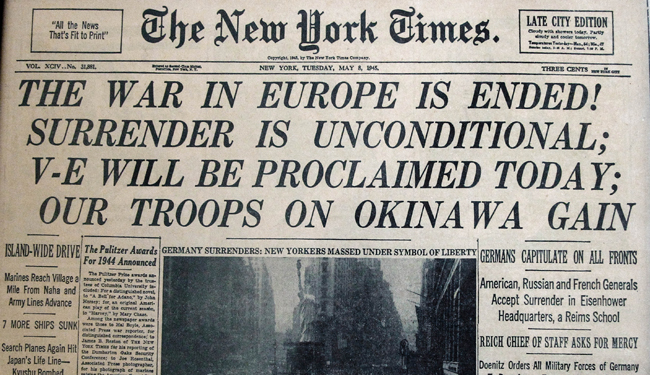
For the gaunt, intense Kennedy, it became the scoop from Hell. Allied headquarters stripped away his press credentials, denounced him personally for defying the rules, and banished him to New York, where the AP fired him. Meanwhile, 54 rival reporters who had abided by the news embargo signed a statement branding Kennedy a double-crosser. The label lingered. In 1960, Walter Cronkite of CBS, a former United Press war correspondent, refused to stand when Kennedy offered his hand, according to a journalist who witnessed the encounter.
Kennedy tried for years to repair his damaged reputation, publishing a lengthy self-defense in the Atlantic ("I'd Do It Again," August 1948.) Among other points, Kennedy argued that Ike had not ordered the blackout for legitimate reasons of military security. He had done so for political reasons that did not justify censorship. Soviet dictator Josef Stalin wanted to stage a second surrender ceremony in Berlin - to sell the illusion that the Nazis had surrendered first to the Soviets. He did not want his propaganda ceremony overshadowed by news of the authentic surrender in Reims. Eisenhower's news blackout was intended to appease an increasingly truculent and distrustful ally. Documents in the National Archives bear this out. But the Atlantic article did not put Kennedy's career back on track. This former star of international journalism spent the rest of his life in small-town-newspaper exile, brooding and embittered. He died in Monterey, CA in 1963 after stepping from a bar into the path of an oncoming sedan.
Now scroll ahead 50 years to the present day: Ed Kennedy has been nominated for a Pulitzer Prize, honoring him in death for the decision that undid him in life. Dozens of journalists have joined the cause, petitioning the Pulitzer board on Kennedy's behalf. Kennedy's rehabilitation began last year with publication of memoirs that had sat for years in a box in his daughter's attic. After being invited to write the forward to Ed Kennedy's War, Associated Press CEO Tom Curley was moved to issue a public apology for Kennedy's firing. Publicity from that apology inspired the Pulitzer drive, and the board is set to announce this year's winners on April 15.
The Pulitzer board has bestowed posthumous awards in the past, all in music, so Kennedy appears eligible by precedent. Does he deserve this recognition? To answer that, one must first address a threshold question: Was breaking the news embargo ethically justifiable? War Department officials, and the journalists that Kennedy "scooped," said emphatically that it was not, and some recent commentators agree. Their case falls apart under scrutiny:
- Kennedy broke his word when he broke embargo. Actually, it was Eisenhower's command that broke the embargo. As Ike's Chief of Staff, Gen. Walter Bedell Smith acknowledged after the war, the Allies ordered German radio to broadcast news of the surrender repeatedly to ensure that German forces stood down. The Germans complied, and Kennedy filed his story only after learning of the German broadcasts. He told the senior censor that these broadcasts had nullified the embargo, and he was no longer pledged to honor it.
- Kennedy failed to inform his bosses that his dispatch broke the embargo. This is true, but he faced a Hobson's choice. Kennedy had dictated his story to the AP London bureau by phone. The London bureau then had to relay the story to New York headquarters for editing, using a trans-Atlantic cable minded by a military censor. Kennedy thus had two options. He could dictate the story without a warning to editors that it was unauthorized, and get it into print. Or he could include a note telling editors that he was breaking the embargo, ensuring that the censor could stop the dispatch. Kennedy made a difficult choice, but not a deceitful one.
- Kennedy betrayed his fellow correspondents by failing to inform them of his intentions in advance. Come on. Wire reporters are paid to be first. If he had stopped to confer with his nearly 60 rivals, not only would he have lost the scoop, but also might inadvertently have alerted the authorities, making it impossible for anyone to file the story.
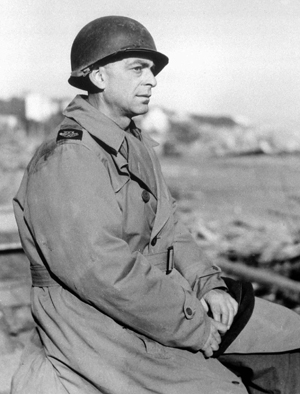 The Pulitzer board has awarded special citations recognizing a journalists' body of work, not merely an article or series. The case for a Kennedy Pulitzer is stronger if one takes into account his entire career as a war correspondent, starting with the Spanish Civil War in 1937 and continuing through desperate battles in North Africa and Crete, the beachhead at Anzio, Italy, and the allied invasion of Southern France. Through it all, he butted heads continually with Army censors and PR officers who sought to keep journalists under tight control. In September 1944, Kennedy took a jeep and broke away from headquarters, driving from southern France toward Paris, eluding retreating German units, mapping areas that had fallen under control of the Resistance, and documenting a Nazi massacre of men, women, and children. He arrived in Paris only to have his credentials suspended for traveling without permission. Eric Sevareid, who covered the war for CBS, described Kennedy in his 1953 memoir as "one of the most rigidly honest, most unflaggingly objective journalists, who never ceased in his efforts to free the news . . . He did more to hold the military to the letter of the censorship rules . . . than any other journalist I know."