What Do You Know About 1491?
The past few decades have seen more and more research that changes the popular narrative about America before Columbus.
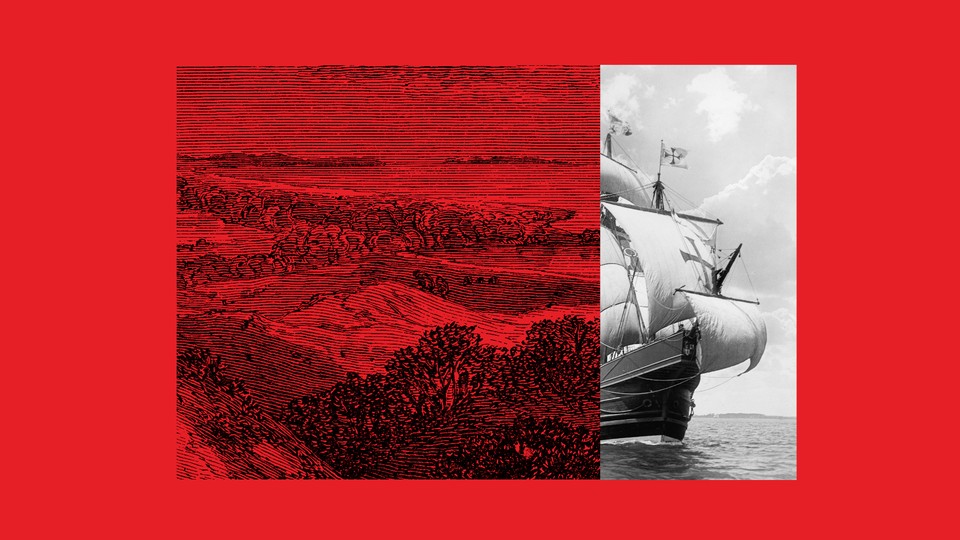
In elementary school, I learned a rhyme about Christopher Columbus sailing the ocean blue in 1492. High school expanded that understanding to a still-simple narrative: Very few people lived in the undeveloped Americas, and the invading Europeans brought a disease that wiped out the few who did.
Then, in college, I read the science journalist Charles C. Mann’s March 2002 Atlantic cover story, “1491,” which lays out a systematic challenge to every aspect of the lesson that I, and so many other kids, were taught in school.
Could the pre-16th-century population of the Americas have rivaled that of Europe? Had waves of lethal diseases wiped out far more people than was previously known? What if the people who lived in the Western Hemisphere were, as Mann writes, “so successful at imposing their will on the landscape that in 1492 Columbus set foot in a hemisphere thoroughly dominated by humankind?”
Mann and I spoke ahead of today’s holiday. The following conversation has been edited for length and clarity.
Shan Wang: Take us back to when the ideas in your 2002 article were completely new to most people.
Charles C. Mann: It started 10 years before the article was published, around the 500th anniversary of Columbus’s landing. I came across a display of new work at a Smith College library, where they had an edition of the Annals of the Association of American Geographers [as it was called then] journal. The cover was something like The Americas Before Columbus: What Was It Like? And I thought, Oh, that’s a good question.
A couple of articles in there told me two things that I had no idea were the case. One was that a substantial number of scholars believed there were just a boatload of people in the Americas at the time of Columbus. The second was that there had been a terrible depopulation due to disease.
A few years later, I was at an archaeological panel about how there was much more in the Amazon than we’d previously thought. Even places I’d always thought of as “virgin wilderness” were actually full of people.
I thought, Someone should write about this. I didn’t think it was me; it just seemed way out of my expertise. This was before the internet, so I would go to bookstores periodically and describe a book like this, and the staff would say, Oh, that sounds like a good idea; I’ve never heard of it. I finally thought, I’ll take a stab at it. Ultimately, the reaction was much larger and much more positive than expected.
When I wrote “1491,” there were far fewer Indigenous voices being spotlighted. By no means is it just me writing about this. Ned Blackhawk, for instance, published a history of Europeans in the Americas from the Indigenous perspective, called The Rediscovery of America, just this year.
Wang: Knowing all that you know now, I’m asking you in the year 2023: How many people actually lived in the Western Hemisphere before 1492?
Mann: The general scholarly critical mass—not necessarily consensus—is behind about 40 million to 60 million. I should also note that that number keeps creeping up. And I personally wouldn’t be surprised if, 20 or 30 years from now, the consensus-type number were 60 million to 80 million. Researchers keep finding new evidence of more populations in areas they didn’t think were populated—in the Amazonian Tierra Firme, for instance.
Wang: I was struck by the politicization of the population numbers in your piece. There were so-called high-number scholars and low-number scholars. All of them were accused of having political reasons for wanting a population number to be lower or higher. Have you seen your own work being taken the wrong way?
Mann: One thing I think has been taken wrong—and I should say I’ve been very lucky; this is really just one little annoyance—is, if you say viruses and bacteria played such a huge role in history, that’s excusing imperialism. (I’ve often joked that if I were writing Guns, Germs, and Steel, it would be called Germs, Germs, and Germs.) But, as I wrote, if Europeans found areas already emptied by disease, with relatively few survivors, and then went in and took all this stuff of people who were just whammed by disease—that’s terrible! That’s not me letting them off the hook morally.
Wang: I wonder what would’ve happened if we had published “1491” today.
Mann: I can give a small example. When I wrote the book that sprang from the article, it was translated into Spanish. Recently, some in the Spanish MAGA world, for lack of a better term, got really upset, calling me anti-Spanish. But neither the article nor the book is really about Spain. Then some Catalan nationalists started embracing the book, saying, This book is great; it tells what the Spaniards were really like. It was seized upon for culture-war purposes.
Wang: That a lot of “virgin wilderness” was actually carefully tamed by humans was also somewhat controversial when you first published the piece. Do you find that perceptions about that have shifted?
Mann: Particularly in the United States and Northern Europe, the idea of “wilderness” is such a powerful, Christian idea—a lost Edenic paradise that we screwed up. That idea of wilderness erases Indigenous people and Indigenous history. Many environmentalists have come to terms with that now. There’s a lot of interest in Indigenous land management, including to help us adjust to climate change, premised on the idea that there were many people here who had a ton of knowledge about the land, and who did manipulate it.
Wang: Our conversation will be publishing on Monday, and I …
Mann: You want to ask me what I think about Columbus Day.
My personal opinion is that there are holidays you celebrate—July 4, yay, the U.S. was born!—and holidays you observe: Memorial Day, for instance. The fact is that when Columbus landed, that inaugurated a series of enormous changes that rippled all over the world. So if the day were about the implications of those changes, then it would seem to me that Columbus Day could work. The weird thing is that Columbus Day was intended to be a celebration of Italian Americans, and Columbus was a terrible Italian American. Now, if we wanted to celebrate Indigenous People’s Day, I personally think we could be doing a better job. There are a ton of Indigenous notables. If you ask me to pick someone from the Americas side of the encounter: There’s this Taíno leader, Guacanagaríx, who attempted to negotiate peace and was incredibly generous. We could be putting this day in his name.
Related:

Read. As the weather cools down, transport yourself to another place with a final pick from our summer reading list.
Watch. The Creator is worth catching on a big screen this weekend.
Listen. Could Ozempic derail the body-positivity movement? Host Hanna Rosin and science writer Olga Khazan discuss on the Radio Atlantic podcast.
Did someone forward you this email? Sign up here.
Katherine Hu contributed to this newsletter.
When you buy a book using a link in this newsletter, we receive a commission. Thank you for supporting The Atlantic.