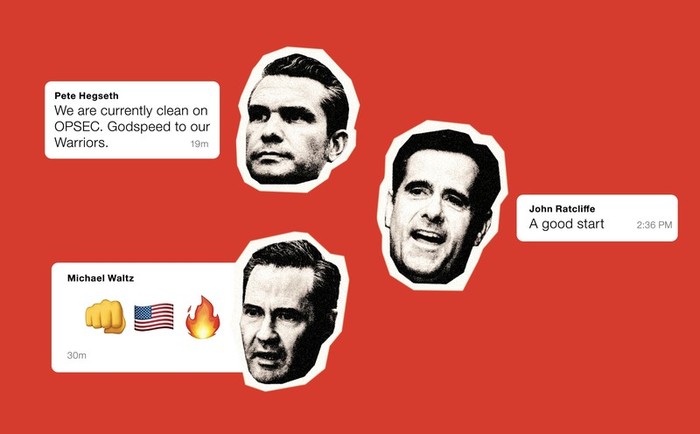
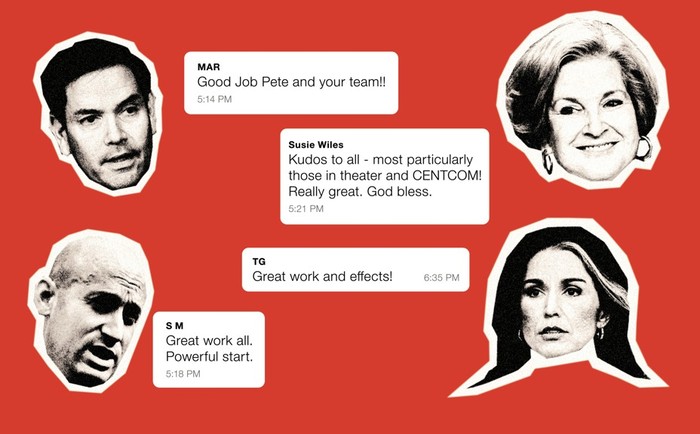
View in browser It has been almost a year since the national-security scandal that came to be known, inevitably, as Signalgate erupted on my iPhone, and I’ve been thinking through its consequences. Michael Waltz, the official who invited me into a Signal chat group whose members included most of America’s national-security leadership, was removed as the president’s national security adviser. But he soon received (what is to my mind, at least) a promotion, and is now serving as U.S. ambassador to the United Nations. The Signal Foundation, the nonprofit organization that owns the messaging app, saw a dramatic increase in usage following the scandal. The Atlantic itself saw an unparalleled burst of subscription growth, and I personally managed to avoid prison and extract a brand-new iPhone from my employer. President Trump suffered no negative consequences from Signalgate. In fact, he found it professionally riveting, carefully studying the way in which The Atlantic temporarily dominated the news cycle. (He also suggested to me, in an Oval Office meeting that took place as the scandal was subsiding, that he should receive more credit for The Atlantic’s success than I have granted him.) As for Pete Hegseth, the secretary of defense who shared what were quite obviously military secrets in a discussion, held on a privately run messaging app, that he didn’t even know included a journalist—well, more on him later. Allow me to recount, as efficiently as possible, the sequence of implausible events here. On March 11 of last year, I was invited to connect on Signal by a user purporting to be Waltz. Soon after, I was invited to a chat called the “Houthi PC small group.” PC refers to principals committee, which included people identified as Vice President J. D. Vance, Secretary of State Marco Rubio, Hegseth, CIA Director John Ratcliffe, and Tulsi Gabbard, the director of national intelligence. I am suspicious by profession, and so I assumed that this was an entrapment scheme, or a foreign-intelligence-service operation, or a simulation beyond easy comprehension. But I know Waltz (please keep this fact in mind), and I have reported on national-security matters for decades, so the invitation wasn’t entirely outlandish. (A reasonable guess is that my telephone number can be found—or could be found, before Signalgate—in the contact lists of seven or eight members of the 18-person “small group.”) The chat itself was highly realistic, and fascinating. I watched as a substantive debate was held over whether the U.S. should immediately launch strikes against Houthi-terrorist targets in Yemen. The vice president, quasi-isolationist in outlook, argued against such strikes, noting that Europe—not his favorite continent—would benefit disproportionately. A little while later, the chat participant identified as Hegseth wrote, “Waiting a few weeks or a month does not fundamentally change the calculus,” though he added, “We are prepared to execute, and if I had final go or no go vote, I believe we should.” The colloquy came to a sudden end when the user “S M,” whom I took to be the Trump confidant Stephen Miller, wrote, “As I heard it, the president was clear: green light, but we soon make clear to Egypt and Europe what we expect in return.” That was that. Hegseth wrote, “Agree,” and the dissident vice president said nothing. And then came the day of the Yemen strikes. At 11:44 a.m. on Saturday, March 15, I was at a supermarket—a Safeway in the Chevy Chase neighborhood of Washington, D.C.—when the following alert came in over Signal from Hegseth: “TEAM UPDATE.” What followed was information that, had it been seen by an enemy of the United States, could have been used to kill American military and intelligence personnel. Hegseth promised that Yemen would be attacked within two hours. I’ve seen strange things in my career, but nothing quite like this. I stayed in my car in the Safeway parking lot and waited. I took screenshots of the chat and searched X and other platforms for news of U.S. military activity. Hegseth had said in the chat that the first detonations would be felt at 1:45 p.m. eastern time. At approximately 1:55 p.m., credible news reports started appearing about an attack. In the chat, congratulations began to pour in. Waltz posted three emoji: a fist, an American flag, and fire. Steve Witkoff, Trump’s all-purpose, in-over-his-head global-conflict negotiator, responded with five emoji: two praying hands, a flexed bicep, and two American flags. Later, the Houthi-run Yemeni health ministry reported that at least 53 people had been killed in the attack (the number has not been confirmed independently). The Houthis are despicable terrorists, and in my opinion should be fought and defeated, but there was still something disturbing about the proliferation of emoji. |