Reporter's Notebook

Orbital View
Show Newer Notes

Of course, these would make for pretty big pebbles:

These bright pots of color—at an oil depot in Tokyo—have a far more important function for the Japanese. As Anthony Qugley explains in his caption:

Japan lacks significant domestic reserves of fossil fuel, except coal, and must import substantial amounts of crude oil, natural gas, and other energy resources, including uranium. Japan relied on oil imports to meet about 42 percent of its energy needs in 2010. Japan was also the first coal importer in 2010, with 187 Mt (about 20% of total world coal import), and the first natural gas importer with 99 bcm (12.1% of world total gas import).

(See all Orbital Views here)

This snap provides an interesting optical illusion. Is it a mountain or a canyon? I can see both:

(Answer after the jump)

Not only is it a canyon, it’s the Grand Canyon. Some fun facts about the landmark, courtesy of Daily Overview’s caption:

The Grand Canyon is a steep-sided canyon carved by the Colorado River in the state of Arizona in the United States. The geological wonder is 277 miles (446 km) long, up to 18 miles (29 km) wide, and attains a depth of 6,093 feet (1,857 meters) at it’s deepest point. Recent studies suggest that the river established its course through the area roughly 5 or 6 million years ago and has continuously expanded the size of the canyon and exposed nearly two billion years of Earth's geological history since then.

For a much closer look at the canyon, check out this amazing video of skydivers in wingsuits:

(See all Orbital Views here)

Shine bright like a diamond:

A photo posted by NASA (@nasa) on

Or a bar of gold. This miraculous sunset makes these unidentified water formations look like a liquid metal. NASA re-shared the image from astronaut Tim Peake. Their introspective caption:

'Beautiful to watch the sun reflected from Earth as we approach night,' wrote astronaut Tim Peake of the European Space Agency. Peake (@astro_timpeake) shared the image on April 9. The station is a unique place—a convergence of science, technology and human innovation that demonstrates new technologies and makes research breakthroughs not possible on Earth. It is a microgravity laboratory in which an international crew of six people live and work while traveling at a speed of 17,500 mph, orbiting Earth every 90 minutes.

Have a clue what we’re looking at? Drop us a line.

(See all Orbital Views here)

That hunk of metal is Dragon, a SpaceX capsule that reached the International Space Station on Friday, carrying 7,000 pounds of supplies, spacewalk gear, and science experiments. Below, the Palm Islands of Dubai look like tiny trilobite fossils.

NASA’s Tim Peake captured Dragon by operating the Canadarm2 robotic arm from inside the orbital station. I wonder if Peake is any good at claw cranes?

(See all Orbital Views here)

Since the Orbital View feature launched last August, we’ve seen a lot of crop circles formed by center-pivot irrigation, but here’s the first from abroad:

From NASA’s caption:

The Al Khufrah Oasis is featured in this image photographed by an Expedition 10 crew member on the International Space Station in October 2004. Green circles in the desert frequently indicate tracts of agriculture supported by center-pivot irrigation. The Al Khufrah Oasis, in southeastern Libya near the Egyptian border, is one of Libya’s largest agricultural projects, and is an easy-to-recognize landmark for orbiting crew members aboard the station.

More recent images of the oasis can be found in a 2013 video from the European Space Agency, whose host goes into great detail over the fossil aquifers that supply the irrigation water:

For more YouTube goodness, here’s some footage from 1942 of Nazi Germany bombing the Libyan oasis.

(See all Orbital Views here)

Cutting through the countryside of southern New Zealand:

The braided Rakaia River carries glacial runoff from #NewZealand’s Southern Alps to the Pacific Ocean.

A photo posted by Planet Labs (@planetlabs) on

A similar view of the braided Rakaia was voted the most popular satellite image among DigitalGlobe fans. So what’s a braided river exactly?

It has a channel that consists of a network of small channels separated by small and often temporary islands called braid bars or, in British usage, aits or eyots. Braided streams occur in rivers with high slope and/or large sediment load. Braided channels are also typical of environments that dramatically decrease channel depth, and consequently channel velocity, such as river deltas, alluvial fans and peneplains. Braided rivers, as distinct from meandering rivers, occur when a threshold level of sediment load or slope is reached.

(See all Orbital Views here)

This snowy scene evokes something out of Star Wars:

Fear not, young Jedis; it’s Earth. Anthony Quigley’s caption identifies the plot as Munich International Airport.

Anthony also posted visual evidence that, in summer, the airport takes on more earthly tones:  

(See all Orbital Views here)

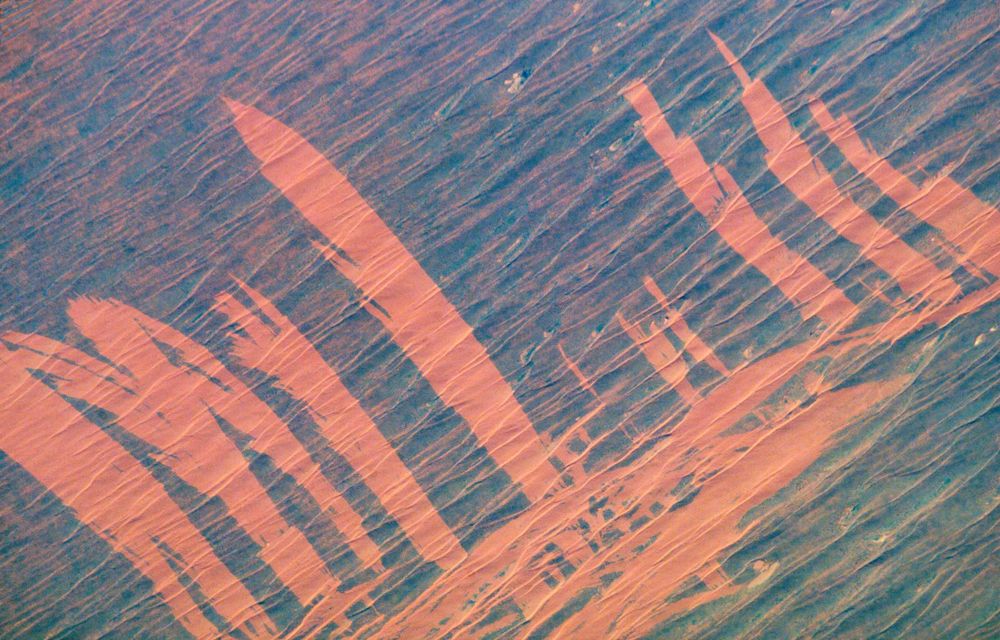
At first glance, these orange-pink stripes look like sand dunes in an ocean:

But they’re actually scars of scorched land. From NASA’s caption:

Fire scars in Australia are featured in this image photographed by an Expedition 5 crew member on the International Space Station in November 2002. Bright orange fire scars show up the underlying dune sand in the Simpson Desert. The fire scars were produced in a fire, probably within the last year. The fires advanced across the dunes in a series of frond-like tendrils. Each frond starts at some point on the earlier fire scar, and sharp tips of the fronds show where the fires burned out naturally at the end of the episode.

“Over time, the scars will become less distinct as vegetation grows back,” NASA’s Earth Observatory notes on its website (it also offers a higher resolution, non-square version of the Insta).

(See all Orbital Views here)

The thick borders on this plot of land look straight out of a coloring book:

That symmetrical pattern, however, is definitely not the handiwork of a child. From Daily Overview’s caption:

Agricultural fields line the shores of the Itaipu Reservoir—a body of water that forms the border between Brazil and Paraguay. The area’s tropical climate makes it an ideal place to grow sugarcane, coffee, tea, and cotton.

Speaking of the Daily Overview and South America, CityLab Latino—the Spanish-language version of CityLab that launched today—is featuring a spectacular selection of Overview shots above Latin America, selected especially for the site by Daily Overview founder Benjamin Grant. (If you love his work, as we do, check out the Overview print shot.)

(See all Orbital Views here)

A quick skim of our favorite satellite and space Instagram accounts revealed some out-of-the-ordinary sights:

From Daily Overview’s caption:

We think we’ve spotted something unusual on the surface of Loch Ness in Scotland. The lake extends for approximately 23 miles (37 km) and is well-known as the possible home to “Nessie” - reportedly a massive sea monster resembling a plesiosaur. While water visibility is exceptionally low at the lake because of high peat content in the surrounding soil, our Overview perspective does not suffer from the same limitations and picked up this figure in imagery from 2014.

Hmmm. And over in Nevada, are those what I think they are?

Groom Lake, Nevada, more commonly known as Area 51

A photo posted by Planet Labs (@planetlabs) on

April Fools jokes or signs of something darker? You be the judge.

(See all Orbital Views here)

The world's largest wetlands, #Brazil's #Pantanal, looks like modern art from space.

A photo posted by Planet Labs (@planetlabs) on

Planet Labs sees modern art in this view above the Pantanal, but to me it evokes something a bit more organic:

Jumana El-Heloueh / Reuters

The Cheetah Conversation Fund explains the functional purpose of the pattern:

Adult cheetahs are easy distinguished from other cast by their solid black spots. The color and spots are a form of camouflage which helps cheetahs hunt prey and hide form other predators. Until about three months of age cheetah cubs have a thick silvery-grey mantle down their back. The mantle helps camouflage the cubs by imitating the look of an aggressive animal called a honey badger. This mimicry may help deter predators such as lions, hyaenas, and eagles from attempting to kill them.

And now, for purely scientific purposes, here is a photo of a baby cheetah drinking milk:

Ina Fassbender / Reuters

(See all Orbital Views here)

That’s what this post hopes to inspire you to do today; its caption reads, “It's #TakeAWalkInTheParkDay!”

A photo posted by TerraServer (@terra_server) on

It’s Grant Park in Chicago, which is, by all accounts, a real park. But is “Take A Walk In The Park Day” a real holiday? The National Park Service appears recognize it as such, though it acknowledges that “the origins of this holiday are unclear.” If you’re interested in more micro-holidays, Megan wrote about their rise in 2014.

Holiday or not, it’s springtime in the Northern Hemisphere. A walk in the park probably wouldn’t hurt you.

(See all Orbital Views here)

More Notes From The Atlantic
  • Notes Home