


Return to this issue's Table of Contents.
F E B R U A R Y 2 0 0 0


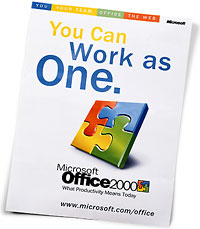
A short and stimulating brush with Microsoft's corporate culture
DURING the first six months of last year I worked at Microsoft's headquarters, in Redmond, Washington, on a team designing the next release of Microsoft Word. For me this started out as the midlife fulfillment of a fantasy. I'd been intrigued by software design since 1979, when I started using my first word-processing program, The Electric Pencil, on a prehistoric computer called the Processor Technology SOL-20. As programs became bigger, fatter, stronger, and more fully controlled by Microsoft, I found myself drawing up increasingly elaborate wish lists of the features that a really great piece of software for writers would include. So I made a proposal to try to persuade Microsoft designers to see things my way. The terms were that I'd work at the company as a consultant for a fixed period of time. Any of "my" features they decided were worthwhile could be included as part of Word or Office, but anything they decided not to use would remain my intellectual property, so that in some theoretical other life I could start a company and sell my own little word processor in competition with theirs.
More on technology & digital culture in The Atlantic Monthly and Atlantic Unbound.
From the archives:
"Zoot!," by James Fallows (August, 1997)
"The wave of software standardization led by Microsoft products like Windows and Word has made computers simpler to use than they once were.... But it is harder for a software developer to introduce a genuinely new approach ... if another product, especially one from Microsoft, seems likely to become the standard in that field."
"The Java Theory," by James Fallows (March, 1996)
"Last December, Microsoft seemed to acknowledge the importance of Java when it said that it would license the technology for use with its software. Immediately another of the religious wars that always surround Microsoft's actions broke out in the computer world."
From Atlantic Unbound:
Flashbacks: "A Great Monopoly" (November 10, 1999)
"America," Henry Demarest Lloyd wrote in March, 1881, "has the proud satisfaction of having furnished the world with the greatest, wisest, and meanest monopoly known to history." That was then. Does his expos� of Standard Oil speak to us today?
Web Citations: "What Side Are You On?," by Nicholas Confessore (January 6, 1999 )
Order and chaos, right and wrong, good and evil. True believers know what the U.S. v. Microsoft case is really about.
Web Citations: "Liberty and Linux for All," by Ralph Lombreglia (October 21, 1998)
Microsoft's worst nightmare may not be a courtroom in Washington, D.C.
Politics & Prose: "Games of Monopoly," by Jack Beatty (April 8, 1998)
The striking parallels between two of America's most powerful -- and controversial -- capitalists.
Related links:
Microsoft: What We Do
Information about working at Microsoft, the corporate mission, and news for investors.
US Department of Justice: "U.S v. Microsoft: Court's Findings of Fact"
Complete text of the DOJ's findings concerning Microsoft in the antitrust suit brought against the company by the U.S. government.
My contacts at Microsoft knew that through the 1990s I'd written warnings about the company's growing monopoly power. So why did I want to work there? Because Microsoft had eliminated the competition. If you want to affect the program people use for writing, you have to deal with Word. We agreed to disagree about the antitrust trial, which was under way while I worked there; I kept my views about it to myself unless asked.
Under these terms I spent an almost entirely enjoyable, and more or less productive, six months in Redmond, working mainly on Word but also on features that might be used in some other parts of the Microsoft Office "suite" of programs (which includes Word, PowerPoint, the spreadsheet program Excel, the e-mail and scheduling program Outlook, and others). Some of the features I was most excited about may well survive to appear in the next release of Word, which is supposed to go on sale sometime next year. Others were killed off early in the process. Sorry, no details! This is life in the world of trade secrets. You'll know that my features prevailed if you find me grabbing strangers next year, saying, "Hey, look how cool this program is! Wonder where they got the idea for it?" Until then what I can try to convey, in a form that matches the "generalities only" spirit of my agreement with Microsoft, is the instructive surprise of the experience. Having read about software design and Microsoft culture for many years, I found a few things that exactly matched my expectations. But many more things did not. Just before leaving Microsoft, I gave a talk "on campus" about what I'd learned. These are the things that I told them had surprised me:
The people are nice. Okay, this sounds like a high school bromide. The reason it's worth mentioning is that it is a surprise, given both the public's and the software industry's impressions of the company. At Redmond the prevailing view is that Microsoft has prospered strictly because it builds great software, and that Americans can't help being proud that their dynamic national culture has spawned such entrepreneurs. That strikes me as being years out of sync with the real national attitude. Polls indicate that people still admire Bill Gates -- who will, after all, probably rank as the greatest American business strategist of the twentieth century. But the devastating "findings of fact" in the antitrust case last November said that the company had gone out of its way to squash competitors, which in effect reduced the rate of innovation in mainstream software products to whatever Microsoft chose to do. This is the view the software industry has held for a long time -- with the added twist that Microsoft employees are thought to be haughty, sharp-tongued, and prickly to deal with.
Perhaps my standards were skewed. After all, before working at Microsoft I'd been hanging out with journalists and political types in Washington, D.C. And I never had to face Microsoft's intensity as a competitor. Viewed from within, though, this was about as collegial and nonbackbiting an environment as I've ever been part of. What people considered a sharp exchange about features or strategy (they call such a disagreement "pushback") was nothing compared with the way lawyers, journalists, or politicians snap at one another.
A small but noticeable group within the Redmond work force would have to be considered geeks: grossly over- or under-weight, weirdo hair and clothes, various hygienic oddities. One guy appeared to have a boa constrictor living in his office (it was in a cage). Another office contained several thousand empty soft-drink cans. A man who befriended me when I arrived had rigged up a way to see what his cats were doing at home in Seattle while he was at work in Redmond.
But even the oddest people seemed generally to have a sense of humor about themselves, and at least as large a group seemed happy, well balanced, normally proportioned, and so on. I got into a little psychological cold war with one manager, who considered me a spy and wouldn't talk to me. I took every opportunity to glower at him in the halls. But I was in good spirits during the forty-minute drive from Seattle to Redmond each morning, because I looked forward to spending time with everyone else.
There was a lot of time to spend, because the next surprise was that the pace is slow. I figured out, not quite soon enough, that it drove my colleagues crazy to hear this observation, so eventually I stopped mentioning it. Nonetheless, it was true: the work week seemed less grueling at Microsoft than at other organizations I've been part of. There was a noticeable thinning in the parking lots by the middle of Friday afternoons. It seemed as if every week or so work shut down for some campus-wide or division-wide party.
I had assumed that Microsoft's pace would be at the workaholic extreme of society, but compared with people in other very hard-driving organizations -- high-powered law firms, investment banks, presidential election campaigns, Internet startups, even newspapers and weekly magazines -- the people at Microsoft seemed to average fewer hours a week and a lower percentage of all-nighters. Compared with other companies of more than 30,000 employees, of course, Microsoft keeps up quite a brisk pace.
Naturally, some people at Microsoft, including senior managers, do work all the time, and at certain points in the software production cycle lots of people have to work nonstop. This is especially so during "bug-bashing" sessions, when defects in program code have to be cleaned up to meet deadlines. Colleagues pointed out to me that if I stayed for a whole development cycle, over two or three years, I'd see the pace pick up. I was used to the much shorter cycles of the magazine world, where the "slow times" are a day or two, not six-month stretches.
(The online version of this article appears in two parts. Click here to go to part two.)
James Fallows was the Washington editor of The Atlantic from 1979 to 1996. His most recent book is Breaking the News (1996).
Photographs by Bruno Debas.
Copyright © 2000 by The Atlantic Monthly Company. All rights reserved.
The Atlantic Monthly; February 2000; Inside the Leviathan - 00.02;
Volume 285, No. 2; page 34-38.