


Beyond "The Coming Anarchy"
"What if the shantytowns and bidonvilles sprouting up around the globe that do not appear on any maps are far more important to the future of civilization than many of the downtowns and prosperous suburbs that do appear on maps?" "Will this new order be characterized by moving 'centers' of power, as in the Middle Ages?" And what if, as a result, borders and nation-states as we now know them cease to exist?
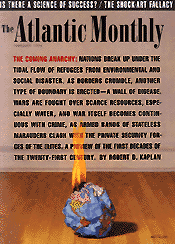 So muses Robert D. Kaplan
-- one of The Atlantic Monthly's most provocative
writers -- in his latest work, The Ends of the Earth
(Random House, 1995). The book is an outgrowth of Kaplan's phenomenally
popular (and in some quarters unpopular) Atlantic cover
story
titled "The
Coming Anarchy" (February, 1994). The article focused on blighted regions
of
Europe, West Africa, and the Middle East and ended by predicting that the
first half of the twenty-first century will be characterized by
"environmental scarcity, cultural and racial clash, geographic destiny,
and the transformation of war." The writing is bleak -- even apocalyptic
-- but it is deliberately so: Kaplan felt at the time that nobody was
paying
attention to what was really news.
U.S. President Bill Clinton was drawn in; he referred
to "The Coming Anarchy" as "stunning" and passed it around as recommended
reading in the
White House. Others were not so impressed: one writer in The New York
Times accused Kaplan of making an "alarmist jumble of Africa that
betrays
American prejudices," and an editorialist in the magazine West
Africa suggested that points made in "The Coming Anarchy" were not
"the
first time that different parts of [West Africa] have been used as passive
foils for the psychoses of others."
So muses Robert D. Kaplan
-- one of The Atlantic Monthly's most provocative
writers -- in his latest work, The Ends of the Earth
(Random House, 1995). The book is an outgrowth of Kaplan's phenomenally
popular (and in some quarters unpopular) Atlantic cover
story
titled "The
Coming Anarchy" (February, 1994). The article focused on blighted regions
of
Europe, West Africa, and the Middle East and ended by predicting that the
first half of the twenty-first century will be characterized by
"environmental scarcity, cultural and racial clash, geographic destiny,
and the transformation of war." The writing is bleak -- even apocalyptic
-- but it is deliberately so: Kaplan felt at the time that nobody was
paying
attention to what was really news.
U.S. President Bill Clinton was drawn in; he referred
to "The Coming Anarchy" as "stunning" and passed it around as recommended
reading in the
White House. Others were not so impressed: one writer in The New York
Times accused Kaplan of making an "alarmist jumble of Africa that
betrays
American prejudices," and an editorialist in the magazine West
Africa suggested that points made in "The Coming Anarchy" were not
"the
first time that different parts of [West Africa] have been used as passive
foils for the psychoses of others."
"The Coming Anarchy" became one of the best-selling issues in The Atlantic Monthly's history -- proving, depending upon one's reaction to the article, either that many people share Kaplan's concerns or that apocalyptic reporting sells magazines. In either case, the article was read and cited far and wide; Kaplan succeeded in provoking the debate that he felt was necessary.
In The Ends of the Earth, Kaplan travels throughout Africa, the Middle East, and Asia -- to places predominantly not on the political map -- and finds largely what he had hypothesized in "The Coming Anarchy": a world in which populations are booming, the environment is poisoned and withering, borders of all sorts are crumbling, cultures are rotting, and cities are being transformed into huge and sprawling villages. Do we realize, he asks at the book's conclusion, that "We are not in control"? Are we aware that he's not just talking about the future of the Third World, but of the rest of the world, too?
In the August, 1996 issue of The Atlantic, Kaplan is back with
"Proportionalism," a proposal for dealing
with the problems described in "The Coming Anarchy" and The Ends of the
Earth. "We are all wringing our hands over the plight of failing,
unstable regions of the Third World," he says, "especially those in
sub-Saharan Africa. But there is little consensus on what the American
response should be." Kaplan here proposes a foreign policy that "might do
gradual but unmistakable good where good can in fact be done." The ideas
he lays out are controversial, but Kaplan's aim, as always, is to raise
important
questions and make them available for intelligent debate.
Copyright © 1996 by The Atlantic Monthly Company. All rights reserved.
 |
 |
 |
 |
 |
 |