


Return to this issue's Table of Contents.
S E P T E M B E R 1 9 9 9

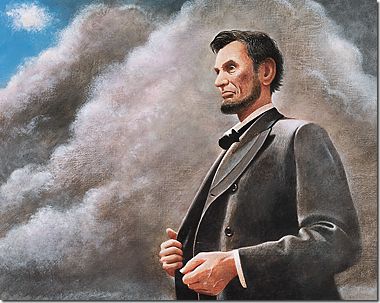
Frederick Douglass called it "a sacred effort," and Lincoln himself thought that his Second Inaugural, which offered a theodicy of the Civil War, was better than the Gettysburg Address
by Garry Wills
More on politics & society in The Atlantic Monthly and Atlantic Unbound.
Related feature:
Flashback: "Rhetoric of Freedom," (September, 1999)
"Emancipation is the demand of civilization," Ralph Waldo Emerson wrote in April, 1862. "That is a principle; everything else is an intrigue." Atlantic articles by Emerson and Frederick Douglass comment on Lincoln's greatest decision, and his greatest legacy.
See a collection of Atlantic articles on Abraham Lincoln.
From the archives:
"The Election in November," by James Russell Lowell (October, 1860)
"We are persuaded that the election of Mr. Lincoln will do more than anything else to appease the excitement of the country. He has proved both his ability and his integrity; he has had experience enough in public affairs to make him a statesman, and not enough to make him a politician."
"The Battle Hymn of the Republic," by Julia Ward Howe (February, 1862)
"Mine eyes have seen the glory..."
"American Civilization," by Ralph Waldo Emerson (April, 1862)
"Why cannot the best civilization be extended over the whole country, since the disorder of the less civilized portion menaces the existence of the country?"
"The President's Proclamation," by Ralph Waldo Emerson (November, 1862)
"In so many arid forms which States incrust themselves with, once in a century, if so often, a poetic act and record occur."
"Boston Hymn," by Ralph Waldo Emerson (February, 1863)
A poem.
"Voluntaries," by Ralph Waldo Emerson (October, 1863)
A poem.
"Reconstruction," by Frederick Douglass (December, 1866)
"The assembling of the Second Session of the Thirty-ninth Congress may very properly be made the occasion of a few earnest words on the already much-worn topic of reconstruction."
"An Appeal to Congress for Impartial Suffrage," by Frederick Douglass (January, 1867)
"Suffrage for the negro, while easily sustained upon abstract principles, demands consideration upon what are recognized as the urgent necessities of the case."
"A Passive President?", by James M. McPherson (November, 1995)
A rich one-volume biography of the touchstone of American greatness.
"Lincoln Speaks," by James M. McPherson (December, 1996)
A review of The Recollected Words of Abraham Lincoln.
Related links:
"Getting Right With Lincoln," by David Donald (1956)
In our age of anxiety it is pertinent to remember that our most enduring political symbolism derives from Lincoln, whose one dogma was an absence of dogma.
The Gettysburg Address
An online exhibit by the Library of Congress.
Abraham Lincoln Online
"This non-profit site is a clearinghouse of information about [Abraham Lincoln], offering selected speeches and writings, and news of Lincoln studies and events."
The Collected Works of Abraham Lincoln
Posted by the Abraham Lincoln Association, a group dedicated to the study of Abraham Lincoln.
From Atlantic Unbound:
"Dashed Hopes at the White House," (August 15, 1998)
A cartoon.
 ARCH 4, 1865, the day of Lincoln's second inauguration as President, began in a driving rain that raddled Washington's famously muddy thoroughfares -- women would wear the mud caked to their long dresses throughout the day's ceremonies. Walt Whitman saw Lincoln's carriage dash through the rain "on sharp trot" from the White House to the Capitol, scene of the swearing-in. He thought Lincoln might have preceded the tacky parade in order to avoid association with a muslin Temple of Liberty or a pasteboard model of the ironclad Monitor. Though Whitman was a close observer of the President, and would shadow him throughout this day, there was no way for Lincoln to recognize him in the crowd.
|
SPEECHES AND PROCLAMATIONS BY LINCOLN:
The First Inaugural Address (March 4, 1861)
The Preliminary Emancipation Proclamation (September 22, 1862)
The Emancipation Proclamation (January 1, 1863)
The Gettysburg Address (November 19, 1863)
The Second Inaugural Address (March 4, 1865) |
The first expression which came to his face, and which I think was the true index of his heart, was one of bitter contempt and aversion. Seeing that I observed him, he tried to assume a more friendly appearance, but it was too late; it is useless to close the door when all within has been seen.Much of future tragedy could be glimpsed in that silent exchange of glances -- and much of the problem Lincoln faced in framing a speech for this occasion. Johnson, who had served as governor of the border state of Tennessee, was just one of the many compromises Lincoln had been forced to make in his attempt to shorten the war and make reintegration of the nation possible. It is easy for us to think of reconstructing the nation as a task that came after the war. But Lincoln faced problems of reconstruction soon after the war began. He had to govern sectors recaptured from the South, to keep border states from joining the rebellion, and to woo wavering parts of the southern coalition. All this involved the use of carrots as well as sticks -- promises of amnesty, discussion of gradual emancipation, bargaining over things like black suffrage. These in turn alienated the radical Republicans, who wanted no compromise on the question of slavery or black civil rights.
This was a fight that could not be delayed until the war was over, and it flared up most bitterly after the occupation of New Orleans, in May of 1862. Lincoln hoped to make Louisiana, with its high percentage of educated freemen, a showcase of the way the South could be reunited with the North on the basis of a free black work force. But when congressmen were elected by Louisiana's provisional government, which seemed too conservative to Congress, they were not initially seated, and Congress continued with its own plan of reconstruction, entertaining such notions as that southern state lines should be erased and the conquered area territorialized. Lincoln feared that such congressional initiatives would reduce his flexibility in trying to bargain with the South. He placated the radicals with his Emancipation Proclamations (provisional on September 22, 1862, final on January 1, 1863) enough to be able to make his Proclamation of Amnesty and Reconstruction on December 8, 1863. It readmitted any state that could form a government of at least 10 percent of the electorate which was willing to take an oath of allegiance to the Union and to accept the Emancipation Proclamation. Lincoln's proposal failed to affect the nettlesome problems in Louisiana (the Emancipation Proclamation did not apply to those parts of Louisiana that were not formally out of the Union when it was issued). In December of 1864 Lincoln was still protesting to critics that his approach to Louisiana was merely a temporary expedient for putting the state back in operation, and that " we can never finish this, if we never begin it."
People were laboring through all these controversies as they labored through the mud to Lincoln's inaugural ceremony. The end of the war was in sight -- Lee would surrender at Appomattox a mere five weeks after the inauguration. But what would be done with that victory? Lincoln's appeal for latitude in the use of executive power, on the grounds that it was needed for waging the war, would lose all force when the guns fell silent. What new authority would he argue for to reach new goals? This was as thorny a situation, in its own way, as that which Lincoln had addressed in his lengthy First Inaugural. Then he had had to explain what terms he would accept for maintaining peace (including a promise to leave slavery perpetually undisturbed where it already existed) and what terms he would not accept (secession). That was a legal argument, involving constitutional philosophy, with many fine distinctions to be sharply drawn. If anything, the legal problems were even more complex in 1865. Would the Confederacy be a conquered nation? Or would it be a continuing part of America, in which some had committed crimes and others were innocent? How could the guilty be distinguished from the innocent, for assigning proper punishments or rewards? On what timetable? Under whose supervision? Using what instruments of discipline or reform (trials, oaths of allegiance, perpetual disqualification for office)? And what of the former slaves? Were they to be allowed suffrage, indemnified for losses, given lands forfeited by the rebels, guaranteed work and workers' rights? The problems were endless, and the very norms for discussing them were still to be agreed on. Lincoln had his work cut out for him, and his audience could reasonably expect a serious engagement with matters that were haunting everyone on the eve of victory.
 NLY against the backdrop of such concerns can we appreciate the daring, almost the effrontery, of the Second Inaugural's most obvious characteristic -- its extreme brevity. It is true that the Gettysburg Address is even briefer (272 words to the Inaugural's 703), but that was given at a ceremonial occasion for which Lincoln was not even the principal speaker. No one expected serious discussion of national imperatives when the business of the day was honoring fallen soldiers. It is a different matter when a presidential address is given during a war that is collapsing into a potentially more divisive peace. Yet Lincoln almost breezily dismissed questions of both war and peace, saying that nothing in either called for lengthy treatment. Was he not able to appreciate the scale of the difficulties facing him? Did he think he could reduce them to manageable size by ignoring or belittling them?
That this bold defiance of expectation was deliberate is clear from the pride Lincoln took in this speech. Some have wondered if he realized what a masterpiece he had created at Gettysburg. He clearly knew that he had done well; but he expected to do even better in the years ahead -- years he would not be given. He believed he had already equaled or surpassed the Gettysburg Address at least once -- in his Second Inaugural. Eleven days after delivering it he wrote to Thurlow Weed, the Republican organizer in New York, that he expected it to "wear as well as -- perhaps better than -- any thing I have produced."
Yet if this later speech was better than the earlier one, that was because it built on the earlier one. At Gettysburg, Lincoln had proved to himself and others the virtues of economy in the use of words. He had put many-layered meaning in lapidary form. He aspired to the same thing in his inaugural speech. This is the more surprising when we consider the full-blown nature of most nineteenth-century oratory, and the fact that Presidents had so few opportunities for making speeches at that time. They did not deliver their annual messages to Congress in person. They did not address the conventions that nominated them. They could address groups that came to visit them in Washington, but Lincoln tried to avoid impromptu statements. All the words of a man in his position had to be well considered. He had denied himself the chance to make campaign speeches in both his presidential races, for fear of saying something divisive. All this must have been frustrating to Lincoln, who knew well the power of his oratory -- what it had accomplished in the "House Divided" speech and the Douglas debates of 1858, and the Cooper Union speech in 1860, and at Gettysburg in 1863. The temptation must have been strong to load his inaugural address with everything he had been wanting to say. Here, at last, was his opportunity, too good to be wasted, and at just the moment when major issues were being hotly debated and an intervention by the President was desired.
The first thing to admire, then, is the discipline that kept him from saying anything more than what he considered essential, just as at Gettysburg. The earlier speech was a model for more than its brevity. He used the same rhetorical ploy to begin the two addresses. At Gettysburg he would not dedicate the battlefield, though he admitted that that was "altogether fitting and proper." In the Second Inaugural he would not make an extended speech, though he conceded that doing so had been "fitting and proper" at his first inauguration. (The phrase "fitting and proper," occurring in these two short addresses, thus ends up being repeated in the inscriptions on the Lincoln Memorial.) Familiarity with both speeches has made us appreciate too little how unexpected this approach was at the time.
We most easily read Lincoln's refusal to dedicate the battlefield as acting like a praeteritio in rhetoric: "I will not mention ... " But it has been mentioned in the very statement that refuses mention, and that device draws more attention, after all, to the "unmentioned" thing. So we expect Lincoln to say that he will not dedicate in some sense or other, leaving the impression of dedication at a deeper level. But Lincoln was not doing anything so tame. He did not distinguish different kinds of dedication. He turned the whole subject upside down: We cannot dedicate the field. The field must dedicate us.
The online version of this article appears in three parts. Click here to go
to parts two and three.
Garry Wills is the author of the Pulitzer Prize-winning Lincoln at Gettysburg: The Words That Remade America (1992). His book A Necessary Evil: A History of American Distrust of Government will be published in October.
Illustration by Wendell Minor.
Copyright © 1999 by The Atlantic Monthly Company. All rights reserved.
The Atlantic Monthly; September 1999; Lincoln's Greatest Speech? - 99.09;
Volume 284, No. 3; page 60-70.