

98.03.11
Pay Day
Slate's big gamble.
98.03.04
Banking on Bright Ideas
What do lost-pet ads, dentist-office ceilings, and in-flight recordings have in common?
98.02.25
ThinkQuest
Techno-savvy kids.
98.02.19
Mapping Cyberspace
Is there a "there" there?
98.02.11
Information-Free
Sometimes the Web can be its own best antidote.
98.02.04
Clintonalia
Investigating rumors of a vast conspiracy.
98.01.28
Eye Candy
Art for the interface's sake.
98.01.22
Alternating Currents
An online exhibit surveys the impact of technology on late-twentieth-century art.
98.01.15
Janeites Unite
Jane Austen's place in cyberspace.
98.01.08
Inquiring Minds
What questions are on our "most complex and sophisticated minds"?
97.12.31
Sites of the Year
A look back at our favorite sites of 1997.
For more, see the complete Web Citations Index.
 As spring begins, gardeners will once again be seeking guidance from nurseries,
books, and landscapers. Some might aim for a garden of harmonious colors.
Others might like a garden that blooms throughout the summer. A few, however,
will find themselves wishing for a garden with overtones of horror and gloom.
For advice their best bet will quite likely be Gothic Gardening.
As spring begins, gardeners will once again be seeking guidance from nurseries,
books, and landscapers. Some might aim for a garden of harmonious colors.
Others might like a garden that blooms throughout the summer. A few, however,
will find themselves wishing for a garden with overtones of horror and gloom.
For advice their best bet will quite likely be Gothic Gardening.The site is the project of Alice Day, or mAlice, as she calls herself. As mAlice explains, Gothic Gardening started as a joke on a vampire mailing list. "Everyone was fighting, so I kidded that if we all didn't stop it, I was going to start posting Gothic Gardening Tips, subtitled: More Black Plants Than You Can Shake a Stick At. Some people were actually interested in the idea." The joke has grown into a site
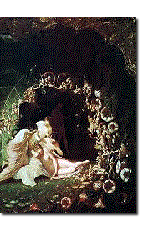 with quirky and intelligently presented information
on how to create more than thirteen gothic "theme gardens," along with
gardening folklore going back to ancient times.
with quirky and intelligently presented information
on how to create more than thirteen gothic "theme gardens," along with
gardening folklore going back to ancient times.How about a garden that appeals to bats? Day suggests growing plants such as cornflowers, salvia, and phlox, all of which attract night-flying insects, and either building a roost or planting a cabbage palm for bats to sleep on. (The advantages of bats are that they're "terribly gothic," of course, and that they can eat up to five hundred insects an hour -- a big consideration for "goths," who wear dark clothes that insects are attracted to.) Or how about a garden to entice fairies? First read Day's warning: "Let's get one thing straight here.... Fairies are not cute.... The Fey [elves, fairies, gnomes, trolls, goblins, etc.] are capricious, mischievous, arrogant, menacing, and sometimes downright evil and dangerous to humans." For those who still want to bring fairies to their gardens, some tips: they like to eat heather, they use foxgloves as thimbles, and they put their babies in cradles made of tulips.
Gothic Gardening is full of tidbits that could cause one to think differently about what might already be in one's garden. For instance, to express contempt for someone through flowers,
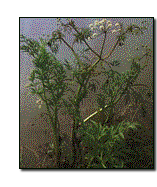 pick a bouquet of peonies
(signifying anger), yellow roses (jealousy), and snapdragons (deception). Old
folklore has it that basil is a symbol of poverty and madness; a pot of it in
the window signifies a house of ill repute. Growing parsley brings death to a
house. And so on. Gothic Gardening may also change people's opinions of
witches. Day points out that the sometimes gruesome ingredients of witches'
brews -- eye of newt, say, or tongue of dog -- were actually plants with secret
names to keep non-witches from being able to reproduce the recipe. "Blood from a
head," for instance, stands for lupines,
a "calf's snout" is a snapdragon, and "bat's wings" mean holly.
pick a bouquet of peonies
(signifying anger), yellow roses (jealousy), and snapdragons (deception). Old
folklore has it that basil is a symbol of poverty and madness; a pot of it in
the window signifies a house of ill repute. Growing parsley brings death to a
house. And so on. Gothic Gardening may also change people's opinions of
witches. Day points out that the sometimes gruesome ingredients of witches'
brews -- eye of newt, say, or tongue of dog -- were actually plants with secret
names to keep non-witches from being able to reproduce the recipe. "Blood from a
head," for instance, stands for lupines,
a "calf's snout" is a snapdragon, and "bat's wings" mean holly.Gardens designed to attract bats or bad luck are never likely to be wildly popular, of course. Gothic Gardening may prove to be most useful for those who are planting a garden for someone else.
Copyright © 1998 by The Atlantic Monthly Company. All rights reserved.
 |
 |
 |
 |
 |
 |