|
|


|
Previously in Web Citations: 99.06.30 Sim City The virtual partition of Jerusalem is a fait accompli. 99.06.23 Politics Made Simple A new political site aims for the GenX mind -- and shows us what the world does not need now. 99.06.09 Front Runners Presidential campaigns are starting earlier and earlier. Here's how the field is shaping up for 2024. 99.05.19 Menace to Society The hype isn't the most annoying thing about the new Star Wars release. 99.05.06 All Crime, All the Time An online news site gives the people what they want. See the complete Web Citations Index. From The Atlantic:
"Technology Versus African-Americans," by Anthony Walton (January 1999)
"The Computer Delusion," by Todd Oppenheimer (July 1997)
"Down and Out in Silicon Valley," by Marci McDonald (U.S. News & World Report, July 19, 1999)
|
The Great Divide July 15, 1999
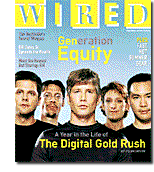
At the opposite end of the spectrum from Bronson's billionaires and aspiring billionaires are those less fortunate Americans who are profiled (albeit en masse) by the Commerce Department in its new report "Falling Through the Net: Defining the Digital Divide," released last week. The report (the department's third on the topic since 1995) dishes up the latest statistics on Internet access and usage in the United States, and finds that the worrisome gap between so-called "information haves" and "information have-nots" is growing dramatically -- that is, Internet usage among the affluent is soaring while the poorer and less educated are being left behind. Eighty percent of blacks and Hispanics, and two-thirds of Americans overall, are without Internet access from home or work. For this vast unwired majority, the only connection to the online world is through whatever form of public access they can find, whether at local libraries, schools, or other "community access centers."
These are fine initiatives, all of them (and there are others). Yet they share a common theme, one that runs through the Commerce Department report like an article of faith: namely, the idea that simply putting technology in the hands of those who have been without it, and giving Internet access to those who have been isolated from the new (and old) economy, will somehow close the "digital divide" in America. But what if the digital divide is defined as something wider and altogether more profound than the gap between those with technology at their fingertips and those without? What if it is defined as a deep cultural divide between the kind of fevered pursuit of individual wealth one sees in Silicon Valley (and other nodes of the digital economy) and an old-fashioned belief in the ideal of a civil society in which citizens take responsibility for the public good? What if Silicon Valley is really a microcosm of American capitalism at the end of the twentieth century -- a place where becoming a billionaire by the age of thirty is the new definition of success for the young, restless, and well-educated, and where philanthropy means equipping the masses not with a first-rate primary education but with the tools they need to become good electronic consumers? No, I tell myself, I should relax and not worry so much. It's still normal to go weird around money. And Silicon Valley is still a very strange place. --Wen Stephenson Join the conversation in Post & Riposte. More on Technology and Digital Culture in Atlantic Unbound and The Atlantic Monthly. Wen Stephenson is the editorial director of Atlantic Unbound. Copyright © 1999 by The Atlantic Monthly Company. All rights reserved. Clinton photo by David Scull, courtesy of the White House Web site. | ||||||||||||
|
|||||||||||||