



Sweet Couscous -- A Jewish Holiday Tradition
Hanukah and the Food That Goes With It / Couscous Sucré "Seffa"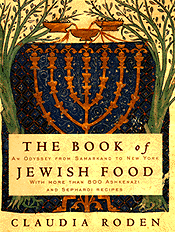 December 1996
Claudia Roden has long been the English cook's guide to exotic and seductive cuisines of the Mediterranean; she has published many books in both England and the United States on cuisines from all around that sea, and has served as host for several popular series on the BBC. I've been lucky enough to enjoy her company on several Mediterranean jaunts and to witness her gracious but persistent curiosity in finding new information and new recipes.
Never has she been more scholarly, personal, or marvelously comprehensive as in her new Book of Jewish Food, just published by Knopf. Roden grew up in a distinguished Jewish family in Cairo and never lost track of family customs: I remember her once recounting to me in her lilting English-French accent how she and her sisters would collect the carbon from burning candles to make kohl, or black eye shadow -- something she still does in London.
Roden admirably includes Eastern European Ashkenazi recipes and folkways throughout her new book, but for most American readers the revelation will be the world of Sephardi foods she documents. Couscous -- the tiny beadlike grain that is a kind of pasta although it looks like it might be millet -- is a dish served everywhere in North African countries. Here Roden gives several variations, and talks about how Sephardi and Russian Ashkenazi Jews celebrate Hanukah -- which this year starts on the evening of Thursday, December 5, continuing for eight nights.
-- Corby Kummer
From The Book of Jewish Food, by Claudia Roden
Hanukah and the Food That Goes With It
Hanukah commemorates a victory and the rededication of the desecrated Temple to the God of Israel. The victory is that of a small band of Jews led by Judah Maccabeus in their battle against the Syrian Hellenists and the oppressive reign of King Antiochus Epiphanes in 165 B.C. The Maccabean uprising is significant because it was the first time that the Jews resorted to arms in order to preserve their faith and religious liberties. The victorious Judah returned to Jerusalem to find a sacked and burned Temple which had been desecrated by pagan rituals. All the oil vessels had been polluted by substances repugnant to the Jewish faith, except for one cruse, which contained the pure, consecrated olive oil and still had the High Priest's seal. But it contained only enough oil to burn for one day. The Jews lit it, and it lasted eight days, allowing the priests to cleanse the Temple precincts while they prepared new supplies of the holy oil.
The miracle of the oil is symbolized in Jewish homes by the kindling of eight lights. Starting with one light, each night one more is lit until the eighth day, when eight are lit. Years ago in Egypt, we had wicks floating in oil in little glass cups, but a nine-branched candlestick or menorah, called a hanukiah, is generally used today. The ninth candle, in the middle, serves to light the eight others. The miracle of the oil is remembered in the kitchen with the abundant quantities used to deep-fry the traditional Hanukah treats. The Ashkenazim eat potato latkes (grated potato fritters). In Israel they make soufganioth or ponchkes (jam-filled doughnuts). The Sephardim eat fritters in syrup variously called zalabia, loukoumades, sfenj, and yoyos. Italians eat chicken pieces dipped in batter and deep-fried. Moroccans eat couscous with chicken that has been deep-fried rather than boiled.
A "flaming-tea" ceremony, which celebrates the burning light, is an old Hanukah custom of Russian Jews. Everybody puts a lump of sugar in a spoon, pours brandy over it, then sets it alight and drops it in a glass of tea.
Couscous Sucré "Seffa"
Sweet Couscous
Sweet couscous is a festive Jewish dish in North Africa. In Morocco it was served at Hanukah in bowls with wooden spoons. When it is made with butter, it is the custom to serve cold milk or buttermilk with it, in little tea glasses.
|
1 pound (500 g) couscous |
I shamelessly make couscous the easiest way, as prescribed in some of the package instructions, with very good results. It is so easy you can make it for very large parties.
For 6 people, put 1 pound (500 g) medium-ground couscous in a bowl. Add 2 1/2 cups (600 ml) warm water with 1/2-1 teaspoon of salt gradually, stirring so that the water becomes absorbed evenly. After about 10 minutes, when the couscous has become a little plump and tender, add 4 ouncess of butter or 6 tablespoons of peanut or light vegetable oil.
Rub the grain between your hands to air it and break up any lumps. Heat it through by steaming in the top part of a couscoussier or double boiler (it is ready as soon as the steam passes through the grain) or, more simply, in the oven covered with foil.
I usually make couscous for a large number of people by heating it right in the huge ovenproof clay dish I serve it in. There is nothing easier. A small quantity for 2 or 3 can be heated in a saucepan, stirring so as not to burn it. Before serving, break up any lumps very throroughly.
Serve the sweet couscous shaped in a cone, sprinkled with lines of cinnamon and confectioners' sugar down the sides and, if you like, with the drained raisins or sultanas.
Variations
Copyright © 1996 by Corby Kummer. Recipes from The Book of Jewish Food , by Claudia Roden; cover image: page from the Cervera Bible. Alfred A Knopf: New York, 1996. 668 pp. ISBN: 0-394-53258-9. $35.00. Copyright © 1996 by Claudia Roden.
 |
 |
 |
 |
 |
 |