




Potato Pie Gianna Amore
Frittata With Sausages
Pasta in the Style of Amatrice
Drunken Cauliflower
October 7, 1998
Anna Teresa Callen arrived in America in 1959 as a young intellectual who had spent her college and post-college years intent on becoming an archaeologist. But the pull of the foods of her native Abruzzo, a region in Italy, was too strong, and, in the 1970s, through a series of happy errors, she found herself the acclaimed and fulfilled proprietor of her own cooking school, Anna Teresa Callen's Italian Cooking School. Her warmth, her flair for entertaining commentary in her charming English-accented English (she lived in England for several years), and her easy laugh, all combined with firm opinions and a love of good-tasting food, endeared her to students, who still flock to the classes she gives at her school.
 In the early eighties Callen began a successful career as a cookbook writer, but when she was first writing no publisher was interested
in regional food, let alone food from a place no one had
ever heard of. I admit to ignorance too. Until having the luck recently to
accompany Callen on a trip to her native region, I thought that the Abruzzo,
being southeast of Rome, must be something like the regions of Naples and
Puglia, farther south.
In the early eighties Callen began a successful career as a cookbook writer, but when she was first writing no publisher was interested
in regional food, let alone food from a place no one had
ever heard of. I admit to ignorance too. Until having the luck recently to
accompany Callen on a trip to her native region, I thought that the Abruzzo,
being southeast of Rome, must be something like the regions of Naples and
Puglia, farther south.Abruzzo certainly has plenty of hot pepper and strong flavors, but the region is defined by its high Apennine Mountains and the national parks that cover three quarters of its territory. Mountain climbing -- or, at the very least, long hillside hiking -- is the weekend pastime. Cities are high, generally surrounded by blue-green sugarloaf mountains, and have a serene grace unlike neighboring regions, perhaps because of the area's relative isolation.
The hills are alive with the smells of cooking. One of the towns perched on a mountainside, Villa Santa Maria, has for centuries been home to a famous cooking school, established by a prince 400 years ago; for decades its graduates have populated hotels and fancy restaurants the world over. (Boston, where I live, even has two natives, women who absorbed the cooking expertise in the air and run two of the city's favorite restaurants, Galleria Italiana and La Bettola.)
Another town, Fara San Martino, is in a national park, and houses two of the country's best-known pasta factories, Del Verde (named for the river) and De Cecco (of the blue box). These factories are right beside each other, dwarfing every other construction in the otherwise very small town. They are archrivals whose managers want little to do with each other, even if the staffs by necessity mix freely. The mountain-filtered water and the grain from the close-by regions of Puglia and Campania, along with a longtime tradition, ensure excellent pasta.
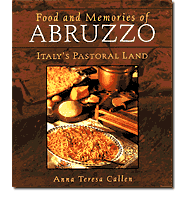
Callen's new book, Food and Memories of Abruzzo, Italy's Pastoral Land, is full of charming, funny, moving family reminiscences. The group she led recently met some of the nieces she once babysat and now considers daughters, along with their children, who are like Callen's own grandchildren. Nieces and cousins and cousins' husbands all have contributed recipes to the book -- or rather, served Callen dishes she liked and duplicated. It makes for a lovely familial book.
Here are several emblematic recipes, and a reminiscence or two. Although fish and seafood are not as popular as you might assume they would be in this coastal region, mussels are everywhere. In this easy and fast braise, mussels are paired with saffron -- a local ingredient that comes as a surprise, like the black and white truffles whose vendors pronounce them the equal of anything in Umbria or Piedmont. Gattò (from the French gâteau, not the Italian word for cat) di patate Gianna Amore is a crustless layered potato pie with smoked mozzarella, ham, and any leftover vegetables or meat you have around -- a terrific catch-all dish that makes a perfect Sunday supper. Frittata with sausage is a savory egg dish; in Abruzzo eggs hold a place of honor rather than being an afterthought or brunch item, although this frittata would be welcome at a long brunch. Amazingly enough, pasta all'Amatriciana -- the peppery, darkly tomato-ey sauce indelibly associated with Rome -- originated in Abruzzo. It's a fast and geographically appropriate way to showcase the superior pasta of Fara San Martino. "Drunken cauliflower" -- whose name, cioffa 'mbriaca, sounds marvelous in dialect -- is one of those incredibly simple recipes that can change your way of thinking about a vegetable and become the preparation you automatically turn to whenever you buy it.
Naturally, it's easy to fall in love with a region when you have the privilege of traveling it with a native. Food and Memories of Abruzzo has the specificity, the sway, and the marvelous recipes to make anyone want to go -- if not south of Rome, then to the kitchen.
Previously in Corby's Table:
Paula Wolfert's latest Mediterranean explorations.
The ultimate guide to eating your vegetables.
Jasper White gets up close and personal with lobster claws, tails, and tomalley.
A rare book that shows Italy unromanticized -- and more appetizing.
New reasons not to get out of bed in the morning.
In Ruth Reichl's new memoir, Tender at the Bone, food is about more than eating.
South America's well-traveled cuisine.
Just in time for the holidays, a look back over the year's best.
A book to help one get wise to the whys of cooking.
More by Corby Kummer in Atlantic Unbound
Excerpts from Food and Memories of Abruzzo, Italy's Pastoral Land, by Anna Teresa Callen (Macmillan USA)
Mussels with Saffron
Cozze Allo Zafferano
Abruzzo, and perhaps Sardinia, are the only regions in Italy where saffron is cultivated, yet we Abruzzesi do not use it much. This recipe of sautéed mussels served on the half shell is one of the rare examples.
Do not be too generous with this wonderful and expensive spice. A little goes a long way; too much will make your food taste of medicine.
| 2 pounds mussels, scrubbed and debearded | 3/4 cup dry white wine |
| 2 shallots, each quartered; or 1 onion, quartered | 1/4 cup water |
| 2 sprigs fresh Italian parsley | Freshly ground pepper to taste |
| 1 sprig fresh thyme; or 1/2 teaspoon dried | 1/2 teaspoon saffron, preferably powdered |
| 2 bay leaves | 3 tablespoons extra virgin olive oil |
1. Place all the ingredients in a large skillet. Cook over medium heat, shaking the skillet often, until the mussels open, 5 to 8 minutes. Remove the open mussels and discard half of the shell. Discard the mussels that have not opened. Place the remaining half with the mollusk on a serving plate. Keep warm.
2. With a slotted spoon, remove the solids from the skillet and discard. Strain the liquid through a paper towel into a small saucepan. Bring the liquid to a boil and if there is more than 3/4 cup, reduce it by boiling it. Pour the liquid over the mussels and serve. This dish can also be served chilled.
Variation: Pepata di Cozze -- Peppered Mussels
This is a spicy dish from the resort town of Termoli, but found in many coastal towns of Abruzzo and neighboring Molise. It is a must during the feast of the patron saint, San Basso, which takes place at the beginning of August. During this celebration, and since the city is so geared to its beautiful coast, sea spectacles are the main attraction.
This dish is often served with fett'onta, crusty slices of bread drizzled with olive oil and grilled. (Unlike bruschetta, fett'onta contains no garlic.)
The preparation for the pepata is similar to the Cozze allo Zafferano. The zafferano is replaced by a touch of diavoletto (dried Italian hot red pepper) and a good grinding of pepper.
Potato Pie Gianna Amore
Gattò Di Patate Gianna Amore
Gattò is a corruption of the French word gâteau. (Without the accent on the "o" it means "cat" in Italian.)
The crustless, layered gattò is a classic Neapolitan preparation which my mother learned to make when we lived in Naples. She loved the dish and served it often for Sunday supper or as an elegant accompaniment to meats. It became a favorite with our extended family, each contingent adding his or her own touch. But my cousin, Gianna Amore has made it even more personal. Her addition of smoked mozzarella was a stroke of genius and adds a subtle, unsuspected flavor to the dish. My mother, after tasting Gianna's version, started to make her gattò alla Gianna.
| 4 to 5 baking potatoes, about 2 1/2 pounds, unpeeled | 1/4 pound prosciutto, chopped |
| 6 tablespoons unsalted butter | 2 to 3 sprigs fresh parsley, minced |
| 2/3 cup freshly grated parmesan cheese | Salt to taste, optional |
| 1 cup milk | Freshly ground pepper to taste |
| 2 large eggs, lightly beaten | Plain bread crumbs |
| 8 ounces smoked mozzarella cheese, diced | 4 ounces plain mozzarella cheese, thinly sliced |
1. Boil the potatoes until soft. Drain and cool. Peel them, mash them in a ricer or a food mill, and turn into a mixing bowl. Add 5 tablespoons of the butter and the parmesan cheese, mix well, and add the milk, eggs, smoked mozzarella, prosciutto, parsley, and salt and pepper. Mix well.
2. Preheat the oven to 375°F. Butter a 9- to 10-inch pie plate from which you can serve. Sprinkle it with bread crumbs.
3. Spoon half of the potato mixture into the prepared pie plate, smooth the top, cover with plain mozzarella slices in one layer. Spoon the remaining potato mixture on top, smooth, sprinkle with bread crumbs, and dot with the remaining butter.
4. Bake until the top is golden, 40 to 45 minutes. Cool 10 to 15 minutes and serve.
Note: This pie reheats well.
Variation 1: My mother prepared several versions of this gattò. She would make it meatless (without the prosciutto) by adding a layer of fresh vegetables like broccoli, zucchini, baby artichokes, and peas sautéed in butter or oil. When she used peas, she would mix them with the potato and cook the pie in a deeper pan so that when the gattò was cut, the slices showed the vibrant green dots.
Everybody in the family tried to "improve" on my mother's savory potato gattò and so did I. My version came because, after a fest of corn, I was left with one ear only. I also had a solitary zucchini, so it too went into the pie. No need to tell you that you can use other vegetables if you wish.
Variation 2: Pizza degli Avanzi -- The Kitchen Sink Pie
I named this pie "The Kitchen Sink Pie" for obvious reasons. The filling can be assembled with whatever you have in the refrigerator. While I call it a pie, this dish doesn't have a pastry crust. After buttering the pie plate, I sprinkle it with bread crumbs, fill it with whatever I have, and top it with a layer of mashed potatoes. You can put the mashed potatoes on the bottom, too.
Frittata With Sausages
Frittata con le Salsicce
I remember one evening at grandmother's house. We were all sitting around the table in the kitchen, in front of a huge fireplace, as we often did in winter, when a large frittata arrived at the table all neatly cut into wedges. But for some reason, one of the wedges contained more sausages then the others and all the forks pointed to that one. So a coin was tossed and it went to my father who, politely, offered it to his friend Modesto della Porta, who was our guest. Modesto, a poet of some repute, later on described the scene in a funny poem which he wrote in Abruzzese dialect.
| 1 sweet Italian sausage, about 1/2 pound, cooked | 6 large eggs |
| 2 tablespoons extra virgin olive oil | 1 tablespoon minced fresh parsley |
| 1 leek, trimmed, washed and sliced in thin circles | Freshly ground pepper to taste |
1. Cut the sausage in thin rounds.
In the old days, eggs were available every day in an Italian household. Chickens were raised in courtyards or backyards in affluent and poor houses alike. Odd as it may seem, raw eggs were considered a nutritional boost, and children were given one every afternoon, still warm from the chicken! As I related in this chapter's introduction, the egg was pierced at the top and bottom with a pin and we sucked with gusto. Nowadays, not knowing where the egg came from, it is better to cook the eggs properly to avoid the risk of salmonella.
3. Beat the eggs, add the parsley, pepper, and sausage.
4. Pour the mixture into the skillet, raise the heat to medium, and stir a little, trying to distribute the slices of the sausage evenly. Cook 5 to 8 minutes, or until the bottom is set. Holding a flat lid or a platter over the skillet, turn the frittata onto its other side and then slide it back into the skillet, cook 5 minutes longer. Serve immediately.
Pasta in the Style of Amatrice
Pasta All'Amatriciana (Matriciana)
A well-known recipe, this one, a classic, is fortunately still being served in good Italian restaurants in the United States. I say fortunately, because, with the mania of being new and innovative, some of these excellent, traditional dishes are being discarded.
How many people know that Pasta all'Amatriciana or Matriciana originated in Abruzzo? The town of Amatrice borders on the region of Lazio, of which Rome is the capital, and Abruzzo. Nowadays, though, because this town is part of the Lazio jurisdiction, its most famous recipe is often referred to as being part of the Roman cuisine. So be it.
| 2 tablespoons extra virgin olive oil | 1/4 cup dry white wine |
| 1 medium-size onion, chopped | A few flakes diavoletto (dried Italian hot red pepper) |
| 1/4 pound pancetta or prosciutto, in 1 slice, diced | 1 pound penne or ziti |
| 1 teaspoon tomato paste | Freshly ground pepper to taste |
| 1 pound fresh, ripe tomatoes, peeled, seeded, and chopped; or one 16-ounce can peeled tomatoes, with their juice | Freshly grated pecorino romano cheese or a combination of pecorino and parmesan |
1. In a 10-inch skillet, heat the oil over medium heat. Add the onion and cook, stirring, until it is soft and translucent, about 5 to 8 minutes. Add the pancetta, or prosciutto, and cook briefly, stirring, until it releases its flavor, about 5 to 8 minutes. Add the wine and let evaporate. Stir in the tomato paste, tomatoes, pepper, and diavoletto, if used. Bring to a boil over medium heat, reduce the heat to low, and simmer about 15 to 20 minutes.
2. Meanwhile, cook the pasta in boiling, salted water according to the package directions. Drain and dress with the sauce. Serve with the grated cheese separately.
Drunken Cauliflower
Cioffa 'Mbriaca
In Abruzzo we like to cook vegetables in a covered pan where they slowly absorb the flavor of the condiment in which they are dressed. In this case, wine gives flavor and makes the cauliflower "drunk." Cooked this way the cauliflower remain nice and white.
| 1 or 2 medium-size heads of cauliflower, about 3 pounds | 1 small diavoletto (dried Italian hot red pepper) |
| 5 tablespoons extra virgin olive oil | Salt to taste, optional |
| 1/2 cup white wine | 1 cup water |
| 2 bay leaves | 1 tablespoon minced fresh parsley |
| 3 cloves garlic, peeled and sliced |
1. Separate the cauliflower into flowerets and cut the stems into bite-size pieces, or reserve them for use in a salad.
2. Place the cauliflower in a large, heavy pan. Add the oil, wine, bay leaves, garlic, diavoletto, salt, and water. Cover and bring to a boil. Reduce the heat to medium and simmer until the cauliflower is tender and all the water has evaporated, about 20 minutes. Stir occasionally.
3. Sprinkle with parsley and serve.
The House in Pescare
La Casa di Pescara
After the war, my parents bought an apartment in Pescara just one block from the beach which finally had reopened, safe from mines.
We had three bedrooms, a living room and a large kitchen with its own balcony. Another large balcony faced the street and fronted almost all of the other rooms. I can still see my parents sitting there in the late afternoon, entertaining their friends "al fresco." It was pleasant in the summer, when the sea breeze cooled the heat of the day.
Sadly, buying this apartment cost us the house in Guardiagrele. With the older generation gone, we and Aunt Ela had been owners of the house. It was becoming more and more evident that the house was a luxury that could barely be afforded. We had to sell it.
It took me many years before I could walk again along Via dei Cavalieri, the street where the house stood. I would go to Guardiagrele often, to the cemetery, and to visit the relatives we still had there, but I would never pass that house. I did so many years later when I took my husband, Harold, for the first time to Guardiagrele. I could not avoid showing him the house of which I had spoken so often.
It was a beautiful day, and I felt calm and prepared, so after calling the new owners, whom I knew, we went for a visit. The house had been divided into four units, but the main core, the part in which we had lived in the most, had not changed much. The garden with my secret corners, where I used to hide and read forbidden books like Madame Bovary, seemed so small. The pine we had planted when my cousin Gianna was born was no longer there. It had been cut down by a cannon, shot during the war. Looking at that spot, I remembered a story I had heard many times about a hole near where the tree had been. The hole was where our silver had been buried before we were forced to abandon the house during the war. When the family returned, no one had bothered to look there, thinking that everything was gone. But Annina, our ever-wise maid who had done the digging, remembered that she had made a very deep hole, and this seemed shallow to her. With her innate Abruzzese stubbornness, and a little hope, she started to dig again, and lo and behold, our treasure was still there. She had done a really good job. The family silver was one of the few things saved from the war. So many things were lost forever.
One place I was afraid to see again was the terrace. How many happy days we had spent there with all the dear people who were no longer with us. How many dreams I dreamed on that terrace; how many games I played with my brother and cousins. Maybe because of Harold's presence I felt protected. Yes the ghosts came, I did cry, but it was a release. I could look at that familiar landscape of mountains and fields and feel grateful for many things.
My life in Pescara had many episodes of leaving and returning. When I went to the university in Rome, studying literature and specializing in archeology, I lived with a very dignified widow who had a daughter a little older than me. Although I loved living in Rome, I was happy to go back to Pescara for my vacations.
One year, while still at the university, I was offered a job at the Museum of Ostia Antica, near Rome. This was the ancient port of the Romans and is now an archeological site, similar to Pompei. The sea has now receded from its port and Ostia Antica lies inland. Modern Ostia, with its beautiful beach, has become the Coney Island of Rome, albeit a little more elegant.
I accepted the job in Ostia Antica because I wanted to become an archeologist. My job there was fascinating. But my destiny was not to be a "grave digger," as my brother called me -- I was always excavating tombs. One summer I went to England to learn to speak English better. And my life took a turn. I never went back to Ostia Antica. I never became an archeologist; I left London and came to America, for good. And that is another story.
Corby Kummer is a senior editor at The Atlantic Monthly and the author of The Joy of Coffee.
Copyright © 1998 by Corby Kummer.
Recipes from Food and Memories of Abruzzo, Italy's Pastoral Land by Anna Teresa Callen. Macmillan: New York 1998. Hardcover, 459 pages. ISBN: 0025209159. $35.00. Copyright © by Anna Teresa Callen.
 |
 |
 |
 |
 |
 |